The disconnect between corporate performance evaluations and actual employee growth remains one of the most significant hurdles in modern human resources management. While organizations invest billions of dollars annually into sophisticated performance review cycles, calibration meetings, and ranking systems, the data suggests that these efforts rarely translate into tangible skill acquisition. According to recent research from the American Productivity & Quality Center (APQC) in 2025, a striking 67% of employees surveyed had formal goals related to developing for future roles, yet only 33% strongly agreed that their company’s performance management process actually helped them build the necessary skills to achieve those goals. This "follow-through gap" highlights a systemic failure where the diagnostic phase of a review is rarely followed by a practical, structured remedy.
To address this deficiency, industry experts are increasingly advocating for the implementation of a 90-day development plan—a focused, time-bound framework designed to bridge the gap between feedback and mastery. By moving away from vague, year-long aspirations and toward a structured quarterly cycle, organizations can ensure that the insights gained during performance reviews are immediately converted into actionable learning behaviors. This approach not only improves employee competency but also enhances the perceived value of the human resources function within the enterprise.
The Structural Failure of Traditional Reviews
The primary reason performance management fails to drive development is the lack of integration between HR systems. In many traditional corporate environments, performance reviews and individual development plans (IDPs) exist in silos. Reviews typically follow a rigid HR calendar, involving ratings and formal conversations that are often viewed as bureaucratic hurdles rather than growth opportunities. Conversely, development plans may be drafted months later, managed by different stakeholders, and stored in separate software systems that do not communicate with the performance data.

Furthermore, managers are increasingly stretched thin, often overseeing larger teams with fewer administrative resources. Crafting a thoughtful, personalized development plan requires a significant time investment that many supervisors feel they cannot afford. Without a clear template or a technological framework to guide the process, the "development" portion of the performance review is frequently relegated to a generic list of goals, such as "improve communication" or "demonstrate leadership," which lack the specificity required for actual improvement.
A Chronological Framework for the 90-Day Development Cycle
Effective development requires a transition from general feedback to specific, observable milestones. A successful 90-day plan is typically divided into three distinct phases, each moving the employee closer to autonomous proficiency.
Phase 1: Analysis and Evidence Gathering (Days 1–15)
The initial stage of the development plan focuses on identifying the root cause of performance gaps. Rather than relying solely on a manager’s subjective opinion, high-performing organizations utilize multi-source evidence. This includes Key Performance Indicators (KPIs), competency assessments, and 360-degree feedback.
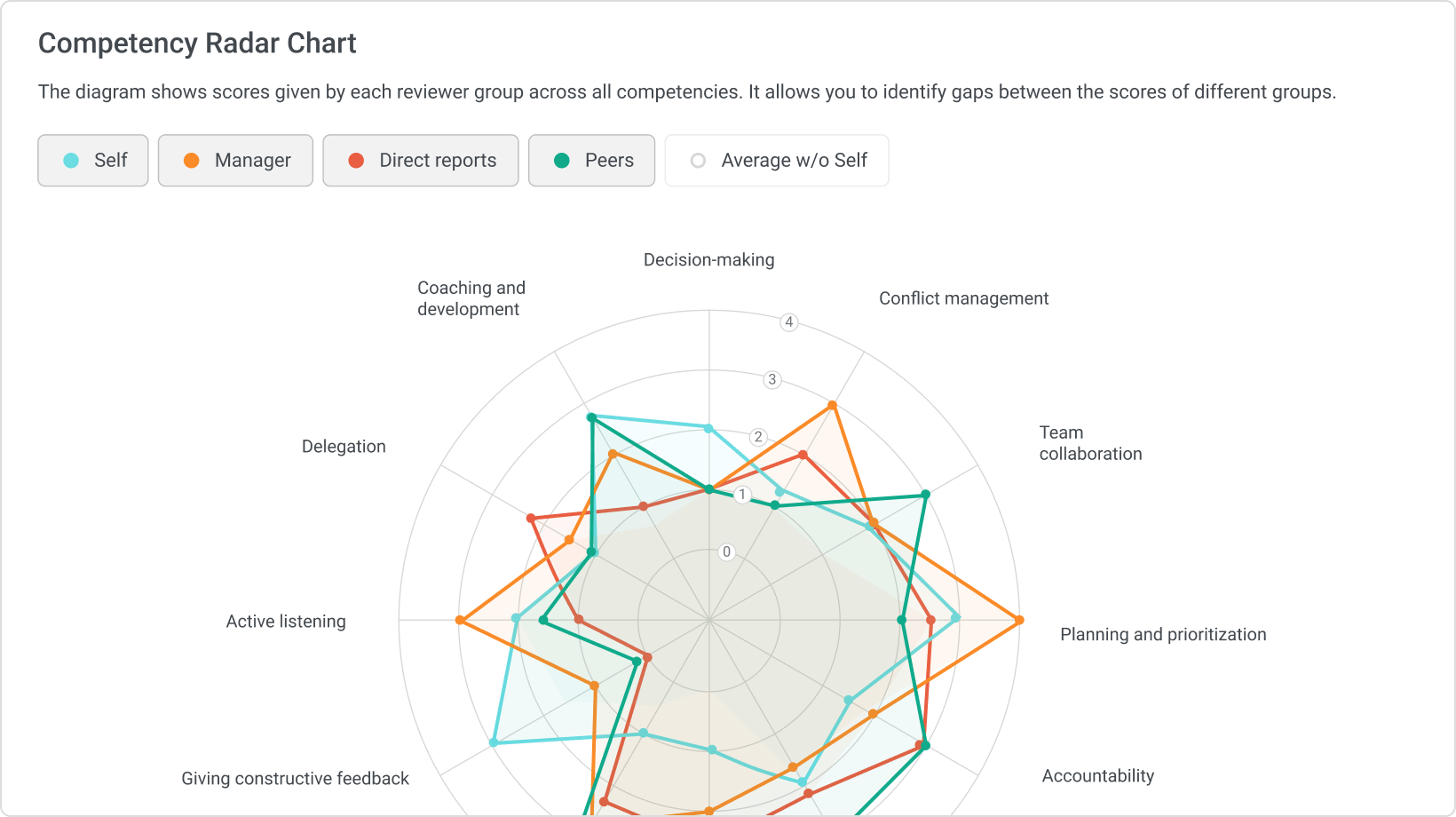
For instance, if a newly promoted team leader receives feedback suggesting a lack of "soft skills," a 360-degree review can provide a competency radar that highlights specific friction points. A leader might rate themselves highly on communication, while their direct reports flag a consistent difficulty in receiving constructive feedback. This data-driven approach allows the development plan to target the actual behavior—such as "delivering actionable feedback"—rather than the vague concept of "communication."

Phase 2: Goal Definition and Activity Mapping (Days 16–30)
Once the gap is identified, the plan must shift toward observable outcomes. A critical exercise in this phase is imagining the next performance review. Stakeholders must ask: "What specific behaviors must change for this development to be considered a success?"
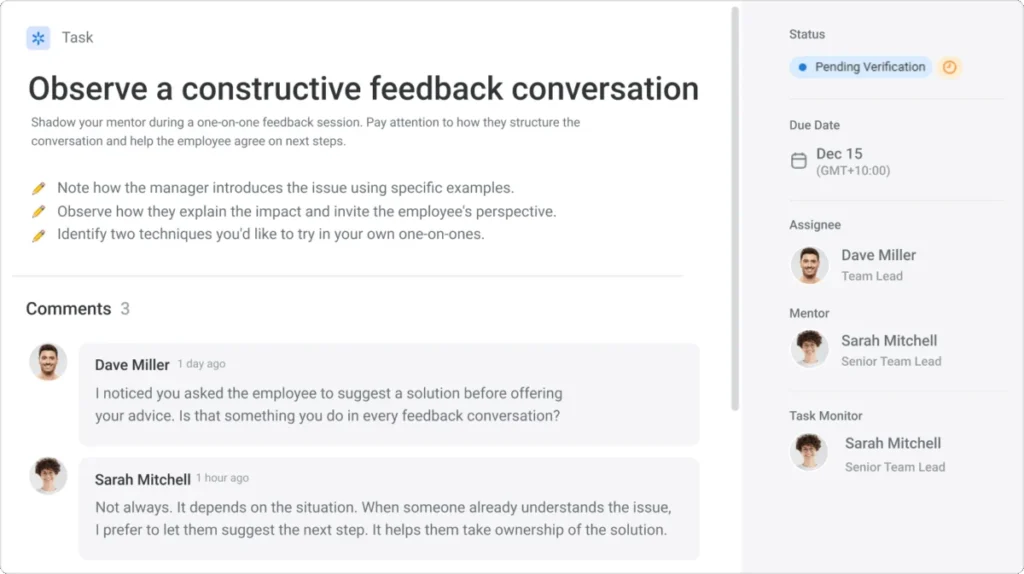
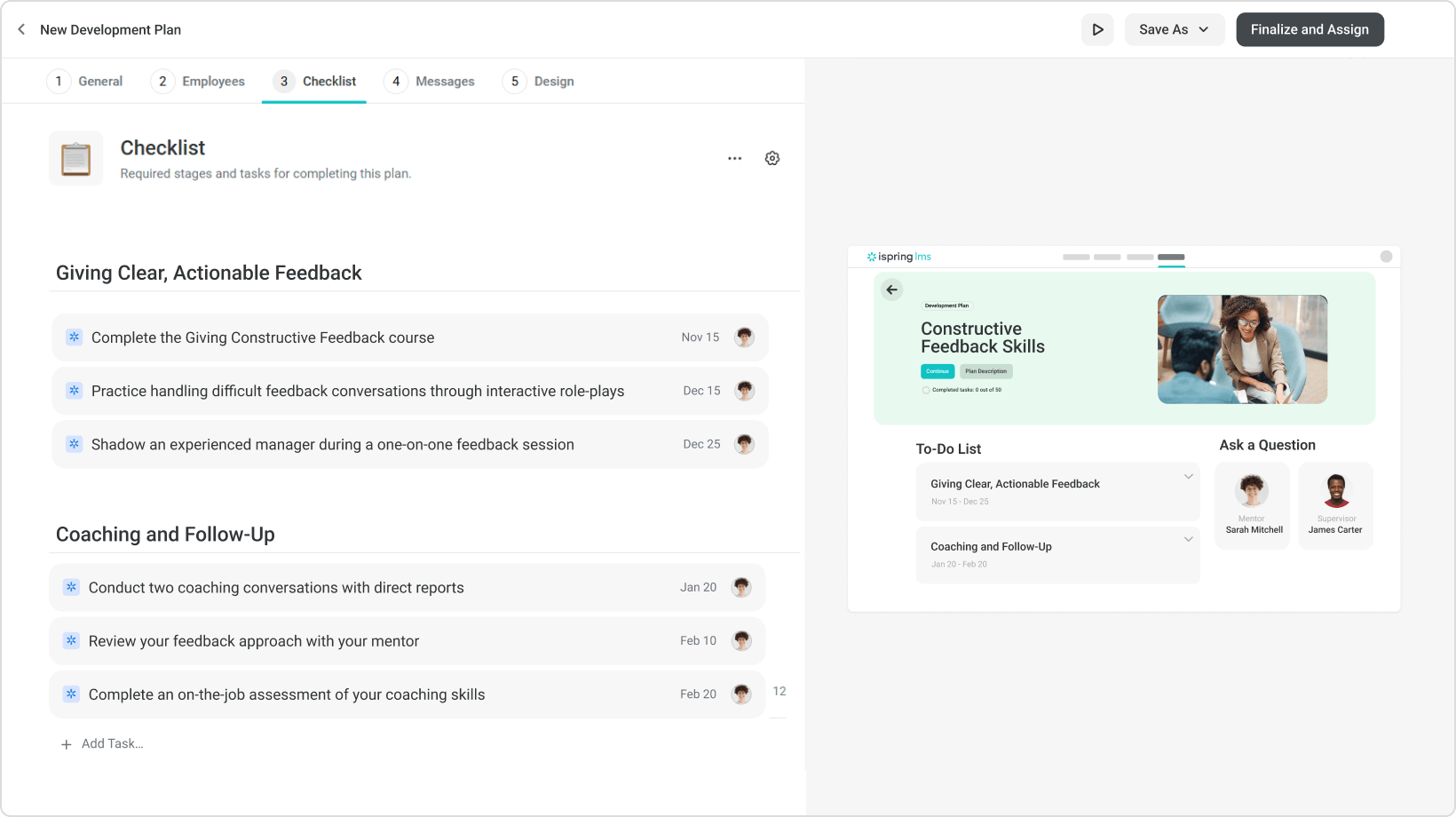
Modern Learning Management Systems (LMS), such as iSpring LMS, now offer dedicated development modules that allow managers to create shared roadmaps. These digital frameworks enable the breakdown of goals into manageable tasks, the assignment of mentors, and the setting of hard deadlines. By making the plan visible to both the employee and the supervisor, the organization creates a culture of mutual accountability.
Phase 3: Implementation and Iterative Learning (Days 31–90)
The bulk of the 90-day cycle is dedicated to a mix of formal and informal learning. This phase often follows the 70-20-10 model of development, which suggests that 70% of learning comes from job-related experiences, 20% from interactions with others, and 10% from formal educational events.
- Formal Training (The 10%): This involves scenario-based online courses or branching role-plays. These tools allow employees to practice difficult conversations in a low-stakes environment, exploring different responses and learning from mistakes without impacting real-world business relationships.
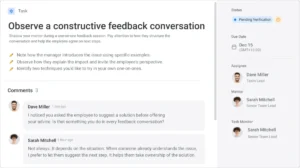
- Social Learning and Mentorship (The 20%): Tasks are assigned for the employee to shadow experienced peers or mentors. In a structured plan, this might involve a "shadowing task" where the employee observes a senior manager delivering a performance review, followed by a debriefing session.
- On-the-Job Application (The 70%): The final stage of the 90-day plan involves supervised application. This is often validated through On-the-Job Training (OJT) assessments, where a supervisor observes the employee performing the new skill in a real-world setting and provides immediate, structured feedback based on a checklist of competencies.
Supporting Data: The Impact of Structured Development
The shift toward a 90-day cycle is supported by broader industry trends regarding employee retention and engagement. Data from LinkedIn’s Workplace Learning Report suggests that 94% of employees would stay at a company longer if it invested in their career development. However, that investment must be perceived as relevant. When development plans are disconnected from the performance review, employees often view training as a distraction from their "real work" rather than a pathway to success.
Furthermore, the integration of performance data into Learning Management Systems has shown to reduce the time-to-proficiency for new managers. By automating the collection of 360-degree feedback and linking it directly to recommended training modules, organizations can reduce the administrative burden on managers by up to 40%, allowing them to focus on coaching rather than data entry.
Industry Reactions and Expert Analysis
Human resources thought leaders argue that the 90-day development plan represents a shift toward a "coaching culture." This transition is viewed as essential for managing the younger workforce, particularly Gen Z and Millennials, who prioritize frequent feedback and clear paths for advancement.
"The annual review is a post-mortem; the 90-day development plan is a roadmap," says one industry analyst. "If you only talk about performance once a year, you are essentially managing through the rearview mirror. A 90-day cycle allows for mid-course corrections that can save a project or a career before it’s too late."
From a technological perspective, the rise of "full-cycle" employee development platforms reflects a growing demand for data continuity. When a competency gap is identified in a performance review, the system should ideally suggest the specific training content required to close that gap. This "just-in-time" learning approach ensures that development is always aligned with the current needs of the business.
Broader Implications for the Future of Work
The move toward structured, short-term development plans has significant implications for organizational agility. In a rapidly changing economy, skills have a shorter shelf life than ever before. A company that relies on annual cycles to update its workforce’s skill set will inevitably fall behind competitors who operate on quarterly or even monthly development rhythms.
Moreover, the use of 90-day plans addresses the issue of assessment bias. When development is based on observable, documented tasks and multi-source feedback, it becomes harder for subjective biases to dominate the performance narrative. This transparency fosters a sense of equity and inclusion, as employees can clearly see the link between their efforts, their learning, and their career progression.
Ultimately, a performance review without a follow-up development plan is a wasted opportunity. By adopting a 90-day framework, organizations can transform a dreaded administrative task into a powerful engine for growth. The success of such a plan depends not just on the quality of the feedback, but on the commitment to providing the tools, time, and structured environment necessary for an employee to turn that feedback into a new level of professional excellence. As the 2025 APQC data suggests, the desire for development is present in the workforce; it is now up to leadership to provide the bridge.