The relentless march of artificial intelligence is fundamentally altering the corporate landscape, impacting everything from daily workflows to the very architecture of jobs. This pervasive technological evolution is not merely an incremental change; it is actively upending traditional notions of career progression, leading to significant concerns about the future of leadership development within organizations. A recent, pivotal report from Seramount, a prominent talent services firm, highlights a critical emerging challenge: as AI increasingly automates tasks historically performed by junior employees, the entry-level talent pool is shrinking, posing a tangible risk to the cultivation of future leadership pipelines.
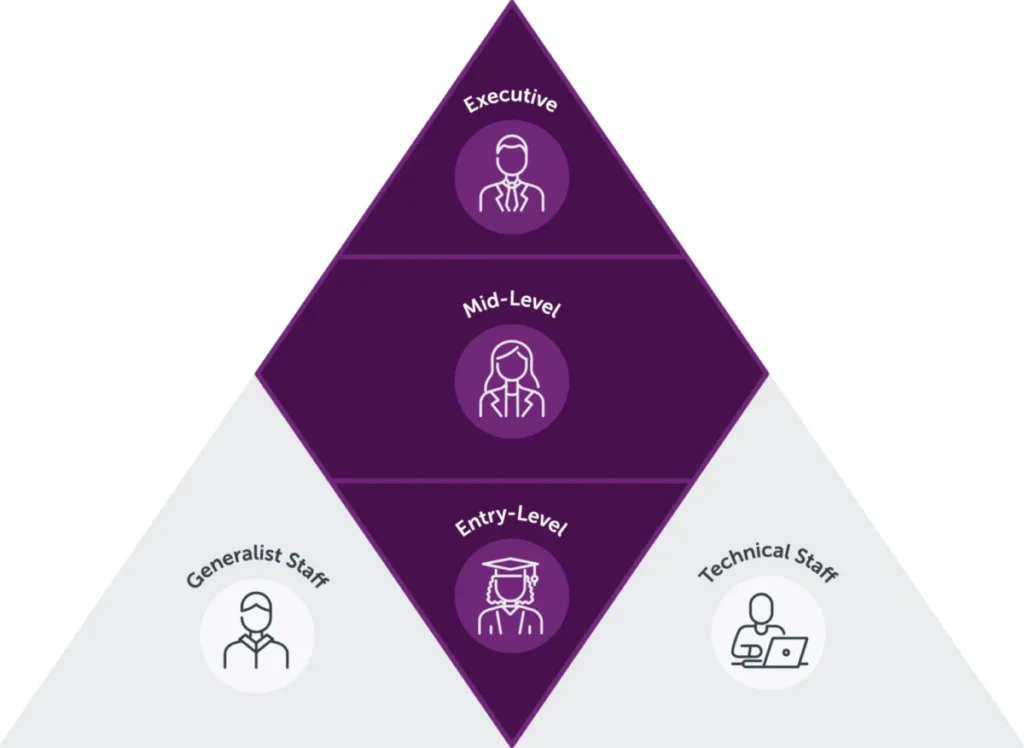
The Shifting Sands of Career Progression: From Pyramid to Diamond
For decades, the conventional career trajectory for many professionals has resembled a pyramid. At the broad base, an abundant supply of entry-level talent occupied accessible, low-skill starter jobs. Through a combination of consistent high performance, dedicated training, and organizational loyalty, a select group of these individuals would gradually ascend through the ranks, transitioning into mid-level management positions. Beyond this tier, a progressively narrower pool of exceptionally high-potential talent would then navigate the path toward executive leadership. This structured, albeit competitive, progression provided a predictable framework for aspiring leaders to hone their skills, gain critical experience, and develop the judgment necessary for senior roles.
However, the advent of sophisticated AI technologies is fundamentally challenging this established model. The report from Seramount meticulously details how early-career roles, often characterized by repetitive or rule-based tasks, are becoming particularly susceptible to automation. Simultaneously, senior employees, who might have once overseen teams of junior staff learning the ropes, are increasingly being tasked with the more complex, technical, and analytical work that AI can augment or perform. This dynamic inversion means that the foundational experiences that historically paved the way for leadership are diminishing for nascent talent.
The consequence of this seismic shift, according to Seramount’s findings, is the transformation of the traditional career pyramid into a "career diamond." This new model is characterized by a significantly constricted entry-level population. As a result, individuals are finding themselves promoted to management roles with potentially less preparation, leading to uneven development and, critically, a deficit in capacity and resources at crucial leadership junctures. The implications of this structural change are far-reaching, impacting not only individual career trajectories but also the overall health and strategic agility of organizations.
The Leadership Bench Under Strain: Quantifying the Impact
The imperative for robust leadership advancement and development in the AI era is no longer a theoretical concern; it is a business-critical necessity. The Seramount report underscores the profound impact of ineffective leadership, citing that a staggering half of all employees depart their organizations primarily due to a poor manager. The financial ramifications of this phenomenon are substantial. The report estimates that a single bad manager can cost an organization approximately $126,000 annually, a figure derived from the cumulative effects of decreased productivity, increased employee turnover, and heightened internal conflict.
"The shift toward a career diamond is putting the leadership bench under significant strain, impacting long-held assumptions about succession readiness, attrition cost, and execution speed, all of which affect the bottom line," the report’s researchers assert. This statement encapsulates the core concern: the foundational disruption caused by AI automation is not a minor inconvenience but a strategic threat to an organization’s ability to maintain a capable and ready leadership cadre.
Joe Infantino, Senior Director of Research at Seramount, a division of EAB, emphasizes that the "career diamond" is not a transient disruption but a fundamental restructuring of how talent develops. His firm’s ongoing dialogues with Chief Human Resources Officers (CHROs) and other senior talent leaders consistently reveal a pervasive anxiety about ensuring a sufficient pipeline of qualified individuals ready to assume leadership responsibilities. Echoing this sentiment, Infantino points to a stark statistic: only a meager 20% of HR professionals express confidence in their organization’s current leadership bench.
"The old pyramid depended on a broad base of early-career work, where people developed judgment and experience over time," Infantino explains. "As that work changes or shrinks, those development opportunities don’t automatically get replaced. The shape may continue to evolve, but organizations are going to have to be much more deliberate about how they help employees build toward leadership." This deliberate approach, he suggests, will require a proactive and strategic overhaul of talent development initiatives, moving beyond traditional models that are no longer sustainable.
Reimagining Roles: A Proactive Approach to Entry-Level Talent
While the trend of shrinking entry-level roles is evident in many sectors, some forward-thinking organizations are actively challenging this narrative. These companies are not simply eliminating junior positions but are strategically leveraging AI to reimagine and elevate the nature of these roles. A prime example of this innovative approach comes from IBM. Nickle Lamoreaux, CHRO at IBM and a recognized Top 100 HR Tech Influencer, has publicly stated the tech giant’s commitment to tripling its entry-level hiring over the next three years.
Lamoreaux attributes this ambitious strategy to a fundamental belief in maintaining a robust entry-level talent pool. "Keeping the bottom rung of the traditional career pyramid robust requires a ‘growth mentality’," she asserts. While acknowledging that AI will undoubtedly continue to automate routine aspects of entry-level work, Lamoreaux posits that the freed-up capacity of these junior employees should be redirected towards pursuing innovation and tackling challenges that were previously beyond their reach due to time constraints or skill specialization.
"We have to get comfortable constantly reengineering jobs to the value, and that value is always going to be shifting," Lamoreaux adds. This perspective highlights a crucial paradigm shift: rather than viewing AI as a replacement for junior talent, it should be seen as an enabler for more strategic and impactful work at all levels. The "drudgery" that AI can eliminate from entry-level roles should not mark the end of their contribution but rather the beginning of their potential for greater innovation. HR leaders, therefore, are urged to ask themselves: "What can entry-level workers now be empowered to do?"
This question is central to fostering a proactive approach to talent development. As Lamoreaux, a former HR Tech Conference keynoter, provocatively asks, "We have to get people excited about the ‘to do what?’" This excitement stems from reimagining the scope and impact of entry-level positions. When junior employees are entrusted with more complex, ambiguous, or innovative tasks, it not only enhances their engagement and development but also provides invaluable insights into their potential for future leadership.
Identifying Future Leaders in Ambiguity
The process of identifying and nurturing future leaders in this new "career diamond" landscape requires a recalibrated focus. Infantino suggests that organizations should actively seek opportunities to observe employees navigating ambiguity, demonstrating influence across diverse teams, and driving challenging initiatives forward even in the absence of a clear roadmap. "Creating opportunities to see those capabilities in action gives organizations much better evidence before making the promotion decision," he states. This approach moves beyond traditional performance metrics and focuses on the behavioral and cognitive skills that are increasingly critical for leadership in a rapidly evolving environment.
The implications of this shift are profound. Organizations that fail to adapt their talent development strategies risk facing a leadership vacuum, characterized by underprepared managers, increased employee disengagement, and a diminished capacity for innovation and strategic execution. Conversely, those that embrace the challenge of reimagining entry-level roles and deliberately cultivating leadership competencies will be better positioned to thrive in the age of AI.
A Historical Context: The Evolution of Work and Talent Management
The current AI-driven transformation of career progression is not the first time in history that technological advancements have reshaped the workplace. The Industrial Revolution, for instance, saw the rise of mass production and the creation of factory jobs that provided entry points for many. Later, the advent of the digital age and the internet dramatically altered information flow and created new industries, demanding different skill sets and career paths. Each of these shifts necessitated adjustments in how companies managed their workforce and developed talent.
The current era, however, is distinguished by the speed and pervasiveness of AI. Unlike previous technological waves that might have primarily impacted specific sectors or job functions, AI has the potential to touch nearly every aspect of work. This universality necessitates a more comprehensive and agile response from organizations. The challenge lies not just in understanding the immediate impact of AI on existing roles but in anticipating the future needs of the workforce and proactively shaping talent development strategies to meet those evolving demands.
Looking Ahead: The Imperative for Strategic Adaptation
The Seramount report serves as a critical wake-up call for businesses globally. The transition from a career pyramid to a career diamond is not a theoretical construct but a tangible reality that demands immediate attention. Organizations must move beyond a reactive stance and adopt a proactive, strategic approach to talent development. This involves:
- Re-evaluating Entry-Level Roles: Instead of simply eliminating roles susceptible to automation, companies should explore how to re-engineer them, infusing them with more strategic, innovative, and analytical components. This might involve leveraging AI as a tool to augment junior employees’ capabilities, enabling them to tackle more complex problems.
- Investing in Deliberate Development Programs: The organic development pathways of the past are no longer sufficient. Organizations need to design and implement structured leadership development programs that explicitly focus on cultivating the skills required for future leadership, such as critical thinking, problem-solving, adaptability, and strategic foresight.
- Fostering a Culture of Continuous Learning: In an era of rapid technological change, continuous learning is not optional; it is essential. Companies must create an environment where employees are encouraged and supported in acquiring new skills and knowledge throughout their careers.
- Rethinking Succession Planning: Traditional succession planning models may need to be revised to account for the shrinking entry-level pool and the evolving nature of leadership competencies. This might involve identifying high-potential talent earlier and providing them with accelerated development opportunities.
- Embracing Agility and Experimentation: The future of work is uncertain, and organizations must be prepared to adapt and experiment with new approaches to talent management. This includes being open to new organizational structures, learning methodologies, and performance evaluation frameworks.
The insights provided by Seramount, coupled with the forward-thinking strategies demonstrated by companies like IBM, offer a roadmap for navigating the complex challenges and opportunities presented by AI. By acknowledging the profound shifts in career progression and proactively adapting their talent development strategies, organizations can not only mitigate the risks to their leadership pipelines but also harness the transformative power of AI to build a more agile, innovative, and resilient future workforce. The time for deliberate action is now, to ensure that the next generation of leaders is equipped to guide organizations through an increasingly dynamic and technologically advanced world.