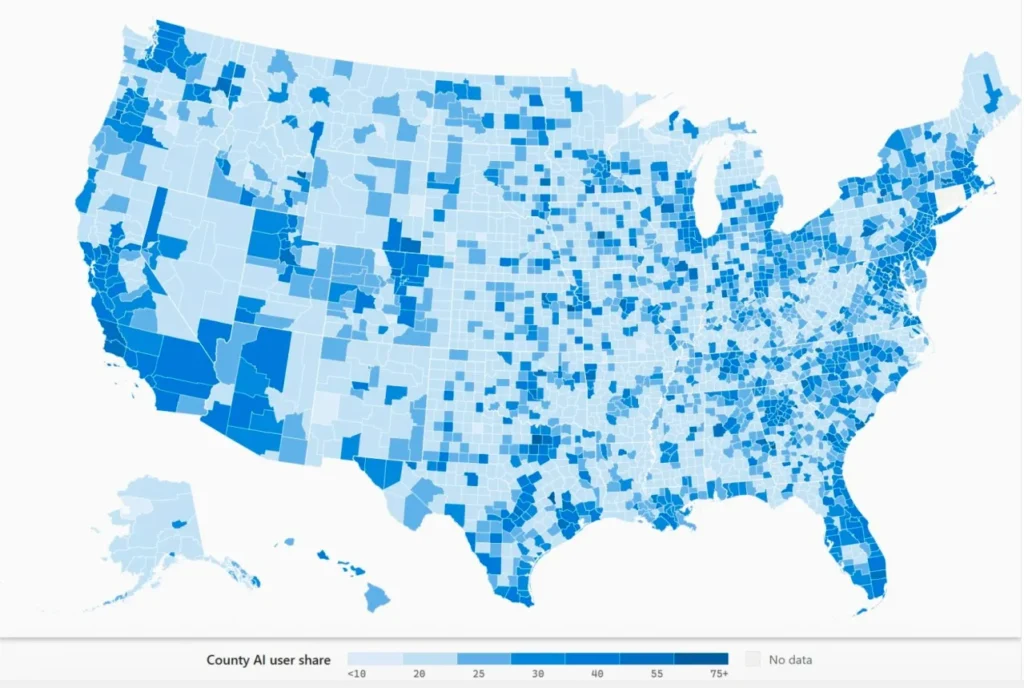
The traditional image of artificial intelligence’s burgeoning landscape in America often conjures visions of the familiar tech hubs: the bustling innovation ecosystems of San Francisco, the cloud-computing giants of Seattle, the financial and media powerhouses of New York, and the academic research powerhouses of Boston. These locations are synonymous with venture capital, cutting-edge university research, and a deep wellspring of engineering talent. However, a recent comprehensive report by Microsoft challenges this narrow perspective, suggesting that the widespread adoption of AI is far more decentralized and accessible than commonly perceived.
Microsoft’s U.S. AI Diffusion Report, released on a recent Tuesday, paints a picture of AI integration that extends far beyond these established corridors of technological influence. Juan Lavista Ferres, Microsoft’s chief data scientist and the architect behind the report, expressed his own astonishment at the findings. "Within my own company, lawyers are building tools—people who are not software developers are translating their ideas into applications," Lavista Ferres shared in an interview with Fortune. While acknowledging that a large tech company like Microsoft actively encourages AI adoption among its employees, he confessed, "I was surprised by my AI map: ‘A lot of normal people are adopting AI.’"
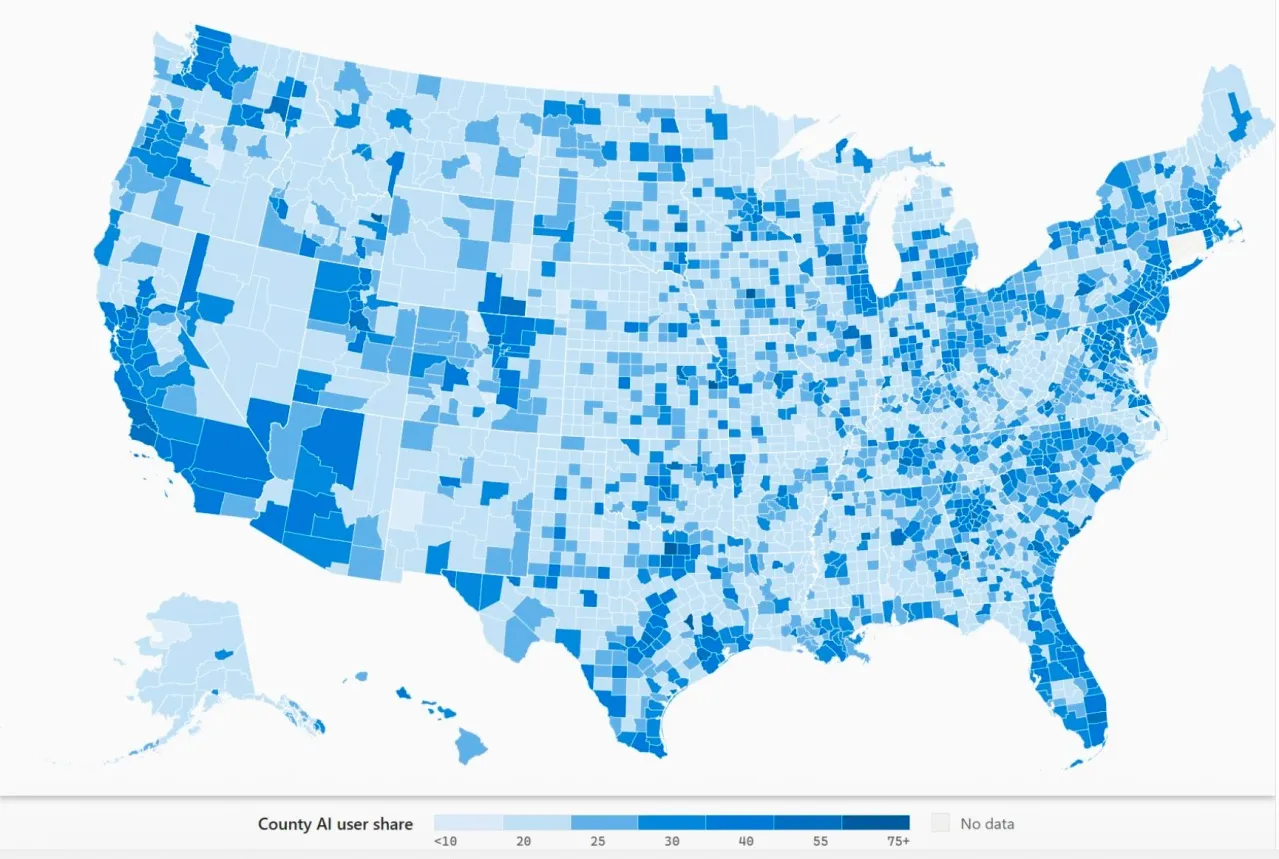
The data underlying the report substantiates this observation, revealing geographic and demographic trends that defy conventional wisdom. The report meticulously tracks AI user share across all 50 states, the District of Columbia, and over 3,100 counties, offering a granular view of AI’s penetration into the American fabric.
Texas Surpasses California in AI Adoption
One of the most striking revelations from the Microsoft report is the unexpected performance of Texas, which emerges as a national leader in AI adoption. The Lone Star State ranks fourth overall, with 35.4% of its population utilizing AI tools, edging out established tech giants California (34.1%) and New York (32.9%). The report’s apex is led by the District of Columbia (40.6%), followed by Maryland (36.5%) and Utah (35.9%). This clustering of leading states in the mid-Atlantic corridor, the Mountain West, and the Sun Belt underscores a broader trend of economic and demographic shifts across the nation. Conversely, regions in Appalachia, the Northern Great Plains, and rural New England lag, with West Virginia showing the lowest adoption rate at 20.8%.
Lavista Ferres admitted his surprise at California’s relatively lower ranking. "A lot of people would associate that as [the leader], the majority of the models are created in California," he stated. "But the fact that you have states like Texas or Utah or Maryland ahead of California was interesting for us."
The ascendancy of Texas in AI adoption aligns with a larger demographic and economic realignment that the U.S. Census Bureau has been documenting for years. Texas has become a magnet for domestic migration, boasting the five fastest-growing cities in the United States, predominantly located in the Dallas and Houston suburbs. Furthermore, the Houston and Dallas-Fort Worth metropolitan areas have consistently added more residents than any other metros nationwide in recent years. This influx of new residents is fueling a dynamic entrepreneurial spirit, which the AI diffusion data appears to capture. For instance, Fortune has previously reported on Fathom AI, an Austin-based sales platform. This innovative company was launched by a lean, three-person team in early 2026 with a modest initial capital of $300. Remarkably, it achieved an annualized revenue of $300,000 within its first 12 weeks, largely driven by AI agents adeptly managing sales tasks that would typically require a substantial sales force.
When directly asked about the connection between Texas’s burgeoning AI adoption and its population growth, Lavista Ferres affirmed, "I think it’s completely fair. I think there is a connection." He elaborated, "It’s difficult sometimes to talk about causality, right now we only need to talk about correlation, things that aren’t necessarily causal at this point, but I do think that there is a phenomenon there." This suggests that the migration patterns and the resulting economic dynamism are creating fertile ground for AI integration and innovation.
The Persistent Urban-Rural Divide in AI Adoption
While the state-level figures are compelling, the county-level data within the Microsoft report reveals an even more concerning disparity: a significant urban-rural divide in AI adoption. Across the more than 3,100 counties analyzed, the average AI usage rate in metropolitan areas stands at 33%. This figure drops to 22% in micropolitan areas and further to just 16.2% in rural counties. This translates to a substantial 16.8 percentage point gap between the most and least digitally connected regions of the country. Crucially, this divide persists even after controlling for factors such as age, income, and demographic composition, indicating that it is not solely attributable to socioeconomic status or age demographics.
Lavista Ferres described this finding as "quite striking." He noted that while one might typically attribute such disparities to older demographics or wealth inequality in rural populations, "even controlling for all those factors, you still have a big gap." Drawing parallels to his own upbringing in rural Uruguay, the Microsoft data scientist observed that this technological divide between rural and urban areas "is kind of the norm in multiple countries." The Microsoft data suggests that this same dynamic is deeply entrenched in the United States as well.

The implications of this persistent gap are profound and potentially compounding. If AI adoption serves as a leading indicator of productivity and wage growth, as suggested by emerging research, then the urban-rural divide is not merely stagnating but may be actively widening. This risks leaving communities least connected to the AI economy further behind, with diminished capacity to adapt and thrive. Lavista Ferres indicated that Microsoft is already observing the productivity connection at a micro-level. He referenced a widely cited Harvard/BCG study on consulting productivity, which demonstrated significant gains through AI implementation. On a personal note, he shared that a report his team would have previously taken months to compile was completed in just one week using AI coding tools. "The best software developer in the world cannot compete with the average software developer using these tools," he asserted. "There’s no competition."
This productivity dividend is already extending beyond the traditional tech industry. Previous reporting by Fortune has highlighted the story of Rick Chorney, a 29-year-old high school dropout who runs a janitorial services company in the suburbs of Vancouver. Chorney leveraged AI tools to achieve a remarkable feat: tripling his revenue to nearly $1 million in a single year. He accomplished this by automating customer intake processes, implementing an AI receptionist capable of handling 15 calls per hour, and compressing years of potentially costly trial and error into a matter of months. Chorney’s success story serves as a tangible, ground-level illustration of the broader trend captured by Microsoft’s diffusion data: AI adoption is permeating small and medium-sized businesses far beyond the established technology corridors.
College Towns Emerge as Unexpected AI Hotspots
Perhaps one of the most surprising findings from the Microsoft report is the outsized performance of college towns in AI adoption. The top-ranking AI-using county in the United States is not nestled in Silicon Valley but is Williamsburg, Virginia, home to the College of William & Mary. Here, the AI user share reached an impressive 73.7%. Following closely are Harrisonburg, Virginia (home to James Madison University) at 67.9%, Madison, Idaho (BYU-Idaho) at 67.7%, Brazos County, Texas (home to Texas A&M University) at 64.5%, and Story County, Iowa (home to Iowa State University) at 64.2%.
This trend was not immediately apparent to Lavista Ferres or his team. "We were doing an analysis on the top 20 counties—just looking at the list—and [someone on my team] said, ‘These are college towns.’ And that’s when we start going like, ‘Okay. There’s something happening in the college town that is different than the rest,’" he recounted. He further noted that if Williamsburg were a country, its AI user share would rank first globally. Counties where more than 10% of the population falls within the 18-24 age bracket exhibit an average AI user share of 28.8%, significantly higher than the 20.5% observed in other areas. Lavista Ferres indicated that his team has data suggesting a dip in AI usage in college towns during the summer months when students leave, a factor they intend to explore further in subsequent analyses.
New York Trails the Pack in AI Diffusion
In stark contrast to the unexpected leaders, New York state’s AI adoption rate of 32.9% places it 14th nationally. This ranking is below not only California but also states like Georgia, Massachusetts, Connecticut, Illinois, and Rhode Island. Given New York’s status as the home of the nation’s largest financial sector and a significant portion of its technology industry, this discrepancy between reputation and data warrants closer examination.

Lavista Ferres was cautious about drawing definitive conclusions from this data alone. "I’m not saying it’s not there," he stated, acknowledging that some major cities within New York do exhibit strong AI adoption. However, he noted that his team has not yet conducted a deep dive into intra-state variations. State-level AI user share can mask considerable differences within a state; a high-adoption metropolitan area like New York City could potentially inflate the state’s overall figure, even as surrounding regions drag it down, or vice versa. He expressed hope that future reports would incorporate more detailed breakdowns at the metropolitan level.
In a comparison that echoes the demographic shifts seen in Texas, New York is also experiencing population decline. New York City lost 12,196 residents last year, marking the largest numeric population decrease of any city in the country. The largest cities in the Northeast saw their average population growth plummet from 1.2% to a mere 0.2% within a single year.
Political Affiliation and AI Sentiment
The geographic patterns of AI adoption may also be influenced by underlying attitudes and political leanings. The Axios Harris Poll 100, released concurrently with the Microsoft report, revealed that 44% of Republicans expressed a more positive view of AI over the past year, compared to only 35% of Democrats. Notably, the states that are outperforming in AI adoption—Texas, Utah, Nevada, and Georgia—are among those with a strong Republican presence.
This partisan gap is particularly pronounced when considering specific AI companies. OpenAI’s reputational score among Republicans was only slightly higher than among Democrats in 2024; however, this gap has since widened to 12 points. John Gerzema, CEO of The Harris Poll, commented on this trend: "The cultural fault lines are quickly being drawn on whether AI is a benefactor or a ‘broligarchy’." While the Microsoft diffusion report measures behavior rather than sentiment, the convergence of these two datasets suggests that AI adoption and public attitude may be moving in tandem, aligning with existing political geography.
Broader Implications and the Future of AI Diffusion
Lavista Ferres remains measured in his interpretation of the data, emphasizing what it can and cannot definitively prove at this stage. However, he expresses optimism about the implications of AI diffusion beyond the traditional elite corridors. He shared an anecdote about a lawyer with dyslexia within Microsoft who developed an AI tool to aid his work. This tool was not only effective but also garnered interest from the Windows team, who saw potential for incorporating its ideas into their own development.

"He was basically building tools to help him and not only was the tool great, he showed it to the Windows team and they said, ‘We’ve actually been thinking about something like this for a long time. We might get some of your ideas,’" Lavista Ferres recounted. He foresees a potential "renaissance" driven by such examples, stating, "What will matter the most is these tools will help you get an idea and make it to production in a much easier way."
The entrepreneurs featured in recent Fortune reporting—from Rick Chorney’s janitorial business to Fathom AI’s medical aesthetics platform—epitomize the pattern Lavista Ferres describes. The technology is demonstrably moving out of research labs and into the everyday operations of businesses and individuals in diverse locales. AI is embedding itself in suburban neighborhoods, college towns, and small businesses in areas that were previously on the periphery of the AI revolution.
The American economy is not adopting artificial intelligence uniformly. Instead, it is integrating along existing fault lines—those of density, education levels, employer mix, infrastructure, and increasingly, political affiliation—fault lines that have shaped economic inequality for decades. The crucial difference now is that AI has the potential to exacerbate these disparities at an accelerated pace compared to previous technological waves. Microsoft has committed to releasing updated diffusion data every three months, promising a continued and evolving picture of AI’s widespread integration across the nation.