The intricate landscape of modern talent acquisition presents a myriad of challenges for organizations, from attracting diverse talent to navigating complex regulatory frameworks. At the heart of this challenge lies the ubiquitous job description (JD) – a seemingly simple document that, when poorly managed, can severely hinder hiring success. Enter the automated job description builder, a technological solution rapidly gaining traction, with Ongig’s Text Analyzer emerging as a key player in transforming how companies approach this critical task.
The Evolving Landscape of Job Descriptions: More Than Just a List of Duties
For decades, job descriptions served as static lists of responsibilities and qualifications. However, the 21st century has redefined their role. Today, a JD is a strategic communication tool, a crucial touchpoint in the candidate journey, and a foundational element for a company’s employer brand. Its effectiveness directly impacts the quality of applicants, the diversity of the talent pipeline, and ultimately, the success of an organization’s hiring strategy.
Companies of all sizes grapple with the perpetual cycle of writing, updating, and managing job descriptions. While smaller organizations might perceive this as a less daunting task due to a limited number of roles, the reality is that even a few ill-conceived JDs can deter top talent. As a company scales, this administrative burden amplifies exponentially. Managing hundreds or even thousands of JDs across diverse departments, ensuring consistency, accuracy, and compliance, becomes a monumental undertaking that often strains HR and recruitment teams. The sheer volume can lead to inconsistencies in language, format, and content, creating a fragmented and often negative candidate experience.
The importance of effective job advertisements cannot be overstated. Beyond merely listing requirements, a well-crafted JD is instrumental in cultivating a diverse hiring pipeline, reducing candidate churn during the application process, and clearly articulating the company’s culture and values. Recent data from a Career Plug report starkly illustrates this, revealing that a staggering 52% of job seekers have declined opportunities due to poor experiences with prospective employers. This underscores that a JD is not just an internal document but a public-facing representation of an organization’s commitment to its people and processes.
Addressing the Multidimensional Challenges of JD Creation
Crafting an optimal job description demands a delicate balance of detail, accuracy, consistency, and objectivity. Furthermore, modern JDs must actively strive for gender neutrality, be free from exclusionary industry jargon, and avoid any language that could be perceived as offensive or biased. They must comprehensively describe the role, the company culture, and the desired applicant qualifications, all while showcasing the value proposition for potential candidates.
In smaller enterprises, HR managers and recruiters may write JDs infrequently, leading to a lack of standardization and often subjective or less professional output. Conversely, larger organizations face the challenge of disparate teams generating JDs, making it incredibly difficult to uphold company-wide standards for content, format, and linguistic tone. This often results in a patchwork of descriptions that fail to present a cohesive employer brand.
The rise of artificial intelligence (AI) and natural language processing (NLP) has offered a powerful antidote to these challenges. Automated job description builders leverage these technologies to bring unprecedented levels of precision, consistency, and efficiency to the JD lifecycle. Ongig’s Text Analyzer exemplifies this evolution, providing a comprehensive suite of tools designed to streamline the creation, management, and optimization of job descriptions at scale.
Ongig’s Text Analyzer: A Deep Dive into Automated Excellence
Ongig’s Text Analyzer is positioned as an ultimate automated job description builder, designed to empower recruitment teams to "recruit smarter." It addresses various pain points across the entire JD management spectrum.
1. Creating New Job Descriptions from Scratch:
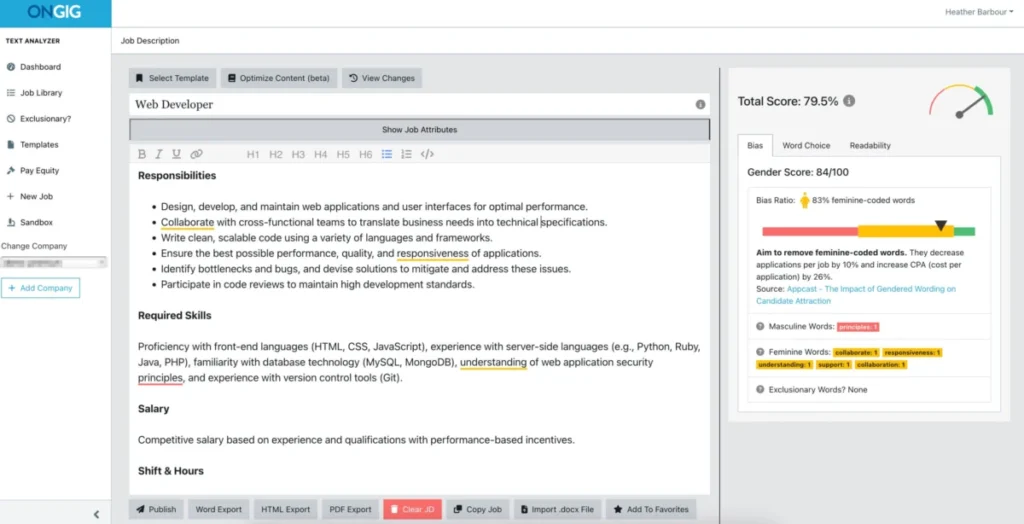
For organizations starting fresh or creating entirely new roles, the Text Analyzer offers an intuitive starting point. Users simply input a job title, such as "Web Developer," into the tool. The platform then presents a selection of customizable sections, drawing from both user-defined templates and Ongig’s research-backed recommendations. With a click of the "Generate Now" button, the AI swiftly drafts a comprehensive job description. This initial draft serves as a robust foundation, allowing teams to quickly edit and refine the content to perfectly align with the specific nuances of the position. This process significantly reduces the time and effort traditionally associated with drafting new JDs, accelerating the time-to-market for new roles.
2. Optimizing Content for Inclusivity and Readability:
Beyond initial generation, the Text Analyzer features a crucial "Optimize Content" function. This capability uses AI to identify and correct potential issues such as masculine bias and overly long, complex sentences. For instance, the system might flag "support" as a feminine-coded term, suggesting "help" as a neutral alternative. This iterative optimization process helps eliminate subtle biases that can inadvertently narrow the applicant pool, ensuring the language resonates with a broader and more diverse audience.
The platform also provides a "readability score" under its "Section Finder" tab. This score, based on linguistic analysis, indicates how easily candidates can understand the JD. It also highlights important sections that appeal to quality candidates, such as "Required Skills," "Diversity & Inclusion," and "Mission Statement." Crucially, the tool contextualizes the importance of these sections with current workforce data. For example, it might cite that 32% of working professionals would consider relocating with a pay cut for a remote work opportunity, thereby emphasizing the strategic inclusion of a "Flexible Location" section where applicable. The AI-driven improvements often result in a measurable increase in the readability score, signaling a more accessible and engaging job posting. Users can view a "View Changes" comparison to see the before-and-after impact of the optimization, fostering transparency and control.
3. Ensuring Compliance and Mitigating Risk:
In an era of increasingly stringent employment laws and diversity mandates, compliance is paramount. Ongig’s Text Analyzer offers robust features to keep JDs up-to-date with the latest regulatory standards. A simple checkbox enables the platform to verify adherence to standards like those from the Office of Federal Contract Compliance Programs (OFCCP). This functionality helps ensure merit-based talent acquisition decisions, minimizes instances of discrimination, and reinforces a company’s reputation as an Equal Employment Opportunity (EEO) employer.
EEO branding is not merely a legal requirement; it’s a strategic advantage. It signals a commitment to prioritizing employee-first environments where every individual has equal opportunities, irrespective of background. This fosters trust among employees, investors, partners, and clients alike. Moreover, EEO compliance aligns with recent merit-based hiring criteria, such as those administered by the Trump administration, further cementing a company’s position as a fair and ethical employer.
4. Updating Existing Job Descriptions:
Even a meticulously crafted JD can quickly become obsolete. Organizational changes, evolving industry standards, and new legal requirements necessitate continuous updates. For companies with vast libraries of existing job descriptions, manual review and update is a daunting, resource-intensive task. The Text Analyzer addresses this by reviewing existing JDs for quality, consistency, and language, identifying outdated phrases, jargon, and biased terms. Customers have successfully used it to remove biased language, reduce jargon, and subsequently observe improved conversion rates from prospective employees.
The automation capabilities of Text Analyzer drastically cut down the human labor involved in reviewing and updating postings. For teams preferring a more hands-on approach, the tool still offers immense value. It scores existing JDs based on readability and inclusivity, providing targeted suggestions for improvement and enabling comparative analysis across different descriptions. This blend of automation and guided manual editing ensures that every JD, regardless of its age, can be brought up to modern standards. Studies consistently show that diverse companies outperform their less inclusive competitors, with some reports indicating a 36% increase in profitability. Objective, skills-based hiring facilitated by such tools can lead to a 2.6 times higher likelihood of organizations meeting their hiring targets.
5. Large-Scale Reformatting and Template Management:
Consistency across a large volume of job descriptions is often elusive. Different departments, managers, and even individual recruiters may have distinct styles, leading to a fragmented candidate experience. The Text Analyzer excels in large-scale reformatting by comparing existing JDs against preferred templates, making automated edits to enhance readability, clarity, and consistency. It can automatically populate missing sections, such as details on salary, benefits, and the hiring process, ensuring every JD adheres to company-wide standards.
These customizable templates are central to maintaining consistency. Once designed to fit an organization’s specific needs and preferences, they can be "locked" to prevent unauthorized edits, guaranteeing compliance and brand uniformity across all postings. This feature is invaluable for large enterprises striving for a unified employer brand message.
6. Bridging the Gap: From Job Description to Job Posting:
A job description is an internal document outlining the role; a job posting is a marketing tool designed to attract candidates. Ongig’s AI-driven platform offers a seamless transition, reformatting internal JDs into attractive, candidate-centric job postings with a single click. This shortcut dramatically boosts the talent acquisition team’s efficiency, improving the "speed-to-job market" rate. Furthermore, the platform optimizes job postings for SEO, enhancing visibility on job boards and increasing candidate conversions.
By reformatting, the platform ensures the posting speaks the language of the target audience, prioritizing sections most relevant to today’s job seekers, such as "What You’ll Do," "Salary," and "Making an Impact." This strategic ordering, informed by the latest job seeker trends, ensures maximum engagement.
7. A Centralized, Cloud-Based JD Library:
Managing thousands of JDs for a vast array of roles is inherently complex. Outdated content carries not only efficiency costs but also significant legal risks in a continuously evolving compliance landscape. Ongig’s centralized, cloud-based JD library provides a reliable, intuitive storage solution. It offers crucial details at a glance, including the job title, department, creation date, last update, associated hiring manager, status (active/inactive), and compliance score. The ability to cycle through active and non-active jobs facilitates systematic management, keeping hiring teams aligned with a consistent record and enabling easy editing, updating, and deletion of JDs. This serves as a single source of truth for all recruitment-related content.
Integration and Scalability:
Ongig’s Text Analyzer is designed for seamless integration with existing Applicant Tracking Systems (ATS) and other Human Resources Information System (HRIS) software. Through API integration for premium and professional plans, it creates a full-circle job creation workflow, pushing optimized JDs directly to the ATS. This minimizes manual data entry and reduces the potential for errors. The platform also offers a flexible, tiered system, allowing organizations to pay only for the tools they need, scaling with their business’s changing priorities and growth.
Success Stories: Tangible Impact in Talent Acquisition
The real-world impact of Ongig’s automated job description builder is evident in its diverse client success stories, underscoring its ability to drive meaningful change in recruitment.
-
A Global Employment Website’s Leap in Application Rates: A major global employment website, utilizing Text Analyzer for its 60,000 job postings, witnessed a remarkable 133% increase in total application starts and a significant 21% rise in applications from women. This case powerfully illustrates how nuanced, thoughtful language can dramatically broaden and diversify an applicant pool.
-
Healthcare Sector Achievements: In the healthcare industry, where precision and compliance are critical, Ongig assisted one client in revamping over 5,000 job postings, achieving not just standardization but infusing inclusivity across the board. Another healthcare client, managing over 100,000 job postings monthly, achieved complete automation, revolutionizing their process efficiency.
-
Entertainment Industry Transformation: An enterprise in the entertainment sector focused on enhancing job descriptions for inclusivity and consistency. The outcome was an impressive 100% increase in candidate quality, demonstrating the direct link between effective JDs and attracting top-tier talent.
-
Aerospace and Insurance Sectors’ Strides: An aerospace technology agency tackled gender imbalance in historically male-dominated fields like engineering and finance. Through Text Analyzer, they reported a 22% increase in female applicants. Similarly, a large insurance organization leveraged the tool to target underrepresented groups, resulting in a 4X increase in applications from these crucial demographics.
These outcomes, featured in Ongig’s promotional materials, consistently highlight the platform’s commitment to improving the hiring process and demonstrate how strategic changes in job description management can yield substantial, measurable results.
The Broader Implications for Talent Acquisition
The adoption of automated job description builders like Ongig’s Text Analyzer signals a significant shift in talent acquisition. The implications are far-reaching:
- Enhanced Efficiency and Cost Savings: By automating repetitive and time-consuming tasks, HR and recruitment teams can reallocate resources to more strategic initiatives, reducing time-to-hire and cost-per-hire.
- Superior Candidate Experience: Consistent, clear, and inclusive job descriptions create a more positive and transparent candidate journey, fostering greater engagement and reducing dropout rates.
- Stronger Employer Branding: A unified, professional, and inclusive voice across all job postings reinforces a positive employer brand, making the company more attractive to a wider talent pool.
- Mitigated Legal Risk: Proactive compliance checks and bias identification help organizations avoid costly discrimination lawsuits and uphold ethical hiring practices.
- Improved Diversity and Inclusion Outcomes: By systematically removing biased language and promoting inclusive messaging, these tools directly contribute to building more diverse workforces, which are proven to be more innovative and profitable.
- Data-Driven Recruitment: The analytics and scoring features provide valuable insights into JD performance, enabling continuous improvement and more strategic talent attraction efforts.
The evolution of job descriptions from mere administrative forms to powerful strategic assets is undeniable. Automated builders, championed by solutions like Ongig’s Text Analyzer, are not just tools for efficiency; they are foundational elements for building fair, effective, and future-ready talent acquisition strategies. As the war for talent intensifies and the demands for inclusive hiring grow, the role of such technology will only become more critical in shaping the workforce of tomorrow.