
The landscape of talent acquisition has undergone a profound transformation, evolving from manual processes to sophisticated, data-driven strategies. At the heart of this evolution lies the ubiquitous job description (JD), a document that, despite its critical importance, has long been a source of inefficiency and inconsistency for organizations worldwide. The challenge of crafting, maintaining, and updating accurate, inclusive, and compliant job descriptions at scale is a persistent hurdle for human resources and talent acquisition teams. Enter the automated job description builder, a technological leap designed to streamline this complex task, with solutions like Ongig’s Text Analyzer leading the charge in redefining how companies approach their hiring narratives.
The Evolving Landscape of Talent Acquisition and the Persistent JD Challenge
For decades, job descriptions were often static documents, drafted with varying degrees of precision and updated infrequently. In smaller organizations, the burden of writing JDs falls on HR managers or even hiring managers who may lack specialized writing skills or consistent templates. This can lead to subjective, inconsistent, and often legally ambiguous language. As companies grow, this challenge compounds exponentially. A large enterprise might manage thousands of unique roles across multiple departments and geographies, each requiring a distinct yet standardized job description. The sheer volume makes manual oversight nearly impossible, resulting in a fragmented approach to talent messaging.
The consequences of poorly managed job descriptions are far-reaching. They can deter qualified candidates, particularly those from underrepresented groups, due to biased language or exclusionary phrasing. Inaccurate JDs lead to misaligned expectations, increasing employee churn and recruitment costs. Furthermore, non-compliant language can expose organizations to significant legal risks and penalties. A Career Plug report highlighted that a staggering 52% of job seekers decline opportunities due to negative experiences during the hiring process, often stemming from poorly articulated job advertisements. This underscores the imperative for precision, clarity, and an engaging tone in every candidate interaction, starting with the job description.
The Critical Role of Effective Job Descriptions in Modern Hiring
Effective job descriptions are more than just a list of duties and qualifications; they are powerful marketing tools and foundational elements of a robust talent strategy. They are crucial for:
- Attracting a Diverse Talent Pipeline: Inclusive language and unbiased descriptions significantly broaden the pool of applicants, inviting candidates from all backgrounds. Studies by McKinsey & Company have repeatedly shown that diverse companies outperform their less diverse counterparts, with a 36% increase in profitability being a frequently cited figure.
- Enhancing Candidate Experience: Clear, concise, and engaging JDs set appropriate expectations, making the application process smoother and more positive. This reduces churn during the hiring funnel and strengthens employer branding.
- Improving Quality of Hire: Well-defined roles attract candidates whose skills and aspirations genuinely align with the position and company culture. Objective, skills-based hiring practices, often facilitated by structured JDs, lead to a 2.6 times higher likelihood of organizations achieving their hiring targets.
- Ensuring Compliance: JDs must adhere to a complex web of local, national, and international labor laws, including equal employment opportunity (EEO) regulations and anti-discrimination statutes. Non-compliance can result in hefty fines and reputational damage.
- Optimizing SEO and Visibility: For job postings, strategically crafted keywords and clear structure improve search engine optimization (SEO), making roles more discoverable on job boards and career sites.
The critical nature of job descriptions has spurred innovation in HR technology, leading to the development of automated builders that promise to transform this administrative burden into a strategic advantage.
Introducing Ongig’s Automated Solution: Text Analyzer
Ongig’s Text Analyzer stands as a prime example of how artificial intelligence (AI) is being leveraged to address the intricate challenges of job description management. This automated builder offers a comprehensive suite of features designed to create, optimize, and manage job descriptions at an unprecedented scale and level of detail.
From Concept to Comprehensive Draft: AI-Powered Creation
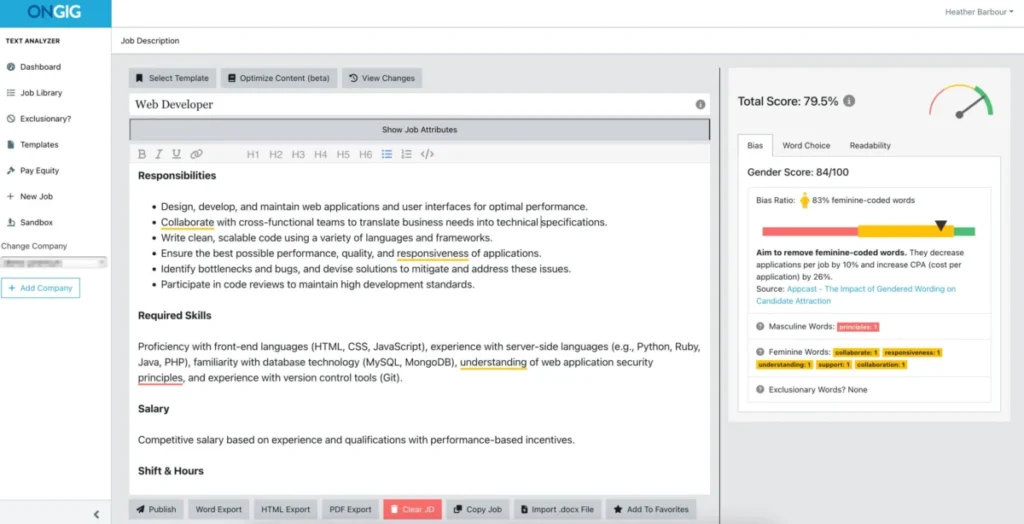
One of Text Analyzer’s most compelling capabilities is its ability to generate new job descriptions from scratch with remarkable efficiency. Recruiters no longer need to face a blank page; instead, they can simply input a job title, such as "Web Developer," and the AI takes over.
The process is intuitive:
- Initiate Creation: Within Text Analyzer, users open a new job and click the "Write Sample" button, inputting the desired job title.
- Select Sections: The tool then presents a choice of sections to include, drawing from either custom organizational templates or Ongig’s research-backed recommendations for optimal JD structure.
- Generate Draft: With a click of "Generate Now," the AI swiftly constructs a comprehensive draft of the job description, populated with relevant duties, qualifications, and company information.
- Refine and Edit: The generated draft serves as a robust starting point, allowing hiring teams to quickly review, edit, and tailor the content to the specific nuances of the role and company culture. This collaborative editing feature ensures accuracy and buy-in from all stakeholders.
This AI-driven drafting dramatically reduces the time spent on initial content creation, freeing up recruiters to focus on more strategic aspects of talent acquisition.
Refining for Impact: Readability and Inclusivity Scores
Beyond initial drafting, Text Analyzer excels in optimizing content for maximum impact. The tool features a "Section Finder" tab that not only identifies critical JD sections like "Required Skills," "Diversity & Inclusion," and "Mission Statement," but also provides a "readability score." This score is crucial, as complex or jargon-filled language can alienate potential candidates.
The platform provides context for its recommendations, citing relevant workforce data. For instance, it highlights that 32% of working professionals would consider relocating for a pay cut if offered a remote work option, underscoring the importance of including a "Flexible Location" section where applicable.
A key differentiator is Text Analyzer’s advanced bias detection. After generating a draft, users can click "Optimize Content" and then "Rewrite Now." The AI then actively works to reduce masculine bias and shorten lengthy sentences. The platform visually indicates improvements, with the example showing a score increase from 79.5% to 83.3% after optimization. By simply hovering over an underlined word, users are alerted to potential biases (e.g., "support" being a feminine-coded term) and offered neutral alternatives like "help," or the option to delete. This proactive approach ensures that job descriptions are inherently inclusive and appeal to a broader demographic. Furthermore, it identifies and allows for the removal of "exclusionary words," preventing unintentional barriers to application.
Users can also track these improvements through the "View Changes" feature, which provides a comparative analysis of different versions, ensuring transparency and accountability in the refinement process. Once finalized, JDs can be easily exported in various formats (Word, PDF, HTML) or pushed directly to an Applicant Tracking System (ATS) via API integration for premium and professional plans, ensuring seamless workflow.
Navigating Regulatory Complexities: Compliance and EEO
In today’s highly regulated hiring environment, compliance is non-negotiable. Ongig’s Text Analyzer incorporates critical features to ensure job descriptions meet the latest standards, particularly those mandated by the Office of Federal Contract Compliance Programs (OFCCP). With a simple checkbox, the platform scrutinizes JDs for potential instances of discrimination, helping organizations make merit-based talent acquisition decisions.
This commitment to compliance not only mitigates legal risks but also significantly strengthens a company’s employer brand. By consistently demonstrating a commitment to Equal Employment Opportunity (EEO), organizations build trust with candidates, employees, investors, and partners. EEO branding fosters an employee-first environment where every individual has equal opportunities, irrespective of background, leading to improved employee engagement, higher quality of hire, and reduced workplace dissatisfaction. This feature is particularly pertinent given evolving regulatory landscapes, such as recent mandates emphasizing merit-based hiring criteria for federal contractors.
Revitalizing Existing Content: Large-Scale Updates and Reformatting
Many organizations grapple with extensive libraries of outdated job descriptions. Ongig’s Text Analyzer is not just for creating new JDs; it’s also a powerful tool for auditing and updating existing ones at scale. The platform reviews current descriptions for quality, consistency, and language, identifying jargon, biased phrasing, and areas for improvement.
For teams that prefer manual review, the Text Analyzer still offers immense value. It scores existing JDs based on readability and inclusivity, providing actionable suggestions. Recruiters can then manually replace biased words with inclusive alternatives or simplify complex legalistic language into plain English, all while seeing real-time score improvements. This hybrid approach ensures that even legacy content can be brought up to modern standards without excessive human labor.
For organizations needing a comprehensive overhaul, the tool’s automation capabilities simplify large-scale reformatting. It compares existing JDs against preferred templates, automatically making edits to enhance readability, clarity, and consistency. Crucially, it can fill in missing sections according to company-wide standards, such as details about salary, benefits, and the hiring process. These templates are customizable to match specific organizational needs and can be "locked" to prevent unauthorized edits, ensuring enterprise-wide consistency and compliance.
Transforming Descriptions into Dynamic Postings
The distinction between a job description (an internal document outlining responsibilities) and a job posting (an external marketing piece designed to attract candidates) is often blurred. Ongig’s AI-driven platform bridges this gap seamlessly. With a single click, it can reformat a detailed job description into an attractive, candidate-centric job posting.
This feature significantly boosts the efficiency of talent acquisition teams, improving the speed-to-job market rate. By optimizing job postings for SEO, the platform helps roles rank higher on job boards, increasing visibility and candidate conversions. Text Analyzer understands the latest job seeker trends, prioritizing sections that matter most to candidates, such as "What You’ll Do," "Salary," and "Making an Impact," ensuring that the most compelling information is front and center.
The Centralized Hub: Ongig’s JD Library
Managing thousands of job descriptions across an enterprise can be a logistical nightmare, leading to version control issues and potential compliance gaps. Ongig’s centralized, cloud-based JD library provides a reliable, intuitive solution. This single source of truth for all hiring needs offers essential details at a glance, including:
- Job title
- Department
- Location
- Status (active/inactive)
- Creation date
- Last updated date
- Associated templates
- Readability and inclusivity scores
Users can easily cycle between active and non-active jobs, maintaining a consistent record that keeps hiring teams informed and aligned. This systematic management simplifies editing, updating, and deleting JDs, ensuring that hiring strategies remain current and compliant.
Ongig Automated Job Description Builder Success Stories: Tangible Impact
The real-world impact of Ongig’s Text Analyzer is best illustrated through its success stories, demonstrating its ability to drive significant improvements in recruitment metrics across diverse industries.
- A Leap in Application Rates: A global employment website, testing Text Analyzer across 60,000 job postings, observed a remarkable 133% jump in total application starts. Crucially, they also reported a 21% rise in applications from women, showcasing the tool’s effectiveness in fostering diverse pipelines.
- Healthcare Sector Achievements: In the high-stakes healthcare industry, Ongig assisted one client in revamping over 5,000 job postings, achieving both standardization and deep inclusivity. Another healthcare client, managing over 100,000 job postings monthly, attained complete automation of their JD process, leading to unparalleled operational efficiency.
- Entertainment Industry Transformation: An enterprise in the entertainment sector focused on enhancing inclusivity and consistency in their job descriptions. The result was a 100% increase in candidate quality, proving that well-crafted JDs attract top-tier talent.
- Aerospace and Insurance Sectors’ Strides: Addressing gender imbalance in traditionally male-dominated fields, an aerospace technology agency saw a 22% increase in female applicants for roles like engineering and finance after implementing Text Analyzer. Similarly, a large insurance organization utilized the tool to target underrepresented groups, leading to an impressive 4X increase in applications from these crucial demographics.
These outcomes, featured in Ongig’s YouTube video and client testimonials, underscore the platform’s commitment to enhancing the hiring process through nuanced, data-driven improvements.
Broader Implications for the Future of Hiring
The advent of sophisticated automated job description builders like Ongig’s Text Analyzer carries significant implications for the future of talent acquisition and the broader HR function:
- Elevated Efficiency and Cost Savings: By automating tedious tasks, HR teams can drastically reduce the time and resources spent on JD management, thereby lowering cost-per-hire and improving overall recruitment efficiency.
- Measurable Progress in Diversity, Equity, and Inclusion (DEI): The built-in bias detection and readability features provide a tangible mechanism for organizations to move beyond aspirational DEI goals to concrete, measurable improvements in attracting diverse talent. This is not just ethical but also a business imperative for innovation and market relevance.
- Strategic Employer Branding: Consistent, professional, and inclusive job descriptions project a strong, positive employer brand. This helps companies differentiate themselves in a competitive talent market, attracting candidates who align with their values.
- Enhanced Risk Mitigation: Proactive compliance checks reduce the likelihood of legal challenges related to discrimination, safeguarding the organization’s reputation and financial stability.
- Shift from Administrative to Strategic HR: By offloading administrative burdens, automated tools empower HR professionals to focus on more strategic initiatives, such as talent planning, employee development, and fostering a thriving company culture.
- The Continued Integration of AI in HR Tech: Automated JD builders represent just one facet of AI’s transformative potential in HR. Their success signals a future where AI-powered solutions will increasingly optimize every stage of the employee lifecycle, from recruitment to retention.
Conclusion
The task of writing, updating, and managing job descriptions has long been an overlooked yet critical bottleneck in talent acquisition. Automated job description builders, exemplified by Ongig’s Text Analyzer, offer a powerful remedy. By leveraging AI to ensure clarity, consistency, inclusivity, and compliance, these tools empower organizations of all sizes to recruit smarter, build more diverse teams, and strengthen their employer brand. As the world of work continues to evolve, embracing such innovative solutions will be paramount for companies aiming to attract, engage, and retain top talent in a competitive global marketplace. To learn more and explore how Text Analyzer can optimize your hiring strategy, scheduling a demo today could be the first step towards a more efficient and equitable recruitment future.
FAQ: Automated Job Description Builders
Q: Do automated job description builders use AI?
A: Yes—many modern job description builders, including Ongig’s, use AI to generate and optimize job content. For example, Ongig’s Text Analyzer uses AI to suggest edits, rewrite text for inclusivity and readability, and score job descriptions based on quality metrics. The AI can also identify biased or exclusionary words and propose more inclusive alternatives, helping you reach a broader, more diverse talent pool.
Q: How does an automated job description builder help the hiring process?
A: Automated JD builders streamline the hiring process by cutting the time it takes to write and edit job descriptions. They ensure your postings are compliant, engaging, and consistent across the board. This consistency improves candidate experience and boosts applicant quality. Ongig’s tool also flags outdated language, optimizes formatting, and integrates with ATS platforms—so you spend less time on admin work and more time engaging top talent.
Q: What is an automated job description builder?
A: An automated job description builder is a digital tool that helps HR teams and hiring managers create, update, and optimize job postings quickly and efficiently. Instead of writing job descriptions from scratch or using outdated templates, this tool leverages structured inputs, templates, and often AI-powered suggestions to generate job ads that are clear, accurate, and aligned with your brand voice. Tools like Ongig’s Text Analyzer even help manage large libraries of job postings and ensure consistency across departments.
April 14, 2026 by Olivia Jones in Job Descriptions






