Organizational culture, often described as the invisible operating system of an enterprise, is a fundamental component present in every organization, regardless of its size or sector. It manifests in the subtle yet profound ways individuals interact, how crucial decisions are deliberated and finalized, and the specific behaviors that are either celebrated and reinforced or implicitly tolerated and overlooked. Far from being a mere abstract concept, a robust and intentionally cultivated culture serves as a powerful catalyst for both human capital development and sustained organizational performance. Industry research consistently underscores this correlation; for instance, Great Place to Work® has reported that organizations fostering high-trust cultures are an impressive 5.5 times more likely to achieve year-over-year revenue growth. This significant statistical advantage stems from the direct influence of trust on employee engagement, decision-making efficacy, and overall productivity. In environments where trust permeates relationships between employees and leadership, operational processes accelerate, and complex challenges become considerably more manageable to resolve.
The encouraging news for businesses and leaders is that organizational culture is not immutable; it is a dynamic construct capable of systematic improvement through deliberate, actionable strategies. These strategies, when implemented consistently, translate into tangible experiences for employees, fostering a workplace environment that is not only productive but also genuinely desirable. The modern business landscape, characterized by rapid technological advancement, evolving workforce demographics, and increased global competition, has elevated organizational culture from a ‘soft’ HR concern to a critical strategic imperative. Companies are increasingly recognizing that their competitive edge is not solely defined by products or services, but by the strength and adaptability of their internal culture, which directly impacts talent attraction, retention, and overall resilience.
The Strategic Imperative of a Nurtured Culture
The concept of organizational culture has evolved significantly over recent decades. What was once considered a byproduct of an organization’s operations is now understood as a primary driver of success. In the 21st century, with the rise of knowledge economies and the increasing demand for employee engagement and well-being, culture has moved to the forefront of strategic business discussions. The "Great Resignation" phenomenon, for example, highlighted how deeply dissatisfaction with workplace culture can impact talent retention, prompting a widespread reevaluation among companies regarding their internal environments. Data from Gallup indicates that highly engaged teams show 21% greater profitability, underscoring the direct financial benefits of a positive cultural climate. Furthermore, a study by Deloitte revealed that 94% of executives and 88% of employees believe a distinct workplace culture is important to business success.
A strong culture provides a sense of identity and purpose, guiding employees through ambiguity and fostering a shared commitment to organizational goals. It influences everything from innovation rates and customer service quality to an organization’s ability to adapt to market shifts. Organizations that prioritize culture building often report higher levels of employee satisfaction, lower absenteeism, and enhanced brand reputation, making them attractive employers in a competitive talent market.
Ten Pillars for Enhancing Organizational Culture
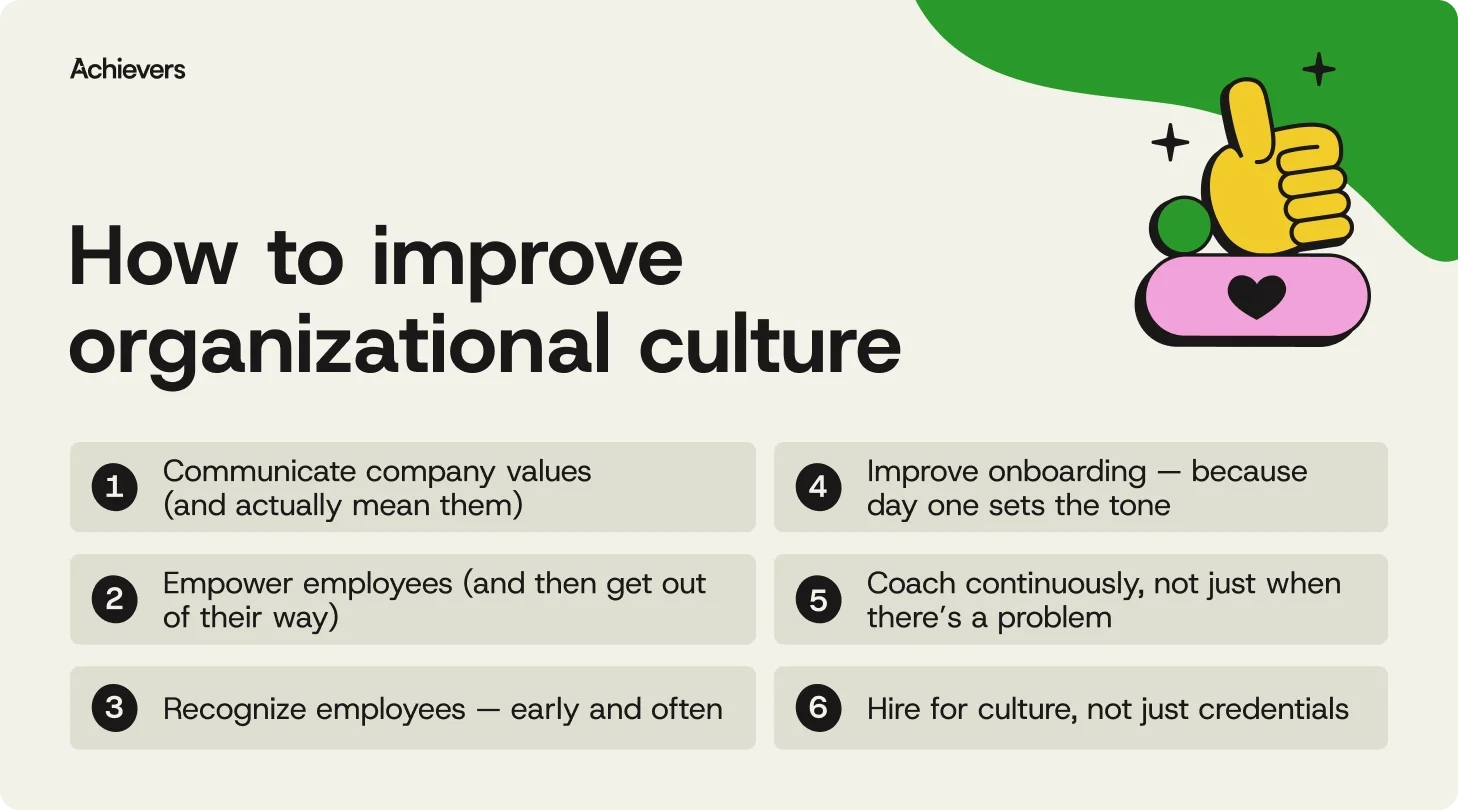
Improving organizational culture requires a multi-faceted approach, focusing on practical interventions that resonate daily with employees. The following ten strategies represent proven methods for cultivating a workplace where individuals feel valued, empowered, and motivated to contribute their best.
1. Articulating and Embodying Core Values
Company values are more than just statements; they are the fundamental beliefs and principles that guide an organization’s actions, shape employee behavior, and define what constitutes exemplary work. For values to truly impact culture, they must be consistently communicated, visibly demonstrated by leadership, and integrated into all organizational processes, including hiring, performance management, and decision-making. When values are actively reinforced, employees gain a clear understanding of expectations and the broader significance of their contributions. This alignment fosters a sense of purpose and cohesion. Research by Bain & Company suggests that companies with strong, clearly articulated values are more resilient and perform better in the long run.

2. Strategic Employee Recognition and Appreciation
Recognition is a powerful motivator that directly correlates with employee engagement and retention. When individuals feel genuinely appreciated for their efforts and achievements, they are more inclined to remain committed to their roles and contribute at elevated levels. Effective recognition extends beyond monetary rewards; it encompasses timely, specific, and public acknowledgment of accomplishments, aligning efforts with company values. A study by HR consulting firm O.C. Tanner found that 79% of employees would leave their job due to a lack of appreciation. Implementing comprehensive recognition programs, such as peer-to-peer recognition systems, leader-led shout-outs, and value-based awards, creates a positive feedback loop that reinforces desired behaviors and fosters a culture of mutual respect and encouragement.
3. Fostering Autonomy and Trust Through Empowerment
Empowering employees means entrusting them with ownership over their work, encouraging them to propose and implement innovative ideas, and granting them the authority to make decisions within defined parameters. This approach does not equate to a lack of support; rather, it involves providing clear objectives, adequate resources, and guidance when necessary, followed by the space for individuals to execute their responsibilities. When employees feel trusted and empowered, they exhibit greater initiative, take increased ownership of outcomes, and approach tasks with enhanced confidence, leading to higher job satisfaction and improved performance. Companies with high levels of employee empowerment often demonstrate greater agility and innovation.
4. Optimizing Onboarding for Cultural Integration
The onboarding process is a critical juncture that profoundly shapes a new employee’s initial perception and experience of an organization. Beyond merely completing administrative paperwork and system setups, effective onboarding should immerse new hires in the company’s culture, articulate its core values, and clarify what success entails in their specific roles. A well-structured onboarding program helps new employees integrate more swiftly, understand cultural nuances, and align with organizational objectives from day one. This strategic investment can significantly reduce early turnover rates, with studies showing that comprehensive onboarding can improve new hire retention by 50% and productivity by over 60%.
5. Cultivating a Culture of Continuous Coaching and Development
Continuous coaching fosters an environment where employees are perpetually learning, growing, and refining their skills. This approach moves beyond sporadic annual reviews, integrating ongoing feedback, mentorship, and developmental discussions into the daily workflow. Regular one-on-one meetings, structured mentorship programs, and access to learning resources enable employees to address challenges proactively, build new competencies, and visualize their career progression within the organization. A culture of continuous development not only keeps the workforce motivated but also ensures the business remains agile and prepared for future demands. It also plays a pivotal role in transforming competent managers into exceptional leaders.
6. Values-Based Hiring for Cultural Synergy
Hiring with an intentional focus on cultural alignment, rather than solely on experience or technical skills, is crucial for building cohesive and high-performing teams. This involves assessing how prospective candidates approach problem-solving, collaborate with others, and resonate with the organization’s core values during the interview process. While "cultural fit" must be carefully balanced to avoid homogeneity, seeking "culture add" – individuals who bring diverse perspectives while aligning with fundamental values – strengthens team dynamics and reduces turnover. When organizations recruit individuals who intrinsically understand and are enthusiastic about the company’s ethos, it results in more robust teams, streamlined onboarding, and improved long-term retention. Deloitte’s research indicates that companies with diverse and inclusive cultures are six times more innovative and agile.
7. Ensuring Transparent and Open Communication
Open and transparent communication is a cornerstone of a healthy organizational culture, originating from leadership but permeating every level of the company. Employees thrive when they are informed about organizational developments, understand the rationale behind strategic decisions, and have clear channels to provide feedback and express concerns. This includes regular updates from leadership, town hall meetings, accessible internal communication platforms, and anonymous feedback mechanisms. When employees feel informed and heard, it builds trust, reduces anxiety, and keeps them engaged and focused on shared objectives rather than succumbing to speculation or uncertainty. Research consistently shows a strong link between transparent communication and employee satisfaction and loyalty.
8. Embedding Collaboration as a Core Operational Principle
Cultivating a collaborative culture involves actively dismantling silos, promoting cross-functional teamwork, and creating opportunities for shared accomplishments. This means designing processes and workspaces that encourage interaction, establishing common goals that necessitate interdepartmental cooperation, and celebrating collective successes. Implementing collaborative tools and platforms, fostering inter-departmental projects, and recognizing team achievements are practical steps. When employees perceive themselves as integral members of a larger team working towards unified objectives, it enhances synergy, accelerates problem-solving, and fuels collective innovation. A report by Salesforce found that 86% of employees and executives cite a lack of collaboration or ineffective communication for workplace failures.
9. Prioritizing Diversity, Equity, and Inclusion (DEI) as Everyday Practice
Diversity drives innovation, and inclusion ensures that diverse perspectives are valued and leveraged, keeping all employees engaged and contributing their full potential. Achieving a truly inclusive environment does not occur passively; it requires deliberate, ongoing action. This includes implementing equitable hiring practices, fostering inclusive meeting environments, establishing Employee Resource Groups (ERGs), and providing unconscious bias training. Celebrating the unique backgrounds, experiences, and perspectives that each individual brings enriches the workplace, making everyone feel like a vital part of a meaningful collective. Companies with strong DEI initiatives consistently outperform their less diverse counterparts in areas like profitability and innovation, according to studies by McKinsey & Company.
10. Leadership as the Apex of Cultural Embodiment
Ultimately, organizational culture is profoundly shaped by the behavior of its leaders. Employees observe leadership actions more closely than they listen to pronouncements. This places a significant responsibility on leaders to consistently demonstrate integrity, practice active listening, transparently acknowledge their mistakes, and frequently recognize the contributions of others. Leaders must model the values and behaviors they wish to see replicated throughout the organization. Their commitment to the culture, visible in their daily conduct, sets the tone for the entire workforce. If leaders genuinely embody the desired culture, employees are far more likely to embrace and perpetuate it. The importance of leadership in culture building is undeniable; a 2018 study by the Society for Human Resource Management (SHRM) found that leadership behavior is the top factor influencing employee engagement.
The Tangible Returns of a Nurtured Culture
Building a great culture extends beyond good intentions; it requires strategic investment and the right infrastructure to translate values into tangible actions and achieve lasting impact. Technology platforms designed for employee engagement and recognition can play a crucial role in operationalizing cultural initiatives, making them visible and experiential in the daily work lives of employees. These tools can facilitate continuous recognition, streamline feedback processes, enhance internal communication, and track cultural health metrics. The result is a vibrant culture where employees feel consistently seen, heard, and empowered to perform at their peak. When recognition, communication, and meaningful connections are embedded into the operational fabric of an organization, they cease to be mere initiatives and become the inherent way the company functions.
Building a thriving organizational culture is not an overnight transformation; it is a continuous journey that begins with intentionality. When organizations strategically prioritize authentic recognition, transparent communication, and genuine employee connection, they establish a robust foundation for something far greater than mere operational efficiency. They cultivate a dynamic environment where individuals feel profoundly valued, inherently trusted, and genuinely excited to contribute their unique talents.
Initiating this journey does not necessitate a complete overhaul. Organizations can begin by consistently reinforcing their core values and actively recognizing the exceptional work already underway. Over time, these seemingly small, consistent actions accumulate, culminating in a powerful workplace dynamic where employees do not simply fulfill their roles but truly flourish. While cultivating a strong culture demands sustained effort and investment, it is an investment with profound and quantifiable returns—manifesting in elevated engagement levels, superior talent retention, accelerated innovation, and ultimately, enhanced financial performance. The strategic imperative to build such a culture is clearer than ever, and there is no more opportune moment to commence this vital work than the present.