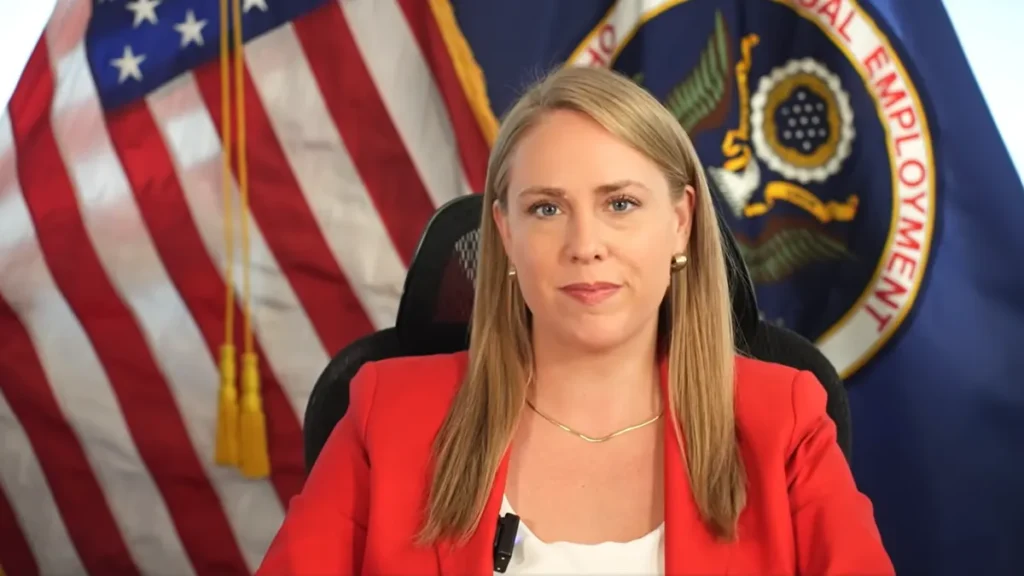
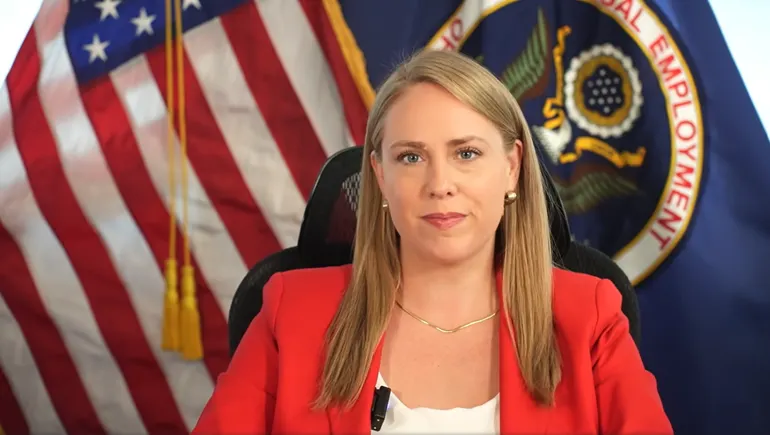
In a significant move aligning with the administration’s stated priorities, the Chair of the U.S. Equal Employment Opportunity Commission (EEOC), Andrea Lucas, issued a public appeal on Monday, September 14, 2026, urging individuals to report instances of alleged "anti-American" workplace discrimination. The call to action, disseminated via video messages on prominent social media platforms LinkedIn and X, marks a notable expansion of the agency’s public engagement strategy and underscores a heightened focus on national origin discrimination as interpreted through an "America First" lens.
The EEOC’s Direct Appeal to Workers
In her video address, Lucas directly engaged the American workforce with pointed questions designed to elicit specific types of complaints. "Have you ever felt that you were treated differently because you’re an American?" Lucas queried, setting the tone for the agency’s new initiative. She elaborated with several scenarios, including instances where U.S. workers might feel displaced by foreign guest workers: "Maybe you were laid off and told to train an H-1B or other guest worker visa holder who replaced you."
Lucas also highlighted issues related to language and cultural integration in the workplace. "Maybe your manager or co-worker has excluded you from conversations because you speak English, or moved work discussions into another language, or even onto a foreign messaging app," she suggested, illustrating potential forms of perceived bias. The Chair further inquired about harassment, asking, "Have you been harassed at work for speaking English or for being too American, or has your employer preferred workers of one foreign national origin to serve customers with that same background?" She also raised concerns about hiring practices in foreign-owned or operated businesses within the U.S., questioning, "Have you applied to a foreign-owned or operated business in the United States and noticed that it mostly hires or promotes non-American workers? Why has your town factory or plant suddenly stopped hiring locals and now mostly employs foreign workers?"
Concluding her address, Lucas reiterated the EEOC’s commitment to protecting all Americans, regardless of race, from employers who unlawfully prefer non-Americans. "EEOC has protected Americans of every race — White, Black, Asian, Hispanic and Native American — from employers who unlawfully preferred non-Americans," she stated, emphasizing the broad scope of the agency’s protective mandate.
Background: The EEOC’s Mandate and National Origin Protection
The Equal Employment Opportunity Commission is a federal agency responsible for enforcing federal laws that make it illegal to discriminate against a job applicant or an employee because of the person’s race, color, religion, sex (including pregnancy, gender identity, and sexual orientation), national origin, age (40 or older), disability, or genetic information. Title VII of the Civil Rights Act of 1964 is the primary statute prohibiting national origin discrimination.
Historically, national origin discrimination has been understood to encompass discrimination based on an individual’s place of birth, ancestry, culture, linguistic characteristics, or appearance. This has traditionally protected individuals from discrimination based on their heritage, such as being of Hispanic, Asian, or Middle Eastern descent. The EEOC’s enforcement has typically focused on preventing employers from favoring or disfavoring individuals based on their ethnic background or perceived national origin. For example, policies that prohibit employees from speaking a language other than English in the workplace have often been scrutinized if they are not justified by business necessity, as they can disproportionately affect individuals whose primary language is not English and who may speak another language to maintain their cultural identity.
The concept of "anti-American bias," while intuitively understandable in a colloquial sense, represents a potentially novel interpretation or a sharpened focus within the existing framework of national origin discrimination. While Title VII protects individuals from discrimination based on their national origin, explicitly protecting "Americans" as a national origin category in the context of favoring "non-Americans" could introduce new complexities. The agency’s current push appears to frame "American" as a distinct national origin group that can be discriminated against, much like any other.
A Shifting Focus: Aligning with "America First" Policies
This latest video from Chair Lucas is not an isolated event but rather a consistent theme within the current administration’s approach to labor and immigration policy. The Trump administration has consistently advocated for an "America First" agenda, which prioritizes American workers and industries. This policy stance has manifested in various initiatives, including efforts to reform immigration policies to favor skilled American workers and reduce reliance on foreign labor in certain sectors.
The EEOC’s initiative can be seen as a direct extension of these broader governmental priorities. By actively soliciting complaints related to the displacement of American workers by H-1B visa holders, the preference for non-American workers in foreign-owned businesses, or workplace language policies perceived as disadvantaging English speakers, the agency is signaling its intent to robustly enforce anti-discrimination laws through this specific lens. This aligns with the administration’s stated goal of ensuring that federal regulations and enforcement mechanisms serve to protect and promote American interests in the job market.
Chronology of Recent EEOC Actions Under Chair Lucas

Chair Andrea Lucas has steadily articulated and pursued this enforcement direction over the past two years:
- Late 2025: The EEOC released a video featuring Chair Lucas that explicitly called on White men to report instances of workplace discrimination. This move drew both support and criticism, with proponents viewing it as a balanced enforcement of anti-discrimination laws for all protected classes, and critics raising concerns about potential misdirection of resources or a chilling effect on diversity, equity, and inclusion (DEI) initiatives.
- 2025 Promises: Throughout 2025, Lucas publicly pledged that the EEOC would intensify its efforts to crack down on "anti-American bias." These promises were often made in conjunction with commitments to address race and sex discrimination allegedly motivated by certain DEI programs, which some critics argue can inadvertently lead to "reverse discrimination."
- 2025 Technical Assistance Document: In line with these commitments, the EEOC published a technical assistance document titled "Discrimination Against American Workers Is Against The Law." Such documents serve as guidance for employers and employees on how the agency interprets and intends to enforce specific provisions of anti-discrimination law. This particular document underscored the administration’s resolve to prioritize American workers through anti-discrimination efforts.
- Immigration Policy Changes (2025-2026): Concurrently, other federal agencies, particularly the Department of Homeland Security (DHS), have been proposing and implementing changes to immigration policy that reflect a similar prioritization of American workers. For example, DHS proposed the end of the 60-day grace period for H-1B visa holders, a measure that could significantly impact foreign workers’ ability to remain in the U.S. if they lose their jobs. These changes create a synergistic environment where both immigration policy and anti-discrimination enforcement are geared towards similar objectives.
Defining "Anti-American" Bias: Legal Ambiguities and Challenges
The concept of "anti-American bias" within the context of federal anti-discrimination law presents unique legal and practical challenges. While Title VII explicitly prohibits discrimination based on "national origin," applying this to "American" as a national origin category, particularly in the context of perceived favoritism towards "non-Americans," could lead to complex interpretations.
Legal scholars note that traditional national origin discrimination cases typically involve a complainant from a specific ethnic or national group alleging discrimination by a dominant group. The current initiative flips this dynamic, positioning "Americans" as a group potentially subject to discrimination, often at the hands of those perceived as "foreign." This could necessitate the development of new legal precedents or at least a significant re-emphasis on existing ones.
One key challenge will be distinguishing between legitimate business practices (e.g., hiring individuals with specific language skills for international operations, or sponsoring H-1B visas for specialized roles where domestic talent is scarce) and discriminatory intent. Employers will need clearer guidance on how to navigate global workforces, multilingual environments, and international business operations without inadvertently triggering "anti-American" bias claims. Critics of the initiative also point out that Title VII protects individuals, not nationalities, and that expanding the definition in this manner could inadvertently lead to discrimination against non-citizens or those perceived as "foreign," undermining the very spirit of anti-discrimination law.
The H-1B Visa Program and Guest Workers: A Focal Point
A significant aspect of Lucas’s appeal centers on the H-1B visa program, a non-immigrant visa that allows U.S. employers to temporarily employ foreign workers in specialty occupations. These occupations generally require a bachelor’s degree or higher in a specific specialty. The program has been a long-standing point of contention in immigration and labor debates.

Supporting Data on H-1B Visas:
- Annual Cap: The H-1B program is subject to an annual numerical cap of 65,000 visas, with an additional 20,000 for those with a U.S. master’s degree or higher. Demand consistently outstrips supply, often by several times, leading to a lottery system for selection.
- Industry Concentration: H-1B visas are heavily concentrated in the technology sector, with companies in Silicon Valley and other tech hubs being primary users. Other significant sectors include healthcare, engineering, and scientific research.
- Economic Impact: Proponents argue that H-1B workers fill critical skill gaps, particularly in STEM fields, fostering innovation and contributing to economic growth. They contend that these workers complement the U.S. workforce rather than replace it, and often bring specialized expertise not readily available domestically.
- Controversies: Critics, however, argue that the program is often misused to depress wages for American workers, displace them, or outsource jobs. They point to instances where companies have laid off American workers while simultaneously hiring or training H-1B visa holders. The allegations of "wage suppression" and "job displacement" have fueled calls for reform or stricter enforcement of existing regulations.
Chair Lucas’s emphasis on H-1B workers and "other guest worker visa holders" directly taps into these long-standing concerns, framing potential job displacement as a form of "anti-American" discrimination. This approach suggests that the EEOC may scrutinize employer practices involving foreign guest workers more closely, particularly if they are perceived to be at the expense of U.S. citizens.
Reactions from Stakeholders
The EEOC’s latest directive is likely to evoke a spectrum of reactions from various stakeholders:
- Civil Rights and Immigrant Advocacy Organizations: Groups such as the American Civil Liberties Union (ACLU) and various immigrant rights organizations are expected to express concern. They may argue that this initiative risks misinterpreting Title VII, potentially leading to increased discrimination against non-citizens or those perceived as "foreign," regardless of their legal status or contributions. They might also worry that such a focus could divert resources from addressing traditional forms of discrimination that disproportionately affect minority groups.
- Employer Associations and HR Professionals: Employer groups, including the Society for Human Resource Management (SHRM) and various business associations, will likely seek immediate clarification and guidance from the EEOC. They face the challenge of navigating an increasingly complex regulatory landscape, balancing compliance with anti-discrimination laws, managing diverse workforces, and addressing legitimate business needs (e.g., specialized talent acquisition, global operations). Concerns may arise regarding potential increases in litigation, the difficulty of proving or disproving "anti-American bias," and the impact on international talent recruitment.
- Labor Unions: Labor organizations may have mixed reactions. Some unions might align with the "protect American jobs" sentiment, particularly in industries where foreign labor is perceived to depress wages or displace domestic workers. Others might caution against policies that could foster xenophobia or divisiveness within the working class, emphasizing solidarity across national origins.
- Legal Experts and Academics: Legal scholars will undoubtedly engage in robust debate regarding the legal foundation and implications of this policy shift. Questions will be raised about how "American" is legally defined for Title VII purposes, the evidentiary standards for proving "anti-American bias," and how this new focus interacts with existing protections for national origin minorities. The potential for novel legal challenges and the need for courts to interpret these evolving definitions will be a significant point of discussion.
- Political Figures: Opposition parties and political commentators are likely to criticize the move, viewing it as a politically motivated directive designed to appeal to a specific base, rather than a neutral enforcement of anti-discrimination law. They might argue that it weaponizes federal agencies for political gain and could undermine the EEOC’s traditional role.
Broader Impact and Implications
This intensified focus on "anti-American" bias carries several broader implications for the American workplace and the ongoing national conversation about immigration and identity:
- Impact on Diversity, Equity, and Inclusion (DEI) Initiatives: The initiative could create a chilling effect on certain DEI programs, particularly those focused on global diversity or supporting employees from specific national or ethnic backgrounds, if employers fear such programs could be construed as "preferring non-Americans."
- Increased Scrutiny of Global Companies: Businesses with significant international operations, or those that frequently hire from a global talent pool, will likely face increased scrutiny. This could lead to a re-evaluation of hiring practices, internal communications policies, and cross-cultural training programs to mitigate perceived bias.
- Shift in Enforcement Priorities: While the EEOC is mandated to address all forms of discrimination, this explicit call for "anti-American" bias complaints signals a clear shift in enforcement priorities. Resources may be reallocated to investigate these types of claims, potentially affecting the volume or speed of investigations into other forms of discrimination.
- Public Perception of the EEOC: The agency’s public image could become more polarized, with some applauding its commitment to protecting domestic workers and others criticizing it for what they perceive as a politicization of its mission or a departure from its traditional role of protecting historically marginalized groups.
- Contribution to Immigration Debate: The EEOC’s initiative will undoubtedly feed into the broader, often contentious, national debate about immigration, labor markets, and national identity. By explicitly linking employment discrimination to immigration policies, the agency is contributing to a narrative that connects foreign workers to potential harm to American citizens.
In conclusion, Andrea Lucas’s latest appeal represents a significant and deliberate strategic shift for the U.S. Equal Employment Opportunity Commission. By actively soliciting complaints alleging "anti-American" bias, the agency is not only aligning itself with the current administration’s "America First" agenda but also signaling a readiness to interpret and enforce national origin discrimination laws in a manner that explicitly prioritizes U.S. citizens. This move is poised to generate considerable debate, challenge existing legal interpretations, and reshape workplace practices, particularly for companies operating in a globalized economy. The long-term impact on the EEOC’s enforcement landscape and the broader fabric of American employment will be closely watched.