The distinction between accuracy and fairness in artificial intelligence, particularly within the critical domain of talent acquisition, is a nuanced yet vital consideration. While an AI model might boast impressive overall accuracy rates, this aggregate performance can mask significant disparities when evaluated across different demographic subgroups. For instance, a model could correctly identify qualified candidates 92% of the time for one gender but only 78% for another. While these numbers might average out to an acceptable figure in broad strokes, they represent a meaningful and potentially harmful inequity in practical application. Recognizing this critical challenge, the Talent Intelligence Platform has been engineered with a foundational principle that transcends mere performance metrics: fairness is not an add-on, but an intrinsic element woven into the very fabric of its development and operation.
This commitment to structural fairness means that it is rigorously evaluated at every stage of the AI lifecycle, from initial training to ongoing deployment. Each model iteration is benchmarked against its predecessors and meticulously measured across multiple dimensions before ever reaching a customer. This article delves into the framework that underpins this approach and elucidates why specific fairness metrics hold greater significance for AI systems deployed in hiring processes.
The Talent Intelligence Platform: A Framework for Equitable Hiring
At its core, the Talent Intelligence Platform operates not by generating standalone candidate scores, but by producing a "match score" for a specific candidate-position pairing. This score quantifies how well a particular individual aligns with the requirements of a given role, as defined by the hiring organization. This dynamic scoring mechanism ensures that the same candidate will receive different scores for different positions, and conversely, the same position will yield varying scores for different candidates.
This fundamental design choice profoundly shapes the evaluation of fairness. The relevant question shifts from "Does the model score Group A higher than Group B?" to a more precise inquiry: "For a given position, does the model identify qualified candidates from Group A and Group B with equal reliability?" This reframing is crucial for uncovering and mitigating hidden biases.
Furthermore, explainability is a cornerstone of the platform’s design. Algorithms are selected not only for their predictive power but also for their ability to articulate the reasoning behind their scoring. This transparency empowers recruiters and hiring managers to understand the basis of a candidate’s ranking, fostering trust and enabling informed decision-making. This feature is more than a usability enhancement; it serves as a practical safeguard against algorithmic bias and is instrumental in enabling the platform to meet stringent standards such as FedRAMP Moderate and ISO 42001 certification – benchmarks that general-purpose AI tools often struggle to attain. When hiring decisions require auditing, the underlying rationale is readily available, demonstrating that transparency is an integral component, not an afterthought.
Embedding Fairness into the AI Training Process
The commitment to fairness begins long before a model undergoes evaluation; it is deeply integrated into the very training process. Training data is meticulously divided into distinct train and test sets, with stringent controls implemented to prevent data leakage. This ensures that the data used for evaluation has not been previously exposed during the training phase, thereby guaranteeing a more accurate assessment of the model’s generalization capabilities.
A critical intervention occurs through the implementation of "early stopping" based on classification performance across protected categories. If, during training, a model begins to exhibit divergent performance across demographic subgroups – for instance, performing substantially better for one group than another – the training process is halted. This proactive measure prevents biased patterns from becoming entrenched in the model’s architecture. This is a direct intervention at the training stage, a deliberate act to preemptively address potential inequities rather than attempting to correct them after the fact.

The ultimate objective is to ensure that every candidate receives an evaluation of equivalent quality, irrespective of their application timing, the size of the candidate pool, or their demographic group affiliation. Each candidate, metaphorically speaking, receives the same "nine o’clock interview"—evaluated with the same rigor, against the same standard, with an unmoving benchmark. Early stopping is one of the key mechanisms that enforces this standard at the model level.
Ongoing research continues to explore avenues for directly integrating anti-bias and fairness objectives into the loss functions that models optimize. As the field of AI ethics advances, the aspiration is for models to proactively optimize against bias rather than merely detecting it post-training. This represents a paradigm shift towards building inherently equitable AI systems.
Understanding the Two Facets of Fairness
Post-training evaluation employs two complementary frameworks to quantify fairness.
Group Fairness Metrics: These metrics assess whether the AI model yields consistent outcomes across demographic groups, defined by protected characteristics such as gender, race, or age. Significant disparities in model performance between different groups constitute a fairness concern, irrespective of individual-level consistency.
Individual Fairness Metrics: These metrics examine whether two similar candidates receive comparable scores, based on a predefined similarity threshold. This approach is adept at identifying situations where overall group-level statistics appear acceptable, yet individual-level disparities persist. An example could be a model that assigns different scores to two equally qualified candidates based on subtle resume formatting differences that may correlate with demographic characteristics.
Both frameworks are indispensable. Group fairness can inadvertently mask individual-level problems, while individual fairness might overlook systemic patterns. A comprehensive understanding of fairness necessitates the integration of both perspectives.
Navigating Parity-Based Metrics
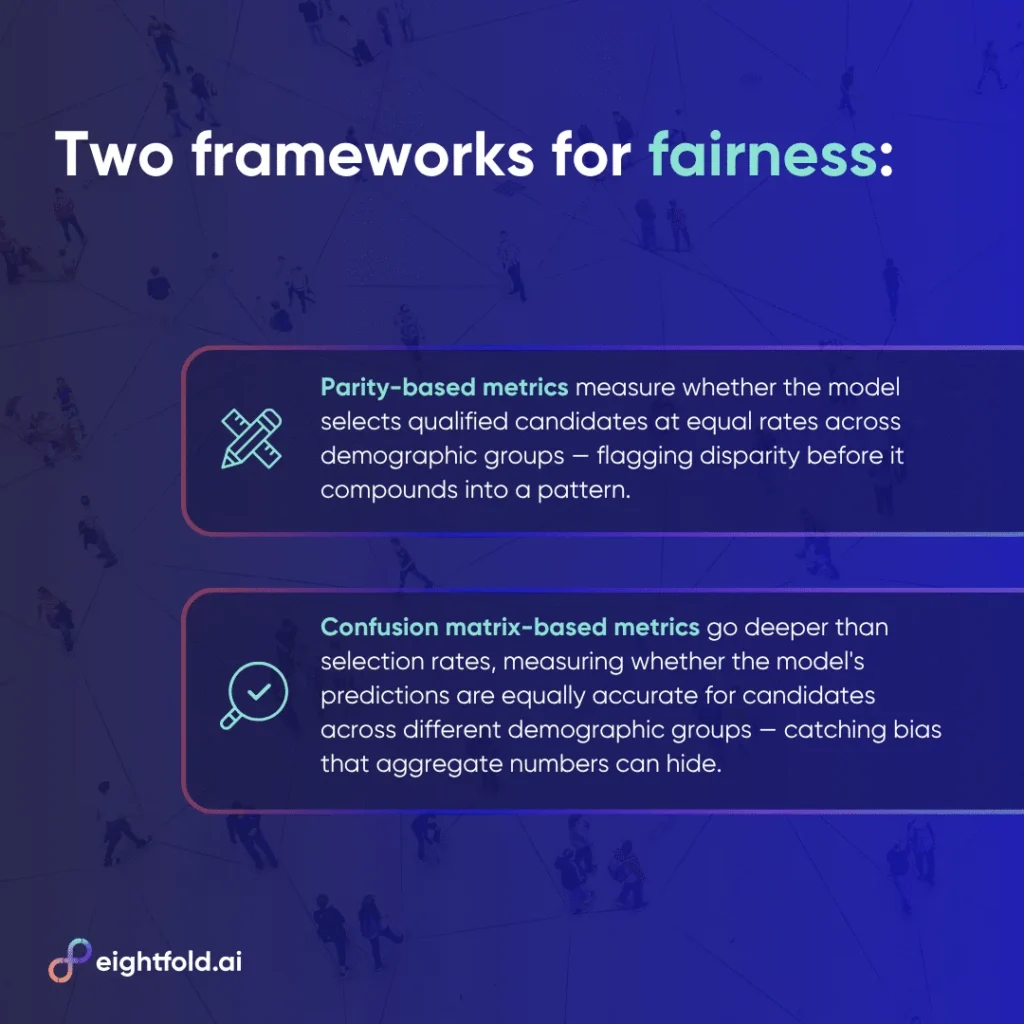
The initial category of group fairness metrics focuses on "predicted positive rates"—the frequency with which the model assigns a positive outcome to candidates across various demographic groups. These metrics are valuable screening tools due to their straightforward calculation and interpretation. However, their limitation lies in the fact that equal selection rates do not always equate to equal model quality across groups. This is where confusion matrix-based metrics become essential.
Leveraging Confusion Matrix-Based Metrics
Confusion matrix-based metrics delve deeper, examining the accuracy of the model’s predictions for different groups. Beyond merely analyzing the rates of positive classification, they scrutinize the precision and reliability of those classifications. This involves evaluating metrics such as:
- True Positive Rate (Sensitivity/Recall): The proportion of actual positive cases that are correctly identified by the model. For fairness, this rate should be comparable across all groups.
- False Positive Rate: The proportion of actual negative cases that are incorrectly identified as positive. This rate should also be similar across groups to avoid disproportionately flagging individuals from certain demographics.
- Precision: The proportion of positively predicted cases that are actually correct. Ensuring this is consistent across groups prevents situations where certain groups are more likely to be inaccurately identified as qualified.
- Accuracy: The overall proportion of correct predictions. While important, it must be considered alongside other metrics to understand performance across subgroups.
By examining these metrics, organizations can gain a more granular understanding of how the AI model is performing for each demographic group, identifying specific areas where disparities might exist.
Real-World Evaluation: A Continuous Process
These fairness metrics are not static; they are rigorously calculated not just at the initial launch of a model but with every new iteration. Each updated model undergoes a comprehensive battery of evaluations, with results systematically benchmarked against the preceding version. A model that demonstrates improvements in accuracy metrics but shows a regression in fairness metrics will not meet the established standards.
Furthermore, metrics are evaluated across multiple dimensions: by job title cluster, by language, and across other relevant segmentations. A model that performs equitably on average but exhibits disparities in specific contexts—such as certain industries, languages, or role types—fails the evaluation, even if aggregate numbers appear favorable. Compliance is not a one-time hurdle; it is a continuous standard maintained at every level of specificity. This signifies a commitment to fairness as the fundamental bedrock of the AI system, not merely an optional feature.
The Limits of Evaluation Alone
Even a model that successfully navigates rigorous pre-release evaluations operates within a dynamic and evolving environment. Production data can diverge from training data, usage patterns can shift, and candidate populations can change in ways that no static model can fully anticipate.
This reality underscores why comprehensive model evaluation, while essential, constitutes only one component of a truly responsible AI strategy. The ongoing work that commences after deployment—including continuous monitoring, robust governance structures, and mechanisms for detecting and rectifying data drift—is where the commitment to fairness is either sustained or quietly abandoned. The pursuit of equitable AI in hiring is an ongoing journey, demanding perpetual vigilance and a proactive approach to adaptation and improvement.
Organizations seeking to deepen their understanding of responsible AI principles and the specific methodologies employed to combat bias can access further resources, including whitepapers and research publications, to inform their strategies and ensure their adoption of AI technologies aligns with ethical and equitable practices.