
The journey from capable employee to senior leader is a critical, often underestimated, transition point within any thriving organization. Middle management stands as the crucible where potential is forged into executive acumen, forming the bedrock of an organization’s leadership pipeline. This internal development mechanism offers immense strategic value, enabling leaders to leverage existing institutional knowledge, navigate complex relationships, and assimilate rapidly into senior roles—a stark contrast to the significant costs and extended timelines often associated with integrating external hires. Yet, a persistent paradox plagues many corporations: despite the clear benefits of cultivating internal talent, a scarcity of leadership-ready candidates emerges when senior positions become vacant. This deficiency poses a significant threat to long-term organizational stability and growth, necessitating a deeper examination of internal development processes.
Recent research conducted by APQC, a leading authority in organizational best practices, casts a spotlight on two profoundly underutilized, yet pivotal, levers for rectifying this critical deficiency: onboarding and performance management. The findings reveal a systemic vulnerability: many aspiring middle managers enter the leadership pipeline without clear expectations, subsequently receiving inconsistent developmental support that significantly impedes their progression. The cumulative effect is a diminished pool of leadership-ready individuals, jeopardizing robust succession planning and ultimately compromising organizational resilience. While numerous managers may initially enter this vital pipeline, the insidious cracks introduced by ineffective onboarding and suboptimal performance management practices progressively slow their advancement and erode their readiness for future leadership responsibilities over time.
This article delves into the precise points where these crucial development systems falter and outlines actionable strategies for human resources (HR) leaders to fortify them, effectively sealing the leaks within their leadership pipelines.
The Genesis of Leadership Pipeline Leaks: A Systemic Breakdown
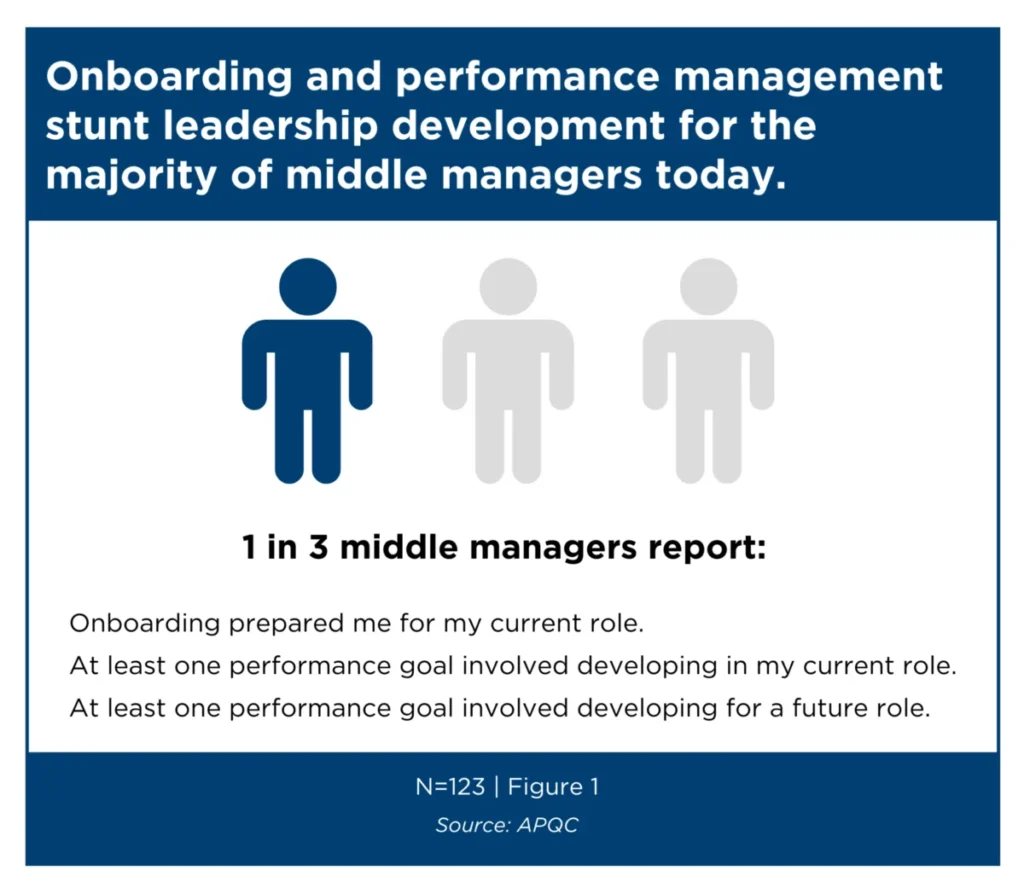
The APQC study provides a stark quantitative illustration of where the leadership pipeline begins to falter. Approximately one-third of middle managers report experiencing significant gaps in their onboarding processes, while a similar proportion—only about one-third—state that their performance goals genuinely support their development for either their current or future roles. These figures are not merely statistical anomalies; they represent profound systemic failures that undermine an organization’s long-term leadership capacity, indicating a widespread disconnect between strategic intent and operational execution in talent development.
These findings strongly suggest that a substantial number of organizations are failing to consistently equip middle managers for success in their current capacities, let alone prepare them for advancement to higher levels of leadership responsibility. The consequence is not necessarily an exodus of talent from the organization, though that remains a risk. More commonly, it manifests as a stagnation in professional growth, where managers cease to acquire the critical capabilities, gain the necessary visibility, or accumulate the requisite experience to remain viable contenders for future senior leadership roles. This creates a hidden attrition, where talent remains but its potential is left untapped and uncultivated for higher strategic impact. The absence of a robust internal pipeline often forces organizations to costly and sometimes risky external hires, further underscoring the urgency of addressing these internal deficiencies.
Onboarding: More Than an Administrative Checkbox
Onboarding serves as the crucial gateway for middle managers, the initial phase where they should acquire the clarity, contextual understanding, and vital connections necessary for sustained progression through the leadership pipeline. Regrettably, a significant segment of middle managers surveyed by APQC commences their roles without a fundamental grasp of their responsibilities, setting them at an immediate disadvantage.
For instance, a concerning one in three managers indicated they were compelled to independently decipher core aspects of their job responsibilities. Furthermore, approximately one in four reported that their initial training failed to encompass all essential facets of their role. Crucially, 43% revealed that their onboarding process did not effectively link their role’s overarching purpose to the broader strategic objectives of the organization. Without this foundational context, managers are inherently hindered in their leadership transition. They may competently execute tasks, but they will inevitably struggle with the more strategic imperatives of prioritization, making nuanced trade-offs, and aligning their teams effectively with the organization’s most critical goals. This often leads to a reactive management style rather than a proactive, strategic one.
Industry experts widely concur on the transformative power of effective onboarding. A 2018 study by the Brandon Hall Group found that organizations with a strong onboarding process improve new hire retention by 82% and productivity by over 70%. While these figures often relate to all new hires, the impact on managerial roles, with their exponential influence, is arguably even more significant. A well-structured onboarding program for managers should not only clarify immediate tasks but also immerse them in the strategic landscape, fostering a sense of purpose and direction from day one. As one HR executive recently noted in a private forum, "Our onboarding process for managers needs to be less about paperwork and more about strategic assimilation. It’s about setting the stage for their entire leadership journey, not just their first 90 days."
Beyond Task Readiness: Cultivating Leadership Acumen
The deficiencies in onboarding extend beyond mere task-oriented readiness, penetrating the crucial realm of relationships and organizational culture—elements indispensable for effective leadership. Only approximately one in three middle managers are formally introduced to key stakeholders during their onboarding period, severely limiting their early networking opportunities and ability to build influence. Even more concerning, fewer than half receive any form of one-on-one mentoring, depriving them of personalized guidance and insights vital for navigating complex organizational dynamics and building a foundational network essential for upward mobility.
Organizational culture represents another significant, yet frequently overlooked, gap. A mere half of middle managers receive onboarding specifically addressing company culture, leaving a substantial proportion to independently infer expectations, norms, and unwritten rules. This pervasive ambiguity can significantly impede timely decision-making, foster misalignment within teams, and prove particularly problematic in large, complex organizational structures where cultural nuances are paramount. HR thought leaders consistently emphasize that cultural integration is not a passive process but an active, guided journey. As an organizational development specialist might articulate, "Cultural onboarding isn’t just about sharing values; it’s about providing experiential learning and mentorship that helps managers understand how those values translate into daily decisions and leadership behaviors." Without this, managers operate in a vacuum, unable to fully leverage the collective wisdom and established pathways of their new environment, often leading to missteps and reduced effectiveness.
The Continuing Leak: Performance Management’s Unfulfilled Promise
Even for middle managers who successfully navigate the initial transition into their roles, persistent gaps in performance management practices can steadily erode their leadership readiness and decelerate their advancement through the pipeline. A critical failing observed is the widespread inability of many organizations to embed robust development objectives within their performance management frameworks for middle managers. APQC’s research indicates that a mere 29% of respondents have performance goals directly tied to development within their current role, and only 37% have goals specifically aimed at developing them for future leadership roles. This represents a significant missed opportunity, transforming performance reviews from potential growth catalysts into mere evaluative exercises.
The implications are profound. When performance management focuses predominantly on past results rather than future potential, it inadvertently stifles proactive development. Managers, even those with strong aspirations, may find themselves without a clear roadmap for skill acquisition, competency enhancement, or experience diversification. This static approach contradicts the dynamic requirements of leadership development, which demands continuous learning and adaptation. A senior HR executive might lament, "If our performance management system isn’t actively fostering growth and preparing managers for the next level, it’s not truly performing its strategic function. It becomes a bureaucratic hurdle rather than a springboard for talent." The shift from annual reviews to continuous performance management, a trend gaining traction in progressive organizations, aims to address this by integrating ongoing feedback and developmental discussions into the regular workflow.

Understanding Promotion Criteria vs. Clear Advancement Paths
Compounding this issue is a discernible disconnect between understanding what is required for promotion and having clear, supported pathways to achieve it. While a notable 75% of middle managers assert they comprehend the criteria necessary for promotion, a significantly lower 49% report that the performance management process genuinely assisted them in achieving that promotion. This disparity highlights a crucial flaw: knowing the destination is insufficient without a navigable map and the necessary resources for the journey.
Over time, this fundamental disconnect inevitably slows upward movement through the leadership pipeline. It exacerbates the readiness gaps that often originate during the onboarding phase, creating a cumulative disadvantage. Managers become aware of what they should be doing but lack the structured support, developmental assignments, and targeted coaching to bridge the gap between their current capabilities and future requirements. This leads to a sense of frustration and, ultimately, a decline in proactive engagement with their own development, as the system itself does not appear to facilitate their aspirations. This "stalled potential" not only impacts individual careers but also starves the organization of its next generation of leaders.
Strategic Imperatives for HR Leaders: Plugging the Leaks
Strengthening the leadership pipeline necessitates a concerted effort to mitigate the points where capable managers lose momentum or fall out of readiness for future leadership roles. This requires a strategic re-evaluation and recalibration of existing HR processes, moving beyond transactional approaches to truly transformative talent development.
Reimagining Onboarding: A Leadership Launchpad
Traditional onboarding, often designed for short-term role entry, critically misses the opportunity to cultivate capable managers into future leaders. A truly effective onboarding program for middle managers must be meticulously structured around the fundamental shift to leadership, incorporating several key elements:
- Clear Role Expectations and Strategic Context: Beyond outlining daily tasks, onboarding must delineate the strategic impact of the manager’s role, connecting it explicitly to organizational goals. This includes defining key performance indicators (KPIs) that reflect leadership contributions, not just individual output, and explaining how their team’s efforts contribute to broader enterprise objectives.
- Leadership Competency Development: Integrate foundational leadership training from day one, focusing on crucial skills such as decision-making under uncertainty, fostering team motivation, effective conflict resolution, and strategic thinking. This proactive approach sets a developmental mindset early, emphasizing that leadership is a continuous learning process.
- Comprehensive Stakeholder Mapping and Introductions: Facilitate structured introductions to critical internal and external stakeholders. This isn’t merely about names and titles but about understanding their roles, influence, and how the new manager will interact with them to achieve departmental and organizational objectives. Provide a "who’s who" guide with key relationships and their strategic importance.
- Early Mentorship and Coaching: Establish formal mentorship programs or assign dedicated coaches who can provide personalized guidance, share institutional wisdom, and help new managers navigate their initial challenges and strategic dilemmas. This informal learning is often as crucial as formal training.
- Cultural Immersion and Values Alignment: Move beyond theoretical discussions of company culture. Provide practical insights, case studies, and opportunities for interaction that illustrate how cultural values translate into leadership behaviors and decision-making in real-world scenarios. This might involve shadowing senior leaders or participating in culture-focused workshops.
- Performance Goal Setting with a Developmental Lens: Integrate initial performance goals that are explicitly tied to both immediate role success and future leadership growth, ensuring a forward-looking perspective from the outset. These goals should evolve as the manager progresses.
Without this comprehensive level of structure and support, many middle managers will inevitably struggle to gain traction in their new roles, failing to position themselves effectively for future advancement. They will remain competent individual contributors rather than evolving into impactful leaders.
Transforming Performance Management into an Advancement Engine
To keep managers advancement-ready, performance management must evolve from a retrospective evaluation tool into a dynamic, forward-looking development engine. This requires ensuring that performance goals and conversations are:
- Explicitly Linked to Development: Goals should not only measure current performance but also target the acquisition of new skills, experiences, and competencies necessary for progression. This includes setting SMART (Specific, Measurable, Achievable, Relevant, Time-bound) goals related to leadership development, such as improving a specific communication skill or leading a cross-functional project.
- Focused on Continuous Feedback and Coaching: Replace annual reviews with a system of ongoing, constructive feedback and regular coaching sessions. This allows for timely course correction, reinforcement of positive behaviors, and personalized guidance on developmental areas, making performance management a dynamic conversation rather than a static evaluation.
- Integrated with Career Pathing: Performance discussions should explicitly include conversations about career aspirations, available leadership roles, the competencies required for those roles, and a concrete plan for how the current role and development initiatives contribute to achieving those aspirations. This involves creating visible career ladders and lattices.
- Supported by Learning and Development Resources: Ensure that developmental goals are backed by access to relevant training programs, executive education, leadership workshops, and opportunities for stretch assignments that build specific competencies. This requires a robust learning ecosystem.
- Transparent and Equitable: The criteria for advancement and the process for achieving it must be clear, objective, and applied consistently across the organization to foster trust and motivation. Bias mitigation training for managers conducting reviews is also crucial.
Middle managers also require transparent, accessible information about potential career paths: what senior roles are available, the specific requirements (skills, experience, education) to move into them, and practical guidance on how to prepare. Without this clarity, even high-performing individuals can find their career progression stalling due to a lack of actionable insight, leading to frustration and potential disengagement.
Elevating Visibility for Emerging Leaders
Beyond formal development, creating structured opportunities for middle managers to showcase their contributions and leadership potential is paramount. This increased visibility is a critical, often overlooked, component of leadership readiness.
Cross-functional initiatives, where managers lead or contribute to projects spanning different departments, offer invaluable exposure. Strategy workshops, steering committees, and enterprise-wide project teams provide platforms for managers to present their work, articulate their insights, and contribute to higher-level organizational discussions in the presence of senior leaders. These opportunities not only build crucial soft skills like influencing and strategic communication but also allow senior executives to identify and assess emerging talent firsthand. Crucially, these opportunities must be paired with mentoring that specifically guides managers on how visibility is built, what aspects of their work senior leaders prioritize, and how to effectively position their accomplishments and insights for maximum impact. This strategic guidance ensures that exposure translates into meaningful recognition and consideration for future roles, fostering a sense of readiness and aspiration.
Leveraging Data to Monitor Pipeline Health
Finally, HR leaders must actively use onboarding and performance management data as diagnostic tools to monitor the health of their leadership pipeline. Focus on a few key signals:
- Onboarding Completion and Satisfaction Rates: Track completion rates of critical onboarding modules and survey new managers about the effectiveness and clarity of their onboarding experience. Low satisfaction or high rates of self-reported gaps signal immediate areas for improvement. Qualitative feedback through interviews can also provide rich insights.
- Development Goal Attainment: Monitor the percentage of managers with active development goals and their progress towards achieving them. A low number or consistent failure to meet development goals indicates a systemic issue in performance management or insufficient support.
- Internal Promotion Rates for Middle Managers: Track the ratio of internal promotions to external hires for senior roles. A low internal promotion rate, particularly when qualified internal candidates are scarce, points directly to a compromised pipeline and a potential over-reliance on external sourcing.
- Manager Retention and Engagement Data: Analyze retention rates specifically for middle managers and correlate them with engagement survey results. Disengaged managers are less likely to invest in their own development or be considered for advancement, signaling a potential leak point.
- Diversity and Inclusion Metrics within the Pipeline: Ensure that the pipeline is representative of the organization’s diversity goals, actively tracking representation at different leadership levels to identify and address potential biases in development and promotion. This ensures equity and broadens the talent pool.
Crucially, HR leaders must foster alignment across all HR functions when acting on this data. Those responsible for onboarding, performance management, leadership development, and succession planning should operate from a shared understanding of what it truly takes to cultivate future leaders and precisely where breakdowns are occurring. This integrated approach ensures that interventions are coordinated, comprehensive, and ultimately more effective, transforming HR into a strategic partner in organizational success.
Stopping Leaks for Sustainable Leadership
A robust and sustainable leadership pipeline is inextricably linked to an organization’s capacity to effectively retain, develop, and advance its most capable managers over time. This foundational truth necessitates treating onboarding and performance management not as mere administrative processes or isolated HR functions, but as strategic imperatives. Both systems profoundly shape whether middle managers acquire the clarity, receive the essential support, gain the requisite visibility, and undertake the critical development needed to remain viable successors for senior roles. Over time, the collective effectiveness of these interconnected systems dictates not only the day-to-day performance of managers but, more significantly, determines whether organizations possess genuine, well-prepared leadership choices when senior executive positions inevitably open. Investing in these foundational elements is not merely an HR best practice; it is a critical investment in the organization’s future resilience, innovation capacity, and sustained competitive advantage in an ever-evolving global market.
Data in this content was accurate at the time of publication. For the most current data, visit www.apqc.org.








