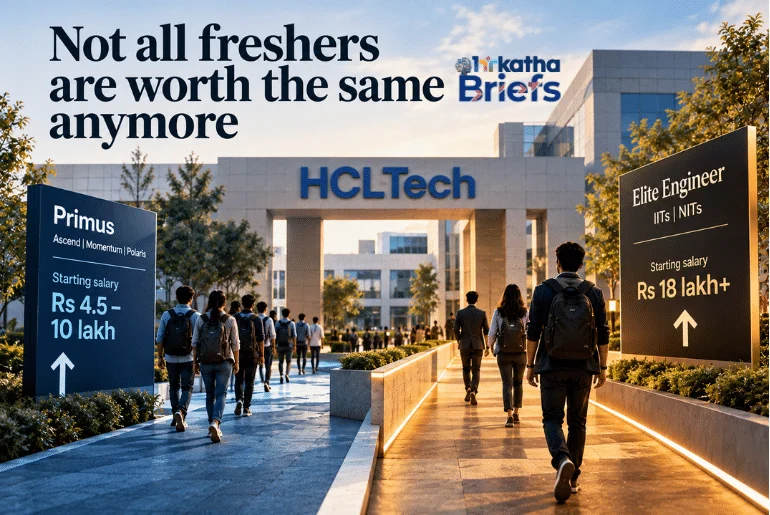
HCLTech, a global technology services and consulting company, has unveiled a significantly differentiated compensation structure for its incoming fresher talent, setting a new precedent in the Indian IT services sector. The company’s campus pay scale for fresh graduates now ranges dramatically from a base of Rs 4.5 lakh per annum to an unprecedented Rs 18 lakh per annum, reflecting a strategic pivot towards a skills-based hiring approach. This substantial four-fold disparity underscores the escalating value attached to highly specialized skills in frontier technology areas, contrasting sharply with traditional volume-based recruitment models that have long characterized the industry.
The company has concluded its fresher hiring drive for the Financial Year 2027 (FY27), a process that commenced in July and saw HCLTech teams engage with engineering campuses across the nation. Ram Sundararajan, Chief People Officer at HCLTech, indicated that the total intake for FY27 is projected to remain largely consistent with FY26 figures, estimated at approximately 11,000 fresh graduates. However, this numerical stability belies a profound transformation in how talent is identified, valued, and compensated. Sundararajan explicitly stated that while the overall headcount may remain steady, the value ascribed to diverse skill sets is undergoing a significant re-evaluation.
The Elite Engineer Cadre: A Premium on Frontier Technologies
At the pinnacle of this new compensation hierarchy is HCLTech’s "Elite Engineer" cadre, a program that has seen considerable scaling up this year. Graduates designated as Elite Engineers are offered an impressive starting salary of Rs 18 lakh per annum, a figure that places them among the highest-paid freshers in the Indian IT landscape. This select group is primarily drawn from premier institutions such as the Indian Institutes of Technology (IITs) and National Institutes of Technology (NITs) across the country.
The rationale behind this premium compensation is the critical nature of the technology domains these elite engineers are recruited for. HCLTech is strategically investing in talent focused on highly specialized and in-demand areas including semiconductors and silicon design, artificial intelligence (AI), advanced data engineering, physical AI and robotics, and quantum computing. These fields represent the cutting edge of technological innovation and are pivotal to HCLTech’s ambition to move up the value chain and deliver sophisticated solutions to its global clientele. The scarcity of expertise in these niche domains, coupled with their strategic importance, dictates the elevated remuneration.
Sundararajan articulated the company’s overarching strategy, stating, "The company is pivoting to a skills-based hiring approach with focus on emerging technologies that are in demand with clients globally." He further elaborated on the significance of the Elite Engineer programme, affirming that it "continues to play an important role in our strategy to build future-ready talent." This statement highlights HCLTech’s proactive stance in cultivating a workforce equipped to address the evolving technological demands of the global market, positioning itself as a leader in next-generation services.
The Primus Programme: Building a Broad Talent Base
While the Elite Engineer cadre targets highly specialized talent, the bulk of HCLTech’s fresher intake is channeled through its established "Primus" programme. This initiative involves a robust partnership with over 60 engineering colleges across India, which receive priority in HCLTech’s hiring process. The Primus programme is designed to foster industry readiness among graduates, with HCLTech actively collaborating with these partner institutions. This collaboration extends to providing guidance on curriculum development, conducting expert mentorship sessions, organizing tech talks, and facilitating hackathons on their campuses. Such initiatives aim to bridge the gap between academic learning and industry requirements, ensuring that graduates are better prepared for the demands of the IT sector.
Candidates from these Primus colleges undergo a rigorous multi-stage assessment process. This evaluation typically includes tests on cognitive ability, coding proficiency, technical skills, and English language proficiency, followed by comprehensive interviews. Based on their performance in this assessment, successful candidates are categorized into one of three distinct tiers: Ascend, Momentum, or Polaris. The starting salaries for these tiers reflect a structured progression, with Ascend tier freshers commencing at Rs 4.5 lakh per annum, and salaries escalating up to Rs 10 lakh per annum for the Polaris tier.
The Widening Compensation Chasm: A Reflection of Market Realities
A critical observation from this new compensation framework is the significant salary gap between the highest-paid tier within the Primus programme (Polaris, at Rs 10 lakh) and the entry-level for the Elite Engineer cadre (Rs 18 lakh). This substantial difference, where the Elite Engineers earn nearly double that of the top-tier Primus graduates, speaks volumes about the shifting paradigms in campus talent valuation. For a company maintaining a consistent overall fresher intake year-on-year, this widening salary range unequivocally signals that while an engineering degree remains a prerequisite, it is the scarcity and strategic relevance of specialized skills that increasingly dictate a company’s willingness to pay a premium. The market is clearly indicating that not all engineering degrees are valued equally in the current technology landscape.
Industry Context: The Great Skill Re-evaluation
HCLTech’s stratified compensation model is not an isolated phenomenon but rather a prominent manifestation of a broader, industry-wide shift within the Indian IT services sector. For decades, the industry relied on a volume-based hiring model, absorbing vast numbers of engineering graduates into entry-level roles, often with standardized pay scales. This model was effective during phases of rapid expansion and when the demand for foundational IT services was paramount. However, the advent of disruptive technologies like AI, cloud computing, automation, and advanced analytics has fundamentally reshaped client expectations and the nature of IT projects.
Global clients are increasingly seeking highly specialized solutions that drive innovation, optimize operations, and create new revenue streams, moving beyond traditional maintenance and support services. This demand has created an acute scarcity of talent proficient in these emerging domains. Consequently, IT service providers are compelled to re-evaluate their talent acquisition strategies, shifting from a "numbers game" to a "skills game." Companies are prioritizing depth of expertise over sheer volume, recognizing that a small team of highly skilled professionals in niche areas can deliver disproportionately higher value than a large team with generalist skills.
Other major IT players in India, while perhaps not as explicitly detailing their pay scales, have also been observed to adopt differentiated hiring practices, offering higher packages for specialized roles or for graduates from top-tier institutions. This trend reflects the intense competition for high-demand skills, forcing companies to offer attractive incentives to secure the best talent. The Indian IT sector, which contributes significantly to the national GDP and employment, is undergoing a profound transformation, with implications for educational institutions, students, and the future workforce.
Timeline and Evolution of HCLTech’s Strategy
HCLTech’s strategic pivot has been evolving over recent years, culminating in the explicit stratification seen in the FY27 hiring cycle. The company’s engagement with engineering campuses typically begins around July, with various stages of assessments and interviews spanning several months. The "Elite Engineer" program itself is not entirely new but has been significantly "scaled up this year," indicating a growing emphasis and investment in this specialized talent pool. This scaling up aligns with the company’s consistent efforts to enhance its capabilities in areas like digital engineering, cloud native development, and AI/ML, which have become central to its service offerings.
Over the past three to five years, the IT industry has witnessed an accelerated shift towards digital transformation initiatives globally. This has pushed companies like HCLTech to continuously adapt their talent strategies. The emphasis on "future-ready talent" is a long-term vision, recognizing that technological cycles are shortening, and continuous upskilling and reskilling are imperative. The development of programs like Primus, with its focus on industry readiness, also reflects a sustained effort to build a robust talent pipeline by collaborating directly with educational institutions, a trend that has gained momentum across the industry to ensure a steady supply of relevant skills.
Implications for Education and Future Workforce
The HCLTech model carries significant implications for India’s vast engineering education ecosystem and the aspirations of millions of students.
- Curriculum Reform: Engineering colleges, particularly those partnering with companies through programs like Primus, will face increased pressure to update their curricula to align with industry demands. The traditional syllabus, often criticized for being outdated, must integrate modules on AI, machine learning, data science, cybersecurity, cloud platforms, and even nascent fields like quantum computing and semiconductor design. Institutions that fail to adapt risk producing graduates who are less competitive in the job market.
- Student Specialization: For students, the message is clear: a generic engineering degree may no longer suffice to secure top-tier roles. There is an imperative to acquire specialized skills, often through elective courses, certifications, online learning platforms, internships, and participation in hackathons and coding competitions. Proactive engagement with emerging technologies will become crucial for career differentiation and higher earning potential. The emphasis shifts from simply "getting a degree" to "acquiring in-demand skills."
- The "Two-Tier" Workforce: This stratified hiring approach could lead to the emergence of a more pronounced "two-tier" workforce within the IT sector. While foundational roles will continue to exist, the gap in compensation and career progression between highly specialized "elite" talent and more generalist roles could widen. This has potential socio-economic implications, necessitating greater access to specialized training and resources for a broader student population.
- Continuous Learning Culture: The dynamic nature of technology demands a commitment to lifelong learning. Initial skills, however specialized, will require constant updating. Companies like HCLTech are not just hiring for current needs but for future capabilities, implicitly expecting their workforce to adapt and evolve with technological advancements.
HCLTech’s Strategic Rationale and Broader Impact
HCLTech’s decision to implement such a distinct compensation structure is deeply rooted in its strategic vision to enhance its global competitiveness. By attracting top-tier talent in critical, high-growth domains, the company aims to:
- Elevate Service Offerings: Deliver more complex, high-value, and innovative solutions to clients, moving beyond commoditized services. This allows HCLTech to bid for and win more sophisticated projects, increasing its average contract value.
- Strengthen Innovation Hubs: Foster internal innovation and develop proprietary intellectual property in cutting-edge technologies.
- Improve Profitability: Highly specialized projects typically command higher margins, contributing to improved financial performance for the company.
- Talent Retention: Offering premium salaries and engaging work in exciting domains helps attract and retain the best talent, crucial in a highly competitive market.
The implications extend beyond HCLTech. This trend signifies a maturation of the Indian IT services industry, mirroring global tech giants that have long employed highly differentiated compensation models based on skill scarcity and strategic importance. It underscores India’s evolving role from a global outsourcing hub to a center for advanced technological innovation. While posing challenges for mass employment models, it also presents an immense opportunity for India to solidify its position as a powerhouse for specialized digital talent, provided its educational system and workforce development initiatives can adapt rapidly to these new demands.
In conclusion, HCLTech’s new fresher compensation framework marks a significant milestone in the Indian IT sector’s journey towards a skills-first economy. By offering a premium to Elite Engineers in frontier technology areas, the company is not only securing its future talent pipeline but also sending a clear signal to the academic world and aspiring professionals: the era of standardized IT hiring is giving way to an era where specialized, in-demand skills are the ultimate currency, dictating both opportunity and reward in the dynamic world of technology.