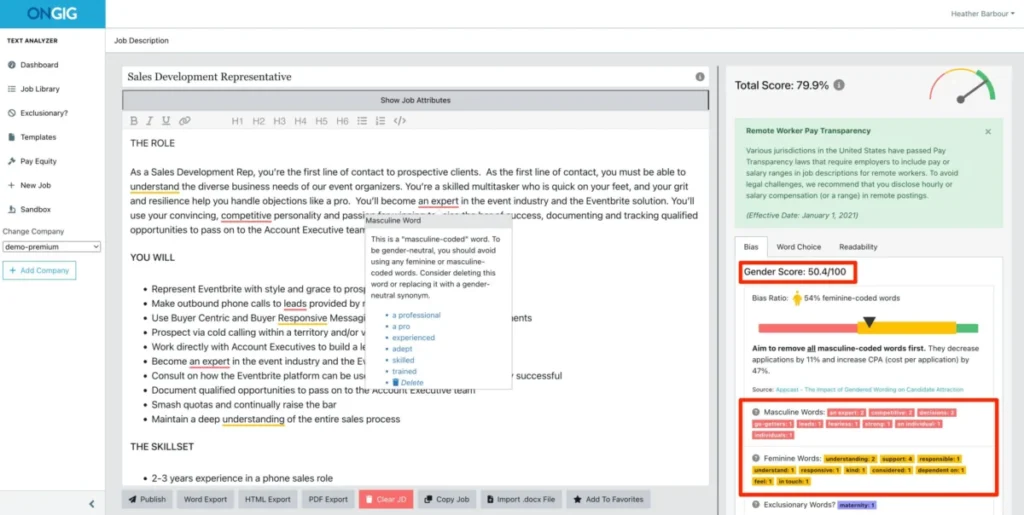
The landscape of talent acquisition is continually evolving, with organizations increasingly recognizing the critical role of diversity, equity, and inclusion (DEI) in fostering innovation, enhancing performance, and building resilient workforces. A pivotal, yet often overlooked, aspect of this endeavor lies in the very first impression potential candidates receive: the job description. In an ongoing effort to illuminate and mitigate subtle barriers to inclusive hiring, Ongig’s Text Analyzer meticulously tracked every instance of masculine-coded word swaps made by its users between January 1 and July 13, 2026. The findings underscore a persistent, albeit often unconscious, bias in recruitment language, with the word "strong" emerging as the most frequently replaced term, swapped 42 times, followed by "lead" (26 swaps) and "independently" (13 swaps). This comprehensive analysis not only highlights the prevalent linguistic pitfalls but also offers actionable pathways toward crafting truly gender-neutral job postings.
The Pervasive Challenge of Unconscious Bias in Hiring
Gender bias in job descriptions is a subtle yet powerful deterrent to attracting a diverse talent pool. It operates largely through implicit bias, where hiring managers or recruiters inadvertently use words that, while seemingly innocuous, resonate more strongly with one gender over another. This phenomenon is not new; studies and observations over decades have consistently pointed to the impact of language on candidate perception and application rates. However, with the advent of sophisticated AI-powered tools like Ongig’s Text Analyzer, organizations now have an unprecedented ability to identify and rectify these biases in real-time. The data collected by Ongig is particularly significant because it reflects real-world editing decisions by employers, providing an authentic snapshot of words actively being removed from job postings in early 2026. This isn’t theoretical; it’s a reflection of practical steps companies are taking to broaden their candidate pools.
Addressing this linguistic bias is often cited as one of the most effective and easiest levers for organizations to pull to increase the representation of women in their applicant pools. Experts frequently refer to an "80/20 Rule" or, more precisely in this context, suggest that approximately 70% of job description gender bias can be mitigated by consciously altering just ten of the most commonly used masculine-coded words. This high-impact, low-effort approach makes refining job description language a cornerstone of any effective DEI strategy.
Ongig’s Text Analyzer: A Data-Driven Approach to Inclusivity
The methodology underpinning Ongig’s 2026 findings is rooted in its AI-powered Text Analyzer. This proprietary tool is designed to scan job descriptions for gender-coded language, as well as other forms of unconscious bias, and subsequently suggest gender-neutral alternatives. The data for this report was not derived from a one-time sample or a third-party scrape, but rather directly from user interactions. Every time a user accepted a suggested swap for a masculine-coded word flagged by the Analyzer, that action was logged. This direct observation of user behavior provides a unique and reliable insight into which words employers are actively identifying and editing out of their current job postings, signifying a tangible shift towards more inclusive language practices across various industries.
The continuous tracking of these swaps from January 1 to July 13, 2026, offers a dynamic view of the ongoing efforts by companies to refine their recruitment communications. It illustrates not just the presence of bias but also the proactive steps being taken to dismantle it. This real-time feedback loop allows Ongig to refine its algorithms and provides invaluable insights into the evolving understanding of inclusive language within the professional sphere.
Chronology of Insights: January to July 2026 Trends in Gender Bias Word Swaps
The period between January and July 2026 witnessed a concentrated effort by Ongig Text Analyzer users to eliminate masculine-coded language. This six-and-a-half-month window yielded clear patterns in the words most frequently deemed problematic and subsequently replaced. The identified words represent forms of implicit bias, meaning their use is typically unintentional, yet their impact on candidate perception, particularly among women, is demonstrably significant. The following table details the top 10 masculine-biased words, ranked by the number of times users swapped them for gender-neutral alternatives:
| Rank | Word | Swaps (Jan 1 – July 13, 2026) |
|---|---|---|
| 1 | Strong | 42 |
| 2 | Lead | 26 |
| 3 | Independently | 13 |
| 4 | Strengthen | 12 |
| 5 | Competitive | 10 |
| 6 | Leaders | 10 |
| 7 | Analyze | 9 |
| 8 | Champion | 8 |
| 9 | Analysis | 7 |
| 10 | Independent | 7 |
These words, while seemingly neutral or even positive in their dictionary definitions, often carry connotations that, when accumulated within a job description, can subtly signal a workplace culture that values traditionally masculine traits such as dominance, autonomy, and aggression over collaborative, supportive, or empathetic qualities.
Deconstructing the Top 10 Masculine-Coded Words and Their Impact
1. "Strong" (42 swaps)
"Strong" is a ubiquitous adjective in job descriptions, frequently used to describe desired skills or qualities: "strong communication," "strong written skills," "strong desire." However, its repeated application tends to align with traditionally masculine attributes, implying a need for dominance or unyielding resolve. Women, research suggests, may be less inclined to apply for roles that emphasize such singular, forceful attributes, preferring language that signals collaboration and adaptability.
- Gender-neutral alternatives: Effective, excellent, proficient, robust, comprehensive, well-developed, advanced, solid, capable, impactful.
2. "Lead" (26 swaps)
Used to describe managerial or directional responsibilities: "Lead sales," "Lead status review," "Lead projects," or in titles like "Project Lead," "Lead Developer," "Analytical Lead." While "lead" itself isn’t inherently masculine, its frequent use in a singular, authoritative context can deter women who may be seeking roles that emphasize team collaboration and mentorship rather than solely individual command. The perception of leadership can be gendered, with traditional "leader" archetypes often being male.
- Gender-neutral alternatives: Guide, manage, oversee, direct, coordinate, facilitate, spearhead, direct, drive, mentor, develop, responsible for, guide, cultivate.
3. "Independently" (13 swaps)
This adverb describes autonomous work: "Must be able to work independently on multiple projects," "Manages priorities independently and reliably," "Comfortable making decisions independently." The implication of solo achievement and self-reliance, while valuable, can be perceived as less appealing to candidates who thrive in collaborative environments, a trait often, albeit stereotypically, associated with feminine work styles. It signals a preference for individual contribution over team synergy.
- Gender-neutral alternatives: Autonomously, self-directed, self-sufficient, with minimal supervision, proactively, resourcefully, self-motivated, with initiative, responsibly, with autonomy.
4. "Strengthen" (12 swaps)
As a verb, "strengthen" is used to describe improvement: "Strengthen our client relationships," "Strengthen internal reporting processes," "Strengthen the sales pipeline." Similar to "strong," its root carries masculine connotations of force and resilience, potentially alienating candidates who prefer terms associated with growth, enhancement, or refinement.
- Gender-neutral alternatives: Enhance, improve, develop, optimize, bolster, reinforce, refine, expand, fortify, elevate.
5. "Competitive" (10 swaps)
Often used to describe compensation ("competitive salary") or desired candidate traits ("seeking a highly competitive individual"). The word "competitive" can evoke a cutthroat, win-at-all-costs environment. While some individuals are drawn to this, research suggests that an overemphasis on competition can be less attractive to female candidates, who may prioritize collaboration and a supportive work culture.
- Gender-neutral alternatives: Market-leading, attractive, robust, excellent, compelling, industry-standard, challenging, innovative, driven, high-performing.
6. "Leaders" (10 swaps)
Used to describe desired hires or team structures: "We’re looking for future leaders," "Join a team of industry leaders," "Leaders in this role set the tone for the department." The term "leaders" can perpetuate a traditional, often male-centric, view of authority. Inclusive language broadens the scope to encompass diverse leadership styles and contributions.
- Gender-neutral alternatives: Experts, innovators, key contributors, visionaries, accomplished professionals, team members, role models, mentors, influencers, pioneers.
7. "Analyze" (9 swaps)
A common verb in JDs: "Analyze quarterly performance data," "Analyze customer feedback trends," "Analyze and report on campaign results." While analysis is gender-neutral, its frequent pairing with other masculine-coded words can contribute to an overall biased tone. The emphasis on detached, objective analysis without corresponding terms for synthesis, collaboration, or communication can subtly shift the perception of the role.
- Gender-neutral alternatives: Evaluate, assess, review, examine, interpret, scrutinize, dissect, investigate, understand, process.
8. "Champion" (8 swaps)
Used as a verb to describe advocacy: "Champion our DEI initiatives," "Champion best practices across teams," "Champion change management efforts." "Champion" is inherently competition-coded, evoking a sense of battling for a cause or being the primary advocate. This can be perceived as aggressive, which may resonate less with female candidates who prefer terms associated with collaboration, support, or advocacy.
- Gender-neutral alternatives: Advocate, promote, support, foster, drive, uphold, endorse, advance, cultivate, facilitate, encourage.
9. "Analysis" (7 swaps)
The noun form of "analyze": "Make recommendations based on detailed analysis," "Provide qualitative analysis," "Conduct data analysis." Like its verb counterpart, "analysis" often appears in contexts that emphasize detached, objective evaluation. While essential, an over-reliance on this term without balancing it with descriptors of synthesis, insight, or collaborative interpretation can contribute to a less inclusive overall message.
- Gender-neutral alternatives: Evaluation, assessment, review, examination, interpretation, investigation, insights, scrutiny, understanding, data processing.
10. "Independent" (7 swaps)
Similar to "independently," this adjective describes self-sufficiency: "Seeking an independent, driven individual who works well alone," "You must be able to work independently and assertively," "Be comfortable working independently." This term can be interpreted as masculine-coded by emphasizing solo achievement and self-reliance over teamwork and collaborative skills, which are often (stereotypically) associated with feminine traits.
- Gender-neutral alternatives: Autonomous, self-reliant, self-motivated, proactive, resourceful, capable, self-governing, self-starting, decisive, responsible.
The Science Behind Inclusive Language: Research and Evidence
The impact of gendered language in job descriptions is not merely anecdotal; it is substantiated by rigorous academic and industry research. Labor market data provider Lightcast, in collaboration with UNESCO, conducted an extensive analysis of job postings across six countries. Their findings revealed a direct correlation between masculine-coded language and lower female employment rates, particularly in senior and STEM roles. Significantly, two of the terms flagged by Lightcast as most problematic, "lead" and "independent," also feature prominently in Ongig’s 2026 top 10 list, reinforcing the consistency of these biases across different datasets and analytical approaches.
Further corroborating these findings, a groundbreaking 2025 study published in the Proceedings of the National Academy of Sciences (PNAS) examined nearly 38,000 applicants across four separate research studies. The PNAS study concluded that the deliberate act of swapping masculine-coded words for gender-neutral alternatives measurably increased application rates not only among women but also among men who do not strongly identify with traditional masculine traits. This highlights that inclusive language benefits a broader spectrum of candidates, fostering a more diverse and representative applicant pool overall.
Psychological theories explain these phenomena by suggesting that language acts as a signal of organizational culture. When job descriptions contain an abundance of masculine-coded words, they can subtly communicate an environment that may not be welcoming or equitable for women. This can lead to self-selection, where qualified female candidates may perceive a lack of "belongingness" or a poor cultural fit, leading them to bypass the application process entirely.
Broader Implications for Talent Acquisition and Organizational Success
The implications of removing gender-biased language extend far beyond simply correcting a few words; they touch upon fundamental aspects of talent acquisition, organizational culture, and business performance.
Attracting a Wider Talent Pool: By eliminating biased language, companies immediately broaden their appeal to a more diverse range of candidates. This includes women, non-binary individuals, and men who prefer collaborative environments. A larger, more diverse applicant pool naturally increases the chances of finding the most qualified individual for any given role, irrespective of gender.
Enhancing Diversity & Inclusion Goals: Addressing linguistic bias is a tangible demonstration of a company’s commitment to DEI. It aligns recruitment practices with broader corporate values, showing that the organization is serious about creating an equitable workplace from the very first point of contact. This commitment is increasingly important for attracting top talent, particularly younger generations who prioritize inclusive workplaces.
Improving Employer Branding: An organization that actively works to remove bias from its communications signals itself as progressive, thoughtful, and inclusive. This strengthens its employer brand, making it a more attractive place to work in a competitive talent market. Conversely, companies perceived as perpetuating outdated biases risk damaging their reputation and struggling to attract high-caliber talent.
Legal and Ethical Considerations: While not always explicitly illegal, biased language can contribute to an environment that could be perceived as discriminatory. Proactively addressing gender bias in job descriptions aligns with equal opportunity principles and helps companies avoid potential legal challenges or reputational damage associated with unfair hiring practices. Ethically, it is simply the right thing to do to ensure all individuals have an equal opportunity to apply for and secure employment based on their qualifications.
Business Performance: Diverse teams are proven to be more innovative, make better decisions, and achieve superior financial results. By attracting a more diverse workforce through inclusive job descriptions, companies are investing in their long-term success. A wider range of perspectives and experiences leads to better problem-solving and a deeper understanding of diverse customer bases.
Expert Perspectives on Driving Change
Industry experts, including HR leaders and diversity and inclusion consultants, universally agree on the imperative of scrutinizing recruitment language. Rob Kelly, a key figure behind Ongig’s Text Analyzer, highlighted the ease with which these fixes can be implemented and their significant impact. "The changes required are often minimal," Kelly stated, "yet the difference in who applies, and ultimately who you hire, can be profound. It’s about ensuring your job description truly reflects an open and equitable opportunity for everyone."
The role of technology, such as Ongig’s Text Analyzer, is crucial in scaling these efforts across large organizations. Manual review of every job description for subtle biases is time-consuming and prone to human error. AI-powered tools offer a consistent, efficient, and data-driven solution, enabling companies to integrate inclusive language practices seamlessly into their existing recruitment workflows.
Beyond Words: A Holistic Approach to Gender Equity
While addressing gender bias in job descriptions is a powerful first step, it is important to acknowledge that it is but one lever in the broader effort to achieve gender equity in the workplace. True inclusivity requires a holistic approach that also encompasses fair parental leave policies, robust mentorship and sponsorship programs, equitable pay structures, transparent promotion pathways, and a workplace culture that actively supports and celebrates diversity. However, given that the job description is often the very first interaction a potential candidate has with an organization, ensuring it is free from bias is a foundational element upon which all other DEI initiatives can build.
Conclusion: Paving the Way for Equitable Recruitment
The 2026 data from Ongig’s Text Analyzer serves as a compelling reminder of the subtle ways in which gender bias can permeate even the most well-intentioned recruitment efforts. The consistent identification and replacement of words like "strong," "lead," and "independently" by users underscores a growing awareness among employers of the need for more inclusive language. By embracing AI-powered tools and committing to a conscious review of their job descriptions, organizations can significantly broaden their talent pools, attract more qualified female candidates, and foster workplaces that truly reflect the diversity of the modern world. Promoting job titles and job listings that are written with inclusive language is not just a matter of compliance or good optics; it is a strategic imperative that streamlines the hiring process, strengthens employer branding, and ultimately drives better business outcomes. The path to equitable recruitment begins with the words we choose, making every effort to ensure they invite, rather than inadvertently exclude, the talent of tomorrow.
To understand more about job description gender bias and how Ongig’s Text Analyzer can empower your organization to eliminate it, reach out for a demo today and discover the hidden biases in your own job postings.