
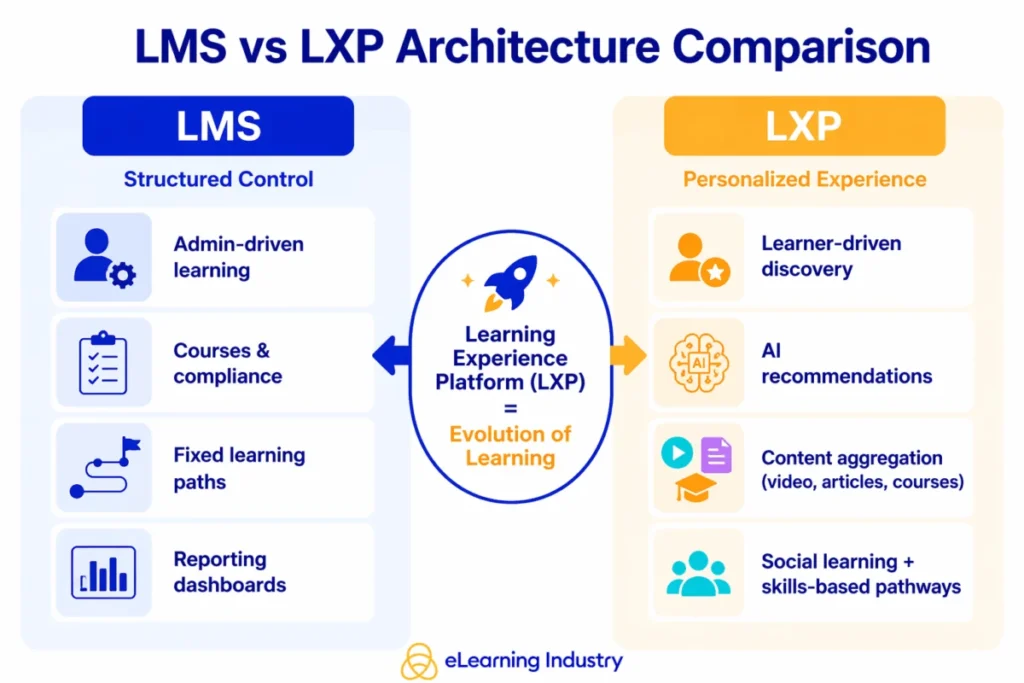
The corporate learning landscape is undergoing a fundamental transformation as organizations move away from rigid, administrative-heavy systems toward dynamic, learner-centric environments known as Learning Experience Platforms (LXPs). As global industries face an unprecedented skills gap and a rapidly changing technological environment, the LXP has emerged as a critical tool for Chief Learning Officers (CLOs) and HR leaders seeking to foster a culture of continuous improvement and employee engagement. Unlike its predecessor, the Learning Management System (LMS), which was designed primarily for compliance and top-down administration, the LXP leverages artificial intelligence, social connectivity, and vast content ecosystems to place the individual learner at the center of the educational journey. This strategic shift represents a move from "push" learning, where training is mandated and assigned, to "pull" learning, where employees actively seek out knowledge that aligns with their specific career goals and daily job requirements.
The Chronological Evolution of Workplace Education
To understand the rise of the LXP, one must examine the timeline of corporate training over the last three decades. In the late 1990s and early 2000s, the introduction of the Learning Management System revolutionized the way companies tracked employee progress. These systems were built for an era of regulatory oversight, focusing heavily on ensuring that employees completed mandatory safety certifications and legal compliance modules. However, as the digital economy expanded in the 2010s, the limitations of the LMS became apparent. These platforms were often described by users as "content graveyards"—places where training materials went to be forgotten rather than utilized.
By 2015, the "skills-first" economy began to take shape, and the traditional LMS could not keep pace with the demand for rapid upskilling. Employees, accustomed to the personalized experiences provided by consumer platforms like Netflix and Spotify, began to expect the same level of intuitive recommendation and ease of use from their workplace tools. This demand led to the emergence of the first LXPs, which prioritized the user interface and content discovery over administrative tracking. The COVID-19 pandemic further accelerated this trend, as the sudden shift to remote work necessitated digital platforms that could support social interaction and self-directed growth in the absence of physical classrooms.
Architectural Pillars of a Modern Learning Experience Platform
A sophisticated LXP is defined by several core technological pillars that distinguish it from legacy software. The first is AI-powered personalization. Modern platforms utilize machine learning algorithms to analyze an employee’s job title, previous learning history, stated interests, and even the skills gaps identified in their performance reviews. By processing this data, the LXP can serve a "Daily Feed" of relevant articles, videos, and courses, ensuring that learning becomes a habit rather than a quarterly chore.
The second pillar is content aggregation and curation. While an LMS typically hosts internal SCORM-compliant files, an LXP acts as a central hub for an entire knowledge ecosystem. It integrates internal company documents with external libraries such as LinkedIn Learning, Coursera, or industry-specific journals, and even pulls in open-source content like TED Talks or professional blogs. This "single pane of glass" approach prevents the fragmentation of knowledge and allows employees to find the best possible resource regardless of its origin.
Thirdly, the LXP facilitates social and collaborative learning. Industry research consistently shows that approximately 70% to 90% of workplace learning happens informally—through conversations with peers, mentorship, and on-the-job problem-solving. LXPs formalize this informal learning by providing discussion forums, "expert" tagging, and the ability for users to share their own curated playlists of content. This democratizes the creation of knowledge, allowing a senior engineer in one department to easily share a "how-to" video that benefits hundreds of junior staff across the globe.
Strategic Benefits and Economic Impact
The adoption of an LXP provides measurable advantages that extend beyond simple educational metrics. Data from leading HR research firms suggests that organizations with high levels of employee engagement see a significant increase in profitability and a reduction in turnover. By providing personalized learning journeys, LXPs directly contribute to employee retention. Modern workers, particularly those in the Millennial and Gen Z demographics, cite "opportunities for growth and development" as a primary reason for staying with an employer.
Furthermore, the LXP addresses the critical need for workforce agility. In sectors such as technology and healthcare, the half-life of a learned skill is now estimated to be less than five years. A Learning Experience Platform allows organizations to deploy "just-in-time" training. If a company pivots to a new software framework or enters a new market, the LXP can instantly curate and push relevant learning pathways to the affected teams, significantly reducing the time-to-competency compared to traditional classroom-based training schedules.

From a data perspective, LXPs offer "Skills Intelligence" that legacy systems cannot match. Advanced analytics dashboards allow leadership to see exactly which skills are trending within the workforce and where critical gaps exist. This data-driven approach to talent management enables more informed hiring decisions and internal mobility strategies, as HR teams can identify employees who have proactively developed the skills needed for future leadership roles.
Comparative Analysis: LXP vs. LMS
The distinction between an LXP and an LMS is often a point of confusion for organizations looking to upgrade their infrastructure. However, the industry consensus is that these systems are complementary rather than mutually exclusive. The LMS remains the "system of record"—the authoritative source for compliance, certifications, and high-stakes training where audit trails are essential. It is built for the administrator.
In contrast, the LXP is the "system of engagement." It is built for the learner. While the LMS manages the "must-do" training, the LXP inspires the "want-to-do" learning. Many forward-thinking enterprises now utilize a "bi-modal" approach, where the LXP sits on top of the LMS. The LXP provides the beautiful, intuitive interface that employees interact with daily, while the LMS runs in the background, handling the heavy lifting of data tracking and regulatory reporting. This integration ensures that the organization meets its legal obligations while simultaneously fostering a modern, attractive employer brand.
Use Cases and Industry-Specific Applications
The versatility of the LXP makes it applicable across various scales and industries. In the enterprise sector, companies with tens of thousands of employees use LXPs to standardize global training while allowing for local customization. For example, a global retail chain might use an LXP to deliver a unified brand message while allowing individual regions to curate content specific to local labor laws or consumer trends.
In the Small and Mid-sized Business (SMB) market, LXPs provide a cost-effective way to offer world-class training without the need for a large, dedicated L&D department. By leveraging pre-built content libraries and AI recommendations, smaller firms can provide their employees with the same level of professional development as major corporations.
Industry-specific use cases are also rising. In the healthcare sector, LXPs are used to keep practitioners updated on the latest medical research and procedural changes, which are too frequent for traditional annual training cycles. In the technology sector, LXPs serve as a vital tool for "continuous upskilling," where developers can stay abreast of evolving coding languages and cybersecurity threats through peer-shared resources and real-time content updates.
Broader Implications and the Future of Corporate Learning
As we look toward the future, the role of the LXP is expected to expand further into the flow of work. Industry analysts predict that the next generation of LXPs will be even more integrated with productivity tools like Microsoft Teams, Slack, and Salesforce. This "learning in the flow of work" means that an employee encountering a challenge in a project management tool might receive a proactive suggestion from the LXP, offering a 2-minute tutorial or an article that solves that specific problem at that exact moment.
The integration of Virtual Reality (VR) and Augmented Reality (AR) into LXP ecosystems is another frontier. By hosting immersive simulations within the LXP, companies can provide high-stakes training—such as emergency response or complex machinery operation—in a safe, digital environment, with the LXP tracking the user’s performance and suggesting remedial content where necessary.
In conclusion, the Learning Experience Platform is more than just a software upgrade; it is a strategic response to the shifting dynamics of the modern workforce. By prioritizing the learner’s experience, leveraging AI for personalization, and fostering a collaborative environment, the LXP enables organizations to build a more resilient, skilled, and engaged workforce. While the LMS will continue to serve its purpose for compliance, the LXP has become the essential engine for growth, innovation, and long-term success in the global digital economy. Organizations that fail to adopt these learner-centric models risk falling behind in the global war for talent and the race for technological proficiency.






