
The modern talent acquisition landscape is characterized by intense competition, shifting candidate expectations, and the persistent challenge of "reneging"—candidates accepting job offers only to withdraw before their start date. This phenomenon, often a silent but costly drain on organizational resources, highlights a critical deficiency in many recruitment processes: a lack of proactive engagement during the crucial pre-start period. Traditionally, teams often discover a renege only after it has occurred, by which point the candidate has typically already made a definitive decision to disengage. This reactive posture leads to frantic backfilling, substantial financial losses, and significant operational disruption. The emerging solution, however, lies in a paradigm shift: treating engagement signals as critical leading indicators, encapsulated in structured frameworks like the Engagement Health Scorecard.
The Silent Exodus: Understanding the Pervasive Challenge of Candidate Renege
Candidate reneging is more than an isolated incident; it represents a systemic vulnerability in the talent pipeline. While precise figures vary by industry and economic climate, studies from recruitment firms and HR consultancies frequently report renege rates ranging from 10% to 20% in highly competitive sectors like technology, finance, and healthcare. Even a seemingly modest 5-10% rate across all hires can translate into significant costs and delays for large organizations. The reasons behind a candidate’s decision to withdraw an accepted offer are multifaceted, often encompassing a more attractive competing offer, unforeseen personal circumstances, or a growing sense of uncertainty and disengagement with the prospective employer.
What exacerbates the problem is the typical organizational response, or lack thereof. Many recruitment programs operate without a defined process for monitoring candidate sentiment between offer acceptance and start date. This void allows disengagement to fester undetected. By the time a candidate goes quiet—ceasing communication or becoming unresponsive to outreach—they have frequently already committed to another path. The window for intervention closes rapidly, leaving companies scrambling to re-initiate recruitment for the now-vacant position. This reactive stance not only wastes previous recruitment efforts but also projects an image of disorganization, potentially damaging the employer brand.
The Financial and Operational Toll of Unfilled Roles
The impact of candidate reneging extends far beyond the immediate inconvenience. Financially, the costs are substantial. Each renege necessitates a full restart of the recruitment process, incurring repeated expenses for job postings, agency fees (if applicable), recruiter time, and interviewer time. Industry estimates suggest that the cost of replacing an employee can range from 30% to 150% of their annual salary, factoring in not just direct recruitment but also lost productivity during the vacancy, onboarding, and training of a new hire. For a senior role, this could easily amount to tens of thousands, if not hundreds of thousands, of dollars per incident.
Beyond direct financial outlays, there are significant operational and strategic ramifications. Project timelines can be derailed, existing team members may become overworked, and critical initiatives might be delayed or understaffed. The ripple effect can impact team morale, increase burnout, and even lead to a decline in overall organizational productivity. Furthermore, a high renege rate can subtly erode an organization’s reputation as an employer of choice. Candidates communicate their experiences, and a perceived lack of engagement or a disorganized pre-start process can deter future high-caliber applicants, creating a vicious cycle. HR leaders frequently cite these challenges as major inhibitors to achieving strategic talent goals and maintaining competitive advantage.
Shifting Paradigms: From Reactive to Proactive Engagement
Recognizing the profound impact of candidate reneging, progressive talent acquisition teams are moving away from reactive damage control towards proactive, data-driven engagement strategies. This fundamental shift involves treating various forms of candidate interaction as "leading indicators" of their engagement health. Instead of waiting for a withdrawal email, these teams actively monitor and interpret signals to predict potential disengagement and intervene effectively. This approach transforms the pre-start period from a passive waiting game into an active, strategic phase of relationship building and commitment reinforcement.
The evolution of pre-boarding strategies reflects this shift. While traditional pre-boarding might have involved sending a welcome packet and standard paperwork, modern approaches emphasize continuous, personalized communication and interaction. This includes early introductions to team members, invitations to company events (virtual or in-person), access to internal resources, and opportunities for candidates to clarify questions and deepen their understanding of their role and the company culture. The goal is to keep candidates feeling connected, valued, and excited about their impending start, mitigating the "cold feet" phenomenon and reducing their susceptibility to competing offers.
The Engagement Health Scorecard: A Framework for Predictive Intervention
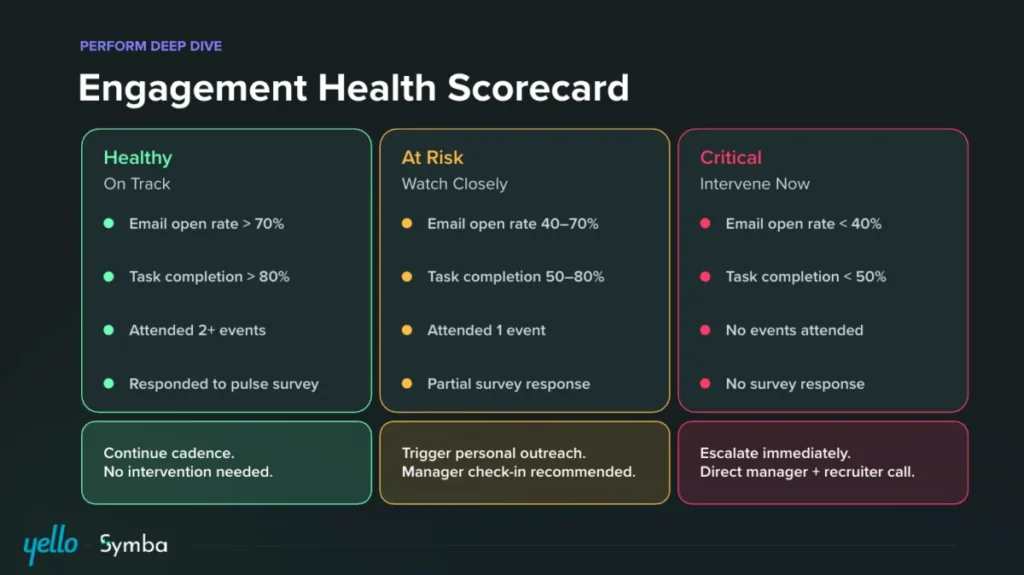
At the forefront of this proactive strategy is the implementation of an Engagement Health Scorecard. This structured framework categorizes candidates into distinct groups based on their behavior during the critical pre-start period, providing immediate, actionable insights for recruitment teams. The scorecard leverages data points that are readily available but often overlooked, transforming them into a powerful diagnostic tool. By assigning thresholds to various engagement metrics, organizations can systematically identify candidates who require different levels of attention and intervention, ensuring resources are deployed efficiently and effectively.
Healthy Candidates: Maintaining Momentum
Behavioral Profile: These candidates exhibit robust engagement signals. They are consistently opening emails at a rate exceeding 70%, diligently completing any assigned tasks (e.g., background check forms, onboarding paperwork), actively attending multiple pre-start events (webinars, virtual coffee chats, team meet-and-greets), and responding promptly and thoroughly to surveys. Their behavior indicates strong commitment and sustained enthusiasm for the role and the organization.
Recommended Action: For healthy candidates, the appropriate strategy is to "continue the cadence and stay the course." This involves maintaining the established communication schedule, providing consistent positive reinforcement, and ensuring that all promised pre-start resources and touchpoints are delivered. The goal is not to intensify engagement unnecessarily, which could feel overwhelming, but rather to reinforce their positive trajectory and ensure no friction points emerge. This consistent, positive reinforcement helps solidify their decision and builds anticipation for their start date. This phase is crucial for nurturing their initial enthusiasm into long-term commitment.
At-Risk Candidates: Targeted Intervention
Behavioral Profile: At-risk candidates display declining engagement signals. Their email open rates fall into a concerning range, typically between 40% and 70%. Their attendance at pre-start events is limited or sporadic, and their responses to surveys might be incomplete, delayed, or non-existent. These behaviors are red flags indicating a potential dip in interest or the emergence of internal doubts.
Recommended Action: Candidates in the "At-Risk" category require swift, personal outreach within 48 hours of detecting these warning signs. The intervention must feel individual and empathetic, rather than a generic, mass-distributed communication. Effective actions include:
- A direct message from the program manager or hiring manager: This personal touch conveys genuine interest and concern.
- An invitation to the next event that is specifically tailored to their interests or addresses a potential concern: For example, if they missed a team social, a direct invite to a smaller, more intimate virtual coffee chat with a specific team member might be more effective.
- A quick, informal check-in from the hiring manager: A brief call or video message can often uncover underlying concerns, whether it’s a question about benefits, team structure, or even just general anxiety about starting a new role.
These personalized interventions are designed to quickly re-engage the candidate, provide reassurance, and address any nascent concerns before they escalate. Often, a timely and empathetic conversation can quickly turn things around, demonstrating the company’s commitment to their well-being and success.
Critical Candidates: Immediate Escalation
Behavioral Profile: Critical candidates exhibit almost no engagement, signaling a severe detachment. Their email open rates are consistently below 40%, they have attended no pre-start events, provided no survey responses, and shown no activity for three or more weeks. This level of disengagement is a clear precursor to reneging and demands immediate, high-level attention.
Recommended Action: For critical candidates, the situation requires immediate escalation and a direct, candid approach. The window for intervention is closing rapidly, but not necessarily shut. Recommended actions include:
- A direct call from the hiring manager: This high-level touchpoint demonstrates the company’s serious investment in the candidate and their future role. It signals that their potential absence is noted and valued.
- A personal touchpoint from the recruiter: The recruiter, having built rapport during the initial stages, can offer a more informal and empathetic channel for conversation.
- A real conversation about "what’s going on": This is not a sales pitch, but an open dialogue designed to uncover the root cause of their disengagement. Often, the underlying issue is a competing offer, a significant personal circumstance, or simple uncertainty that has been left unaddressed.
By catching these candidates in time and engaging in an honest conversation, organizations can often address the root cause directly. This might involve clarifying aspects of the offer, providing additional information to counter a competing offer, or offering flexibility to accommodate personal circumstances. Even if the candidate ultimately decides to withdraw, this proactive approach can leave a positive impression, preserving the employer brand and potentially fostering future goodwill.
Data-Driven Decisions: The Cornerstone of Retention
The fundamental difference between teams that successfully retain candidates and those that scramble to backfill is almost always the same: the first group is looking at data continuously, not just when someone sends a renege email. This continuous monitoring of engagement metrics allows for predictive analytics, transforming the recruitment process from a series of discrete events into an ongoing relationship management strategy.
Data provides an objective basis for decision-making. Instead of relying on gut feelings or anecdotal evidence, talent acquisition professionals can use hard data to identify trends, pinpoint specific points of friction in their pre-start process, and validate the effectiveness of their interventions. This iterative improvement cycle, fueled by data, ensures that each recruitment program is more effective than the last. By embedding data analytics into the core of their talent acquisition strategy, companies can build more resilient pipelines, reduce time-to-hire, and significantly enhance their return on investment in recruitment.
Broader Implications and Strategic Advantage
The widespread adoption of engagement health scorecards and proactive retention strategies carries significant implications for organizations across industries.
Enhanced Employer Branding: A meticulously managed pre-start experience, characterized by personalized engagement and timely support, significantly enhances an organization’s employer brand. Candidates who feel valued and connected before they even start are more likely to become brand advocates, attracting further top talent.
Improved ROI on Recruitment: By dramatically reducing renege rates, companies save substantial amounts on recruitment costs, minimize lost productivity, and accelerate time-to-productivity for new hires. This direct impact on the bottom line makes a compelling business case for investing in sophisticated engagement tools and processes.
Stronger Onboarding and Long-Term Retention: Candidates who arrive on their first day feeling fully engaged and integrated are more likely to have successful onboarding experiences, leading to higher job satisfaction and longer tenure. This proactive approach lays the groundwork for sustained employee retention, reducing the overall churn rate.
Competitive Edge in a Tight Talent Market: In an era where skilled talent is a precious commodity, the ability to effectively attract, secure, and retain candidates before they even step foot in the office provides a critical competitive advantage. Organizations that master this phase are better positioned to outmaneuver competitors for top-tier talent.
The Role of HR Technology: The practical implementation of such a scorecard is heavily reliant on advanced HR technology platforms. Solutions like Yello, mentioned in "The KEEP Playbook," provide the infrastructure to track engagement metrics, automate communications, trigger alerts for at-risk candidates, and consolidate data for comprehensive analysis. These platforms are instrumental in making a continuous, data-driven approach feasible for large-scale recruitment operations.
Looking Ahead: The Future of Talent Acquisition
The trend towards predictive analytics and personalized candidate experiences is set to define the future of talent acquisition. As artificial intelligence and machine learning capabilities advance, they will increasingly be integrated into engagement tracking, allowing for even more sophisticated predictive models and hyper-personalized interventions. The pre-start period will evolve into a dynamic, interactive journey, leveraging technology to foster deep connections and ensure a seamless transition for new hires.
In conclusion, the era of passively awaiting a candidate’s start date is rapidly drawing to a close. The strategic imperative for organizations today is to embrace proactive, data-driven engagement methodologies. The Engagement Health Scorecard, as detailed in resources like The KEEP Playbook, offers a robust, systematic framework for identifying and mitigating renege risks, transforming the pre-start phase into a powerful engine for talent retention and organizational success. By diligently monitoring engagement signals and implementing targeted interventions, companies can build resilient talent pipelines, optimize their recruitment ROI, and secure a lasting competitive advantage in the race for talent. The KEEP Playbook, a comprehensive guide, includes the full engagement health scorecard with thresholds and recommended actions for each tier, alongside a step-by-step intervention playbook and a post-cycle review template, enabling continuous improvement with every program.






