In the increasingly complex landscape of enterprise talent acquisition and management, the traditional approach to crafting and maintaining job descriptions (JDs) has proven insufficient. As of 2026, large organizations are facing unprecedented challenges, necessitating a paradigm shift from basic word processing and shared drives to integrated, intelligent job description management systems. This article delves into the critical need for specialized software, examining key features, market offerings, and strategic implications for enterprise teams aiming to streamline their HR processes, ensure compliance, and attract top talent efficiently.
The Evolution of Job Description Management in the Enterprise Sector
For decades, job descriptions were often static documents, created ad-hoc, stored in disparate files, and updated sporadically. This rudimentary approach, while perhaps manageable for smaller businesses, became a significant bottleneck for large enterprises. The sheer volume of roles, coupled with the need for consistent branding, legal compliance, and a commitment to diversity, equity, and inclusion (DEI), overwhelmed manual systems. The mid-2010s saw a gradual recognition of JDs as more than just administrative boilerplate; they began to be viewed as foundational elements for talent acquisition, performance management, compensation strategy, and organizational design.
By the early 2020s, the acceleration of digital transformation, the rise of remote and hybrid work models, and an intensified focus on ethical hiring practices brought the issue to a head. Companies realized that inconsistent, outdated, or biased JDs directly impacted their ability to attract qualified candidates, led to costly mis-hires, and exposed them to legal risks. Generic tools like SharePoint and Google Docs, while offering basic collaboration, lacked the specialized functionality required for managing JDs at scale, such as workflow automation, version control, structured data, and seamless integration with core HR systems. The market responded with a new generation of sophisticated job description management software designed specifically to address these enterprise-level demands.
The Strategic Imperative for Specialized JD Software
Enterprise teams, often managing thousands of unique job roles across multiple departments and global locations, cannot afford the inefficiencies inherent in manual JD processes. Industry analyses consistently highlight the operational costs associated with poor JD management. Studies indicate that HR professionals spend an average of 10-15% of their time on JD-related administrative tasks, much of which can be automated. Furthermore, a lack of clear and consistent JDs can increase time-to-hire by up to 20% and contribute to a 30% higher turnover rate in the first year due to misaligned expectations.
The core problem is not merely about writing JDs but about managing the entire JD lifecycle as a strategic asset. This encompasses everything from initial drafting and internal approvals to publishing, ongoing updates, and archival. A robust system is required to maintain a live, searchable cloud library, manage JDs at scale, support multi-stage approval workflows, create governed templates, automate repetitive updates, and integrate seamlessly with Applicant Tracking Systems (ATS) and Human Resources Information Systems (HRIS). This integrated approach minimizes manual effort, eliminates audit gaps, ensures content alignment across all systems, and supports a data-driven talent strategy.
Essential Features for Enterprise-Grade Job Description Software
When selecting job description software, enterprise teams must prioritize comprehensive capabilities that extend far beyond basic text editing. Key features to evaluate include:
- Centralized Cloud Library: A single, secure repository for all JDs, offering advanced search, filtering, and version control capabilities. This ensures consistency and accessibility across the organization.
- Workflow Automation and Approvals: Customizable, multi-step approval workflows that route JDs to relevant stakeholders (e.g., hiring managers, HR business partners, legal, compensation teams) for review and sign-off. This reduces bottlenecks and ensures compliance.
- Template Governance: The ability to create and enforce standardized JD templates across the organization, ensuring brand consistency, legal compliance, and alignment with organizational job architecture.
- Automated Updates and Syncing: Features that automatically update JDs based on changes in job roles, compensation structures, or regulatory requirements, and synchronize these changes across linked systems (ATS, HRIS).
- ATS/HRIS Integration: Seamless two-way integration with existing talent acquisition and management systems to ensure data consistency, reduce manual data entry, and enable a holistic view of talent.
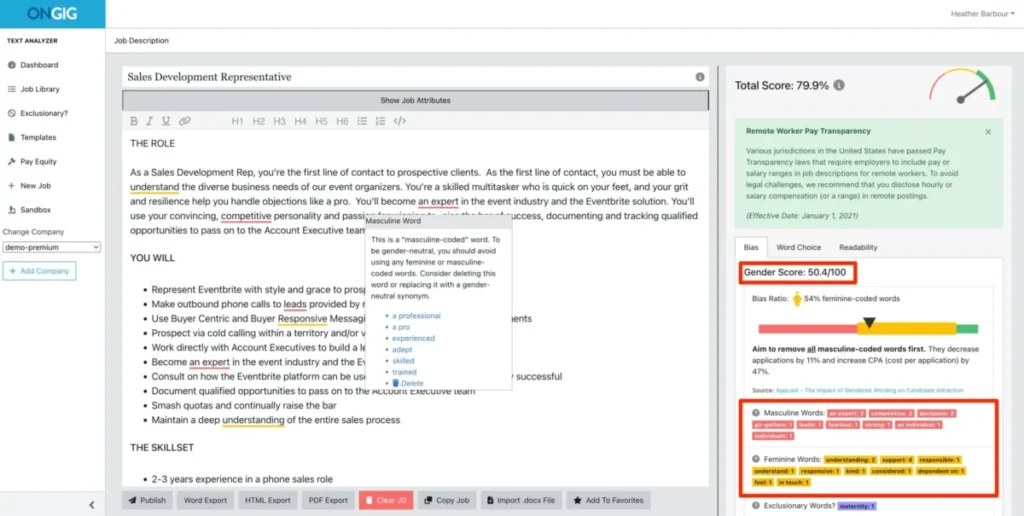
- Inclusive Language and Bias Detection: Tools that analyze JD content for biased language, gender-coded words, or exclusionary phrasing, promoting diversity and widening the applicant pool.
- Compliance and Regulatory Guidance: Built-in intelligence that flags potential compliance risks (e.g., ADA, EEO, pay transparency laws) and provides real-time guidance during JD creation.
- Compensation Data Integration: Linking JDs directly to compensation data and salary benchmarking tools, allowing for fair and competitive pay structures aligned with market rates.
- Role Profiling and Skills Mapping: Capabilities to define specific skills, competencies, and experience levels for each role, supporting clearer job expectations, internal mobility, and learning & development initiatives.
- Audit Trails and Reporting: Comprehensive logging of all changes, approvals, and publications, providing a clear audit trail for compliance purposes and enabling analytics on JD effectiveness.
Leading Software Solutions for Enterprise Job Description Management
The market for specialized JD software has matured, offering several robust platforms tailored for enterprise needs. As of 2026, the following solutions stand out for their comprehensive features and strategic value:
1. Ongig Text Analyzer
Ongig Text Analyzer positions itself as an end-to-end system for job content management, critical for enterprise organizations seeking singular control over their JD lifecycle. Its strength lies in its ability to foster inclusive job descriptions, supported by a searchable cloud library, managed approval workflows, and standardized JD creation. A key differentiator is its seamless synchronization with ATS and HRIS systems, effectively minimizing manual management, eliminating audit gaps, and ensuring content alignment across various platforms. Ongig offers a tiered pricing model, acknowledging varied enterprise requirements, and emphasizes its capacity to simplify the entire job description management process.
- Key Enterprise Features: Inclusive language analysis, searchable cloud library, automated approval workflows, JD standardization, ATS/HRIS integration, content alignment, audit trail, governed templates, bulk updates.
- Pricing: Tiered model, details available upon request for specific enterprise needs.
2. Job Description Management by Payscale
Payscale’s offering focuses on bringing order to the often chaotic realm of job data within large organizations. Recognizing that many companies still struggle with mature job architecture practices, Payscale provides a solution that unifies job architecture, job descriptions, and leveling within a single system. This approach aims to eliminate confusion around roles, levels, and compensation, thereby creating a transparent and consistent framework for talent management. Its integration with compensation data is a significant advantage for enterprises focused on fair and competitive pay structures.
- Key Enterprise Features: Centralized job architecture, compensation data integration, job leveling, content standardization, market data alignment, role definition.
- Pricing: Custom pricing based on required features and organizational size.
3. JDMS by Hrizons
Hrizons’ JDMS (Job Description Management System) prioritizes ease of use and organized management of job descriptions. It enables enterprises to build a highly structured JD library, facilitating efficient filtering and sorting of roles. A core aspect of JDMS is its robust integration capabilities, allowing seamless incorporation of job data into preferred HRIS and ATS systems. This ensures that job descriptions are not isolated documents but integral parts of the broader HR ecosystem.
- Key Enterprise Features: Organized JD library, advanced filtering, HRIS/ATS integration, version control, audit trails, template management, workflow automation.
- Pricing: Starting at $21,000 annually, reflecting its enterprise-grade focus.
4. JDXpert
JDXpert positions itself as a comprehensive job information management tool, extending beyond mere JD writing to encompass building, organizing, approving, and archiving job descriptions. Its platform aims to eliminate the reliance on scattered tools and fragmented processes, providing a centralized environment for all job-related information. This holistic approach supports greater efficiency and consistency across an organization’s talent lifecycle.
- Key Enterprise Features: Centralized job information, workflow management, version control, audit capabilities, content repository, approval routing, template customization.
- Pricing: Demo-based pricing model, requiring direct inquiry.
5. Quinto by HRSG
Quinto addresses the common enterprise challenge of inconsistent job data stemming from disparate tools and document formats. HRSG emphasizes maintaining consistency across all data points within a single platform, from job descriptions to promotion paths and succession planning. By providing a shared, consistent structure, Quinto helps organizations standardize their talent processes and improve the reliability of their HR data.
- Key Enterprise Features: Competency framework integration, consistent data structure, centralized job data, career pathing support, skills mapping, talent mobility.
- Pricing: Demo-based pricing model, indicating tailored solutions.
6. JobArchitect by Salary.com
JobArchitect by Salary.com is specifically designed for the creation, approval, and maintenance of job description content at scale. Its primary value proposition for recruitment teams is replacing fragmented tools with a unified system for all job content. A significant advantage is its integration with the broader Salary.com platform, providing embedded compensation insights that remove guesswork from salary benchmarking and ensure competitive pay structures.
- Key Enterprise Features: Scalable JD management, compensation integration, market data alignment, compliance checks, template governance, unified platform.
- Pricing: Demo-based pricing model.
7. RoleCreate by Role Mapper
RoleCreate focuses on enabling organizations to build inclusive, consistent, and compensation-ready JDs within a single platform. It acknowledges that job descriptions are dynamic assets that must evolve with the company and the market. RoleCreate helps maintain the relevance and accuracy of JDs over time, ensuring they remain effective tools for attracting talent and defining roles.
- Key Enterprise Features: Inclusive JD creation, compensation readiness, role consistency, dynamic JD updates, skills taxonomy, career framework integration.
- Pricing: Details available on their website.
8. Datapeople (now a Payscale company)
Datapeople, now part of Payscale, specializes in improving and managing JD content through data-driven guidance. Its platform leverages real-world hiring data to predict how a job description will perform, offering insights beyond basic grammar checks. Datapeople excels in flagging biased language, identifying missing benefits information, and generally optimizing JDs for better candidate attraction and diversity outcomes. Its acquisition by Payscale strengthens its position by potentially integrating compensation data more deeply.
- Key Enterprise Features: Data-driven JD optimization, bias detection, inclusivity scoring, performance prediction, content improvement suggestions, market insights.
- Pricing: Details available on their website.
General Factors for Enterprise Software Selection
Beyond specific features, enterprise teams must consider broader strategic and operational factors when investing in JD software:
- Ease of Use: The software must be intuitive for all users, from HR generalists to hiring managers, to ensure high adoption rates and minimize training overhead.
- Implementation and Onboarding: Evaluate the vendor’s implementation process, including data migration services from existing systems (e.g., SharePoint, legacy HRIS) and the availability of comprehensive training resources.
- Cost and ROI: Beyond the initial licensing fees, consider the total cost of ownership, including integration expenses, ongoing maintenance, and support. Quantify the potential ROI through reduced time-to-hire, improved candidate quality, lower turnover, and mitigated compliance risks.
- Vendor Support and Reliability: Assess the vendor’s reputation for customer support, including response times, technical expertise, and availability of resources. Look for strong user reviews and case studies.
- Scalability and Flexibility: The solution must be capable of growing with the organization, supporting increasing volumes of JDs, new departments, and global expansion. It should also be flexible enough to adapt to evolving business needs and regulatory changes.
- Security and Data Privacy: Given the sensitive nature of HR data, robust security protocols, data encryption, and compliance with privacy regulations (e.g., GDPR, CCPA) are non-negotiable.
Implications and Future Outlook
The adoption of specialized job description software represents a significant strategic step for enterprise organizations. It transforms JD management from a fragmented, administrative burden into a centralized, intelligent, and proactive function. This shift has several profound implications:
- Enhanced Talent Acquisition: Clear, consistent, and inclusive JDs attract a wider, more diverse pool of qualified candidates, improving the efficiency and effectiveness of recruitment efforts.
- Improved Compliance and Risk Mitigation: Automated compliance checks and audit trails significantly reduce the risk of legal challenges related to discriminatory language or non-adherence to labor laws.
- Optimized Compensation Strategies: Integration with compensation data ensures that roles are benchmarked competitively, promoting fairness and aiding in talent retention.
- Stronger Organizational Design: A well-managed job architecture provides a foundation for clearer career paths, better internal mobility, and more effective workforce planning.
- Data-Driven HR: The ability to analyze JD performance, identify trends, and make data-backed decisions elevates the HR function from operational to strategic.
Looking ahead, the integration of artificial intelligence (AI) and machine learning (ML) will further enhance these platforms, offering predictive analytics on JD effectiveness, personalized content suggestions, and more sophisticated bias detection. The trend towards holistic talent experience platforms will also see JD management solutions becoming even more deeply embedded within broader HR ecosystems, providing a seamless experience from initial job search to employee development and succession planning.
In conclusion, for enterprise teams grappling with the complexities of modern talent management, investing in a specialized job description software is no longer a luxury but a strategic imperative. Such systems centralize the JD process, enforce governance, automate workflows, ensure compliance, and ultimately empower organizations to attract, hire, and retain the best talent in a competitive global market. The choice of the right platform will hinge on a thorough assessment of an organization’s specific challenges, existing HR technology stack, and long-term strategic objectives.