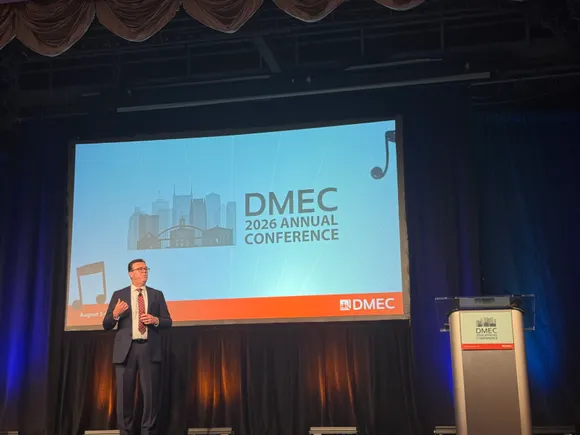
NASHVILLE, Tenn. – Bryon Bass, the seasoned CEO of the Disability Management Employer Coalition (DMEC), addressed a gathering of over 800 attendees at the 2026 DMEC Annual Conference in Nashville, Tennessee, outlining the pivotal shifts and emerging challenges confronting leave management professionals. Now in his third year at the helm of an organization boasting 22,000 members across the U.S. and Canada, Bass brings two decades of prior industry experience to his leadership role, reflecting on a period of foundational development and looking ahead to significant industry evolution.
“These last three years were really about laying the foundation. Now you get to see what we’re building on top of it,” Bass remarked, setting a forward-looking tone for the conference. His insights, shared in an exclusive interview with HR Dive, delved into critical trends, the transformative potential of artificial intelligence, and the enduring imperative of human-centric approaches in the complex world of absence and disability management.
The Enduring Challenge: A Shifting Regulatory Mosaic
At the forefront of challenges for leave management professionals, Bass unequivocally identified the "ever-changing laws and regulations that continue to come into play." This persistent legislative flux demands constant vigilance, requiring organizations to meticulously "watch these policy signals to see what’s happening." The complexity is particularly acute for multi-state employers, who must navigate a labyrinth of federal, state, and increasingly, local mandates.
The Family and Medical Leave Act (FMLA) serves as a federal baseline in the U.S., but its provisions are frequently augmented or expanded upon by state-level initiatives. Over the past decade, a significant trend has been the proliferation of state-mandated paid family and medical leave (PFML) programs. States like California, New Jersey, New York, Massachusetts, Washington, Oregon, Colorado, Maryland, Delaware, Minnesota, and Maine have either implemented or are in the process of rolling out comprehensive PFML programs, each with distinct eligibility criteria, benefit structures, and administrative requirements. This patchwork approach means an employer operating in multiple jurisdictions might contend with different definitions of "family member," varying waiting periods, diverse contribution mechanisms, and unique return-to-work protocols. For instance, while one state might offer 12 weeks of paid leave for bonding with a new child, another might provide 8 weeks, and a third could have a more expansive definition of "serious health condition." This legislative dynamism is further complicated by local ordinances in cities and counties that sometimes impose additional leave requirements, creating an intricate web of compliance obligations that demands specialized expertise.
The ramifications of non-compliance can be severe, ranging from hefty fines and penalties to costly litigation and reputational damage. Consequently, leave management professionals are not merely administrators but de facto legal compliance experts, constantly updating their knowledge and systems to ensure adherence to the latest statutes. This ongoing regulatory evolution underscores the strategic importance of robust leave management frameworks and the specialized knowledge that organizations like DMEC provide to their members.
The Emergent Frontier: Artificial Intelligence in Leave Management
Beyond the regulatory landscape, Bass highlighted artificial intelligence (AI) as the "next emerging challenge." The question, he posited, is "What’s artificial intelligence doing? How’s AI changing the way we interact with each other and the work that we do?" While the full scope of AI’s impact remains to be seen, the industry is actively exploring its potential.
Bass identified several opportunities for AI to enhance leave management, particularly for employers lacking dedicated third-party administrators (TPAs), insurance providers, or sophisticated in-house software solutions. AI could serve as a powerful tool to help these organizations "understand what all those requirements are" across various jurisdictions, thereby enabling them to be "a bit more effective in how they’re managing their programs." AI-powered systems could automate routine inquiries, pre-populate forms, provide instant access to policy information, and even flag potential compliance issues based on updated regulatory databases. For a multi-state employer, an AI assistant could, in theory, instantaneously cross-reference an employee’s state of residence, work location, and leave reason against all applicable laws to provide a preliminary assessment of eligibility and entitlements.
However, Bass also sounded a note of caution regarding the limitations of current AI capabilities. He cited testing in the field revealing "at best they’re seeing 65% accuracy." This crucial detail underscores that while AI can be a valuable assistant, it is not yet a substitute for human judgment, empathy, and nuanced interpretation, particularly in complex or ambiguous cases. The imperative to "keep the human in the loop" remains paramount. Ethical considerations surrounding data privacy, algorithmic bias, and the potential for dehumanizing sensitive interactions also loom large. For instance, an AI system might struggle with the subjective interpretation of medical documentation or fail to account for unique personal circumstances that a human professional would readily address. The goal, therefore, is not wholesale replacement but rather to leverage AI "to make an interaction from a human-to-human perspective even more effective and beneficial," freeing up professionals to focus on the intricate, empathetic aspects of their roles.
Transforming the Professional’s Role: Human-Centric Guidance
Against this backdrop of regulatory complexity and technological advancement, Bass firmly asserted that the fundamental role of the leave management practitioner "has and should have always been centered around the experience of the employee." This core principle remains unchanged. Professionals are tasked with ensuring employees receive "accurate information that they can use, that they understand the expectations and that they have someone who can guide them or navigate them through these various factors."
What does change, according to Bass, is "how we are using technology in a different way to spend more time on the human interaction aspect of things." By automating repetitive tasks and streamlining information retrieval, AI and other digital tools can liberate professionals from administrative burdens, allowing them to dedicate more energy to personalized support, empathetic communication, and complex problem-solving. This shift elevates the practitioner from a transactional processor to a strategic advisor and compassionate guide, focusing on the employee’s well-being during often vulnerable times. In an era where employee experience significantly impacts retention and engagement, this human-centric approach is increasingly vital. A skilled leave professional can offer not just information, but reassurance, clarity, and advocacy, which technology alone cannot replicate. This evolving role aligns with broader trends in human resources, where the focus is increasingly on strategic partnership, employee advocacy, and fostering a supportive workplace culture.
Elevating Leave Management: A C-Suite Imperative
The growing visibility of leave programs, particularly with the proliferation of state-level paid family leave initiatives, has led to a "heightened awareness of leave" within the C-suite. Bass observed that senior leadership is increasingly recognizing that "leave is a part of doing business." This acknowledgment prompts a critical question: "how do we account for that financially and in budgeting processes and things of that nature?"
However, Bass also highlighted a dichotomy in C-suite perception. While some executives embrace leave as an inherent operational reality and a strategic asset, others "may have some C-suites that think it’s detrimental to the business, and they’re maybe resistant to encouraging individuals to take the leave. It’s a cultural thing." He strongly advocated for the former perspective, stating, "Those who see leave as a strategic objective of the organization are the ones that are going to be the most successful at the end of the day."
The challenge, therefore, lies in articulating the intrinsic "value of leave" to the C-suite. Bass compellingly illustrated the "domino effect" of inadequate preparation: "We know leave is going to happen, right? It’s going to happen. The question is: How do we prepare work groups and leaders when that happens?" When an employee takes leave without proper planning, the workload disproportionately shifts to colleagues, leading to increased stress, burnout, and potentially, subsequent leaves among those "left behind." This creates a vicious cycle of disruption and diminished productivity.
A strategic approach to leave, conversely, treats it as an anticipated part of the workforce lifecycle. This involves cross-training, temporary staffing solutions, clear communication, and workload rebalancing. Companies that proactively manage leave often see significant returns on investment. For example, a study by the Center for American Progress found that offering paid family leave can reduce employee turnover by 20%, saving companies substantial recruitment and training costs. Furthermore, a report by the Society for Human Resource Management (SHRM) indicated that employees who utilize paid leave return to work more engaged and productive. By emphasizing these tangible benefits—reduced turnover, enhanced morale, improved productivity, and mitigated compliance risks—leave management professionals can effectively position their function as a strategic enabler of business continuity and employee well-being, rather than merely a cost center. An enlightened C-suite executive might articulate this perspective by stating, "Our investment in robust, well-managed leave programs is an investment in our most valuable asset: our people. It fosters loyalty, reduces burnout, and ultimately strengthens our organizational resilience and productivity."
Breaking Down Barriers: The Quest for Disability Accessibility
The conversation also delved into the persistent barriers hindering disability accessibility in the workplace. Bass squarely pointed to the enduring "stigma that if you’re disabled, you’re less than." This societal misconception often prevents people from recognizing that "individuals who are disabled are differently abled." He lamented that design principles still largely cater to the "able-bodied person more than we think about the population as a whole."
Despite legal frameworks like the Americans with Disabilities Act (ADA) in the U.S., which mandates reasonable accommodations, a cultural shift remains elusive. The ADA, enacted in 1990, prohibits discrimination against individuals with disabilities in all areas of public life, including employment. While it has spurred progress in physical accessibility and accommodation requests, the underlying bias often persists. The term "differently abled" seeks to reframe disability not as a deficit, but as a different way of experiencing and interacting with the world, often bringing unique perspectives and problem-solving skills.
The economic case for disability inclusion is robust. Studies by Accenture, in collaboration with Disability:IN and the American Association of People with Disabilities (AAPD), have shown that companies that champion disability inclusion outperform their peers financially, achieving 28% higher revenue, double the net income, and 30% higher economic profit margins. Employees with disabilities also demonstrate higher loyalty and lower turnover rates. Yet, unconscious biases often lead employers to overlook this talent pool, perpetuating a cycle of underrepresentation.
True accessibility extends beyond physical ramps and accessible restrooms; it encompasses digital accessibility (e.g., screen readers, captioning), communication accessibility (e.g., sign language interpreters, plain language), and most critically, cultural accessibility. This requires fostering an inclusive environment where accommodations are seen as standard practice, not special favors, and where managers are trained to understand and support employees with diverse needs. It also involves designing jobs and workplaces with universal design principles in mind, proactively anticipating a wide range of human abilities and preferences, rather than retrofitting solutions after the fact. Overcoming the stigma requires sustained education, empathy training, and a concerted effort to recognize and value the contributions of all individuals, regardless of ability.
A Holistic Vision for the Future
Bryon Bass’s address at the DMEC conference painted a comprehensive picture of an industry at a critical juncture. The intersection of ever-evolving compliance requirements, the transformative power of artificial intelligence, the imperative of human-centric employee experience, the strategic elevation of leave management within the C-suite, and the ongoing battle for true disability accessibility defines the modern landscape.
DMEC, under Bass’s leadership, aims to equip its 22,000 members with the knowledge and tools necessary to navigate these complexities. The future of leave and disability management is not merely about adherence to regulations; it is about cultivating resilient, inclusive, and supportive workplaces that recognize the inherent value of every employee. It demands professionals who are not only adept at legal compliance and technological integration but are also empathetic advocates for employee well-being and champions of an equitable work environment. As organizations continue to grapple with workforce dynamics, demographic shifts, and the accelerating pace of change, the insights shared by leaders like Bryon Bass will be instrumental in shaping a more effective and humane approach to managing absence and fostering disability inclusion.