Disruption has become the unwelcome yet persistent companion of the modern workplace. This constant flux, amplified by rapid technological advancements like artificial intelligence, is not only reshaping how we work but also significantly draining the vital energy leaders require to foster growth within themselves, their teams, and their organizations. While AI tools offer unprecedented efficiencies, the enduring truth remains: human leaders are, and will continue to be, the primary architects of organizational success. These leaders, often battling a tide of compounding obstacles that can erode motivation, possess a unique and powerful human superpower – a psychological fuel that silently propels organizations forward, enabling them to not just survive but thrive. This essential resource, so intrinsically woven into our daily professional lives that its absence is often noticed only when it’s gone, is known as psychological capital, or PsyCap.
PsyCap serves as the organizational engine’s vital lubricant, sustaining the leaders who meticulously maintain its intricate gears and preventing the entire system from succumbing to the friction of constant change. It is a resource that leaders both critically need and actively produce, representing an invaluable asset for achieving what is humanly possible in an increasingly complex business landscape.
Understanding the Pillars of Psychological Capital
Psychological capital is formally defined as an individual’s positive psychological state, comprising four foundational elements that are crucial for resilience and high performance:
- Hope: This refers to the willpower and the pathways individuals perceive to achieve their goals. It’s the belief that one can identify and pursue desired outcomes, even in the face of adversity.
- Self-Efficacy: This is the belief in one’s own capacity to organize and execute the courses of action required to manage prospective situations. It’s the confidence in one’s ability to perform a specific task or achieve a specific outcome.
- Resilience: This is the ability to bounce back from adversity, uncertainty, conflict, and even failure. It’s the capacity to maintain positive functioning and adapt effectively in the face of significant stress.
- Optimism: This is the attributional style where individuals tend to explain positive events as internal, stable, and global, while attributing negative events to external, temporary, and specific causes. It’s a forward-looking belief that good things are likely to happen.
Extensive research underscores the profound impact of high PsyCap. Studies consistently reveal that employees exhibiting higher levels of psychological capital demonstrate greater commitment to their roles, exhibit superior performance, experience enhanced well-being, and are significantly less susceptible to burnout. In essence, PsyCap acts as a buffer against the corrosive effects of workplace stress and a catalyst for sustained engagement and productivity.
The Indispensable Role of PsyCap in Leadership
Leaders who cultivate high levels of psychological capital are more likely to embody authentic leadership behaviors. These include heightened self-awareness, genuine relational transparency, and a clear moral perspective. These qualities, in turn, foster greater trust among their teams and contribute directly to improved overall performance. Leadership, fundamentally a social process, is inextricably linked to human energy, sustained motivation, and robust psychological capacity. Maintaining this capacity, particularly amidst escalating complexity and uncertainty, requires more than just technical skills; it demands a deeper wellspring of inner strength.
Leaders require robust mental resources to persevere through challenges, adapt to evolving circumstances, and ultimately flourish. This is precisely where psychological capital plays a pivotal role. Decades of academic inquiry into PsyCap have yielded compelling findings, indicating that it is a significant predictor of key organizational success metrics, including performance, employee engagement, and retention rates. PsyCap encapsulates the uniquely human strengths that empower leaders to not only navigate disruption but also to effectively steer their organizations toward future success.
Crucially, psychological capital is not an immutable trait; it is a developable asset. Through deliberate experiences, targeted coaching, and supportive organizational environments, leaders can actively build and sustain their PsyCap over time. This capacity is not merely a byproduct of leadership development but a fundamental driver of its efficacy. Research conducted with participants in intensive leadership development programs consistently shows that improvements in PsyCap, particularly in hope and optimism, correlate directly with enhanced goal attainment and greater team engagement. This evidence strongly suggests that fostering leaders’ psychological capital should be a core objective of any effective leadership development initiative.

Cultivating PsyCap: The Power of Leadership Development
When leaders are provided with opportunities to step away from the daily grind, engage in introspection, receive candid feedback, and experiment with new approaches, they don’t just acquire new skills; they significantly bolster their inner resilience – the crucial "fuel" needed to effectively deploy those skills when faced with significant challenges. In essence, their psychological capital grows.
Empirical data from various leadership development programs consistently illustrates this phenomenon. For instance, a comprehensive analysis of custom programs designed for educational leaders revealed a dramatic increase in reported PsyCap levels. In a typical cohort, the percentage of leaders identifying with "high PsyCap" surged from a baseline of 36% prior to the program to an impressive 79% upon its completion. This substantial growth highlights the transformative potential of structured development interventions.
The question then arises: what specific elements within these development experiences contribute to this enhanced psychological capital? Insights from in-depth program evaluations reveal a nuanced journey. It is not uncommon for PsyCap levels to experience a temporary dip during the mid-stages of intensive development. This often occurs when leaders are confronted with challenging feedback, such as that received through 360-degree assessments, which can momentarily shake confidence or optimism as self-awareness deepens. However, this dip is typically followed by a robust rebound and subsequent growth, as leaders internalize the feedback, acquire new strategies, and develop greater self-efficacy. This temporary decline, while potentially uncomfortable, is a normal and often necessary precursor to significant growth. It signifies that leaders are actively processing challenging information, which, with appropriate support, leads to enhanced resilience and confidence.
Coaching: A Catalyst for Leader PsyCap
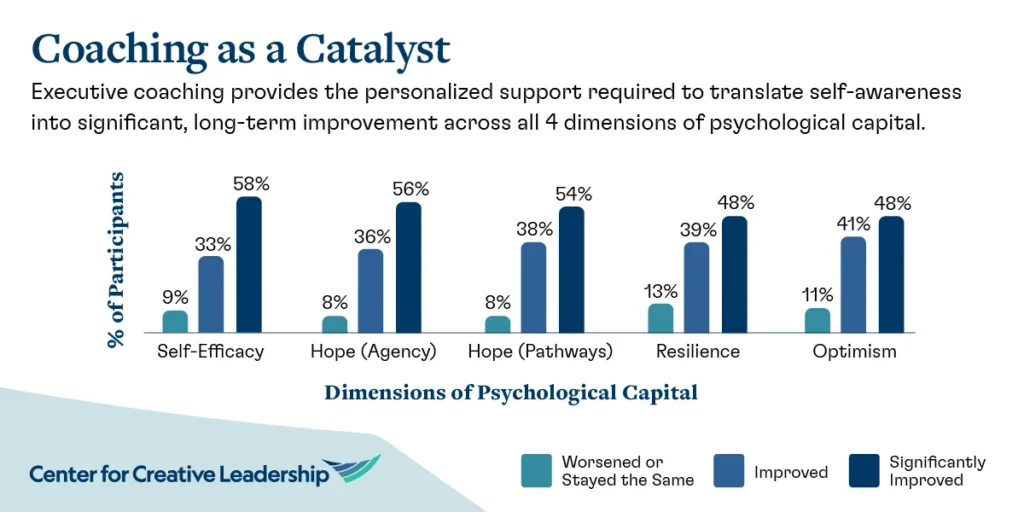
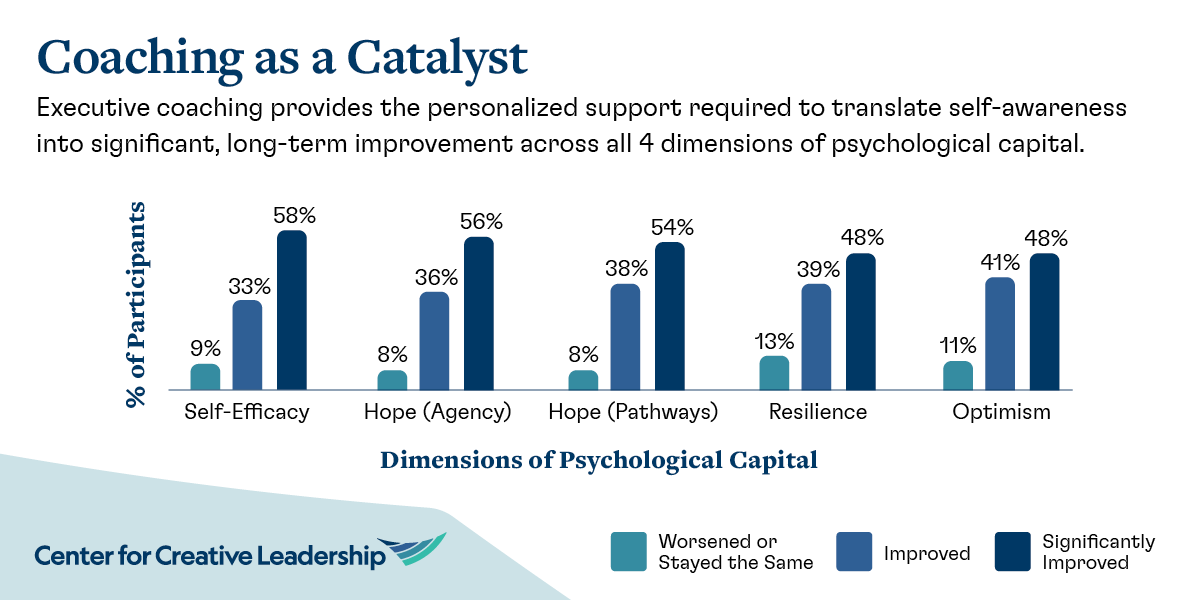
Coaching emerges as one of the most potent and direct avenues for providing leaders with the intentional support needed to nurture their psychological capital. Evaluations of executive coaching programs have consistently demonstrated their personalized effectiveness in helping leaders address challenges, engage in goal-achieving behaviors, and directly impact their PsyCap. Even highly seasoned executives participating in tailored coaching engagements report tangible improvements in their psychological capital. This aligns perfectly with the core tenets of coaching: moving beyond skill-building to foster the self-awareness and internal work necessary for more impactful leadership, while simultaneously replenishing the energy of leaders who consistently apply these learned behaviors.
An infographic developed by the Center for Creative Leadership visually represents this catalytic role of coaching, illustrating how it supports the development of hope, self-efficacy, resilience, and optimism. This personalized approach is particularly valuable in helping leaders navigate complex situations and sustain their effectiveness over the long term.
The Impact of Bite-Sized Interventions on PsyCap
While immersive, multi-day leadership development programs are highly effective, the impact of psychological capital is not solely confined to these intensive experiences. Encouraging evidence suggests that PsyCap can also be significantly strengthened through shorter, targeted online leadership training modules, particularly when the learning content is directly linked to a leader’s immediate work challenges.
A pilot program for a self-paced online course focused on building leaders’ PsyCap yielded promising results. Participants reported a statistically significant increase in their psychological capital, with an average gain of nearly one full point on a 1-to-5 scale (+0.74). Notably, 86% of leaders who completed the online course indicated experiencing overall improvement in their PsyCap. The inherent value of this format lies in its ability to anchor learning within the leader’s specific context. By focusing on a leader’s identified "key leadership challenge," personalized reflections and practice opportunities remain directly relevant to real-world situations, maximizing the transfer of learning and the development of psychological resources.
Neurodiverse Leaders and PsyCap: A Differentiated Perspective
A growing body of research highlights the significant benefits that neurodiverse leadership teams and workforces bring to organizations. However, initial findings also indicate that leaders who identify as neurodivergent, such as those with Attention Deficit Hyperactivity Disorder (ADHD) or autism, may, on average, report lower overall levels of psychological capital when compared to their neurotypical counterparts.
It is imperative to understand that these findings do not signify a deficit in leadership potential. Instead, they underscore the reality that leaders bring diverse strengths and distinct needs related to their individual psychological resources into their roles. For organizations, this necessitates a heightened focus on cultivating supportive psychological conditions that enable all leaders, regardless of their neurotype, to sustain their impact and leverage their unique contributions effectively. An infographic illustrating PsyCap among neurodiverse leaders visually represents these nuanced differences and emphasizes the need for inclusive approaches to leadership development and support.
Psychological Capital: The Essential Fuel for Navigating Disruption
In an era defined by persistent disruption, leadership development must evolve beyond mere skill acquisition. It must actively provide the essential psychological fuel that empowers leaders to remain effective amidst ambiguity, demanding workloads, and rapid environmental shifts. Psychological capital is that critical fuel, and robust data confirms that it can be effectively strengthened through comprehensive leadership development initiatives.
Across a spectrum of interventions, including intensive programs, personalized coaching, and accessible digital learning experiences, PsyCap demonstrably grows when leaders encounter a synergistic blend of heightened self-awareness, meaningful challenges, and supportive environments that facilitate the translation of insight into tangible action. This growth trajectory is not always linear; it frequently involves an initial, temporary dip as leaders grapple with and internalize difficult feedback. However, with the right scaffolding and support, this dip becomes a pivotal turning point, empowering leaders to reclaim their agency, gain clarity, and cultivate the confidence to embrace new ways of operating.
This developmental process is not solely an individual endeavor. While leadership sets the overarching tone, it is the organizational culture that ultimately channels and amplifies this vital energy. Organizations that deliberately cultivate cultures supporting PsyCap – by normalizing constructive feedback, celebrating progress, and valuing recovery as much as performance – witness a multiplicative impact. High-performing organizations foster environments where hope, self-efficacy, resilience, and realistic optimism gain momentum, radiating outwards from leaders to their teams and the broader organizational ecosystem.
However, it is crucial to recognize that developing psychological capital is not a panacea for fundamentally unhealthy organizational dynamics. It is not about asking individuals to simply "muscle through" unsustainable workloads or toxic cultures. Leadership resilience and optimism achieve their full potential when harmonized with systemic support, genuine psychological safety at work, and thoughtfully established boundaries. The ultimate aim is not to cultivate leaders who can endure any hardship, but rather to empower them with the inner resources necessary to confront difficult realities, devise effective solutions, and inspire a collective future that benefits all stakeholders.
Charting the Course Forward
The commitment to exploring and enhancing the human dimension of leadership is paramount. Taking the next step in building this crucial capacity, both within oneself and across leadership ranks, is an imperative for sustained organizational success. Programs like the Leadership Development Program (LDP) and executive coaching services are meticulously designed to cultivate the psychological capital and inner fortitude that leaders require to perform at their zenith, even when faced with the most formidable challenges.