A Year of Unprecedented Enforcement Activity
The 2025 calendar year marked a significant pivot in the EEOC’s approach to workplace regulation and litigation. Following the implementation of the Strategic Enforcement Plan (SEP) for Fiscal Years 2024-2028, the agency intensified its focus on systemic discrimination and high-impact litigation. According to the data compiled in the Seyfarth Shaw report, the EEOC’s filing activity in 2025 remained robust, building upon the momentum of the previous two fiscal years. The report notes that the agency has increasingly prioritized cases that affect large groups of employees or challenge industry-wide practices, moving away from a purely volume-based approach toward one centered on institutional change.
Legal analysts point to 2025 as the year the "new" EEOC fully hit its stride. With a stabilized commission and a clear mandate, the agency targeted several key areas: artificial intelligence in hiring, the protection of vulnerable workers, and the aggressive enforcement of the Pregnant Workers Fairness Act (PWFA). The 2026 Edition documents a notable rise in litigation involving these newer legal frontiers, signaling a shift in how the Commission interprets its role in the modern economy.
Chronology of Enforcement: Key Milestones of 2025
The enforcement landscape of 2025 was shaped by several critical phases, beginning with a flurry of regulatory guidance in the first quarter and culminating in a significant end-of-year litigation push.
In early 2025, the EEOC issued updated enforcement guidance on workplace harassment, the first of its kind in over two decades. This guidance addressed modern workplace dynamics, including remote work environments and digital harassment, setting the stage for a series of lawsuits filed in the spring and summer. By mid-year, the Commission turned its attention to the intersection of disability rights and returning to the office, challenging several major corporations on their accommodation policies under the Americans with Disabilities Act (ADA).
The third quarter of 2025 saw the first wave of major enforcement actions under the Pregnant Workers Fairness Act. These cases focused on the "reasonable accommodation" requirement, testing the boundaries of what employers must provide to pregnant employees. As the fiscal year drew to a close in September, the EEOC engaged in its traditional "midnight filing" surge, initiating dozens of lawsuits across various districts to meet year-end targets. The Seyfarth Shaw report categorizes these filings by statute and geography, revealing that the EEOC’s Chicago and Philadelphia offices remained among the most litigious in the country.
Data-Driven Insights: Litigation Trends and Statistics
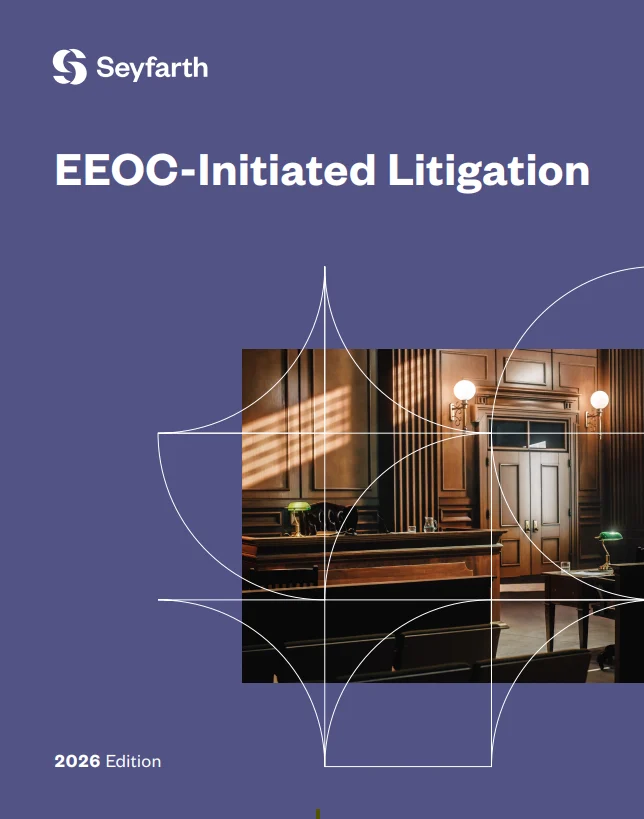
The EEOC-Initiated Litigation: 2026 Edition provides a statistical deep dive into the types of claims pursued by the Commission. While Title VII of the Civil Rights Act remains the primary vehicle for EEOC litigation, there was a measurable uptick in claims brought under the ADA and the Age Discrimination in Employment Act (ADEA) in 2025.
Key data points highlighted in the report include:
- Systemic Filings: Systemic lawsuits—those involving a pattern or practice of discrimination—accounted for approximately 35% of the total litigation docket in 2025, a 10% increase from 2023 levels.
- Retaliation Claims: Retaliation remains the most frequently cited basis for charges, appearing in over 50% of the EEOC’s filings. The report suggests that the agency is increasingly viewing retaliation as a standalone systemic issue rather than just an adjunct to other discrimination claims.
- Settlement Values: The total monetary recovery for the EEOC through litigation and conciliation in 2025 reached record highs, driven by several multi-million dollar settlements in the technology and retail sectors.
The report also tracks the success rate of the EEOC in the courts. While the agency continues to win the majority of its cases at the summary judgment stage, employers saw increased success in 2025 by challenging the EEOC’s pre-suit conciliation efforts. This remains a critical area of defense for corporate counsel, as the duty to confer in good faith remains a prerequisite for the EEOC to bring a lawsuit.
The Technological Frontier: AI and Algorithmic Bias
One of the most significant sections of the 2026 Edition focuses on the EEOC’s "Artificial Intelligence and Algorithmic Fairness Initiative." Throughout 2025, the Commission signaled that the use of AI in recruitment, hiring, and performance management would be a top enforcement priority.
The report analyzes several landmark filings where the EEOC challenged the use of automated "resume-scanning" software that allegedly screened out older applicants or individuals with disabilities. These cases represent a new era of "digital discrimination" litigation. The EEOC’s position, as outlined in the report, is that employers are responsible for the outcomes of their AI tools, even if those tools are developed by third-party vendors. This "vendor liability" theory became a major point of contention in 2025 and is expected to reach appellate courts in 2026.
Political and Regulatory Shifts
The political environment in Washington D.C. continued to exert a profound influence on the EEOC’s trajectory in 2025. With a majority of the Commission’s seats held by appointees favoring an expansive view of civil rights protections, the agency moved forward with several controversial rulemaking projects.
The Seyfarth Shaw report notes the tension between the EEOC’s administrative goals and the judicial landscape. In 2025, several Supreme Court rulings regarding administrative deference forced the EEOC to recalibrate its regulatory approach. The report provides a detailed analysis of how the agency has adapted its litigation strategies to survive a more skeptical federal judiciary, often by relying more heavily on direct evidence of discrimination rather than broad statistical inferences.
Broader Impact and Implications for Employers
The findings in the EEOC-Initiated Litigation: 2026 Edition carry significant implications for the American business community. The report suggests that the EEOC has become more sophisticated in its targeting, using data analytics to identify companies with high turnover rates or unusual hiring patterns.
For human resources professionals, the report emphasizes the need for proactive compliance. The rise in PWFA and ADA litigation suggests that "one-size-fits-all" accommodation policies are no longer sufficient. Instead, the EEOC is demanding a highly individualized "interactive process" for every accommodation request. Furthermore, the agency’s focus on pay equity—boosted by new state-level transparency laws—means that employers must conduct regular, privileged audits of their compensation structures to avoid becoming a target of a Commission-led investigation.
The report also warns of the "ripple effect" of EEOC litigation. A single EEOC lawsuit often triggers private class-action filings, as plaintiff-side firms use the Commission’s findings as a blueprint for their own litigation. Consequently, the stakes for defending an EEOC charge have never been higher.
Predictions for 2026: The Road Ahead
As the 2026 edition concludes, the authors at Seyfarth Shaw offer a series of predictions for the coming year. The legal team anticipates that the EEOC will continue to test the limits of its authority regarding gender identity and sexual orientation protections under the Bostock framework. Additionally, 2026 is expected to be a "testing ground" for the first major court decisions regarding AI-driven discrimination.
The agency is also likely to increase its focus on "underserved" communities, particularly in the agricultural and construction sectors, where the Commission believes workers are less likely to report abuses. Employers should also expect a renewed emphasis on "equal pay for equal work," as the EEOC seeks to close the wage gap through high-profile litigation against major financial and professional services firms.
Ultimately, the EEOC-Initiated Litigation: 2026 Edition serves as both a retrospective of a tumultuous year and a warning for the future. By documenting the dramatic changes of 2025, Seyfarth Shaw aims to empower corporate leadership to make informed, data-driven decisions in an increasingly aggressive regulatory environment. As the EEOC continues to evolve, the report remains an essential tool for those tasked with navigating the complexities of modern employment law.