
In an era of rapid digital transformation, global enterprises are finding that the bottleneck to growth is no longer the quality of strategy, but the speed of human absorption. Execution failure, once attributed to poor planning or lack of resources, is increasingly being redefined by organizational psychologists and business analysts as an absorption problem. As strategies shift at the speed of software updates, traditional workforce enablement—relying on formal training sessions, top-down communication cascades, and massive platform rollouts—is proving insufficient. The contemporary business landscape requires digital learning to move closer to the "point of performance," ensuring that employees can make consistent, high-quality decisions inside live workflows.
The emergence of workflow-integrated learning nudges represents a fundamental shift in how corporations approach productivity. Rather than expanding the footprint of traditional training, which often pulls employees away from their tasks, these nudges reinforce correct decision-making in real-time. This methodology addresses the gap at its source: the moment of work. For leadership teams, the goal is no longer just "training completion," but "execution reliability" at a global scale.
The Crisis of Execution: Why Modern Strategy Often Fails
The disconnect between executive intent and operational reality is a well-documented phenomenon. According to research from the Harvard Business Review, between 60% and 90% of strategic plans fail to deliver their intended results. The primary culprit is rarely the strategy itself, but the friction encountered during implementation.
The Velocity of Strategy vs. Human Capability
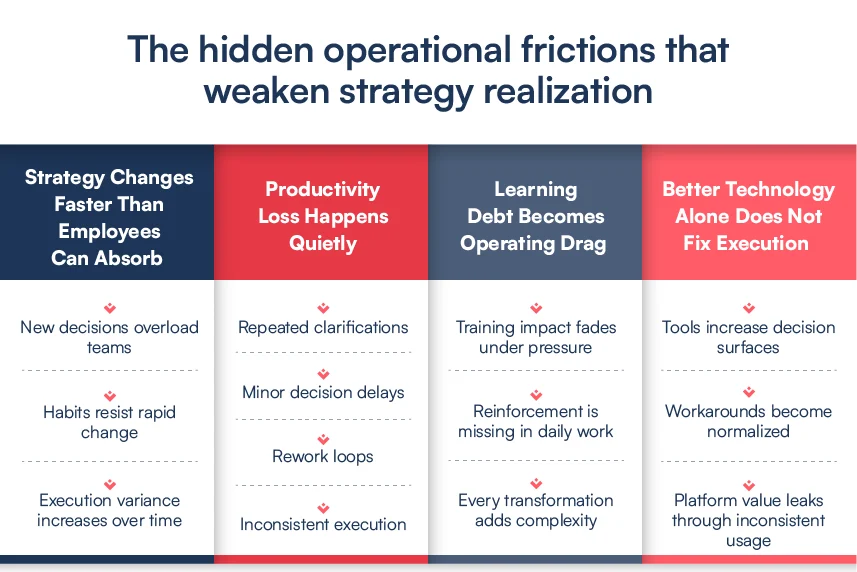
Leadership intent travels quickly through digital roadmaps, governance forums, and internal communications. However, human capability does not evolve at the same pace. Every strategic pivot introduces new decision-making expectations and trade-offs that often conflict with deeply ingrained habits. While an employee may intellectually understand a new strategy, they may struggle to apply it when faced with the pressure of daily operations.
Without reinforcement embedded directly into the tools employees use, adoption of new initiatives remains partial. This creates a "variance gap" where the distance between executive intent and frontline execution grows over time. This is particularly prevalent during periods of overlapping initiatives, where "change fatigue" sets in and employees revert to familiar, albeit outdated, work patterns.
The Accumulation of Learning Debt
Similar to "technical debt" in software development, "learning debt" accumulates when organizations implement changes without providing the necessary reinforcement for those changes to stick. Every transformation creates new requirements for knowledge. When formal training is delivered as a one-time event, its impact inevitably fades under the weight of operational pressure.
Learning debt acts as an operating drag, slowing down every subsequent change cycle regardless of the capital invested. When reinforcement is absent, the root issue is not a lack of effort from the workforce; it is the absence of a support structure aligned with real-world working conditions.
The SaaS Sprawl and the Productivity Paradox
Most modern enterprises operate on comparable technology stacks, utilizing a suite of CRM, ERP, and communication tools. However, the proliferation of these platforms has not always led to a corresponding increase in productivity. This "productivity paradox" occurs when the addition of more tools increases the number of "decision surfaces" without reinforcing the judgment required to navigate them.

Productivity erosion often occurs quietly through micro-frictions, such as:
- Fragmented decision-making across different platforms.
- Time lost to "context switching" as employees move between tasks.
- The use of informal, localized workarounds that bypass official processes.
- Inconsistent data entry or process compliance that degrades overall system quality.
In many digital transformations, the introduction of more tools has actually increased variance by creating more opportunities for error. Value leaks through these gaps, and over time, these informal workarounds become the de facto operating model, regardless of what the official process documentation states.
The Evolution of Workforce Enablement: A Chronological Context
The transition toward workflow-integrated learning nudges is the latest stage in a decades-long evolution of corporate education. Understanding this chronology helps explain why nudges have become the preferred lever for execution.
- The Era of Instructor-Led Training (1990s): Knowledge was disseminated in physical classrooms. While effective for deep learning, it was slow, expensive, and difficult to scale.
- The Rise of the LMS (2000s): Learning Management Systems allowed for the digitization of content. This solved the scale problem but separated learning from the actual work environment.
- The Microlearning Movement (2010s): Organizations began breaking content into smaller, more digestible "nuggets." This improved retention but still required employees to stop working to consume the content.
- The Workflow-Integrated Era (2020s-Present): Learning is now being "pushed" to the employee at the exact moment a decision is required, using AI and API integrations to provide context-aware support.
Case Studies: Moving from Awareness to Action
The theoretical benefits of nudge learning have been validated through practical application in large-scale enterprises. These success stories demonstrate how digital learning can move beyond simple awareness-building to become a critical mechanism for workforce enablement.
Case Study 1: Driving Decision Consistency in Global Operations
A major enterprise recently faced a challenge where, despite heavy investment in formal training, employees were unable to apply new compliance protocols consistently. Knowledge was being consumed, but it was not being operationalized.
Partnering with Harbinger Group, the organization moved from event-based training to workflow-integrated reinforcement using the SprinkleZone platform. Instead of increasing the volume of training materials, the team embedded short, context-relevant nudges at critical decision points within the company’s existing digital tools.
The results were immediate. By addressing the "forgetting curve" and providing guidance at the point of performance, the organization saw a significant reduction in process errors and a more predictable application of knowledge. This approach closed the strategy-to-execution gap by ensuring that the "how" of the strategy was always present where the work was happening.
Case Study 2: Stabilizing Execution Amidst Continuous Change
In another instance, an organization undergoing rapid business model shifts found its workforce overwhelmed. The constant influx of new ways of working led to engagement fatigue and a high rate of rework.
Rather than launching yet another large-scale training initiative, the organization utilized microlearning combined with workflow nudges to act as a stabilizing mechanism. These nudges provided "just-in-time" support, reducing the cognitive load on employees. By providing clarity exactly when it was needed, the organization improved employee engagement scores and preserved productivity levels even during periods of intense change.

Implementing a Nudge Strategy: A Practical Framework
For organizations looking to adopt workflow-integrated reinforcement, the process must be approached with the same rigor as any core business system. Implementation is not about adding "pop-ups"; it is about designing a system of execution reliability.
Identifying Execution Frictions
Effective adoption begins by identifying where execution actually slows down under real operating conditions. This requires looking beyond process documentation to find where employees are struggling or where workarounds have become common.
Design and Governance
Nudges must be designed to be helpful, not intrusive. Over-nudging can lead to "notification fatigue," causing employees to ignore the guidance. A disciplined governance model ensures that nudges are contextually relevant, timely, and aligned with current strategic priorities.
Measurement and ROI: From Leading to Lagging Indicators
To justify the investment in nudge learning, organizations must distinguish between early execution signals and downstream financial outcomes. Traditional metrics like "course completion" are replaced by "execution reliability" metrics.
Leading Indicators (Early Evidence)
- Reduced Decision Variance: A measurable increase in the consistency of actions taken across different teams.
- Lower Error Rates: A decrease in rework and compliance violations.
- Nudge Interaction Rates: High engagement with the nudges indicates they are providing value in the moment.
Lagging Indicators (Enterprise Value)
- Accelerated Cycle Times: Faster execution of core business processes.
- Revenue Growth: Directly linked to the successful implementation of new sales or operational strategies.
- Operating Margin Improvement: Reduced costs associated with inefficiency and error.
Workforce Enablement Indicators
The true value of this approach is often seen in "usage in context." When employees use nudges to successfully complete a task without needing to leave their workflow, it preserves executive confidence and ensures that financial outcomes will mature as planned.
Implications for the Future of Work
The shift toward nudge learning has profound implications for leadership, HR, and IT departments. It suggests that readiness is a structural issue, not just a cultural one.
- For Leadership: Competitive advantage is no longer defined by how clearly a strategy is articulated, but by how reliably it is absorbed. Execution must be treated as a system, not a hope.
- For HR and L&D: The role of the learning professional is shifting from "content creator" to "performance architect." They must understand workflows as deeply as they understand pedagogy.
- For IT: The integration of learning nudges requires a seamless digital ecosystem where tools can communicate and provide context-aware feedback to users.
Conclusion: Making Execution a System
Execution capability has become the primary differentiator in the modern enterprise. As the velocity of change continues to increase, the organizations that thrive will be those that can close the gap between strategy and action in real-time.
Workflow-integrated learning nudges become essential when execution drag persists despite mature systems, when inconsistency compounds faster than remediation, and when change velocity exceeds absorption capacity. By aligning strategy, workflows, and decision reinforcement, enterprises can convert high-level intent into consistent, scalable execution. The future of workforce enablement lies not in more training, but in better support at the moment of truth: where decisions actually happen.






