
The pursuit of top talent remains a critical, yet increasingly complex, objective for large organizations worldwide. As of 2026, the global hiring landscape is characterized by persistent challenges, necessitating urgent reform and the adoption of sophisticated strategies to secure the most skilled professionals. Data from various sources highlights a significant deficit: the United Kingdom alone faces a shortfall of 2.5 million highly skilled workers, a trend mirrored across many developed economies. Concurrently, a staggering 75% of organizations report substantial difficulty in filling full-time positions, underscoring a systemic struggle that impacts productivity, innovation, and competitive advantage. This pervasive talent crunch, exacerbated by evolving skill demands and a dynamic workforce, compels businesses to fundamentally re-evaluate their recruitment methodologies.
The Evolving Talent Landscape and Persistent Challenges
The year 2026 finds the global economy grappling with a confluence of factors contributing to the talent shortfall. Demographic shifts, including aging populations in many industrialized nations, have reduced the inflow of new entrants into the workforce, particularly in highly specialized fields. Furthermore, the rapid pace of technological advancement means that skill sets are constantly evolving, creating a widening gap between available talent and the competencies required for emerging roles, often referred to as the "skills gap." The lingering effects of the "Great Resignation" movement from the early 2020s have also fostered a more discerning workforce, prioritizing flexibility, purpose, and robust employer branding, further complicating traditional recruitment models.
Competition for talent is no longer confined to local markets; the rise of remote and hybrid work models has globalized the talent pool, intensifying the battle for specialized expertise. Large organizations, despite their resources, often struggle with the sheer volume of applications, the efficiency of their screening processes, and the ability to connect authentically with candidates. Delays in hiring, poor candidate experience, and an inability to accurately assess fit can lead to top prospects being poached by competitors. These pressures demand a strategic pivot towards proactive, technology-driven, and candidate-centric recruitment initiatives.
Embracing AI for Enhanced Sourcing and Screening
Artificial Intelligence (AI) has transcended its experimental phase in human resources and is now an indispensable tool in large-scale recruitment drives. By 2026, over half of all large organizations have already integrated AI into various stages of their hiring processes. The capabilities of AI-driven tools span from the automated generation of precise job descriptions to the sophisticated screening of countless CVs and the proactive identification of passive candidates across vast digital ecosystems.
AI’s ability to significantly expand sourcing reach is a game-changer. Rather than relying solely on conventional job boards, AI-powered algorithms can meticulously scan extensive talent pools across professional networking sites, social media platforms, academic databases, and even internal talent pools. These algorithms are designed to cherry-pick potential candidates based on predefined criteria, skills, and experience, identifying individuals who might otherwise remain undiscovered. This capability ensures a broader, more diverse, and highly relevant candidate pipeline.
Beyond sourcing, AI tools provide implicit accuracy in candidate screening. Modern AI-powered recruitment platforms analyze CVs, resumes, and portfolios against specific skill requirements, keywords, and role-related competencies. This automation drastically reduces the manual effort traditionally associated with initial candidate reviews, allowing human recruiters to focus on more nuanced assessments and direct engagement. Statistics reveal that approximately 70% of enterprise-size businesses now leverage AI-powered Applicant Tracking Systems (ATS) for CV screening, highlighting its widespread adoption and proven efficacy.
Investing in a cutting-edge ATS is paramount for streamlining the hiring pipeline. These systems are no longer just repositories for applications; they incorporate advanced features such as automated CV parsing, algorithm-informed candidate ranking based on predictive analytics, and smart scheduling tools that synchronize interview slots with candidate and interviewer availability. By simplifying the candidate selection process and accelerating hiring decisions, AI-powered ATS technology helps organizations secure top talent before they are courted by competitors. A recent Google Case Study demonstrated that ATS optimization can lead to a 70-80% reduction in manual screening time and enable organizations to hire workers twice as fast. This efficiency gain is crucial in a competitive market where time-to-hire can be a decisive factor.
Enhancing Job Description Performance with Smart Optimization Tools
The job description, often overlooked, serves as the initial gateway for potential candidates and a critical component of any recruitment strategy. Poorly optimized descriptions not only severely limit a job posting’s visibility across various platforms but can also adversely affect the quality of the applicant pool and, critically, introduce unconscious bias into the recruitment process. For large organizations aiming to attract and secure the industry’s best, relying on subpar job descriptions can be particularly damaging.
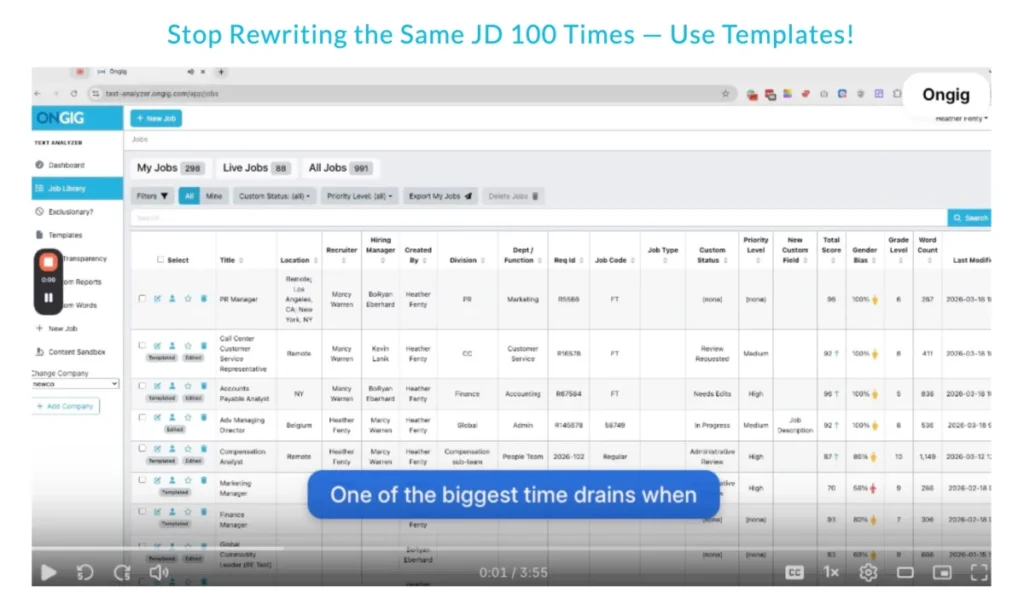
This is where specialized platforms like Ongig provide invaluable assistance. Ongig is a leader in improving job descriptions through data-driven insights. Its sophisticated tools analyze the structure, language, and inclusivity of hiring advertisements, offering concrete recommendations for improvement. This helps organizations craft descriptions that are not only more appealing but also more effective in reaching the desired talent demographic. For instance, large-scale HR teams can utilize Ongig’s resources, including quick demo videos, to understand how job description optimization works in practice. This includes identifying and removing biased language, improving readability scores to ensure clarity and conciseness, and optimizing for search engine visibility (SEO) on job boards and career sites.
The impact of well-optimized job descriptions extends beyond mere visibility. By using inclusive language and clearly articulating role requirements, organizations can attract a more diverse pool of candidates, addressing one of the key challenges in modern recruitment. Improved readability ensures that candidates quickly grasp the essence of the role and the company culture, leading to higher-quality applications from individuals who are genuinely a good fit. In a fiercely competitive hiring market, mastering the art of the job description is a fundamental step toward securing better-fit candidates for large-scale companies.
Prioritizing Proactive Talent Sourcing
In an environment where a reactive approach to hiring often yields unsatisfactory talent pools, proactive sourcing has emerged as an essential strategy. This methodology shifts the focus away from simply waiting for applications to come in, emphasizing instead the active identification and engagement of potential hires before a formal recruitment drive even begins. The core principle is to cultivate a robust pipeline of pre-qualified, ready-to-hire candidates.
Building relationships with best-fit talent ahead of a specific hiring need is central to proactive sourcing. This involves creating and nurturing talent community databases using platforms like LinkedIn Talent Hub, which allows recruiters to maintain ongoing engagement with potential candidates who possess critical skills. Direct outreach on professional social platforms, industry forums, and specialized communities enables recruitment teams to quickly connect with top talent within their respective industries, fostering relationships that can be leveraged when a suitable position opens.
Furthermore, some large organizations, such as the digital music giant Spotify, have successfully implemented effective employee referral programs. These programs capitalize on the existing networks of their current workforce, incentivizing employees to recommend qualified candidates. This strategy not only taps into a rich source of pre-vetted talent but also significantly reduces the time and cost associated with traditional recruitment methods. Spotify’s experience demonstrates the power of internal networks, enabling the company to fill an impressive 70% of its roles internally and effectively halve its hiring pipeline. Proactive sourcing, therefore, is not merely about finding candidates; it’s about strategic talent mapping and relationship building that ensures a continuous flow of high-caliber individuals.
Centralizing Recruitment Data for Enhanced Efficiency
A fragmented hiring process is a common pitfall for large organizations, often leading to significant pipeline delays and missed opportunities. When recruitment teams are forced to juggle multiple disparate HR systems, rely heavily on manual data entry, or operate with siloed information, the efficiency of the entire process suffers. This inefficiency is often the reason why top talent is snapped up by more agile competitors.
To combat this, centralizing recruitment data within a unified system is imperative. Solutions like Access PeopleXD Evo exemplify this approach by integrating the entire talent acquisition lifecycle into a single, comprehensive platform. This means that all candidate data—from initial application to onboarding—is stored in one accessible location, eliminating redundancies and ensuring data consistency.
Such centralization enables the automation of numerous routine recruitment tasks. These include automated CV screening and sorting based on customizable criteria, sending timely interview reminders to both candidates and hiring managers, and even performing automated compliance checks. By freeing HR teams from the burden of extensive manual administration, they can dedicate more time to strategic engagement, candidate nurturing, and developing effective talent acquisition strategies. The ability to accelerate the hiring pipeline through centralized data management is not just an operational advantage; it is a strategic imperative that directly impacts an organization’s capacity to secure and retain critical talent. Moreover, a centralized system provides invaluable analytics, offering insights into recruitment bottlenecks, candidate drop-off rates, and the effectiveness of different sourcing channels, enabling continuous process improvement.
Optimizing the Candidate Experience
In today’s competitive talent market, the candidate experience is paramount. A single negative experience can not only deter a promising applicant but also significantly damage an organization’s employer brand and reputation across the industry. This holds true regardless of a business’s size; every candidate interaction must uphold a high standard of communication, transparency, and efficiency.
For large organizations managing thousands of candidates during a single hiring session, maintaining a personalized and efficient experience manually is nearly impossible. This underscores the critical need to invest in automation specifically designed to streamline candidate communication efforts. Implementing automated status updates, for example, can keep potential hires informed at every stage of the hiring pipeline, from application submission to interview scheduling and final decisions. This proactive communication ensures that top talent remains engaged and does not feel overlooked or forgotten within a large applicant pool.
The impact of timely communication cannot be overstated. According to experts at OpenArc, a significant 62% of candidates lose interest if they do not receive feedback within a few weeks, and a substantial 48% have declined job offers due to excessively long hiring processes. These statistics highlight a critical competitive advantage: organizations that prioritize quick follow-up emails, implement automated status notifications, and maintain consistent communication channels are far more likely to retain candidate interest and secure their preferred hires in 2026. A positive candidate experience not only secures immediate hires but also fosters goodwill, potentially turning unsuccessful applicants into future advocates or even re-applicants.
Industry Perspectives and Broader Implications
Leading HR strategists and industry analysts unanimously agree that the current talent landscape demands a paradigm shift in recruitment. "The days of passive recruitment are over," states Dr. Evelyn Reed, a prominent HR technology consultant. "Organizations must adopt a proactive, tech-infused, and deeply human-centric approach. The blend of AI for efficiency and human empathy for engagement is the winning formula for 2026 and beyond." This sentiment is echoed by venture capitalists investing in HR tech, who foresee continued innovation in areas like predictive analytics for employee retention, advanced skill assessment platforms, and personalized learning and development tools integrated into the recruitment ecosystem.
The broader implications of these evolving recruitment strategies are profound. For the workforce, it means a more dynamic and meritocratic hiring environment, where skills are prioritized, and opportunities are more transparently presented. For organizations, the ability to consistently attract and retain top talent directly translates into sustained innovation, increased productivity, and enhanced competitive resilience. However, this shift also necessitates a focus on ethical AI usage, ensuring fairness, transparency, and the mitigation of algorithmic bias in hiring decisions. Governments and educational institutions also play a crucial role, needing to align curricula with industry demands and foster lifelong learning to bridge the persistent skills gap.
Wrapping Up
The hiring landscape in 2026 is undergoing a rapid and transformative evolution. The widespread adoption of AI, workflow automation, and real-time analytics marks just the beginning of a new, tech-infused HR sector. To optimize recruitment pipelines effectively, businesses must leverage technology to its fullest potential while simultaneously embracing innovative, proactive strategies to identify and engage top talent.
The era of merely posting a job and expecting an influx of qualified candidates is definitively over. Organizations that succeed in 2026 and beyond are those that actively source the best candidates, build meaningful relationships, and streamline their processes before the job application even goes live. This strategic imperative ensures not only the immediate fulfillment of critical roles but also the long-term health and growth of the organization in an increasingly competitive global economy. The future of large-scale recruitment is agile, intelligent, and deeply focused on both technological prowess and the human element of talent acquisition.






