Artificial intelligence is currently reshaping the landscape of global labor at a velocity that far exceeds the traditional capacity of organizational absorption. As Chief Learning Officers (CLOs), HR partners, and development leaders face unrelenting pressure to deploy AI-enabled tools and demonstrate immediate business impact, a significant disconnect has emerged between executive expectations and the lived experience of the workforce. While the corporate mandate focuses on upskilling and rapid adoption, many employees report a growing sense of exhaustion, uncertainty, and cognitive overload. This phenomenon, increasingly categorized as "AI fatigue," represents a critical inflection point in the digital transformation era.
The tension within modern organizations suggests that the primary barrier to digital evolution is not the technology itself, but rather the design of how learning is delivered and integrated. Crucially, contemporary research indicates that employees are not resisting the utility of artificial intelligence; rather, they are fatigued by a lack of clear expectations, the constant churn of new tools, and learning strategies that prioritize the speed of adoption over human readiness. To navigate this crisis, industry experts are advocating for a shift toward "AI fusion skills"—capabilities that move beyond simple tool mastery to emphasize human judgment, agency, and collaborative intelligence.
The Anatomy of the AI Fatigue Crisis
The current crisis is rooted in a dynamic where technological deployment is outpacing the human systems of support built to sustain it. The evidence of this disconnect is striking and backed by recent global data. According to research from The Upwork Research Institute, which surveyed 2,500 global workers including C-suite executives, a profound productivity paradox has emerged. While 96 percent of C-suite leaders expect AI to significantly boost worker productivity, 77 percent of employees report that these tools have actually increased their workload and hampered their efficiency.
The psychological toll of this gap is measurable. Nearly half of the global workforce—47 percent—admit they have no clear understanding of how to achieve the productivity gains their employers expect. This lack of clarity has led to a surge in burnout, with 71 percent of full-time employees reporting high levels of stress related to AI implementation. This data aligns with two decades of academic research on "technostress," a term defining the psychological strain individuals experience from the demands of using information systems. Studies by researchers such as Tarafdar, Cooper, and Stich demonstrate that rapid technological change inevitably increases burnout when job demands rise faster than employee autonomy and skill development.
In this environment, asking employees to simply "experiment" with AI without a structured framework does not foster innovation. Instead, it accelerates fatigue. Furthermore, a widening confidence gap is compounding the problem. Executives, who often have more autonomy and access to high-level strategic overviews, are adopting AI tools at significantly higher rates than frontline employees. This creates a disparity between the optimism at the top of the organizational chart and the reality of the daily workflow on the ground.
A Chronology of the AI Integration Cycle
To understand the current state of AI fatigue, it is essential to look at the timeline of the generative AI explosion and how it disrupted traditional organizational learning:
- November 2022 – Early 2023: The Catalyst Phase. The public release of generative AI models like ChatGPT sparked a global race. Organizations moved from curiosity to frantic experimentation, often bypassing traditional IT and HR vetting processes.
- Mid-2023 – Late 2023: The Proliferation Phase. Companies began integrating AI into standard software suites (Microsoft 365, Google Workspace, Adobe). Employees were suddenly confronted with AI "copilots" in every interface, leading to initial tool churn and fragmented workflows.
- Early 2024 – Present: The Realization Phase. The initial novelty faded, replaced by the realization that AI requires significant "prompt engineering" and fact-checking. This is where the productivity paradox became visible, as the time spent managing the AI began to rival the time saved by the AI.
- The Future: The Fusion Phase. Forward-thinking organizations are now moving away from tool-specific training toward durable human-machine collaboration frameworks, recognizing that the "human in the loop" is the most critical component of the system.
Defining AI Fusion Skills: The Accenture Framework
The concept of fusion skills, originally developed by Paul R. Daugherty and H. James Wilson of Accenture, offers a pedagogical way forward. In their research, including work published in the Harvard Business Review, they define fusion skills as the human capabilities required to work effectively with generative AI. Unlike technical proficiency, which may become obsolete as software evolves, fusion skills focus on judgment, problem framing, and accountability.
Daugherty and Wilson identify three core pillars of fusion skills:
- Intelligent Interrogation: This involves the ability to frame problems and inquiries in ways that allow AI to produce high-quality, relevant outputs. It is less about "coding" and more about linguistic precision and conceptual clarity.
- Judgment Integration: This is the critical capacity to evaluate AI-generated content for accuracy, bias, and ethical alignment. It requires the human user to act as a "chief editor," deciding when to trust the machine and when to intervene.
- Reciprocal Apprenticing: This describes a bidirectional learning relationship. Humans "teach" the AI by providing feedback and refining its models, while the AI "teaches" the human by uncovering patterns and insights that would otherwise remain hidden in large datasets.
By reframing AI as a "thinking partner" rather than a mere productivity shortcut, these skills help restore a sense of agency to the worker. When an employee understands how to frame a task and evaluate the result, the AI becomes a resource they control, rather than a mysterious force that threatens their professional relevance.

Strategic Priorities for Learning and Development Leaders
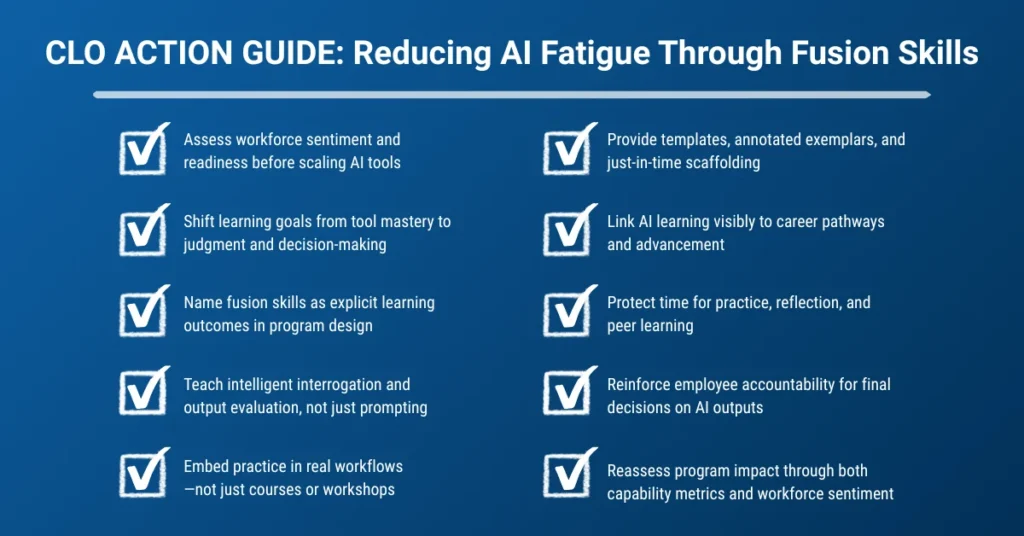
For CLOs and L&D leaders, the objective is not to slow down AI adoption, but to redesign how learning occurs. The following strategic priorities, grounded in current research from organizations like SHRM and Harvard Business Publishing, provide a roadmap for sustainable integration.
Assessing Workforce Sentiment Before Scaling
Before deploying the next enterprise AI capability, organizations must invest in understanding employee readiness. SHRM’s analysis suggests that tailoring adoption strategies to specific departmental needs—rather than applying a top-down, one-size-fits-all approach—significantly reduces resistance. Pulse surveys and focus groups can reveal the specific "friction points" where AI is currently hindering rather than helping.
Making Fusion Skills Explicit Outcomes
Learning programs must move beyond "how-to" tutorials for specific software. Instead, they should focus on assessable outcomes in intelligent interrogation and judgment integration. When employees see that they are building transferable judgment skills—capabilities that will remain valuable even if a specific tool is replaced in 18 months—their engagement increases. This shifts the perception of AI training from a compliance burden to a career-building opportunity.
Embedding Learning Within the Workflow
Research from Harvard Business Publishing Corporate Learning and Degreed highlights a critical finding: AI-fluent individuals are twice as likely to report learning through hands-on experimentation embedded in their daily tasks compared to their less-fluent peers. The primary barrier to scaling AI fluency is not a lack of motivation, but a lack of organizational support. L&D leaders must provide "learning labs" and protected time where employees can practice AI-assisted tasks without the immediate pressure of high-stakes deadlines.
Supporting Capacity and Reducing Cognitive Load
AI fatigue is often a reflection of genuine workload overload. Learning leaders should advocate for "scaffolding"—providing prompt templates, annotated examples, and decision frameworks that reduce the cognitive effort required to use new tools. Reducing cognitive load during the initial learning phase is not a sign of weakness in the workforce; it is a fundamental principle of sound instructional design.
Broader Implications and the Future of Work
The shift toward fusion skills has profound implications for the future of the corporate hierarchy. As AI takes over more routine cognitive tasks, the value of human labor will increasingly be found in "soft" skills that were previously undervalued: empathy, ethical reasoning, complex problem-framing, and cross-functional leadership.
Organizations that successfully bridge the AI fatigue gap will gain a significant competitive advantage. This advantage will not stem from having the fastest algorithms, but from having a workforce that knows how to think, judge, and decide alongside those algorithms. This is a socio-technical challenge that requires a human-centric solution.
The most resilient organizations of the next decade will not be those that automate the most jobs, but those that invest most deeply in their people’s ability to navigate a hybrid intelligence environment. As the "Hype Cycle" of AI settles into a "Plateau of Productivity," the role of L&D will be more central than ever. The goal is clear: move from a state of technological overwhelm to a state of genuine human-machine fluency.
In conclusion, AI fatigue is a signal that the current model of workplace learning is broken. It is a design problem that requires a pedagogical shift. By prioritizing fusion skills and human agency, organizations can transform AI from a source of burnout into a catalyst for professional growth and durable business impact. The future of work is not a choice between humans or machines; it is the sophisticated fusion of both.