The perennial challenge of efficiently writing, updating, and managing job descriptions (JDs) has long plagued human resources departments and talent acquisition teams across industries. What might seem a straightforward administrative task for smaller organizations, with a limited number of annual hires, quickly escalates into a complex, resource-intensive undertaking as companies scale. In today’s dynamic labor market, effective job descriptions are no longer mere administrative documents; they are critical marketing tools, shaping employer brand, influencing candidate perception, and directly impacting the quality and diversity of an organization’s talent pipeline.
The modern hiring landscape demands JDs that are not only detailed, accurate, and consistent but also objective, inclusive, and compliant with an ever-changing mosaic of regulations. The sheer volume of job descriptions in a growing enterprise—potentially hundreds or even thousands—spread across disparate systems like shared drives, email inboxes, Applicant Tracking Systems (ATS), and spreadsheets, creates a logistical nightmare. When a single compliance requirement shifts, manually updating every iteration becomes an almost impossible feat, introducing significant legal and operational risks. This formidable challenge has driven many talent teams toward embracing centralized job content management solutions, moving away from the fragmented approach of treating each job description as an isolated document.
The Evolving Significance of Job Descriptions
Historically, job descriptions served primarily as internal blueprints for roles, outlining responsibilities and required qualifications. Their external function was largely perfunctory, a basic listing for job boards. However, the digital age, coupled with a fiercely competitive talent market and a heightened focus on diversity and inclusion, has transformed the JD into a pivotal component of a company’s recruitment strategy. An effective job description is now instrumental in creating a diverse hiring pipeline, reducing churn during the hiring process, and ultimately securing top talent. Poorly crafted or managed JDs can deter qualified candidates, damage employer reputation, and lead to costly mis-hires. According to a Career Plug report, a significant 52% of job seekers have declined opportunities due to negative experiences with prospective employers, underscoring the profound impact of every touchpoint in the recruitment journey, including the initial job advertisement.
Addressing the Multilayered Challenges of JD Management
The core difficulty isn’t solely about drafting a compelling job description; it’s about maintaining a high standard across an entire organizational ecosystem of roles. For smaller firms, the infrequent nature of JD creation can lead to less objective, less professional, or inconsistent output from HR managers and recruiters who lack frequent practice. Conversely, larger organizations face the monumental task of ensuring uniformity in content, format, and language when multiple individuals across various teams are responsible for drafting. This often results in a patchwork of JDs that fail to adhere to company standards, potentially alienating candidates or creating compliance vulnerabilities.
This is where automated job description builders, such as Ongig’s Text Analyzer, emerge as transformative solutions. These platforms are designed to streamline the entire JD lifecycle, from initial creation to ongoing management and optimization, at scale.
Ongig’s Text Analyzer: A Deep Dive into Smarter Recruitment
Ongig’s automated job description builder offers a comprehensive suite of features engineered to address the complexities of modern talent acquisition. At its heart lies a philosophy of centralized content management and AI-driven optimization.
1. Centralized Job Library: The Single Source of Truth
One of the most significant pain points for organizations managing numerous job descriptions is the lack of a unified, searchable repository. Ongig’s centralized Job Library provides hiring teams with a single source of truth for every job description. This eliminates the chaos of tracking files across fragmented systems, allowing recruiters, HR teams, compensation analysts, and hiring managers to operate from a consistent, up-to-date system. The library incorporates essential features such as robust version history, customizable fields for specific organizational needs, classification by job families, unique requisition IDs, and the capacity for unlimited job volume. This infrastructure ensures consistency across all roles without adding cumbersome administrative overhead.
2. AI-Powered Creation for New Job Descriptions
For teams starting from scratch, Ongig’s Text Analyzer acts as an intelligent guide. The process begins simply by inputting a job title into the tool. For instance, typing "Web Developer" triggers the system to offer relevant sections to include, drawing from custom templates or research-backed recommendations by Ongig. Users can select desired sections and, with a click of the "Generate Now" button, the AI drafts a comprehensive job description. This initial draft serves as a solid foundation, which can then be refined by the team to perfectly align with the specific requirements of the position. This capability dramatically reduces the time spent on initial drafting, freeing up valuable recruiter time.
3. Content Optimization: Enhancing Readability and Inclusivity
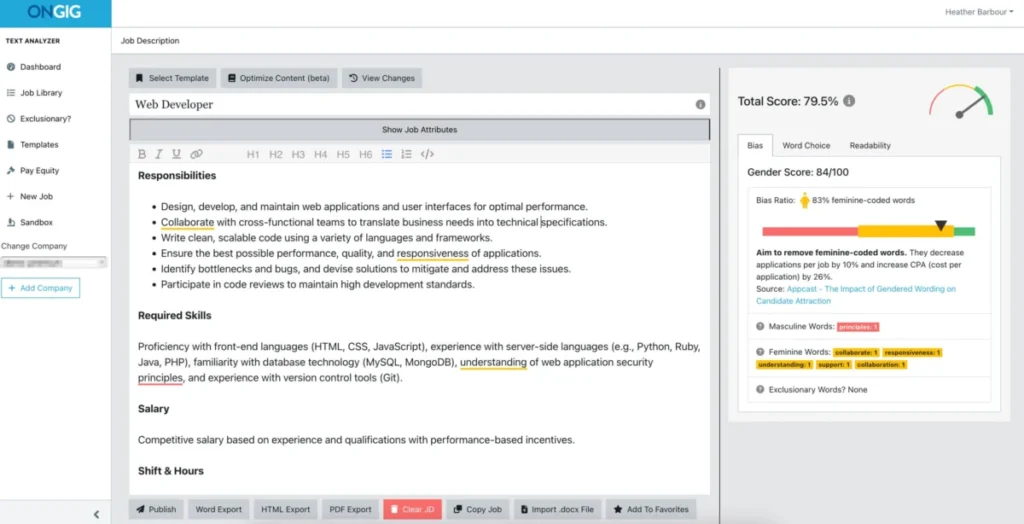
Beyond initial drafting, the Text Analyzer offers sophisticated tools for content refinement. The "Optimize Content" and "Rewrite Now" functions actively work to reduce masculine bias and improve sentence structure for clarity and conciseness. A key feature is the "Readability Score" under the "Section Finder" tab, which evaluates the JD’s appeal to quality candidates. This section also highlights critical JD elements, such as "Required Skills," "Diversity & Inclusion" statements, and "Mission Statement," explaining their importance with supporting workforce data. For example, the platform notes that 32% of working professionals would consider a pay cut to relocate if offered a remote work opportunity, underscoring the strategic value of including a "Flexible Location" section when applicable.
The tool’s AI actively identifies potential biases. Hovering over an underlined word, such as "support," reveals its feminine-coded association, and the platform suggests neutral alternatives like "help" or offers the option to remove it entirely. This extends to identifying and flagging "exclusionary words," ensuring that job postings are maximally inclusive. Optimizing content with Text Analyzer typically leads to a measurable increase in the readability score, as demonstrated by an example where a job’s score rose from 79.5% to 83.3% after AI-driven improvements. This iterative process of detection and suggestion empowers teams to create truly gender-neutral and inclusive job descriptions, which research indicates can significantly broaden the talent pool. Workplace surveys, for instance, reveal that diverse companies outperform their less inclusive competitors with a 36% increase in profitability, while objective, skills-based hiring increases the likelihood of organizations meeting their hiring targets by 2.6 times.
4. Ensuring Robust Compliance and Mitigating Risk
Compliance is a continuous concern, not a one-time check. The real challenge lies in ensuring that every job description remains compliant as regulations evolve. Ongig’s platform addresses this by allowing teams to update approved language once and propagate those changes across their entire job content library. Features like built-in approval workflows, comprehensive revision tracking, explicit pay transparency guidance, and audit-ready version history are crucial for reducing compliance risk. These tools provide HR teams with granular visibility into every update, safeguarding against potential legal issues.
The Text Analyzer is designed to keep JDs aligned with the latest regulatory standards, including OFCCP rules, which are critical for federal contractors. By simply clicking a checkbox, the platform can analyze JDs for instances of discrimination, ensuring merit-based talent acquisition decisions. This capability helps companies streamline hiring contracts and solidify their reputation as equal employment opportunity (EEO) employers. EEO branding not only establishes trust among candidates, investors, and partners but also improves employee engagement, leading to a higher quality of hire and reduced workplace dissatisfaction. In an environment of evolving federal guidelines concerning diversity and inclusion practices, such as those emphasizing merit-based hiring criteria, automated compliance checks become indispensable.
5. Updating Existing Job Descriptions with Efficiency
Even organizations with extensive existing JD libraries benefit immensely from an automated builder. Legacy job descriptions can quickly become outdated, inconsistent, or non-compliant. Ongig’s Text Analyzer reviews existing JDs for quality, consistency, and language, enabling mass updates. Customers have leveraged it to remove biased language and reduce jargon, leading to improved conversion rates from prospective employees. The automation aspect significantly reduces the costly human labor involved in reviewing and updating thousands of documents. For teams preferring manual updates, the tool still offers immense value by scoring JDs based on readability and inclusivity, providing concrete suggestions for improvement and facilitating comparative analysis across different roles. Replacing complex, "legal-sounding" language with plain, accessible terms further enhances candidate engagement and attraction.
6. Large-Scale Reformatting and Template Enforcement
The task of reformatting and updating a large volume of job descriptions is often overwhelming. Text Analyzer’s automation capabilities simplify this process by comparing existing JDs against preferred templates, making edits to improve readability, clarity, and consistency. It can automatically populate missing sections with company-wide standards, such as details on salary, benefits, and the hiring process. This templating functionality is a cornerstone for maintaining consistency across an organization, drastically reducing the person-hours required for updates. Crucially, templates within Text Analyzer can be customized to fit specific company needs and then locked to prevent unauthorized edits, ensuring continuous compliance and brand consistency.
7. Bridging the Gap Between Descriptions and Postings
An internal job description often differs significantly from an external job posting, which needs to be a compelling advertisement. Ongig’s AI-driven platform offers a seamless way to reformat internal JDs into attractive, candidate-centric job postings with the click of a button. This shortcut dramatically boosts the talent acquisition team’s efficiency and speed-to-market. The platform also optimizes job postings for SEO, enhancing their visibility on job boards and improving candidate conversions. By prioritizing sections that matter most to modern job seekers—such as "What You’ll Do," "Salary," and "Making an Impact"—Ongig ensures that postings resonate with the target audience and align with the latest job seeker trends.
8. Strategic Job Content Management vs. Basic Templates
While a thoughtfully designed job description template can address many recruiting issues by fostering consistency and inclusivity, true job content management offers a far more strategic advantage. Ongig’s automated builder works synergistically with existing templates or provides recommended ones, allowing for customization of tone and recruiting priorities while locking in standard features for organizational consistency. The platform integrates seamlessly with existing ATS and HRIS systems through both one-way and two-way integrations. This ensures that the ATS, job library, and career site remain synchronized, eliminating manual copy-pasting, version confusion, and ensuring that all stakeholders work from the same authoritative source of truth when job content changes. Furthermore, Ongig offers a flexible, tiered system that adapts to an organization’s evolving needs, ensuring that companies only pay for the tools essential for their current growth phase.
Proven Impact: Success Stories in Diverse Sectors
The efficacy of Ongig’s automated job description builder is evident in its real-world applications across various industries:
- Global Employment Website: A global employment website, utilizing Text Analyzer across its 60,000 job postings, observed a remarkable 133% increase in total application starts and a 21% rise in applications from women, demonstrating the power of inclusive language in broadening candidate pools.
- Healthcare Sector Achievements: In healthcare, where precise JDs are paramount, one client successfully revamped over 5,000 job postings to standardize and infuse inclusivity. Another healthcare client, managing over 100,000 job postings monthly, achieved complete automation, significantly streamlining their recruitment processes.
- Entertainment Industry Transformation: An enterprise in the entertainment sector witnessed a 100% increase in candidate quality after revamping its job descriptions for inclusivity and consistency, proving how effective JDs attract top-tier talent.
- Aerospace and Insurance Sectors’ Strides: An aerospace technology agency successfully tackled gender imbalance in traditionally male-dominated fields like engineering and finance, seeing a 22% increase in female applicants through Text Analyzer. Similarly, a large insurance organization leveraged the tool to target underrepresented groups, resulting in a four-fold increase in applications from these demographics.
These case studies, featured in Ongig’s public demonstrations, underscore the tangible return on investment in terms of diversity, efficiency, and overall quality of hire. They highlight how nuanced changes in language and process, facilitated by automation, can yield profound results in recruitment outcomes.
The Future of Talent Acquisition: Integrated Solutions
Beyond optimizing individual job descriptions, the future of talent acquisition lies in integrated solutions that enhance the entire candidate journey. While creating a great job description is half the battle, candidates still need an intuitive way to find and engage with it. Ongig’s broader ecosystem, including its Career Site Builder, transforms optimized job descriptions into mobile-friendly, SEO-optimized job pages that remain seamlessly synced with the ATS. This holistic approach, offering department-based navigation and AI-powered job search functionalities, enables employers to craft a superior candidate experience without burdening recruiters with additional manual work.
In conclusion, the complexities of managing job descriptions in an era of rapid organizational growth, evolving compliance standards, and a critical focus on diversity and inclusion necessitate intelligent, automated solutions. Automated job description builders like Ongig’s Text Analyzer provide the tools to not only save significant time and resources but also to elevate the quality, consistency, and inclusivity of job advertisements, ultimately empowering organizations to attract and secure the best talent in a competitive global market.