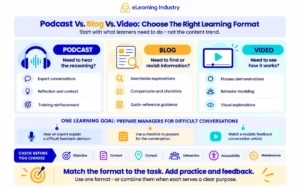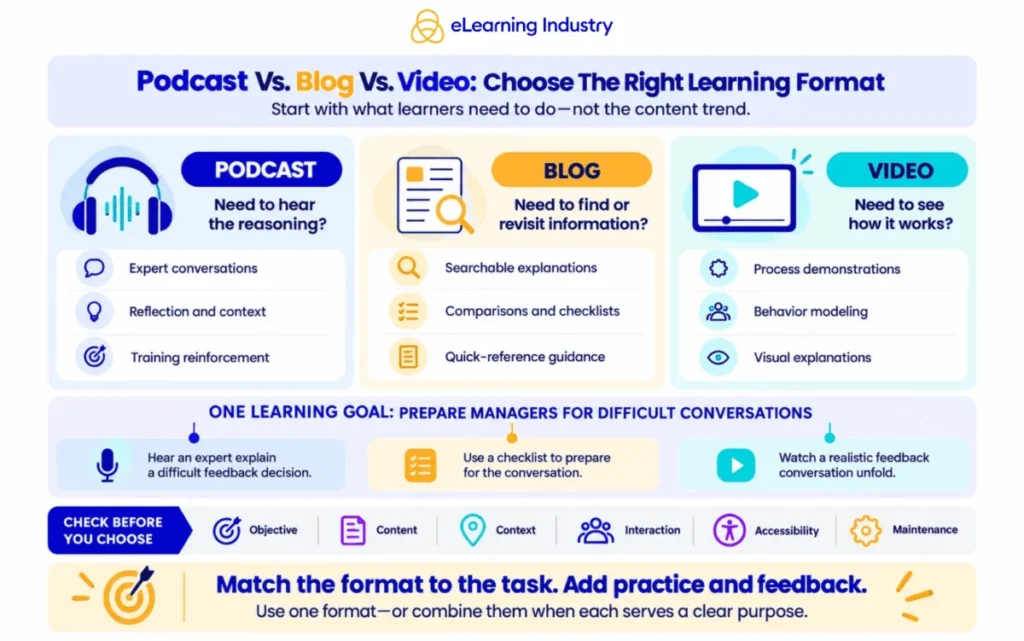
The core challenge for contemporary L&D teams lies in moving away from a "content-first" mentality toward a "challenge-first" strategy. Rather than deciding to produce a podcast because it is a trending medium, experts argue that the decision must be rooted in the specific performance gap being addressed. For instance, a manager preparing for a high-stakes performance review may require a multi-faceted approach: an expert interview via podcast to understand the psychology of feedback, a text-based checklist for immediate preparation, and a video demonstration to observe non-verbal cues and tone. Each format serves a distinct cognitive function, and understanding these nuances is essential for maximizing the return on investment in corporate training.
A Comparative Analysis of Delivery Formats
The fundamental difference between podcasts, blogs, and videos lies in their delivery mechanism and the cognitive load they impose on the learner. Podcasts, defined here as spoken-word audio content, are characterized by their temporal nature; information is delivered over a specific duration and is often consumed linearly. Conversely, blogs and written articles offer a spatial advantage, allowing readers to scan for keywords, skip to relevant sections, and revisit complex technical details at their own pace. Videos introduce a third dimension—motion and visual sequences—which are indispensable for demonstrating physical tasks or modeling interpersonal behaviors.
Despite these differences, instructional designers emphasize that format alone does not dictate efficacy. Effectiveness is instead a product of how well the medium aligns with the learner’s environment and the complexity of the subject matter. While podcasts allow for "eyes-free" learning during commutes or manual tasks, they lack the visual detail necessary for software tutorials. Blogs provide excellent reference material but may fail to capture the nuance and emotional resonance of a leadership discussion.
The Strategic Role of Podcasts in Modern Learning
Podcasts have seen a significant surge in workplace adoption, largely due to their low barrier to entry for consumption and their ability to humanize expert insights. Audio is uniquely suited for exploring "gray areas" such as leadership judgment, project post-mortems, and customer empathy stories. By hearing the cadence, hesitation, and emphasis in an expert’s voice, learners gain a deeper understanding of the reasoning behind a decision—information that is often lost in a sterilized written summary.
However, the "passive" nature of listening presents a hurdle for retention. Research conducted in 2020, involving a randomized trial of 137 emergency medicine trainees, demonstrated that the inclusion of "interpolated questions"—questions placed periodically within the audio—significantly improved knowledge acquisition and long-term retention. This suggests that for podcasts to be effective pedagogical tools, they must be designed with active recall in mind. L&D teams are encouraged to provide reflection prompts before the episode and retrieval questions afterward to ensure the information moves from short-term to long-term memory.
Blogs and Articles: The Foundation of Performance Support
While podcasts excel at nuance, blogs and articles remain the gold standard for performance support and technical reference. In a high-pressure work environment, employees frequently need "just-in-time" information. A manager looking for a specific escalation protocol or a developer searching for a syntax rule cannot afford to scrub through a 30-minute audio file. Text-based resources allow for rapid navigation through headings, bullet points, and tables.
Academic research, including a notable dissertation from the University of Maryland involving 130 undergraduates, indicates that while recall and inference levels are often comparable between print and audio, print provides a distinct advantage in identifying and synthesizing main ideas. The ability to control the speed of consumption and physically locate information on a page (or screen) reduces cognitive strain during complex tasks. Consequently, articles are the preferred format for policy explanations, technical comparisons, and any content requiring frequent updates or cross-referencing.
Video: The Necessity of Visual Modeling
Video remains the most resource-intensive format but is often the most necessary when the learning objective involves motion, sequence, or behavioral modeling. In scenarios such as software training, equipment maintenance, or coaching simulations, the "show, don’t tell" principle applies. Video allows learners to observe the subtle differences between an effective and an ineffective response, providing a visual benchmark that text and audio cannot replicate.
The primary risk with video is "mind-wandering," where the learner becomes a passive observer rather than an active participant. Experimental data involving 80 students showed that adding frequent memory tests to online video lectures not only reduced mind-wandering but also led to superior learning outcomes. To optimize video for learning, instructional designers should incorporate "pause-and-reflect" moments, interactive decision-making branches, and concise segments to prevent cognitive overload.
Chronology and Evolution of Media in L&D
The shift toward this multimodal approach has followed a clear chronological trajectory over the last three decades. In the 1990s, digital learning was dominated by text-heavy Computer-Based Training (CBT) modules delivered via CD-ROM. The early 2000s saw the rise of the Learning Management System (LMS) and the introduction of basic video conferencing. By the 2010s, the "YouTube-ification" of learning occurred, with a massive influx of video content, often at the expense of pedagogical quality.
Today, we are in an era of "curated ecosystems." The modern L&D timeline is defined by the integration of these formats. Rather than a single 60-minute e-learning course, a 2024 training program typically looks like a chronological journey:
- Week 1: A 10-minute podcast episode introducing the "Why" through an executive interview.
- Week 2: A short video demonstration of the "How."
- Week 3: A searchable blog post or "cheat sheet" for on-the-job application.
- Week 4: A live or recorded peer discussion to solidify the "What next."
The 7-Factor Framework for Content Selection
To assist L&D leaders in making objective decisions, industry experts have developed a 7-factor framework. This checklist ensures that the chosen medium serves the learner and the organization efficiently:
- Objective: What is the intended behavioral change? (e.g., "Lookup" vs. "Practice").
- Content: Does the material require visual sequences or is it purely conceptual?
- Context: Where will the learner be? (e.g., at a desk, in a vehicle, or on a factory floor).
- Interaction: How will the learner engage with the material and receive feedback?
- Accessibility: Does the format meet W3C standards, including transcripts and captions?
- Maintenance: How frequently will this information change? (Text is cheap to update; video is expensive).
- Budget: What is the total cost of ownership, including production, hosting, and translation?
Broader Impact and Organizational Implications
The implications of choosing the right format extend beyond individual learning scores; they impact organizational agility and inclusivity. From an accessibility standpoint, the World Wide Web Consortium (W3C) emphasizes that no format is truly "best" if it excludes segments of the workforce. A video without captions or a podcast without a transcript creates barriers for employees with disabilities. Therefore, a professional L&D strategy must involve "alternative format" planning from the inception of the project.
Furthermore, the "Maintenance" factor of the framework highlights a critical business reality: the half-life of knowledge is shrinking. In industries like software engineering or healthcare, information can become obsolete in months. Organizations that over-invest in high-production-value videos for rapidly changing topics find themselves with "technical debt" in their learning libraries—outdated content that is too expensive to reshoot. A more agile approach favors text for volatile information and reserves high-production video and audio for evergreen cultural and foundational skills.
Conclusion: Orchestrating the Multimodal Future
Ultimately, the debate of "Podcast vs. Blog vs. Video" is a false dichotomy. The most effective Learning and Development departments are those that act as orchestrators, blending these mediums into a cohesive learning journey. By matching the format to the cognitive task—audio for reflection, text for reference, and video for demonstration—organizations can create a more resilient and capable workforce.
As workplace learning continues to integrate with daily workflows, the focus will shift further away from the "production value" of the content and toward its "utility value." The goal is not to entertain, but to empower. Whether through the ears, the eyes, or the written word, the best format is the one that provides the most direct path from "not knowing" to "doing." In the modern economy, where skills are the primary currency, the ability to choose the right delivery vehicle for those skills is a significant competitive advantage.