
The global landscape of professional development is undergoing a fundamental transformation as traditional, synchronous training models give way to flexible, on-demand digital solutions. In this shifting environment, podcasts have emerged as a primary vehicle for knowledge transfer, offering a unique blend of convenience, expert access, and narrative-driven instruction. As workplaces become increasingly decentralized and the demand for continuous upskilling intensifies, podcasts for learning are no longer viewed merely as supplementary entertainment but as a critical component of a modern learning and development (L&D) strategy. This evolution reflects a broader trend toward "micro-learning" and "learning in the flow of work," where professionals integrate educational content into their daily routines rather than setting aside dedicated hours for classroom-style instruction.
The Evolution of Audio Learning: From Radio to RSS
The rise of podcasts as a professional resource is rooted in the technological convergence of the early 21st century. While audio learning has existed for decades—ranging from educational radio broadcasts in the 1940s to "books on tape" in the 1980s—the birth of the podcast in 2004, facilitated by RSS (Really Simple Syndication) and the proliferation of portable MP3 players, changed the accessibility of the medium. What began as a hobbyist platform has matured into a multi-billion-dollar industry. According to industry data from Edison Research, the number of monthly podcast listeners has seen a consistent double-digit growth rate over the past decade, with a significant portion of the audience citing "self-improvement" and "professional growth" as primary motivators for tuning in.
For Instructional Designers and L&D leaders, this technological maturity provides a scalable way to deliver content that bypasses the "zoom fatigue" associated with video-heavy remote work. By removing the visual requirement, podcasts allow for a different type of cognitive engagement, one that leverages the power of storytelling to make complex topics more digestible and memorable.
The Strategic Role of Instructional Designers
Instructional Designers (IDs) are increasingly leveraging podcasts to bridge the gap between formal education and real-world application. Rather than replacing comprehensive courses, podcasts are being used to extend the "half-life" of training. Christopher Pappas, CEO and Founder of eLearning Industry, notes that learning often happens most effectively outside the classroom environment. According to Pappas, when professionals find the information they need at the exact moment of need, the retention rate increases significantly. Podcasts facilitate this "just-in-time" learning, allowing employees to stay curious and adapt as the workplace undergoes rapid technological changes.
IDs utilize podcasts to reinforce learning, encourage deep reflection, and provide a platform for expert perspectives that might not be available within a company’s internal staff. By integrating audio content into a broader curriculum, designers can create a "flipped classroom" model where foundational knowledge is delivered via podcast, leaving precious synchronous time for hands-on practice and collaborative problem-solving.
Quantitative Impact and Supporting Data
The shift toward audio-based learning is supported by compelling data regarding human attention and habit formation. Research indicates that the average professional has approximately 24 minutes a week to devote to formal learning. However, the same professional may spend several hours a week commuting, exercising, or performing routine tasks. Podcasts reclaim this "lost time," transforming dead air into productive development opportunities.
Market analysis from Statista suggests that by 2024, the number of podcast listeners worldwide will exceed 500 million. Within the corporate sector, a survey of L&D professionals revealed that nearly 40% of organizations are either currently using or planning to implement internal podcasts as part of their employee engagement and training initiatives. This data underscores a growing recognition that the flexibility of audio content aligns perfectly with the needs of a mobile, overworked workforce.
Mechanics of Effectiveness: Why Audio Works for the Brain
Podcasts are effective for learning because they align with how humans naturally build knowledge over time. Unlike a single-day seminar, which often leads to information overload, podcasts offer steady, incremental exposure to new ideas. This approach supports the "spacing effect," a psychological phenomenon where information is better retained when learning sessions are spaced out over time.
Continuous Learning and Adaptability
For L&D professionals, staying current is a professional requirement. As artificial intelligence and automation reshape industries, the ability to pivot and learn new skills is paramount. Podcasts provide a low-friction way to stay informed about industry trends, fresh methodologies, and emerging technologies without the overhead of formal enrollment.
The Power of Reflective Learning
Audio content encourages a specific type of mental processing. Without the distraction of visuals, listeners are often more prone to "mental modeling"—the process of visualizing concepts and connecting them to existing knowledge. When a listener pauses an episode to consider how a guest’s advice applies to their specific project, they are moving from passive consumption to active, reflective learning.

Accessibility to Global Thought Leadership
Perhaps the most significant advantage of the podcast medium is the democratization of expertise. A junior designer in a remote location can listen to a detailed interview with a world-renowned researcher or a Fortune 500 executive. This direct access to the "inner monologue" of industry leaders provides a level of context and nuance that textbooks often lack.
Implementation Strategies for Training Programs
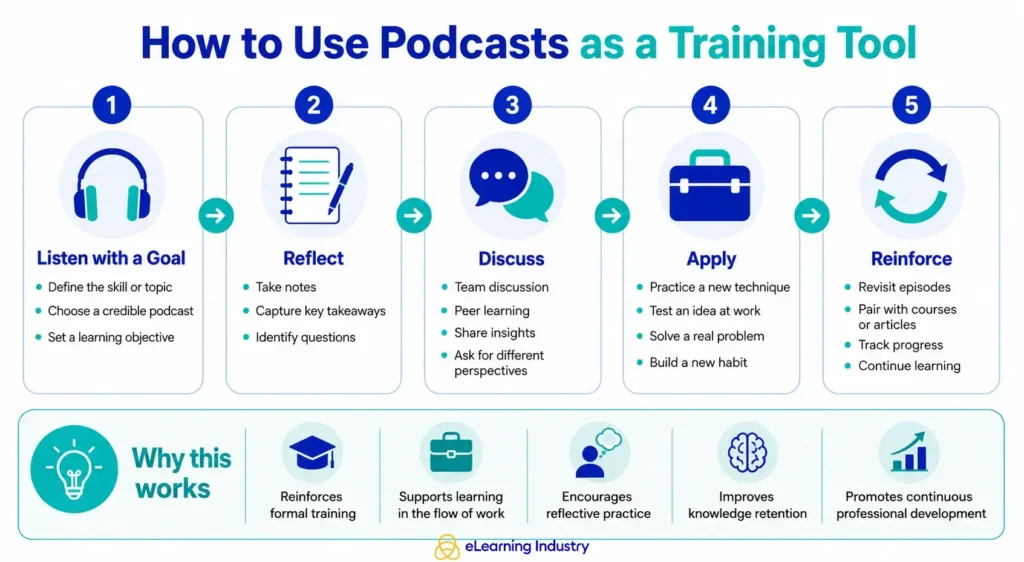
To maximize the value of podcasts, Instructional Designers must move beyond simply sharing links. Effective integration requires a structured approach that spans the entire learning journey.
Pre-Training Priming
Podcasts serve as an excellent "hook" to generate interest before a formal course begins. An episode featuring a case study or a provocative interview can set the stage, ensuring that all participants arrive with a baseline understanding of the topic and a shared vocabulary.
Active Engagement During Training
Within a structured program, podcasts can be used as the basis for group discussions. Learners might be tasked with listening to a specific segment and then debating the merits of the expert’s approach. This turns the audio into a catalyst for social learning.
Post-Training Reinforcement
To combat the "forgetting curve," IDs can schedule podcast "nudges" in the weeks following a workshop. These episodes can review key concepts, provide updated information, or offer advanced tips that build upon the initial training.
Leadership and Executive Development
Leadership training often requires a focus on "soft skills" like empathy, communication, and strategic thinking. Podcasts are uniquely suited for this, as the intimacy of the human voice is particularly effective at conveying tone, emotion, and the subtle complexities of human management.
Addressing the Limitations of Audio Learning
Despite their benefits, podcasts are not a universal solution. Professional journalists and L&D experts point to several common pitfalls that must be managed to ensure the medium remains an effective tool for growth.
- The Passive Listening Trap: The very flexibility that makes podcasts popular—the ability to listen while doing other things—can lead to shallow engagement. Without intentional focus, the content may become "background noise" rather than a learning experience.
- The Absence of Practice: Audio learning is inherently theoretical. It cannot replace the "doing" part of learning. Therefore, podcasts must be paired with practical exercises, simulations, or on-the-job applications.
- Vetting for Quality and Accuracy: The low barrier to entry in podcasting means that misinformation can spread easily. Organizations must curate "verified" playlists and encourage employees to critically evaluate the credibility of the sources they consume.
- Lack of Assessment: Unlike an LMS-based course, a standard podcast does not offer a way to track comprehension or completion. To solve this, many companies are integrating "audio quizzes" or requiring brief written reflections to validate the learning.
Future Implications: AI and Personalization
Looking forward, the integration of Artificial Intelligence (AI) is set to further enhance the value of podcasts for learning. AI tools can now generate accurate transcripts, create searchable indexes of audio libraries, and even summarize hour-long episodes into five-minute "key takeaway" briefs. This allows professionals to treat podcasts like a reference library, quickly finding the specific segment of an interview that addresses a current problem.
Furthermore, the rise of "internal-only" corporate podcasts allows organizations to share proprietary knowledge, culture, and updates in a format that feels more personal than a mass email or a static intranet page. As 5G technology makes high-quality audio streaming even more seamless, the "audio-first" approach to professional development is expected to become a standard expectation for the global workforce.
Conclusion
Podcasts for learning represent a sophisticated evolution in the way professionals acquire and retain knowledge. By moving beyond the confines of the traditional classroom and fitting into the margins of a busy life, they support a culture of lifelong learning and agility. For the Instructional Designer, the challenge lies in moving from curation to integration—ensuring that podcasts are not just "extra resources" but are woven into the fabric of a comprehensive development strategy. When executed with a clear purpose, high-quality audio content has the power to transform the workforce into a more informed, reflective, and capable community, ready to meet the demands of an ever-changing professional world.






