
In an increasingly competitive global talent market, organizations are grappling with a silent but costly challenge: the last-minute withdrawal of job offers by candidates, commonly known as reneges. This phenomenon, which often leaves companies scrambling to backfill critical roles, represents a significant drain on resources, time, and morale. Historically, many recruitment programs have lacked a structured process to anticipate and mitigate these withdrawals, with teams typically becoming aware only after a candidate has already made the decision to disengage. By the time a candidate falls silent, their mind is often already made up, rendering reactive measures largely ineffective. However, a growing number of forward-thinking organizations are pioneering a shift towards proactive engagement, treating pre-start communication signals as critical leading indicators of candidate intent. This strategic pivot aims to identify and address potential disengagement long before it solidifies into a renege, safeguarding recruitment investments and ensuring a smoother transition for new hires.
The Rising Tide of Candidate Reneges: A Pressing Industry Challenge
The prevalence of candidate reneges has seen a marked increase in recent years, fueled by a dynamic labor market characterized by high demand for skilled professionals, particularly in sectors like technology, healthcare, and specialized engineering. Industry reports indicate that renege rates, which traditionally hovered around 5-10%, have in some sectors climbed to 15-20% or even higher for highly sought-after roles. A 2023 survey by the National Association of Colleges and Employers (NACE) found that 12.3% of employers reported experiencing an increase in rescinded offers from candidates in the past year, with some highly competitive industries seeing even higher figures. This trend is not merely an inconvenience; it carries substantial financial and operational repercussions.
The cost of a single renege can be staggering. Beyond the immediate financial outlay for recruitment agency fees, advertising, and interview process expenses, companies incur indirect costs related to lost productivity due to vacant positions, the strain on existing teams covering additional workload, and the erosion of employer brand reputation. Estimates suggest that the cost of replacing an employee can range from 50% to 200% of their annual salary, depending on the seniority and specialization of the role. For a mid-level professional earning $70,000 annually, a renege could cost an organization upwards of $35,000 to $140,000, factoring in the entire recruitment cycle for a replacement. This economic burden underscores the urgent need for more sophisticated predictive and preventative strategies in talent acquisition.
Shifting Paradigms: From Reactive Backfilling to Predictive Engagement
The traditional approach to managing candidate pipelines often involved a "set it and forget it" mentality once an offer was accepted. Communication might become sporadic, limited to administrative onboarding tasks, leaving a critical window open for candidates to be swayed by competing offers, personal circumstances, or developing uncertainties. The fix, as illuminated by leading talent acquisition strategists, lies in adopting a model that treats engagement signals as actionable leading indicators. This proactive stance involves continuous monitoring and analysis of candidate interactions during the crucial pre-start period—the time between offer acceptance and the actual start date.
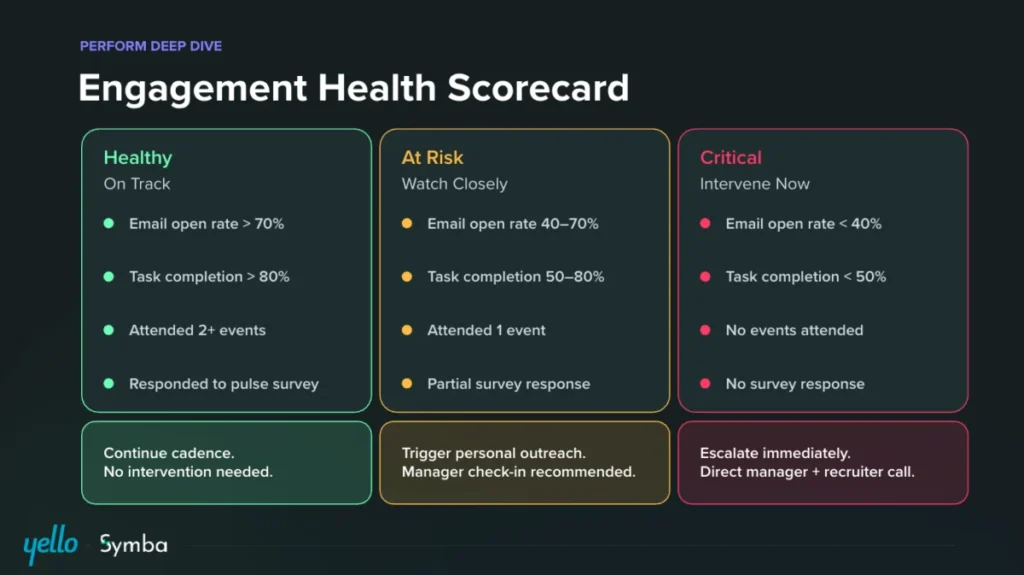
This paradigm shift is epitomized by the implementation of an "Engagement Health Scorecard," a systematic framework designed to categorize candidates based on their observable behaviors and provide prescriptive actions. By analyzing a spectrum of engagement data points, organizations can move beyond anecdotal assumptions and gain a real-time, data-driven understanding of a candidate’s commitment and potential flight risk.
Deconstructing the Engagement Health Scorecard: Tiers of Engagement and Prescriptive Actions
The Engagement Health Scorecard typically segments candidates into three distinct categories, each warranting a specific strategic response:
-
Healthy Candidates: These individuals exhibit robust and consistent engagement, indicating strong commitment and enthusiasm. Their behavior patterns include email open rates consistently above 70%, prompt completion of pre-onboarding tasks, active attendance at multiple pre-start events (e.g., virtual meet-and-greets, informational webinars), and comprehensive responses to surveys. For this group, the recommended action is to maintain the established communication cadence and stay the course. The goal is to reinforce their positive experience, ensure they feel valued, and continue to build excitement for their upcoming role. This might involve sharing company news, team updates, or further details about their role to deepen their connection. The success of this tier lies in consistent, positive reinforcement, transforming initial enthusiasm into sustained commitment.
-
At-Risk Candidates: This category signals declining engagement, indicating potential vulnerabilities that require immediate attention. Behavioral markers for at-risk candidates typically include email open rates falling within a 40-70% range, limited or sporadic attendance at pre-start events, and incomplete or delayed survey responses. Crucially, these candidates demand personalized outreach within a critical 48-hour window. Generic, mass-distributed communications are insufficient. Instead, targeted interventions are necessary: a direct message from the program manager, a personalized invitation to an upcoming event that clearly articulates its relevance to the individual, or a proactive check-in from the future hiring manager. Such individualized attention can often swiftly reverse negative trends, addressing nascent concerns before they escalate. A direct, empathetic conversation can uncover hidden anxieties or questions, demonstrating the company’s commitment to their success and well-being.
-
Critical Candidates: Representing the highest flight risk, critical candidates exhibit almost no engagement. Their behavioral profile includes email open rates plummeting below 40%, complete absence from pre-start events, no survey responses, and a prolonged period of inactivity, often three or more weeks. These signals necessitate immediate escalation. The intervention strategy for critical candidates is direct, urgent, and highly personal: a direct phone call from the hiring manager, a personal touchpoint from the recruiter, and an honest, open conversation about their current situation. The objective here is to unearth the root cause of their disengagement. Common underlying factors include a competing job offer from another organization, unforeseen personal circumstances that might impact their ability to start, or simple uncertainty about the role, team, or company culture that has not been adequately addressed. Catching these issues in time, even at this late stage, can still allow for negotiation, problem-solving, or reassurance that might salvage the offer.
The Data-Driven Advantage: Continuous Monitoring and Predictive Analytics
The fundamental distinction between organizations that effectively retain candidates and those that are perpetually scrambling to backfill roles lies in their approach to data. The former group actively monitors engagement data continuously, treating it as an ongoing diagnostic tool, rather than waiting for a formal renege email to initiate a crisis response. This continuous data analysis, often facilitated by sophisticated Applicant Tracking Systems (ATS) integrated with Candidate Relationship Management (CRM) tools, allows for real-time adjustments to engagement strategies.
For example, tracking email open rates, click-through rates on shared content, and activity logs within an onboarding portal provides tangible metrics. If a candidate’s activity drops significantly after an initial spike, or if they consistently ignore invitations to virtual team introductions, these are red flags. Advanced analytics can even identify patterns associated with higher renege rates, allowing for predictive modeling that flags candidates even before their engagement metrics hit "at-risk" thresholds. This proactive, data-informed approach transforms talent acquisition from a reactive administrative function into a strategic, predictive discipline.
Economic Implications and Return on Investment
The economic rationale for implementing an Engagement Health Scorecard is compelling. By proactively addressing potential reneges, companies can significantly reduce the aforementioned costs associated with replacement hires. A conservative estimate suggests that reducing renege rates by just 5% could save a large organization millions of dollars annually, depending on hiring volume and role seniority. For instance, a company making 1,000 hires per year, with an average replacement cost of $50,000 per renege, could save $2.5 million by preventing 50 reneges.
Beyond direct cost savings, the ROI extends to improved team morale, reduced strain on HR and hiring managers, and a stronger employer brand. Companies known for their supportive and engaging pre-start processes are more likely to attract top talent in the future, creating a virtuous cycle of positive recruitment outcomes. This proactive engagement strategy also contributes to higher quality hires, as candidates who feel genuinely supported and integrated before their start date are more likely to be productive and committed long-term employees.
Industry Perspectives and Expert Commentary
Leaders in talent acquisition are increasingly advocating for these data-driven approaches. "The days of simply extending an offer and hoping for the best are over," states Dr. Evelyn Reed, Head of Global Talent Acquisition at InnovateTech Solutions. "In today’s candidate-driven market, engagement doesn’t end when the offer is accepted; it intensifies. Our shift to a proactive engagement model, driven by an Engagement Health Scorecard, has reduced our renege rate by nearly 10% in the last year alone, saving us significant resources and ensuring a more stable workforce."
Similarly, Marcus Thorne, VP of Human Resources at Apex Pharmaceuticals, emphasizes the importance of personalized outreach. "When a candidate goes quiet, it’s rarely a sign they’re perfectly content. It’s often a cry for attention, a signal of underlying doubt. Our program managers and hiring leads are now trained to see declining engagement as an opportunity for genuine connection. A simple, personal call can often turn a critical candidate into a highly engaged one, just by addressing their concerns directly and showing we care."
These sentiments underscore a broader industry recognition that candidate experience, particularly in the critical pre-start phase, is paramount. Companies that invest in sophisticated engagement strategies are not just mitigating risk; they are actively cultivating a positive reputation that differentiates them in the war for talent.
Implementing the Framework: Practical Steps and Resources
Adopting an Engagement Health Scorecard requires more than just a conceptual understanding; it demands practical implementation tools and a cultural shift within recruitment teams. Resources like "The KEEP Playbook," for example, offer a comprehensive guide, including a full engagement health scorecard with predefined thresholds and recommended actions for each tier. Such playbooks typically provide a step-by-step intervention guide, outlining specific scripts, communication channels, and escalation paths for "At-Risk" and "Critical" candidates.
Furthermore, a robust implementation strategy includes a post-cycle review template, enabling organizations to analyze the effectiveness of their engagement efforts after each hiring program. This iterative process allows for continuous improvement, refining thresholds, optimizing intervention strategies, and adapting to evolving candidate behaviors and market dynamics. Key components of such a review might include:
- Analysis of renege rates by role, department, and recruiter.
- Correlation of engagement scores with successful hires versus reneges.
- Feedback from candidates (both those who started and those who reneged, if possible).
- Assessment of intervention success rates.
Broader Impact on Talent Strategy and Employer Branding
The ripple effect of a robust pre-start engagement strategy extends far beyond individual hires. It profoundly influences an organization’s overall talent strategy and strengthens its employer brand. A company known for its transparent, supportive, and engaging pre-onboarding process becomes an employer of choice. Candidates, even those who ultimately choose another path, often share positive experiences, enhancing the company’s reputation. This contributes to a stronger talent pipeline in the long run, reducing future recruitment costs and attracting higher-caliber applicants.
Moreover, a system that proactively addresses candidate concerns fosters a culture of care and responsiveness within the organization. Recruiters and hiring managers become more attuned to candidate needs, leading to more empathetic and effective communication throughout the entire hiring journey. This cultural shift aligns with modern talent management principles, which prioritize employee well-being and a positive employee experience from the very first interaction.
Challenges and Future Outlook
While the benefits are clear, implementing a comprehensive Engagement Health Scorecard is not without its challenges. Data integration across disparate HR systems, training recruitment teams on new protocols and empathetic communication techniques, and ensuring consistent application of the framework across all hiring managers can be complex. Organizations must invest in the right technology, provide ongoing training, and foster a culture that values proactive candidate management.
Looking ahead, the evolution of AI and machine learning will likely further refine these predictive engagement models. AI-powered analytics could identify subtle behavioral cues that human observers might miss, offering even earlier warnings of potential disengagement. Personalized communication at scale, tailored to individual candidate preferences and concerns, could become the norm. The future of talent acquisition is undeniably moving towards a more data-driven, proactive, and human-centric approach, where the journey from offer acceptance to the first day is as critical as the initial recruitment process itself. Companies that embrace this evolution will be best positioned to secure and retain the talent essential for future success.






