The contemporary talent landscape presents an unprecedented challenge for organizations: the increasing prevalence of candidate reneges. This phenomenon, where a candidate accepts an offer only to withdraw before their official start date, has become a silent but significant drain on resources, productivity, and morale for countless companies globally. Traditional recruitment methodologies often fail to detect these critical shifts in candidate intent until it is too late, leading to reactive scrambling and costly backfilling efforts. A growing number of forward-thinking talent acquisition (TA) teams are now advocating for and implementing a paradigm shift, moving from reactive damage control to proactive, data-driven candidate engagement strategies, epitomized by the adoption of an "Engagement Health Scorecard." This innovative approach treats engagement signals as leading indicators, allowing organizations to intervene effectively and drastically reduce the incidence of pre-start attrition.
The Silent Exodus: Understanding Candidate Reneges and Their Impact
A renege is more than just a withdrawn offer; it represents a significant failure point in the talent acquisition pipeline, carrying multifaceted costs. Industry reports indicate that the average cost of a reneged offer can range from 1.5 to 3 times the salary of the position, factoring in recruitment fees, lost productivity, administrative overhead, and the potential negative impact on team morale and project timelines. For specialized or senior roles, these figures can escalate dramatically. A 2023 study by a leading HR analytics firm revealed that approximately 20-25% of accepted offers across various sectors now result in a renege, a substantial increase from pre-pandemic levels. This surge is attributed to a highly competitive job market, increased candidate confidence, and a greater willingness to explore multiple opportunities even after accepting an initial offer.
Historically, many recruitment programs have operated without a structured process for post-offer, pre-start engagement. Teams often discover a renege only after the candidate has gone silent or, worse, formally withdrawn their acceptance. By this juncture, the candidate has typically already made up their mind, rendering any last-minute intervention largely ineffective. The traditional focus on time-to-hire and cost-per-hire, while important, often overlooks the critical period between offer acceptance and the first day of employment—a window ripe with both opportunity and risk. This oversight has perpetuated a cycle of reactive recruitment, where TA teams find themselves perpetually scrambling to backfill roles, diverting resources from strategic talent initiatives to operational firefighting.
The Evolution of Engagement: From Onboarding to Pre-Boarding
The concept of "onboarding" traditionally commenced on the employee’s first day. However, the modern understanding of talent retention has expanded to include "pre-boarding," recognizing the crucial period from the moment an offer is accepted until the start date. This phase is not merely administrative; it is a critical window for solidifying the candidate’s commitment, integrating them into the company culture, and addressing any lingering doubts or external influences. The absence of a structured pre-boarding process is a primary contributor to reneges, as candidates can feel neglected, disengaged, or perceive a disconnect between the hiring process and the actual company environment.
The shift towards proactive engagement is fundamentally about recognizing that candidate sentiment is fluid. Even after accepting an offer, individuals remain susceptible to external factors—competing offers, personal circumstances, or simple uncertainty. Organizations that fail to maintain consistent, meaningful communication during this period risk losing promising talent to competitors who prioritize candidate experience throughout the entire hiring journey.
The Engagement Health Scorecard: A Framework for Proactive Intervention
To counteract the renege phenomenon, the Engagement Health Scorecard emerges as a robust, data-driven solution. This framework categorizes candidates into distinct groups based on their behavior and interactions during the critical pre-start period, transforming subjective observations into actionable insights. By monitoring specific engagement signals, TA teams can identify at-risk candidates early and deploy targeted interventions.
The scorecard typically monitors a range of metrics, including:
- Email Open Rates: A fundamental indicator of attention and interest.
- Task Completion: Engagement with pre-boarding paperwork, orientation modules, or introductory assignments.
- Event Attendance: Participation in virtual or in-person welcome events, team meet-and-greets, or informational webinars.
- Survey Responses: Feedback on the hiring process, pre-boarding experience, or specific queries about the role/company.
- Activity on Internal Platforms: Engagement with internal communication tools, pre-start portals, or social groups (if applicable).
- Responsiveness to Outreach: Timeliness and nature of replies to communications from recruiters or hiring managers.
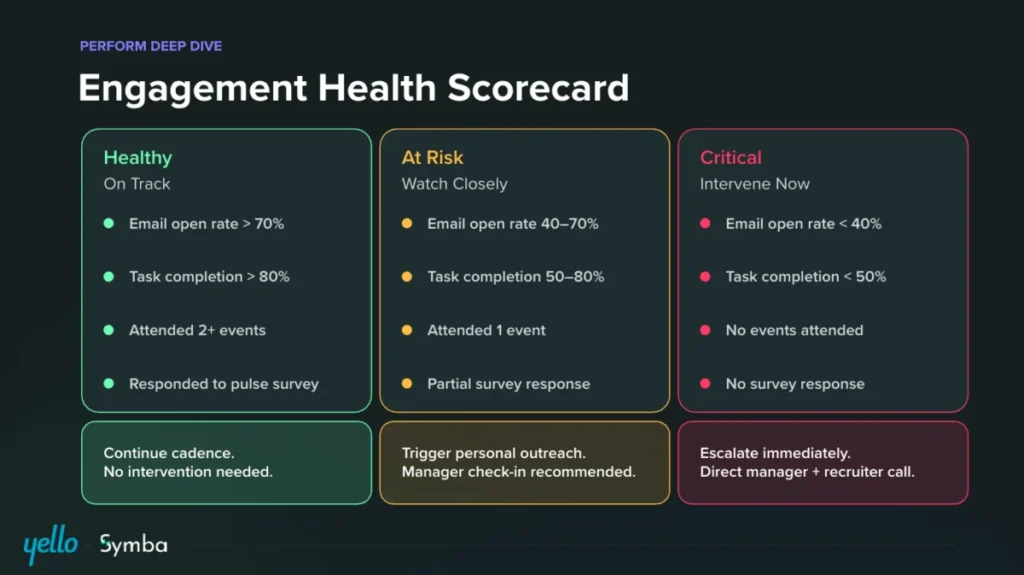
Based on these aggregated signals, candidates are typically classified into three distinct tiers: Healthy, At-Risk, and Critical.
1. Healthy Candidates: Sustaining Momentum
Healthy candidates exhibit consistent and strong engagement, indicating high motivation and commitment. Their behaviors include:
- Email Open Rates: Consistently above 70%, often nearing 90-100%.
- Task Completion: Promptly completing pre-boarding tasks and paperwork.
- Event Attendance: Actively participating in multiple scheduled events, often asking thoughtful questions.
- Survey Responses: Providing complete and timely feedback.
- General Responsiveness: Quick and enthusiastic replies to communications.
For this group, the recommended action is to "continue the cadence and stay the course." The goal is to sustain their positive momentum and further solidify their connection to the organization. This involves maintaining regular, positive communication, sharing relevant company news, providing access to resources that deepen their understanding of the role and culture, and ensuring all administrative steps are smooth and transparent. As one HR expert notes, "Even your most enthusiastic candidates need consistent positive reinforcement. Don’t take their commitment for granted; nurture it." This ongoing engagement ensures they feel valued and connected, reinforcing their decision to join the team.
2. At-Risk Candidates: Timely Personal Outreach
At-Risk candidates display a noticeable decline in engagement, signaling potential underlying concerns that require immediate attention. Their behavioral patterns often include:
- Email Open Rates: Between 40% and 70%, indicating selective attention or a waning interest.
- Limited Event Attendance: Skipping some events or participating minimally when present.
- Incomplete Survey Responses: Providing partial answers or delaying submissions.
- Delayed Responsiveness: Slower replies to emails or messages, sometimes requiring follow-ups.
These signals necessitate personal outreach within 48 hours. The intervention must feel individualized rather than generic. Effective strategies include:
- Direct Message from the Program Manager: A personalized message expressing excitement for their arrival and offering to answer any questions.
- Individualized Event Invitation: Rather than a mass email, a personal invitation to an upcoming team lunch or a specific project briefing, highlighting its relevance to their role.
- Hiring Manager Check-in: A brief, informal call from the future manager to reiterate enthusiasm, discuss initial priorities, and address any potential concerns.
"The 48-hour window for at-risk candidates is crucial," emphasizes Dr. Evelyn Reed, a leading consultant in talent strategy. "It’s about demonstrating that you notice their disengagement and care enough to reach out personally. Often, a small concern can be quickly addressed, preventing it from escalating into a full renege." These personalized touches can often turn the situation around by making the candidate feel seen, valued, and reassured that their concerns will be heard.
3. Critical Candidates: Immediate Escalation and Direct Dialogue
Critical candidates exhibit almost no engagement, indicating a high probability of a renege unless immediate and decisive action is taken. Their behaviors are characterized by:
- Email Open Rates: Consistently below 40%, often near zero.
- No Events Attended: Complete absence from scheduled pre-boarding activities.
- No Survey Responses: Failure to submit any feedback or administrative forms.
- No Activity: Three or more weeks of complete silence across all communication channels.
- Unresponsiveness: Ignoring direct calls or emails.
For this group, immediate escalation is paramount. The interventions must be direct, empathetic, and focused on uncovering the root cause. This typically involves:
- Direct Call from the Hiring Manager: A personal, frank conversation initiated by the hiring manager, expressing concern and a desire to understand what might be happening. This is not a sales call but a genuine offer of support.
- Personal Touchpoint from the Recruiter: A senior recruiter reaching out with empathy, reiterating the value of the candidate, and offering to facilitate any discussions.
- A Real Conversation: The goal is to have an honest dialogue about what’s going on. Often, the root causes are identifiable: a competing offer with better compensation or benefits, a personal circumstance (family, relocation issues), or simple uncertainty about the role or company culture.
"When a candidate reaches the critical stage, you need to move beyond standard protocols and engage in a genuine human conversation," advises Sarah Jenkins, a veteran Talent Acquisition Director. "It’s about demonstrating care and understanding, not just trying to ‘win’ them back. Sometimes, a competing offer can be matched or a personal issue can be accommodated if you catch it in time and address it directly." This direct approach, though sometimes uncomfortable, provides the last opportunity to salvage the offer and, importantly, gather insights even if the candidate ultimately withdraws.
Implementing the Scorecard: Technology and Process Integration
The successful implementation of an Engagement Health Scorecard relies heavily on robust technology and a well-defined process. Organizations often leverage Applicant Tracking Systems (ATS), Candidate Relationship Management (CRM) platforms, and specialized pre-boarding software to track engagement metrics automatically. These systems can integrate data points from various communication channels and automatically update a candidate’s health score.
Furthermore, clear internal protocols are essential:
- Defined Roles and Responsibilities: Clarity on who owns communication at each stage (recruiter, hiring manager, program manager).
- Automated Triggers: Systems can be configured to send alerts to TA teams or hiring managers when a candidate’s score drops below a certain threshold.
- Standardized Intervention Playbooks: Detailed guidelines for what actions to take for each category, ensuring consistency and effectiveness.
- Continuous Data Analysis: Regular review of scorecard data to identify trends, optimize interventions, and refine the scoring methodology.
The difference between teams that effectively retain candidates and those that are constantly scrambling to backfill roles is almost always the same: the former are continuously looking at data and engagement signals, not just reacting when a renege email arrives.
Broader Impact and Strategic Implications
Adopting an Engagement Health Scorecard extends far beyond simply reducing reneges; it has profound strategic implications for an organization’s talent acquisition and overall business health.
- Enhanced Employer Brand: A proactive, caring pre-boarding experience contributes significantly to a positive employer brand. Candidates who feel valued from day one are more likely to speak positively about the company, even if they don’t end up joining, fostering a strong talent pipeline through referrals.
- Improved Candidate Experience: By addressing concerns early and personalizing communication, organizations create a superior candidate experience, which is crucial in today’s talent market.
- Operational Efficiency and Cost Savings: Reducing reneges directly translates to fewer recruitment cycles, lower agency fees, and less time spent on repeat hiring processes, freeing up TA teams to focus on more strategic initiatives.
- Faster Time-to-Productivity: When new hires feel integrated and supported before their start date, they are likely to onboard more smoothly and reach full productivity faster, positively impacting business outcomes.
- Data-Driven Decision Making: The scorecard provides invaluable data for continuous improvement. By analyzing why candidates move between categories or ultimately renege, organizations can refine their recruitment, offer, and pre-boarding processes.
- Stronger Organizational Culture: A focus on early engagement signals a company culture that values its people, even before they officially join. This sets a positive tone for long-term employee retention.
The KEEP Playbook: A Comprehensive Resource for Success
For organizations looking to implement or refine their engagement strategies, resources like "The KEEP Playbook" offer invaluable guidance. This comprehensive resource typically includes the full engagement health scorecard with detailed thresholds and recommended actions for each tier. Beyond the scoring mechanism, it provides a step-by-step intervention playbook, offering practical scripts and strategies for different scenarios. Crucially, it also includes a post-cycle review template, enabling TA teams to conduct thorough analyses after each hiring program, identify areas for improvement, and continuously enhance their pre-boarding and retention strategies. Such playbooks are vital tools for institutionalizing best practices and ensuring that every program contributes to a stronger, more resilient talent pipeline.
In conclusion, the era of passive post-offer management is rapidly drawing to a close. The competitive talent landscape demands a proactive, empathetic, and data-driven approach to candidate engagement. The Engagement Health Scorecard represents a critical evolution in talent acquisition, transforming the pre-start period from a vulnerability into a strategic advantage. By continuously monitoring engagement signals and implementing targeted interventions, organizations can not only stem the tide of candidate reneges but also cultivate a stronger employer brand, enhance operational efficiency, and build a more committed, productive workforce from the very first interaction.