
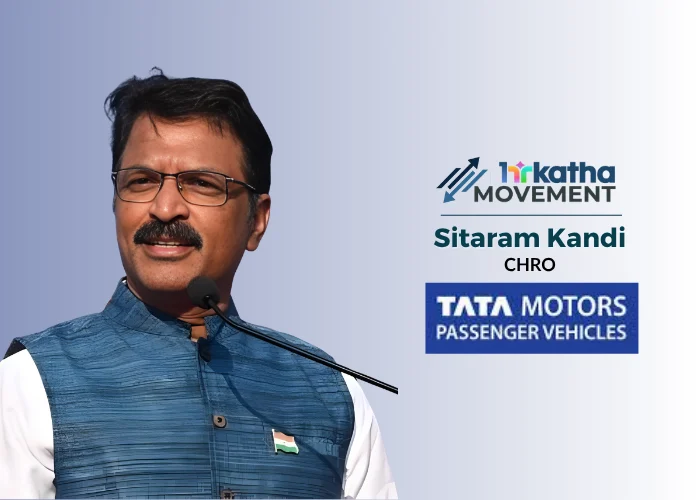
Tata Motors Passenger Vehicles, a pivotal entity in India’s automotive landscape, has announced the strategic appointment of Sitaram Kandi as its new Chief Human Resources Officer (CHRO), effective July 1, 2026. This significant leadership transition will see Kandi succeed Anjali Byce, who is currently serving in the role. The decision, made well in advance, underscores Tata Motors’ commitment to meticulous succession planning and ensuring a seamless leadership handover in a critical organizational function, particularly as the company navigates an era of rapid technological evolution and market expansion in both its conventional passenger vehicle and burgeoning electric vehicle segments.
Kandi’s elevation to this top HR leadership position comes after an extensive career marked by diverse experiences across various industries and geographies, culminating in a significant tenure at Tata Motors. His journey within the company began in 2019 when he joined as Vice President-HR. Over the past nearly seven years, Kandi has been instrumental in shaping the human resources strategy for Tata Motors’ passenger and electric vehicle businesses, a period characterized by aggressive product launches, market share gains, and a pioneering push into the electric mobility space. Prior to this latest appointment, he had already taken on the CHRO responsibilities in 2024, demonstrating a progressive growth trajectory and a deep understanding of the company’s human capital needs. His prior scope included leading employee relations and spearheading critical skill development initiatives across the broader Tata Motors ecosystem, functions that are increasingly vital for a company at the forefront of automotive innovation.
The Strategic Imperative of Human Resources in a Transformative Automotive Era
The role of a Chief Human Resources Officer at a major automotive manufacturer like Tata Motors is more critical than ever, especially in the context of the profound transformations sweeping the global and Indian automotive industries. The transition from internal combustion engine (ICE) vehicles to electric vehicles (EVs), the advent of autonomous driving technologies, and the increasing integration of software and artificial intelligence into vehicle design and manufacturing demand a fundamentally different approach to talent management. Tata Motors, as a leader in India’s EV market and a strong contender in the passenger vehicle segment, requires HR leadership that can proactively identify, attract, develop, and retain the specialized talent necessary to maintain its competitive edge.
The Indian automotive sector, projected to become the third-largest globally by 2030, is characterized by intense competition, evolving consumer preferences, and stringent regulatory frameworks. For Tata Motors, which has successfully revitalized its passenger vehicle portfolio and aggressively captured market share in the EV segment, human capital is the bedrock of sustained growth. A CHRO’s mandate extends beyond traditional HR functions; it encompasses fostering a culture of innovation, agility, and resilience. It involves navigating complex labor relations, implementing robust performance management systems, championing diversity, equity, and inclusion (DEI) initiatives, and driving organizational effectiveness through strategic workforce planning. Sitaram Kandi’s long lead time for assumption of the CHRO role in 2026 suggests Tata Motors’ strategic intent to ensure a comprehensive understanding of these evolving imperatives and to allow for a smooth transition of leadership and strategic priorities.
Anjali Byce’s Contribution and the Path Forward
Anjali Byce, the outgoing CHRO, has played a significant role in guiding Tata Motors Passenger Vehicles’ human resources strategy during a period of considerable growth and change. While specific details of her future endeavors have not been disclosed, her tenure has undoubtedly contributed to strengthening the HR framework that supports the company’s ambitious objectives. Leadership transitions are a natural part of organizational evolution, and the early announcement of Sitaram Kandi’s appointment reflects a well-orchestrated succession plan designed to minimize disruption and ensure continuity in HR leadership. This deliberate approach allows for a prolonged handover period, facilitating comprehensive knowledge transfer and strategic alignment, which is crucial for a role as influential as the CHRO.
Sitaram Kandi’s Extensive Career: A Chronology of Diverse HR Leadership
Sitaram Kandi’s professional journey spans nearly three decades, illustrating a breadth of experience across various industries, organizational cultures, and complex HR challenges. His career trajectory provides a strong foundation for his elevated role at Tata Motors.
-
Early Career & Foundational Experience (1994-2006): Kandi embarked on his professional path in 1994 as an HR Executive with Videocon Industries. This initial experience in a large Indian conglomerate provided him with foundational insights into industrial relations and basic HR operations in a manufacturing context. In 1996, he transitioned to Bosch India as a Deputy Manager. During his over seven-year tenure at Bosch, a global leader in technology and services, he gained comprehensive exposure to all facets of human resources for a significant workforce of over 3,500 employees at their Nashik facility. This period was crucial for developing his expertise in managing large-scale HR operations, talent acquisition, employee engagement, and compliance within a highly structured global engineering environment. Subsequently, Kandi spent nearly three years at TE Connectivity as a Senior Manager, further diversifying his experience within the manufacturing and technology sectors.
-
Diversification and Global Exposure (2006-2011): From 2006 to 2008, Kandi served as HR Lead-West Asia for Monsanto Company, based out of Mumbai. This role exposed him to the unique HR challenges within the agricultural biotechnology sector, including talent management for specialized scientific and field-based roles, and navigating the regulatory and ethical considerations inherent in the industry. September 2008 saw him taking on the role of Head HR for Fourfront Management Solutions, an experience that likely broadened his understanding of HR consulting and talent solutions. A significant international move occurred in March 2010 when he relocated to Oman to assume the position of Group HR Head for Mustafa Sultan Enterprises. Here, he managed the human resources function for over 2,000 employees spread across more than 16 diverse companies, a testament to his ability to handle complex, multi-entity HR portfolios in a multicultural environment. This international exposure was invaluable, providing him with insights into global best practices and cross-cultural HR management.
-
The GE Chapter: A Catalyst for Strategic HR Leadership (2011-2019): Kandi’s association with General Electric (GE) in 2011 marked a pivotal phase in his career. GE is renowned globally for its robust leadership development programs, performance management systems, and a strong emphasis on talent pipeline building. As Director-HR, Global Supply Chain, South Asia, Kandi was entrusted with end-to-end HR responsibility for GE’s expansive supply chain operations across the South Asia region, encompassing over 20 manufacturing sites. A particularly notable achievement during this period was his role as a core member of the team that established the pioneering multi-model manufacturing facility in Pune. This facility was unique globally, designed to manufacture components for seven distinct industries, ranging from aviation to power controls, all under one roof. Managing the human capital aspects of such a complex, high-tech, and multi-faceted operation demanded exceptional strategic foresight, intricate workforce planning, and the ability to foster a highly skilled and adaptable workforce. This experience at GE, with its focus on operational excellence, lean manufacturing, and advanced technological integration, undoubtedly honed Kandi’s abilities in strategic HR partnering and talent development within a demanding industrial environment.
-
Return to India and Ascent at Tata Motors (2019-Present): Kandi’s return to India in 2019 saw him joining Tata Motors as Vice President-HR. This marked a significant homecoming to the Indian industrial landscape, bringing with him a wealth of global and diverse experience. His initial responsibilities at Tata Motors included leading HR for the passenger and electric vehicle businesses. This period coincided with a major strategic push by Tata Motors to revamp its passenger vehicle portfolio, introduce compelling new models, and aggressively expand its footprint in the nascent but rapidly growing EV market. Kandi’s leadership in employee relations and skill development during this phase was critical. As Tata Motors scaled up its EV operations, there was an acute need to upskill the existing workforce in areas like battery technology, power electronics, software integration, and EV specific manufacturing processes, while also attracting new talent with these specialized capabilities. His appointment as CHRO in 2024, prior to this latest announcement, further solidified his strategic influence within the company’s HR function.
An alumnus of Osmania University, Kandi further augmented his academic credentials by studying business analysis at the prestigious Indian Institute of Management, Calcutta. This combination of extensive practical experience and strong academic grounding positions him well for the strategic demands of his new role.
Tata Motors Passenger Vehicles & EV Strategy: A Dynamic Backdrop
Tata Motors has undergone a remarkable transformation in its passenger vehicle division over the last decade. From a period of market share decline, the company has emerged as a formidable player, consistently ranking among the top three passenger vehicle manufacturers in India. This resurgence has been fueled by a focus on design, safety (with models consistently achieving high GNCAP ratings), and technology. Key models like the Nexon, Altroz, Punch, and Harrier have resonated strongly with Indian consumers.
However, the most significant strategic pivot has been Tata Motors’ aggressive and pioneering entry into the electric vehicle market. The company currently dominates the Indian EV passenger vehicle segment, holding a commanding market share, primarily through popular models like the Nexon EV, Tiago EV, and Tigor EV. Tata Motors has ambitious plans to introduce 10 new EV models by 2026 and invest significantly in EV charging infrastructure and battery technology. This EV-centric strategy demands a highly specialized and adaptable workforce. HR leadership, under Kandi, will be instrumental in:
- Talent Acquisition: Attracting engineers, software developers, data scientists, and technicians with expertise in EV powertrains, battery management systems, artificial intelligence, and connected car technologies.
- Skill Development & Upskilling: Retraining and upskilling the existing workforce from ICE to EV manufacturing processes, maintenance, and R&D. This involves developing robust training programs and fostering a continuous learning environment.
- Organizational Culture: Cultivating a culture of innovation, agility, and sustainability that is essential for a technology-driven, future-focused business.
- Employee Engagement & Retention: Ensuring that a highly competitive talent pool remains engaged and motivated, especially given the "war for talent" in emerging technology sectors.
- Industrial Relations: Managing labor relations effectively during periods of technological change and workforce restructuring.
Implications of a Future-Dated Appointment
The effective date of July 1, 2026, for Sitaram Kandi’s CHRO appointment is noteworthy. Such a long lead time for a senior executive transition is unusual but indicative of a deliberate and well-considered strategic approach by Tata Motors. This timeframe offers several advantages:
- Structured Succession Planning: It signifies a mature organizational process for leadership transitions, ensuring continuity and stability in a critical function.
- Smooth Handover: The extended period allows for a comprehensive and thorough handover of responsibilities from Anjali Byce to Sitaram Kandi, encompassing ongoing projects, strategic initiatives, key stakeholder relationships, and institutional knowledge transfer.
- Strategic Alignment: It provides Kandi ample time to deeply immerse himself in the future strategic direction of Tata Motors Passenger Vehicles and EVs, allowing him to shape HR strategies that are perfectly aligned with the company’s long-term business objectives well before he formally assumes the role.
- Proactive Talent Management: This future-dated appointment can also be seen as a message to the internal talent pool, demonstrating clear career progression paths and the company’s commitment to developing its internal leaders.
- Stakeholder Confidence: For investors, partners, and employees, it signals stability and foresight in leadership, reinforcing confidence in the company’s long-term vision.
Industry Perspectives and Broader Impact
Industry observers view Kandi’s appointment as a strategic move to reinforce Tata Motors’ human capital capabilities as it continues its aggressive push in the passenger vehicle and electric vehicle markets. His extensive experience across diverse sectors, particularly his tenure at GE with its focus on complex manufacturing and supply chain HR, provides him with a unique perspective on managing talent in technologically advanced and rapidly evolving environments.
Analysts suggest that Kandi’s leadership will likely focus on strengthening Tata Motors’ talent pipeline for future technologies, enhancing employee productivity through digital HR initiatives, and fostering a robust employee relations framework that supports the company’s growth ambitions. His track record of motivating people and professionalism, as highlighted in the original announcement, will be crucial in cultivating a high-performance culture necessary to navigate the challenges and capitalize on the opportunities presented by the evolving automotive landscape. The competitive talent market, particularly for EV-specific skills, means that a strong and visionary CHRO is paramount for sustained success.
In conclusion, Sitaram Kandi’s appointment as CHRO for Tata Motors Passenger Vehicles and Electric Vehicles is a strategically important development for one of India’s leading automotive players. His rich and varied experience, coupled with Tata Motors’ forward-looking succession planning, positions him to lead the company’s human resources function effectively through a period of unprecedented transformation, ensuring that Tata Motors continues to attract, develop, and retain the talent critical for its ambitious future.








