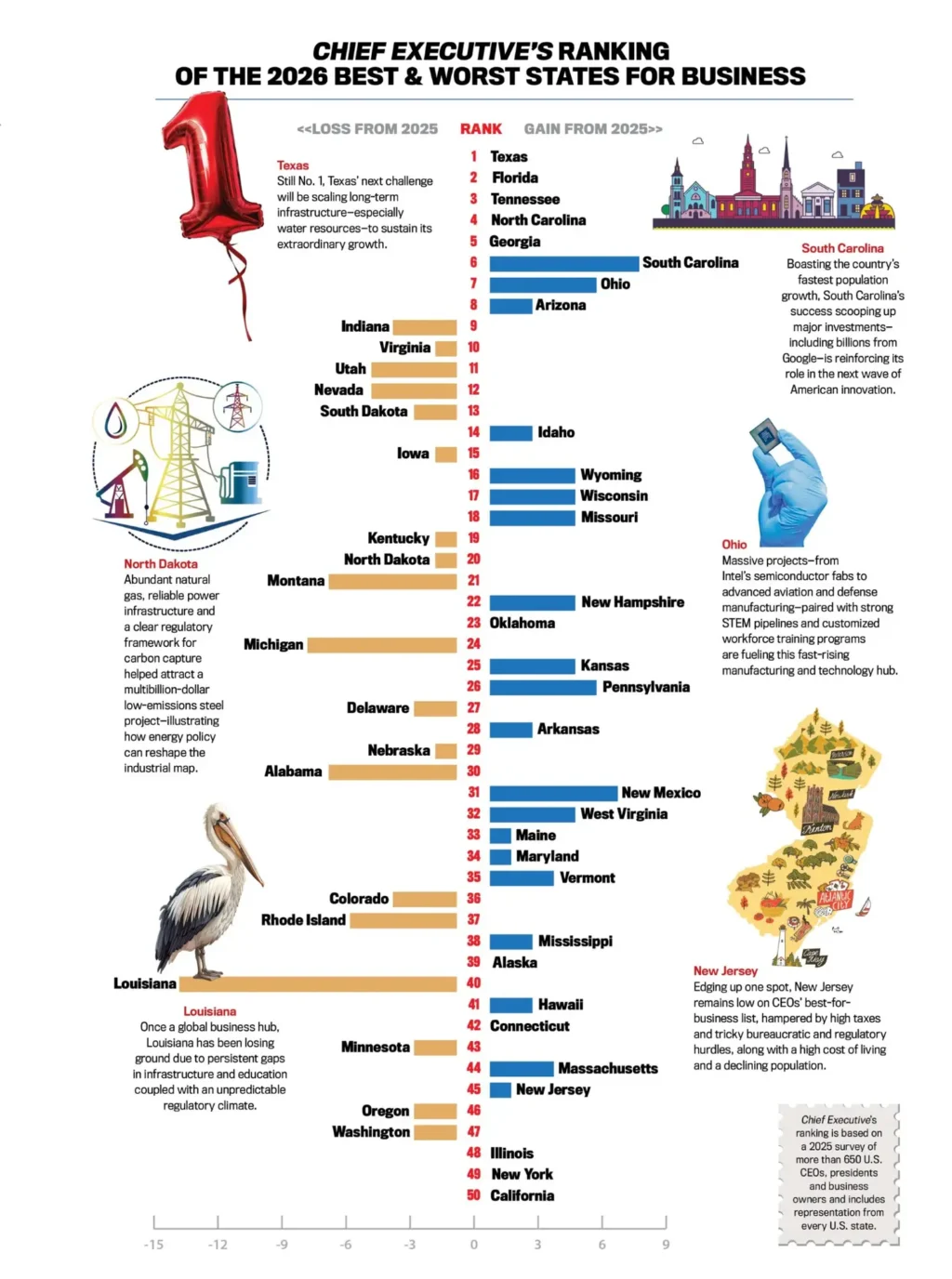
The landscape of American business is in constant flux, a dynamic interplay of evolving economic forces, strategic state-level initiatives, and the ever-present influence of corporate leadership perceptions. This year’s Chief Executive Best & Worst States for Business survey, a comprehensive analysis based on the insights of over 650 CEOs, presidents, and business owners from across all 50 states, underscores both the enduring power of fundamental economic drivers and the significant impact of targeted, long-term state development strategies. While established leaders maintain their positions, the survey reveals notable upward and downward shifts, offering a granular view of which states are successfully cultivating environments conducive to growth and which are facing significant headwinds.
Texas and Florida Continue Their Reign as Top Business Destinations
For another year, Texas has solidified its position as the premier destination for business in the United States, retaining its coveted No. 1 ranking in the Chief Executive survey. This sustained dominance is attributed to a potent combination of factors that resonate deeply with corporate decision-makers: a business-friendly tax structure, a robust regulatory environment, and a rapidly growing, diverse talent pool. Texas’s consistent appeal lies in its ability to offer a predictable and cost-effective operating environment, a crucial consideration for businesses navigating an increasingly complex global economy.
Following closely behind, Florida secures its second consecutive position as the nation’s second-best state for business. The Sunshine State’s success can be largely credited to its attractive tax policies, burgeoning population, and significant investments in infrastructure. Its appeal extends to a lifestyle that draws both talent and retirees, further bolstering its economic engine.
The survey data indicates that these two states have consistently prioritized the "fundamentals" of business attraction and retention: a favorable tax and regulatory climate, accessible and developing infrastructure, and a strong pipeline of skilled labor. This consistent focus has created a powerful flywheel effect, attracting new businesses and encouraging existing ones to expand, thereby reinforcing their top-tier status year after year.
The Ascendance of the Southeast: A New Tier of Economic Powerhouses
Beyond the top two, the southeastern United States continues to assert its growing economic influence. Tennessee, North Carolina, and Georgia round out the top five, demonstrating a sustained commitment to fostering business growth. These states have consistently invested in education, workforce development, and infrastructure, creating an environment that appeals to a broad spectrum of industries, from advanced manufacturing to technology and logistics.
South Carolina’s Impressive Leap: A particularly noteworthy surge in the rankings is South Carolina’s remarkable climb of seven spots to claim the No. 6 position. This ascent is directly linked to the state’s deliberate focus on attracting and nurturing high-skill, high-wage industries, mirroring the success of tech giants. By prioritizing investments in education and training programs that align with the needs of advanced industries, South Carolina is demonstrating that a proactive approach to talent development can yield significant dividends.
Ohio’s Midwestern Momentum: Ohio, the highest-ranked Midwestern state at No. 7, showcases the power of targeted economic development and effective communication. The state’s climb of five places is a testament to its aggressive marketing strategies and its success in articulating a compelling narrative of opportunity. Crucially, Ohio has demonstrated a sustained commitment to upskilling its existing workforce, recognizing that a skilled and adaptable labor pool is essential for attracting and retaining businesses in the modern economy. This focus on internal talent development, combined with strategic outreach, has positioned Ohio as a formidable player in the national economic arena.
Middle-Tier Momentum: Quiet Progress and Structural Shifts
While headline-grabbing announcements often dominate economic news, the Chief Executive survey highlights the significant impact of steady, incremental progress in the middle of the rankings. States that may not be experiencing explosive growth are nonetheless demonstrating resilience and laying the groundwork for future success through consistent efforts in improving their business environments.
Wisconsin’s Building Momentum: Wisconsin’s upward trajectory is particularly compelling. Having already made a nine-place jump last year, the state has continued its ascent, climbing an additional four spots this year to reach a strong position. This sustained momentum suggests that Wisconsin’s efforts to enhance its business climate are no longer statistical anomalies but rather indicative of structural improvements that are beginning to reshape perceptions and attract investment. Such consistent progress, often driven by improvements in regulatory efficiency and targeted industry support, can signal a fundamental shift in a state’s economic competitiveness.
Pennsylvania’s Resurgence: Pennsylvania’s rise of five places to No. 26 is another indication that sustained, positive efforts can indeed alter CEO perceptions over time. This upward movement suggests that the state’s ongoing commitment to addressing fundamental business needs—such as infrastructure improvements and streamlining regulatory processes—is gradually being recognized by business leaders. As site selection expert Larry Gigerich, executive managing director of Ginovus consultants, aptly observes, "The states focusing on the fundamentals—talent, infrastructure, tax and regulatory climate—are the ones that will continue to do well." Pennsylvania appears to be heeding this advice, with tangible results emerging from its strategic focus.
Arizona’s Rebound and the Tightening Competition at the Top
Arizona’s rebound to No. 8 after a slight dip last year underscores the importance of adaptability and responsiveness in a rapidly evolving economic landscape. The state’s previous growth surge had placed a strain on its power grid, a critical infrastructure component for businesses. However, swift action by regulators and utilities, including the approval of nearly 5,000 megawatts of new generation and storage capacity and the launch of multibillion-dollar expansion plans, has effectively addressed these concerns. This proactive approach to infrastructure challenges has helped Arizona regain its standing among top business destinations.
Meanwhile, Indiana and Virginia maintain their positions at No. 9 and No. 10, respectively. Their stability in this highly competitive tier indicates that while significant leaps may be challenging, consistency in providing a solid business environment is a valuable asset. The narrowing margins between states in this upper echelon suggest that the competition for business investment is intensifying, requiring continuous innovation and strategic refinement from all contenders.
States Facing Headwinds: Infrastructure, Regulation, and Demographic Shifts
Not all states are experiencing positive movement. The survey also highlights those that are struggling to maintain their competitive edge, often due to persistent challenges in fundamental areas.
Louisiana’s Steep Decline: Louisiana’s fall of 13 places to No. 40 marks the most significant decline in the rankings this year. This sharp drop is attributed to a confluence of factors that continue to erode its once-strong competitive position. Persistent gaps in infrastructure and education, coupled with an unpredictable regulatory climate, create an environment of uncertainty for businesses. These are critical areas where sustained investment and policy stability are paramount for long-term economic health.
Michigan’s Transition: Michigan’s slip of seven spots to No. 24, while seemingly a setback, is perhaps better understood as a transitional phase. The state is actively working to diversify its economy beyond its traditional automotive base, with strategic investments in technology and life sciences. This period of economic restructuring can lead to short-term fluctuations in perception as the state navigates these significant shifts. The success of this diversification strategy will be a key determinant of Michigan’s future standing.
Other Notable Declines: Delaware dropped four places to No. 27, Colorado fell four spots to No. 36, and Washington slid four places to No. 47. These movements, while less dramatic than Louisiana’s, signal areas where states may be facing challenges in adapting to evolving economic demands or in effectively communicating their strengths to business leaders.
The Persistent Bottom Tier: Challenges in Major Economies
At the lower end of the spectrum, the familiar names of California, New York, and Illinois continue to occupy the bottom three positions, a pattern that has held for several years. These states, despite their significant economic output and vast markets, grapple with persistent challenges that deter business investment.
California’s Continued Struggles: California, at No. 50, faces a complex web of issues, including high taxes, stringent regulatory burdens, and a considerable cost of living, which collectively impact its attractiveness for business. While it boasts innovation hubs and a massive consumer market, these advantages are increasingly being offset by the operational costs and regulatory complexities.
New York’s Similar Predicament: New York, at No. 49, shares many of California’s challenges, including a high tax environment and a perception of regulatory complexity. Despite its global financial and cultural significance, these factors contribute to its consistently low ranking in business surveys.
Illinois’s Stagnation: Illinois, at No. 48, continues to struggle with issues that have historically hampered its business climate, including fiscal challenges and a perception of an unfavorable regulatory environment.
New Jersey’s Modest Gain, Lingering Issues: New Jersey, while edging up one spot to No. 45, remains firmly in the bottom tier. High taxes, bureaucratic friction, and a declining population are significant impediments that continue to affect its overall business appeal, despite some efforts to improve its standing.
The Quiet Achievers: The Power of Sustained, Incremental Improvement
Perhaps the most instructive movements in this year’s survey come from states that have been diligently working behind the scenes, making consistent, albeit less publicized, improvements to their business environments.
New Hampshire’s Steady Climb: New Hampshire’s ascent of four spots to No. 22 demonstrates that consistent efforts in areas like workforce development and a stable regulatory environment can yield significant results over time.
Kansas’s Strategic Gains: Kansas rose three spots to No. 25, indicating that targeted investments in key industries and a commitment to streamlining business processes are being recognized by CEOs.
Arkansas’s Solid Progress: Arkansas gained four spots to reach No. 28, reflecting a similar pattern of sustained improvement in its business climate.
These states exemplify the principle that attracting and retaining businesses is not solely about grand gestures or massive incentives. It is often the cumulative effect of years of focused effort on making a state easier to do business in, fostering a predictable regulatory landscape, and ensuring a skilled and available workforce. These "quiet achievers" are building a strong foundation for future economic resilience.
Methodology: Perceptions and Realities
The Chief Executive survey’s methodology is straightforward yet powerful: it directly solicits the opinions of those who make critical business location and expansion decisions. By surveying over 650 CEOs, presidents, and business owners from every state, the results capture not only the tangible economic realities of each state but also the crucial element of CEO perception. This dual focus is essential, as a state’s perceived attractiveness can be as influential as its objective economic indicators in driving investment decisions. The survey’s consistent application year after year provides a valuable longitudinal dataset, allowing for the tracking of trends and the assessment of the long-term impact of state-level economic development strategies. As the economic landscape continues to evolve, the insights gleaned from this annual survey will remain an indispensable resource for policymakers, business leaders, and economic development professionals alike, offering a clear compass for navigating the path toward sustainable prosperity.