
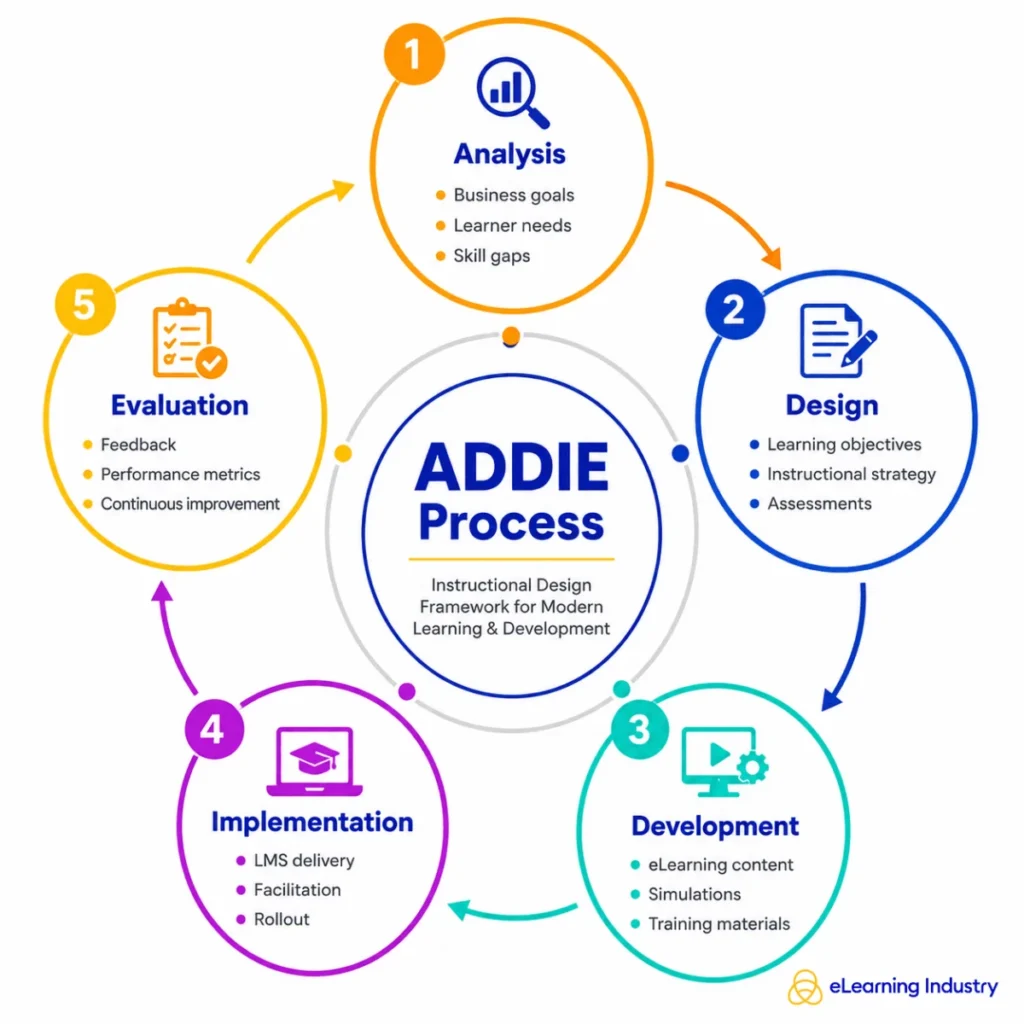
The ADDIE process remains the foundational pillar of the Instructional Design industry, serving as the primary roadmap for creating structured, effective, and scalable training programs across global corporate and academic sectors. Despite the emergence of rapid prototyping and agile methodologies, the ADDIE model—an acronym for Analysis, Design, Development, Implementation, and Evaluation—continues to govern how organizations translate complex business needs into measurable learning outcomes. Originally developed for military applications, its transition into the corporate mainstream has solidified its reputation as a "fail-safe" framework for high-stakes training initiatives, from leadership development to technical compliance.
The Historical Genesis of a Training Powerhouse
To understand the current dominance of the ADDIE model, one must look back to its origins in the mid-1970s. The framework was initially developed by the Center for Educational Technology at Florida State University in collaboration with the U.S. Army. At the time, the military required a rigorous, step-by-step process to train large numbers of personnel with varying backgrounds to perform highly technical tasks with zero margin for error.
By the 1980s, the model moved beyond the barracks and into the boardroom. As corporate America began to prioritize human capital as a competitive advantage, the need for a standardized approach to "Instructional Systems Design" (ISD) became apparent. While the original military version was strictly linear, the modern application of ADDIE has evolved into a more iterative cycle, allowing for feedback at every stage. This evolution has allowed the framework to survive the transition from classroom-based instruction to the digital-first era of e-learning and mobile education.
Phase 1: Analysis – The Critical Foundation of Training
The Analysis phase is often cited by Learning and Development (L&D) experts as the most vital step, yet it is frequently the most overlooked in rushed projects. In this stage, Instructional Designers act as investigators, identifying the "gap" between current performance and desired performance.
The process typically begins with a Training Needs Analysis (TNA). This involves gathering data through surveys, interviews, and performance metrics to determine if training is the actual solution to a business problem. For instance, if a sales team is underperforming, the Analysis phase determines whether the issue is a lack of knowledge (which requires training) or a flawed software tool (which requires a technical fix).
Key elements of this phase include:
- Audience Profiling: Understanding the learners’ demographics, prior knowledge, and technological literacy.
- Resource Identification: Cataloging the budget, timeline, and available Subject Matter Experts (SMEs).
- Goal Setting: Defining the high-level business objectives that the training must support.
Without a robust Analysis phase, organizations risk spending thousands of dollars on "shelfware"—training programs that are aesthetically pleasing but fail to address the core needs of the workforce.
Phase 2: Design – Mapping the Learner’s Journey
Once the analysis is complete, the Design phase translates findings into a blueprint. This stage focuses on the pedagogical strategy and the architecture of the learning experience. Instructional Designers use this time to establish clear, behavioral learning objectives, often utilizing frameworks like Bloom’s Taxonomy to ensure the training moves beyond simple memorization toward application and synthesis.
During the Design phase, the team decides on the "modality" of the training. Will it be an asynchronous e-learning module, a synchronous virtual instructor-led training (VILT), or a blended approach? This stage also involves the creation of storyboards and wireframes. For a digital course, a storyboard outlines every screen, interaction, and voiceover script, allowing stakeholders to visualize the flow before a single line of code or graphic is developed.
Phase 3: Development – Bringing the Blueprint to Life
The Development phase is where the actual "building" occurs. Utilizing the storyboards approved in the Design phase, developers use authoring tools such as Articulate Storyline, Adobe Captivate, or Lectora to create interactive content.
This phase is highly collaborative. Instructional Designers work closely with:
- Graphic Designers: To ensure visual consistency and branding.
- Multimedia Developers: To produce videos, podcasts, or animations.
- Subject Matter Experts (SMEs): To verify that the technical content remains accurate during the transition from text to interactive media.
A critical component of modern Development is accessibility. In today’s regulatory environment, ensuring that training materials are Section 508 or WCAG compliant is mandatory for many organizations. This ensures that learners with visual or auditory impairments have equal access to the training materials.
Phase 4: Implementation – The Strategic Launch
Implementation is the "go-live" moment. However, it involves much more than simply uploading a file to a Learning Management System (LMS). This phase requires a strategic rollout plan to ensure high participation rates and technical stability.

Key activities during Implementation include:
- Pilot Testing: Running the program with a small "alpha" group to identify bugs or confusing instructions.
- Train-the-Trainer (TTT): If the program is instructor-led, ensuring the facilitators understand the material and the technology.
- Communication Planning: Marketing the training to employees to build "buy-in" and explain the "What’s In It For Me" (WIIFM) factor.
- LMS Integration: Ensuring that the course correctly tracks learner progress, scores, and completion data.
Phase 5: Evaluation – Measuring Impact and ROI
The final phase, Evaluation, is what makes the ADDIE process a closed-loop system. While it is listed last, evaluation actually happens throughout the process (formative evaluation) and at the end (summative evaluation).
Most modern organizations use the Kirkpatrick Model of Evaluation in conjunction with ADDIE to measure success:
- Reaction: Did the learners like the training? (Gathered via "smile sheets").
- Learning: Did they acquire the intended knowledge? (Gathered via post-tests).
- Behavior: Are they applying what they learned on the job? (Gathered via manager observations).
- Results: Did the training impact the bottom line? (Gathered via business KPIs).
Data from this phase is fed back into the Analysis phase for the next version of the training, creating a cycle of continuous improvement.
Comparative Analysis: ADDIE vs. Agile and SAM
In recent years, critics have argued that the ADDIE process is too slow for the modern "on-demand" economy. This led to the rise of the Successive Approximation Model (SAM) and other Agile-based frameworks. These models prioritize rapid prototyping and frequent iterations over the structured phases of ADDIE.
However, industry experts suggest that ADDIE and Agile are not mutually exclusive. Many organizations now use a "Hybrid ADDIE" approach. In this model, the high-level structure of ADDIE provides the project management framework, while Agile techniques are used within the Development phase to speed up production.
The primary advantage of ADDIE over more rapid models is its focus on alignment. In highly regulated industries such as healthcare, aviation, and finance, the "move fast and break things" approach of Agile can lead to compliance failures. ADDIE’s rigorous documentation and approval gates ensure that every piece of training is vetted and verified.
The Economic and Strategic Impact of ADDIE
According to industry reports, the global corporate training market is valued at over $370 billion. Within this ecosystem, the efficiency of instructional design models directly impacts profitability. Research indicates that organizations using a structured design process like ADDIE experience a significantly higher return on investment (ROI) compared to those that develop training ad-hoc.
By identifying skill gaps accurately during the Analysis phase, companies avoid wasting resources on unnecessary training. Furthermore, the Evaluation phase allows L&D leaders to present hard data to the C-suite, proving that training is a profit-driver rather than a cost center. For example, a global logistics company using the ADDIE framework to redesign its safety training reported a 22% reduction in workplace accidents within the first year, resulting in millions of dollars saved in insurance and lost-time costs.
Expert Perspectives and Future Outlook
Dr. Michael Allen, a pioneer in the field, has noted that while the model has been criticized for being "linear," its core components remain essential. "You cannot design without analysis, and you cannot know if you succeeded without evaluation," he has famously stated.
Looking forward, the ADDIE process is being integrated with Artificial Intelligence (AI). AI-powered tools are now being used to accelerate the Analysis phase by scanning vast amounts of company data to find skill gaps. In the Development phase, AI can generate first-draft scripts or voiceovers, but the overarching ADDIE framework ensures that these AI-generated assets are aligned with the pedagogical goals of the program.
Conclusion: A Timeless Blueprint for Excellence
The ADDIE process has survived nearly half a century not because of a lack of alternatives, but because it provides a universal language for learning excellence. It offers a balance between the creative art of teaching and the rigorous science of performance improvement.
As the workforce continues to face rapid disruptions from automation and digital transformation, the need for clear, effective, and measurable training has never been greater. By adhering to the principles of Analysis, Design, Development, Implementation, and Evaluation, Instructional Designers can ensure that they are not just "making content," but are instead building the cognitive infrastructure that allows organizations and their employees to thrive in an uncertain future. The ADDIE model, therefore, remains not just a relic of the past, but a vital tool for the future of global education and professional development.






