
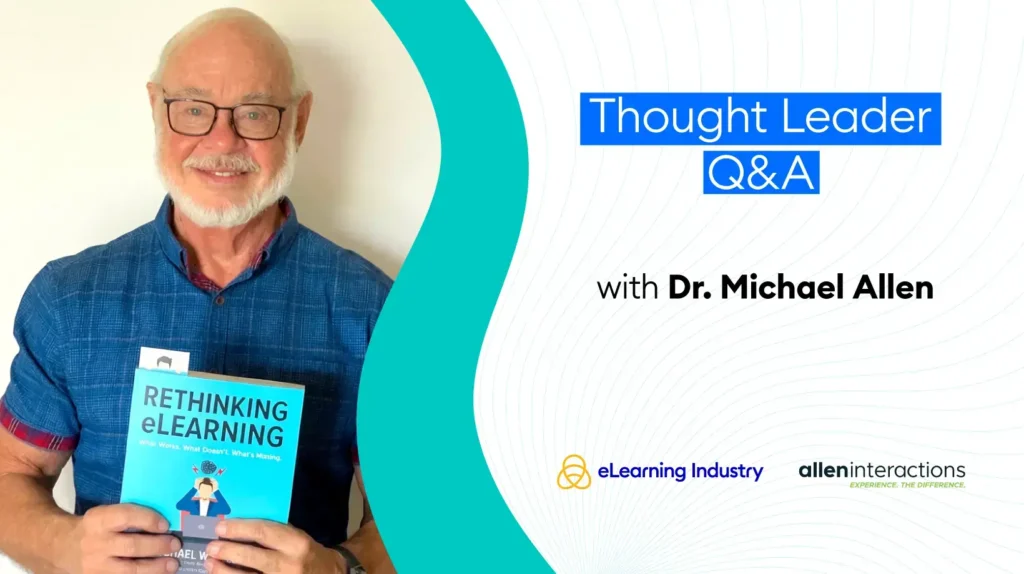
The landscape of corporate education is undergoing a seismic shift as organizations grapple with the diminishing returns of traditional digital training methods. At the forefront of this transformation is Dr. Michael W. Allen, a pioneer in the eLearning industry whose work since 1970 has shaped the way modern professionals acquire skills. As the founder and CEO of Allen Interactions, Dr. Allen has spent decades advocating for a departure from "content broadcasting"—the passive delivery of information—toward immersive, interactive experiences that prioritize emotional engagement and behavioral change. His latest insights, detailed in his book Rethinking eLearning: What Works. What Doesn’t. What’s Missing., serve as a critical compass for organizations seeking to navigate the complexities of talent development in an increasingly digital world.
The Historical Context of eLearning Evolution
To understand the current state of workplace learning, one must look at the chronology of instructional technology. In the 1970s and 1980s, early computer-based training (CBT) was limited by hardware constraints, often consisting of simple text-based prompts. As technology advanced in the 1990s with the advent of the World Wide Web and CD-ROMs, the industry saw a surge in "multimedia" learning. However, this era also gave birth to the "page-turner" model—digital modules that essentially functioned as narrated slideshows.
By the early 2000s, the rise of Learning Management Systems (LMS) allowed corporations to track completion rates with ease, but the quality of the pedagogical content often lagged behind the tracking capabilities. Dr. Allen’s career has been a direct response to this stagnation. Throughout this timeline, he developed the Successive Approximation Model (SAM) as an agile alternative to the traditional, linear ADDIE (Analysis, Design, Development, Implementation, and Evaluation) model. He also introduced the CCAF framework—Context, Challenge, Activity, and Feedback—which remains a gold standard for designing interactive learning.
The Relevancy Revelation: A Turning Point in Instructional Design
A pivotal moment in Dr. Allen’s philosophy occurred during his involvement with the Northside Achievement Zone (NAZ) project in Minneapolis. The initiative aimed to close the achievement gap for children by providing support and training to parents and community members. Dr. Allen observed that when training was presented as a series of academic lectures, engagement was non-existent. However, when the focus shifted to immediate, practical relevance—showing participants exactly how the training would improve their children’s lives and their own economic stability—the engagement levels skyrocketed.
This "relevancy revelation" is directly applicable to the corporate sector. In many modern enterprises, employees view mandatory training as a hurdle to be cleared rather than an opportunity for growth. Dr. Allen argues that if an organization cannot clearly articulate the personal advantages and "power" that a training module affords the learner, the training should perhaps not exist at all. This lack of perceived utility is a primary driver of employee disengagement, which industry data suggests costs global businesses billions in lost productivity and talent turnover.
The High Cost of Content Broadcasting
Despite the availability of sophisticated simulation tools and AI-driven platforms, many organizations remain stuck in a "broadcast" mindset. This approach treats learners as passive vessels for information. Dr. Allen identifies several factors reinforcing this outdated model:
- The Compliance Trap: Organizations often prioritize "checking the box" for legal or regulatory requirements over actual skill acquisition.
- Ease of Production: It is significantly faster and cheaper to record a lecture or upload a PDF than it is to design a branching scenario or a high-fidelity simulation.
- Misunderstood Metrics: Success is often measured by completion rates and quiz scores rather than long-term behavior change or improved job performance.
The economic implications of this failure are significant. According to LinkedIn’s 2023 Workplace Learning Report, 93% of organizations are concerned about employee retention, and "opportunities to learn" is the number one factor employees cite as a driver of a great work culture. When training is perceived as a waste of time, it not only fails to build competence but also erodes the employer-employee relationship. Dr. Allen posits that training that does not result in performance readiness is the most expensive alternative a company can choose, regardless of the initial production cost.
The 3Ms and CCAF: A Framework for Lasting Change
To combat the "forgetting curve"—a concept pioneered by Hermann Ebbinghaus suggesting that humans lose 70% of new information within 24 hours if it is not applied—Dr. Allen emphasizes the "3Ms" framework: Meaningful, Memorable, and Motivational.
Meaningful
For learning to stick, it must resonate with the learner’s current reality. This involves creating a "Context" (the first C in CCAF) that mirrors the actual environment where the skill will be used. If a salesperson is being trained, the digital environment should look, sound, and feel like a high-stakes sales call, not a sterile classroom.
Memorable
Memory is tied to emotion and practice. Dr. Allen’s "Challenge" and "Activity" components require learners to make decisions and face consequences within a safe, simulated environment. This "spaced authentic practice" ensures that the cognitive pathways required for the task are strengthened over time.
Motivational
Motivation is fueled by the "Feedback" component. In the CCAF model, feedback is not just a "Correct" or "Incorrect" popup. Instead, it is a demonstration of the consequences of an action. If a learner makes a poor decision in a leadership simulation, they should see the simulated team’s morale drop or a project deadline being missed. This intrinsic feedback is far more motivational than a numerical score.
Strategic Implementation: Backward Design and Individualized Paths
One of the most radical shifts Dr. Allen proposes is the use of "backward design." Traditionally, training starts with foundational theories and works toward a final exam. Dr. Allen suggests starting with the "final challenge" first.
By allowing learners to attempt the most difficult task immediately, organizations can identify existing competencies. If a learner can successfully navigate a complex simulation on day one, they are exempted from the introductory modules. This creates an individualized pathway that respects the learner’s time and prior knowledge. For those who struggle, the system then invokes specific microlearning modules—short, distributed sessions—to fill the identified gaps. This "just-in-time" learning reduces cognitive load and prevents the frustration associated with redundant training.
The Future of the Industry: From Drudgery to "Fun"
Looking toward the future, Dr. Allen envisions a workplace where learning is synonymous with "fun." This is not a reference to superficial gamification, such as leaderboards or badges, but rather the deep, "hard fun" found in mastering a complex skill. He compares the ideal learning experience to a well-designed video game where the difficulty scales with the player’s ability, maintaining a state of "flow."
Industry analysts suggest that as AI continues to automate routine tasks, the "human skills"—critical thinking, empathy, and complex problem-solving—will become the primary competitive advantage for corporations. Dr. Allen’s methodologies are uniquely suited to these soft skills, which cannot be taught through rote memorization but must be developed through experience and reflection.
Implications for Corporate Leadership
For Chief Learning Officers (CLOs) and HR leaders, the message from Dr. Allen is clear: the ROI of workplace learning is found in performance, not participation. Organizations that embrace these principles—prioritizing emotional engagement, authentic practice, and learner-centric design—are likely to see enhanced competitiveness and higher stakeholder satisfaction.
As the workforce continues to evolve, with Gen Z and Millennials demanding more purposeful and engaging professional development, the "broadcast" model of the past is no longer viable. The transition toward the immersive, empathetic, and effective models championed by Dr. Michael Allen represents more than just a trend in instructional design; it is a necessary evolution for the survival and growth of the modern enterprise. By treating learners as active participants in their own development, companies can transform training from a mandatory burden into a powerful engine for innovation and excellence.






