
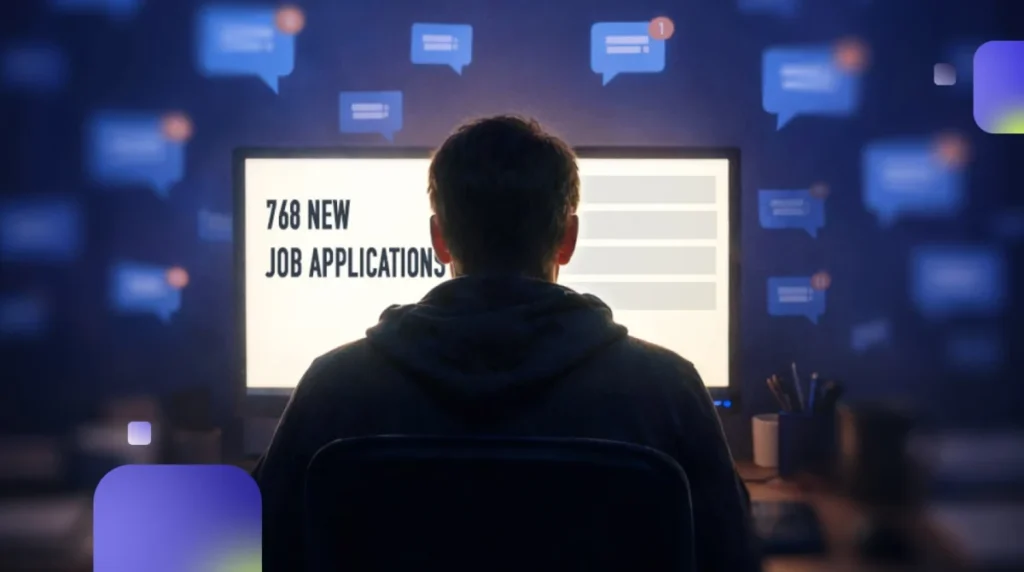
A profound transformation is sweeping through the global hiring landscape, profoundly reshaping traditional recruitment paradigms. Data from Workable, a leading hiring platform, reveals a significant indicator of this shift: approximately 10% of all job applications processed through their system are now being submitted via AI mass-apply tools. This burgeoning trend signals a critical juncture for employers and recruiters worldwide, prompting a crucial question: Is this merely a misunderstood evolution in candidate behavior, or does it represent a genuine, disruptive force that demands immediate strategic adaptation?
The Inevitable Shift: AI Candidates Are Real
For some in the recruitment sector, the sudden surge in AI-assisted applications evokes a sense of "pollution," an overwhelming influx of potentially low-intent submissions that threaten to dilute the quality of applicant pools. The initial, instinctual reaction for many is to implement blanket blocks against such applications. However, Nikos Moraitakis, CEO of Workable, offers a critical perspective that challenges this reactive stance. "These aren’t ‘fake’ candidates," Moraitakis asserts emphatically. "The vast majority are real people with real resumes." His insight underscores a fundamental truth: the individuals leveraging these AI tools are legitimate job seekers actively pursuing employment opportunities, not malicious actors or bots. They are simply employing the latest technological advancements to navigate an increasingly complex and competitive job market.
Moraitakis draws a compelling historical parallel to contextualize the current resistance: "Refusing AI-assisted applications in 2025 is a little like refusing applications that came from the web in 1997." This analogy highlights the futility and potential harm of resisting an inevitable technological tide. Just as the internet fundamentally altered how businesses operate and how individuals seek information and opportunities, AI is now embedded in the fabric of job searching. To block AI-assisted applications is not merely to filter out noise; it risks systematically excluding a growing segment of qualified, proactive individuals who are simply leveraging modern tools to streamline their job search process. The landscape of talent acquisition is irrevocably changing, and an adaptive mindset, rather than a resistive one, is paramount for success.
A Brief History of Job Seeking: From Classifieds to AI Algorithms
To fully grasp the significance of AI mass-apply tools, it’s essential to understand the historical evolution of job searching and application methods. For centuries, job opportunities were primarily disseminated through word-of-mouth, apprenticeships, or local community bulletins. The advent of newspapers brought classified advertisements, making job postings accessible to a broader audience. In the mid-20th century, physical mail applications, often accompanied by typed resumes and cover letters, became the standard. The 1980s saw the brief rise of fax machines for application submissions, a technological marvel at the time for its speed.
The late 1990s and early 2000s marked the true digital revolution in recruitment. The internet gave birth to online job boards like Monster and CareerBuilder, transforming the application process from paper to pixels. Companies began implementing Applicant Tracking Systems (ATS) to manage the burgeoning volume of digital applications. Initially designed to bring efficiency, these systems soon became infamous for their often-rigid keyword filtering, complex forms, and the perception of a "resume black hole" where applications disappeared without a trace. This period also saw the rise of "easy apply" buttons, particularly on professional networking sites, which significantly lowered the barrier to application, leading to an initial surge in application volume.
The current era, however, is witnessing another exponential leap. The frustration with ATS, the time-consuming nature of tailoring multiple applications, and the sheer competition for desirable roles have spurred candidates to seek more efficient solutions. This environment has created fertile ground for the development and widespread adoption of AI-powered tools that automate various aspects of the job search, including the mass submission of applications.
The Rise of AI in Candidate Tools: A Chronology of Empowerment
The integration of artificial intelligence into the job application process has not been an overnight phenomenon but rather a gradual evolution, accelerating rapidly in recent years.
- Early 2010s: AI in Recruitment Back-End: Initial applications of AI in recruitment were primarily on the employer side, focusing on basic resume parsing, keyword matching within ATS, and rudimentary candidate scoring to help recruiters manage large volumes.
- Mid-2010s: AI-Assisted Resume & Cover Letter Generation: Tools began to emerge that leveraged AI to analyze job descriptions and help candidates optimize their resumes and cover letters with relevant keywords and phrasing. These were primarily assistive, requiring significant human input.
- Late 2010s: Personalization at Scale: AI began to offer more sophisticated personalization, helping candidates tailor their applications more effectively for specific roles, improving their chances of passing initial ATS screens.
- Early 2020s: The Emergence of Mass-Apply Platforms: Driven by advancements in natural language processing (NLP) and the increasing accessibility of AI models, dedicated AI mass-apply platforms began to gain traction. Companies like Simplify, LazyApply, and others emerged, promising to submit hundreds or even thousands of applications on a candidate’s behalf, often with minimal manual effort. These tools typically ingest a candidate’s resume and preferences, then automatically identify suitable roles across various job boards, fill out application forms, and even generate semi-customized cover letters.
- Present Day: Embedded and Sophisticated Integration: Today, these tools are becoming more sophisticated, integrating directly with job boards and company career pages, and offering features like application tracking, interview scheduling assistance, and even AI-powered interview preparation. The 10% figure from Workable underscores their significant, albeit relatively recent, penetration into the mainstream job search process.
This chronological development highlights a shift in power dynamics. While employers initially used AI to streamline their hiring, candidates are now leveraging AI to optimize their job search, creating a new equilibrium that demands strategic responses from both sides.
Supporting Data: The Scale of the Application Challenge
The statistic that 10% of applications are AI-driven is not an isolated phenomenon but rather a symptom of broader trends in the labor market. Industry data consistently shows that the number of applications per job opening has been steadily increasing. For example, a LinkedIn study once indicated that the average corporate job opening receives around 250 applications. Other reports suggest that competitive roles in tech or high-growth sectors can attract upwards of 1,000 applications.
This massive volume creates a significant burden for both candidates and recruiters. Job seekers often report spending hours, if not days, tailoring individual applications, with many feeling that their efforts are swallowed into the aforementioned "black hole." This frustration is a primary driver for adopting AI mass-apply tools. A recent survey by ResumeBuilder.com found that nearly half of job seekers (46%) are using AI tools in their job search, with 70% reporting positive results. While specific figures for "mass-apply" are harder to isolate, the general trend towards AI adoption by candidates is undeniable.
From the employer’s perspective, this volume translates into immense screening challenges. Recruiters spend a significant portion of their time sifting through resumes, many of which may not be a perfect fit. The influx of AI-generated applications, even if from real candidates, can exacerbate this "signal-to-noise" problem. The average time a recruiter spends looking at a resume is often cited as a mere 6-7 seconds. With AI-driven applications potentially increasing volume further, the pressure on recruiters to efficiently identify genuinely qualified and engaged candidates becomes even more intense. This data underscores the urgent need for sophisticated tools that can help discern intent and suitability amidst a torrent of applications.
Implications for Employers: Adapting to the New Reality
The initial "pollution" sentiment among some recruiters is understandable. An increased volume of applications, particularly those generated with minimal candidate effort, can indeed create a sense of information overload and a fear of wasting valuable time on unqualified leads. There’s a concern that AI tools might encourage a spray-and-pray approach, leading to a higher proportion of irrelevant applications. However, as Moraitakis points out, the vast majority of these candidates are real people. The challenge, therefore, is not to block them, but to understand their motivations and integrate them into a refined hiring strategy.
Blocking AI-assisted applications carries significant risks. Firstly, it could lead to the unintended exclusion of highly qualified candidates who are simply tech-savvy and efficient in their job search. In a competitive talent market, alienating such individuals could mean missing out on top talent. Secondly, it sends a message that an organization is resistant to technological advancements, potentially impacting its employer brand among a digitally native workforce. Thirdly, attempting to perfectly detect and block all AI-assisted applications is likely a losing battle, as AI tools continuously evolve to bypass detection mechanisms.
The pragmatic approach, championed by Workable, is to "Adapt, Don’t Resist." This philosophy acknowledges that AI tools for candidates are not a fleeting trend but an embedded component of modern job seeking. The real challenge for employers shifts from blocking to discerning. It’s about separating the "signal from the noise" in an environment where application volume, driven by both human and AI efforts, continues its upward trajectory. Employers need more robust mechanisms to understand who is applying, their level of genuine interest, and their qualifications, irrespective of the method of submission.
Workable’s Strategic Response: Building the Infrastructure for the Future
Workable is directly addressing this paradigm shift by focusing on enhancing identity and intent signals throughout the inbound hiring funnel. This proactive strategy aims to provide recruiters with clearer insights into each application, moving beyond a superficial assessment of the submission method. By leveraging its vast dataset and analyzing behavioral patterns that are only visible at Workable’s scale, the platform is developing solutions to help hiring teams:
- Identify Genuine Intent: Distinguish between candidates who are truly interested and engaged versus those merely submitting applications en masse without careful consideration. This might involve analyzing application completeness, engagement with company content, or prior interactions.
- Verify Candidate Identity: Ensure that applications are indeed from real individuals, mitigating concerns about fraudulent submissions.
- Prioritize Qualified Candidates: Use sophisticated algorithms to highlight candidates who best match job requirements, regardless of how their application was generated.
- Streamline Screening: Provide tools that help recruiters quickly assess the most promising candidates, reducing the manual burden of sifting through high volumes.
As Moraitakis succinctly puts it, "The winners will be the employers with tools that can separate signal from noise." This statement underscores the critical need for advanced technological solutions on the employer side to counteract the impact of candidate-side AI tools. The goal is not to eliminate AI from the process but to harness it intelligently to maintain hiring effectiveness, fairness, and a focus on human judgment.
The Necessity of AI as a Countermeasure: Equipping Recruiters
The increasing sophistication of candidate-facing AI tools necessitates an equally advanced suite of AI-powered tools for recruiters. As application volume grows, the old adage "AI must help process AI" becomes a core tenet of modern talent acquisition. Workable, recognizing this imperative, is actively equipping recruiters with screening tools designed to ensure:
- Fair and Unbiased Screening: AI can be trained to objectively evaluate qualifications based on job requirements, potentially reducing human bias in the initial screening stages.
- Efficient Candidate Matching: Advanced AI can quickly identify candidates whose skills, experience, and even cultural fit align closely with the role and company, saving significant time.
- Focus on High-Value Tasks: By automating routine screening and administrative tasks, AI frees up recruiters to focus on more strategic, human-centric activities like candidate engagement, interviewing, and building relationships.
Moraitakis articulates this perfectly: "We’re going to need AI as a countermeasure to AI." This isn’t about an AI arms race, but rather about achieving balance and efficiency. Recruiters, armed with intelligent tools, can move beyond being mere gatekeepers, transforming into strategic talent advisors who leverage technology to make more informed, human-centric decisions. This includes advanced semantic search capabilities that understand the context of skills and experience, rather than just keywords, and AI-driven candidate ranking systems that present the most promising individuals upfront.
Looking Ahead: The Evolving Landscape of Talent Acquisition
The trajectory of AI in recruitment indicates that candidate tools will continue to become more intelligent, and application volumes will inevitably increase. This expansion of scale fundamentally alters processes that once felt intimate and entirely human. Recruiters are no longer just evaluating individual applications; they are managing a dynamic ecosystem where technology plays an increasingly central role for both parties.
The future of talent acquisition will demand a delicate balance: leveraging the power of AI to manage scale and efficiency, while simultaneously ensuring that the core of hiring remains rooted in human judgment, empathy, and strategic insight. Ethical considerations surrounding AI bias, data privacy, and transparency will also become paramount, requiring robust governance and continuous refinement of AI algorithms.
Workable’s mission, however, remains steadfast amidst this technological upheaval: to help employers find and hire great people. The method of application may evolve, but the fundamental need for organizations to attract and secure top talent persists. The companies that thrive in this new era will be those that embrace technological evolution, adapt their strategies, and invest in the tools that empower their recruitment teams to effectively navigate the complexities of AI-driven job markets.
As Moraitakis concludes, encapsulating the forward-looking imperative for the industry: "The job market isn’t going back. It’s time to build the infrastructure that lets great hires rise to the top – no matter how they knock on the door." This vision emphasizes the importance of creating resilient, intelligent, and adaptable hiring systems that can discern genuine talent and potential, irrespective of the technological pathways candidates choose to utilize. The AI revolution in hiring is not a threat to be resisted, but a new reality to be embraced and strategically leveraged.






