The Human Resources (HR) profession has long been characterized by a persistent identity crisis, caught between its perceived roles as a strategic partner driving organizational value and human capital growth, and its more traditional function as an administrative arm enforcing policies and regulations. This dichotomy, often symbolized by the "Don’t Trust HR" meme, has defined the profession for decades. However, a profound transformation is underway, propelled by the advent of Artificial Intelligence (AI), which is poised to reshape HR’s landscape, particularly starting in 2026. This impending shift promises to liberate HR from its administrative burdens and usher in an era of the "full-stack" HR professional, deeply integrated into strategic decision-making.
The Evolving Complexity of Human Resources
For over half a century, the HR profession has undergone a dramatic expansion in scope and complexity. Globally, it encompasses over 40 million professionals across hundreds of distinct job titles. This growth is intrinsically linked to the dynamic nature of business, societal expectations, and legal frameworks. Initially focused on fundamental tasks such as payroll, recruitment, and general work administration, HR’s responsibilities have steadily broadened. The 1960s and 1970s saw the integration of industrial psychology, career management, and sophisticated succession planning tools like forced ranking and the nine-box grid.
More recently, HR has grappled with emerging disciplines including employee well-being, hybrid work models, Diversity, Equity, and Inclusion (DEI) initiatives, productivity management, organizational culture, and leadership development. The current wave of innovation, fueled by AI, introduces concepts like "talent density," flexible organizational design, "jobless" work models, and nuanced approaches to pay equity and performance management. The emergence of highly capable individuals, akin to the hypothetical "Superworker" capable of multifaceted contributions, raises questions about compensation models and organizational structures, potentially challenging traditional pay scales and demanding innovative talent management strategies.
This increasing specialization has led to a complex ecosystem within HR departments, with numerous specialists often focusing on individual domains. The operational structure further compounds this complexity. Larger organizations typically adopt federated HR models, featuring central oversight coupled with localized teams catering to specific geographic regions or business units. These teams are often spearheaded by HR Business Partners, whose roles can range from highly strategic to purely operational. They are tasked with adapting global policies to local nuances, including varying labor laws, job market conditions, and cultural expectations. The practical implications are significant; for instance, recruiting an engineer in Singapore presents vastly different challenges and requirements than doing so in Germany.

For the past two decades, Human Capital Management (HCM) systems from industry giants like Workday, Oracle, and SAP have served as the primary technological solutions for managing this intricate HR landscape. While these platforms offer sophisticated functionalities for data management, payroll processing, and workflow automation, they have largely operated as advanced record-keeping and business process management tools. Their efficacy is often contingent on substantial human intervention for tuning, administration, and ongoing management, necessitating large teams of HR professionals.
AI as the Catalyst for Transformation
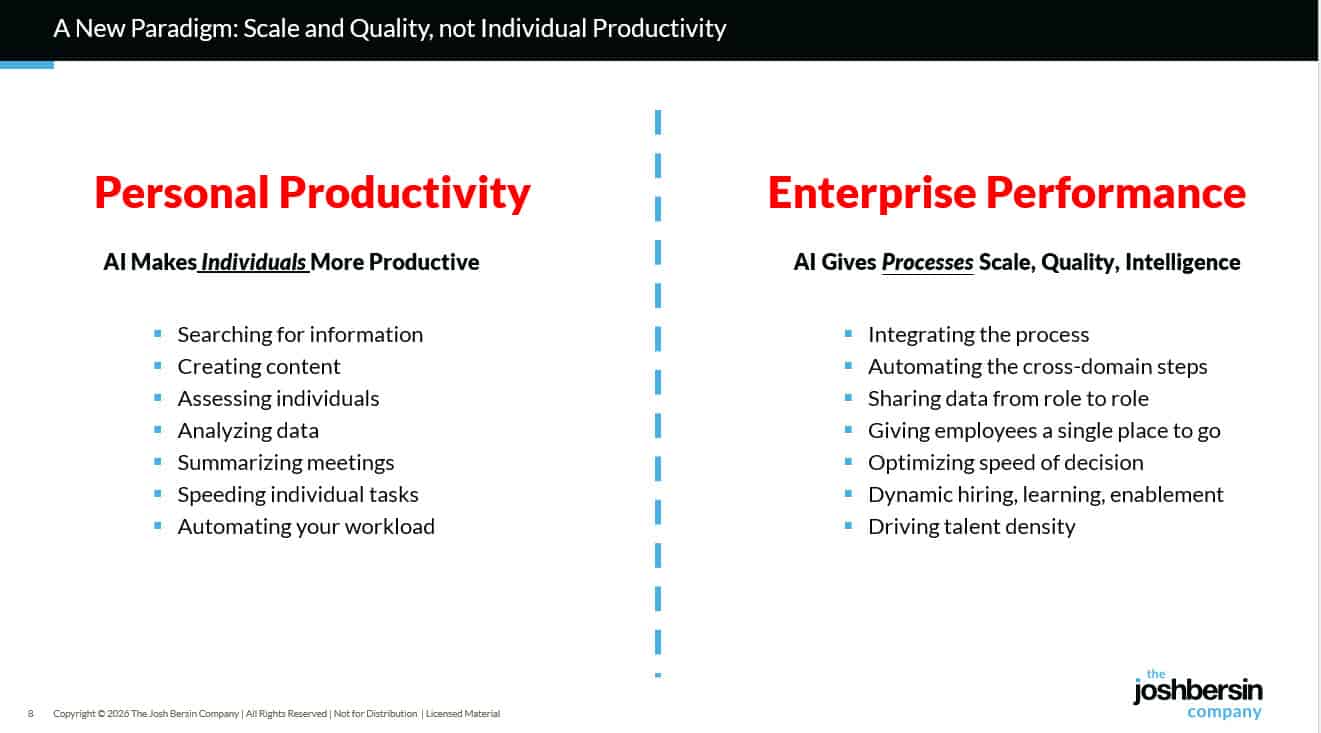
The year 2026 is emerging as a pivotal moment, marking the widespread adoption of enterprise AI, fundamentally altering the operational paradigm of HR. The focus is shifting from augmenting individual productivity to revolutionizing entire business processes. This strategic application of AI moves beyond incremental improvements, aiming to redesign organizational operations and deploy "Superagents" capable of achieving unprecedented scale and autonomy.
The analogy of the autonomous vehicle serves as a potent illustration of this shift. Instead of continuously enhancing driver assistance features – such as power steering, advanced braking systems, lane departure warnings, and automated parking – the development of autonomous vehicles centers on creating an integrated "Superagent" that prioritizes the passenger’s mobility outcome. The primary objective is to optimize the journey for those being transported, rather than merely easing the driver’s workload. This transition effectively redefines the role of the driver, akin to how AI is poised to automate routine HR tasks, leading to significantly enhanced safety and efficiency, and paving the way for novel business models such as pay-per-mile services.
Within the business context, this evolution mirrors the progression from personal assistants to individual agents (automation tools) and now to "Superagents" that manage entire processes. While this transformation will not occur instantaneously, its acceleration is undeniable. Companies are already implementing Superagents for critical functions such as global onboarding, highly targeted talent acquisition, and specialized sales training in sectors like insurance, aviation, and pharmaceuticals. These agentic applications are demonstrating the potential to streamline HR operations, reduce manual intervention, and deliver superior organizational outcomes.
The Reshaping of the HR Workforce
Analysis conducted through initiatives like the Systemic HR AI Blueprint, which examines task-level data across more than 250 HR job roles, indicates a significant potential for automation. It is estimated that 30-40% of existing HR job functions could be automated with relative ease. Roles such as "interview scheduler," "recruitment coordinator," and "helpdesk assistant," which constitute the tactical and administrative backbone of traditional HR, are prime candidates for this automation. This reallocation of human capital allows individuals in these positions to pivot towards new responsibilities, including the development and management of AI agents, direct engagement with candidates, and providing consultative support to business units.

Contrary to concerns about a net reduction in HR employment, projections suggest a shift in the composition of the HR workforce rather than a contraction. Over the past five years, HR job postings have seen a substantial increase of 60%, outpacing many other professional fields. The future HR landscape will likely feature a decline in routine operational roles, a rise in new AI-centric positions, and a significant number of HR professionals evolving into "full-stack" practitioners. This evolution is also anticipated to drive an increase in HR salaries, as professionals acquire more strategic and specialized skill sets.
Areas Ripe for AI-Driven Automation
The Systemic HR AI Blueprint identifies six key areas within HR that are particularly amenable to AI-driven automation. These typically include:
- Recruitment and Talent Acquisition: Automating candidate sourcing, initial screening, interview scheduling, and candidate communication.
- Onboarding and Offboarding: Streamlining the administrative processes associated with bringing new employees into the organization and managing departures.
- Employee Data Management and Payroll: Enhancing accuracy and efficiency in managing employee records, benefits administration, and payroll processing.
- Performance Management and Development: Facilitating continuous feedback, skill gap analysis, and personalized learning and development recommendations.
- Compliance and Policy Enforcement: Automating the monitoring of policy adherence and ensuring regulatory compliance.
- Employee Engagement and Support: Utilizing AI-powered chatbots and sentiment analysis to provide instant support and gauge employee morale.
The Emergence of "Full-Stack" HR
The ultimate objective of this extensive automation is not merely cost reduction but the generation of substantial business value. By automating these processes, organizations can achieve greater scalability, enhance accuracy, and improve the overall employee and manager experience. This allows HR teams to accelerate strategic hiring, mitigate the impact of volatile "hire/fire" cycles, deliver real-time training to managers and employees, and proactively identify potential management issues, high-turnover areas, and organizational risks.
For HR professionals, this shift liberates them to concentrate on "Full-Stack HR" – strategic initiatives that directly contribute to the company’s bottom line. This repositioning fosters a closer alignment between HR and the business units it supports. Instead of dedicating time to data entry or enforcing rigid policies, HR business teams can now focus on:
- Strategic Workforce Planning: Aligning talent strategies with long-term business objectives.
- Talent Development and Capability Building: Cultivating a skilled and adaptable workforce.
- Organizational Design and Change Management: Facilitating agile organizational structures and smooth transitions.
- Employee Experience and Culture Enhancement: Creating a positive and productive work environment.
- Data-Driven People Analytics: Leveraging insights to inform strategic people decisions.
- Executive Coaching and Leadership Development: Supporting and enhancing leadership effectiveness.
Shifting HR Benchmarks and Increased Value
A traditional HR benchmark has been the employee-to-HR staff ratio, historically hovering around 100:1. As AI assumes responsibility for tactical and administrative tasks, this ratio is projected to increase significantly, potentially reaching 200:1, 300:1, or even 400:1. While this suggests a reduced need for personnel in purely administrative roles, it does not necessarily portend a substantial overall reduction in HR department size, given the emergence of new AI-focused roles.
The true impact lies in the enhanced value proposition of HR. With AI automating routine functions, HR professionals can command higher salaries by focusing on strategic contributions. For instance, retail and food service companies can directly boost revenue by leveraging AI for faster hiring and scheduling, enabling them to meet customer demand more effectively, as exemplified by companies like Chipotle. Similarly, manufacturing giants such as Boeing can increase production efficiency through accelerated training, a reinforced safety culture, and more agile talent mobility.
The Criticality of Data Quality and Trust in the AI Era
As HR operations accelerate to the pace of AI, the paramount importance of data accuracy, explainability, and trustworthiness cannot be overstated. In manual systems, occasional human errors might occur without widespread impact. However, in scaled automated systems, a single error in an AI-driven recruiting algorithm or payroll rule could affect thousands of employees instantaneously.
Consequently, a significant portion of new HR roles will be dedicated to managing the quality and integrity of these AI systems. HR professionals will be responsible for ensuring that AI agents are powered by accurate, up-to-date, and complete data. Furthermore, HR will now bear the responsibility for addressing AI bias and fostering trust in these systems. Recent lawsuits against HR technology vendors, such as those involving Workday and Eightfold, underscore the critical need for explainable and high-trust AI systems, a responsibility that now squarely falls on the shoulders of HR departments.
The transformation of the HR profession is not a distant prospect but a present reality. For HR professionals and leaders, embracing this evolution is imperative. The advent of AI heralds a new era for Human Resources, one where administrative overhead is minimized, and strategic impact is maximized, ultimately redefining the value and perception of the HR function within organizations.