As artificial intelligence continues its rapid integration into every facet of professional and educational life, a critical divide has emerged in how institutions manage this transition. On one side, academic administrators have largely adopted a policy of prohibition, utilizing AI detection software and revised integrity policies to keep the technology out of the classroom. On the other, corporate leadership has pushed for aggressive adoption, prioritizing speed and fluency through deployment targets and organizational pressure. However, emerging neurological research and pedagogical analysis suggest that both approaches are fundamentally flawed, leading to a phenomenon known as "cognitive debt." The solution, according to experts in learning design, is a structured, sequenced practice known as The Bot Check Method, which prioritizes human agency over mere tool proficiency.
The Neuroscience of Cognitive Debt: The MIT Media Lab Findings
The debate over AI integration has shifted from theoretical concerns about academic integrity to measurable neurological impacts. A landmark study conducted by researchers at the MIT Media Lab, titled "Your Brain on ChatGPT: Accumulation of Cognitive Debt when Using an AI Assistant for Essay Writing Task," provides the first empirical evidence of how AI usage affects the human brain during the learning process. Led by Nataliya Kosmyna, the research team outfitted 54 university students with electroencephalogram (EEG) caps to measure real-time brain activity across three distinct conditions: writing with ChatGPT, writing with a standard search engine, and writing without any external tools.
The findings were stark and unambiguous. Students who relied on ChatGPT exhibited the weakest neural connectivity across brain regions associated with memory and active thinking. In contrast, those working without any digital tools showed the strongest and most distributed neural networks. Most significantly, the study identified a lasting effect: when students who had previously used ChatGPT were asked to write a subsequent essay without it, their neural engagement remained depressed. This "underengagement" suggests that the habit of deferring to AI alters the patterns of cognitive activation, a state the researchers termed "cognitive debt."
Furthermore, the study highlighted a decline in "cognitive ownership." Participants in the LLM (Large Language Model) group reported the lowest levels of ownership over their work and struggled to accurately quote or explain their own writing. This suggests that when AI is used as a replacement for thinking rather than an interlocutor, the user fails to internalize the information, rendering the "learning" process ineffective.
The Chronology of AI Policy: From Prohibition to Ungoverned Adoption
The current crisis in learning design can be traced back to the public release of ChatGPT in late 2022, which triggered an immediate and polarized response across sectors.

- Late 2022 – Early 2023 (The Panic Phase): High schools and universities across the globe moved to ban AI tools, viewing them primarily as engines for plagiarism. In corporate settings, several major financial and tech firms banned internal use due to data privacy concerns.
- Mid-2023 (The Adoption Pivot): As the capabilities of GenAI became undeniable, the corporate narrative shifted toward "AI or die." Companies began mandating AI fluency training and integrating "Copilots" into standard workflows.
- Late 2023 – 2024 (The Realization of "Shadow AI"): Organizations that maintained strict prohibitions discovered that employees were using AI regardless, often on personal devices. This "Shadow AI" created massive security risks, as sensitive corporate data was fed into consumer-grade models without oversight.
- 2025 and Beyond (The Design Era): The focus is now shifting from whether to use AI to how to sequence its use to prevent the erosion of human capability.
The "Abstinence Error" in Academia and Corporate Governance
The push for AI prohibition in academia has been compared to abstinence-only education in public health. While intended to prevent a specific behavior, it often fails to stop the behavior and instead removes it from a controlled, educational environment. When students use AI "underground," they do so without the pedagogical scaffolding necessary to make the encounter generative. They use it as a shortcut, which leads directly to the cognitive debt identified in the MIT study.
In the corporate world, the abstinence error manifests as a significant security threat. When a Chief Learning Officer or IT department prohibits AI, they do not stop its use; they merely lose visibility. Employees frequently use personal accounts to summarize internal strategy documents, analyze compensation files, or draft client-facing materials. This "Shadow AI" bypasses corporate data retention controls and audit trails, creating a vulnerability that sanctioned, governed programs would otherwise mitigate.
Conversely, ungoverned adoption is equally problematic. When companies measure success by how often AI is used rather than how it augments human thinking, they risk building an workforce that can no longer operate independently. This creates a reliance on the tool that mirrors the neural underengagement found in the MIT study.
Implementing The Bot Check Method: A Four-Phase Sequence
To bridge the gap between prohibition and ungoverned adoption, Christyl L. Murray has developed "The Bot Check Method." This framework is designed to protect human agency by ensuring that AI enters the cognitive process only after human thinking has been established. The method is rooted in the "Community of Inquiry" (CoI) framework, which emphasizes cognitive presence through four stages: triggering, exploration, integration, and resolution.
Phase 1: Think Human
Before any AI tool is consulted, individuals must work through a problem or task alone. This creates a "triggering event" that establishes a cognitive stake in the outcome. By forcing the brain to form its own neural pathways and initial conclusions, the learner avoids the immediate accumulation of cognitive debt.
Phase 2: Think Human Together
Participants move into small groups to share their individual diagnoses and challenge each other’s reasoning. This phase activates "social presence," which is essential for reaching cognitive depth. By debating with peers before consulting an algorithm, learners build a shared human recommendation that they are prepared to defend.
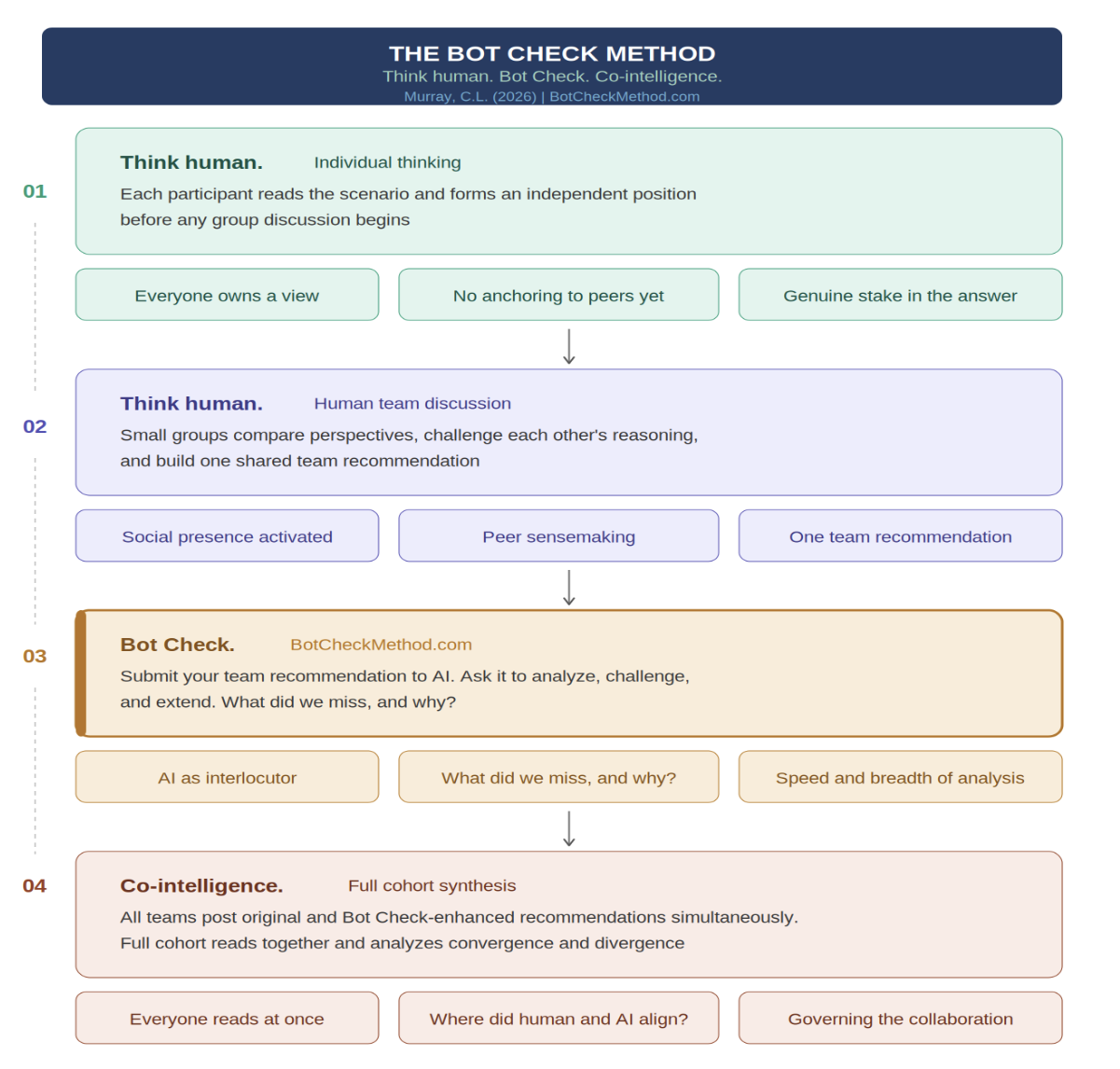
Phase 3: Bot Check
Only after the human team has a defensible recommendation do they introduce AI. The team submits their work to the AI, asking it to analyze, challenge, and extend their thinking. The prompt here is critical; instead of asking for "the answer," the team might ask: "What is the sharpest, most rigorous way to challenge this recommendation’s weakest assumption?" In this phase, the AI acts as an interlocutor rather than an authority.
Phase 4: Co-Intelligence
In the final phase, teams share both their original human recommendation and the AI-enhanced version. The larger group then analyzes the patterns of convergence and divergence. This process produces insights that neither the humans nor the AI could have produced in isolation, while maintaining clear intellectual ownership.
Scaling Agency: The SHINE Framework for Governance
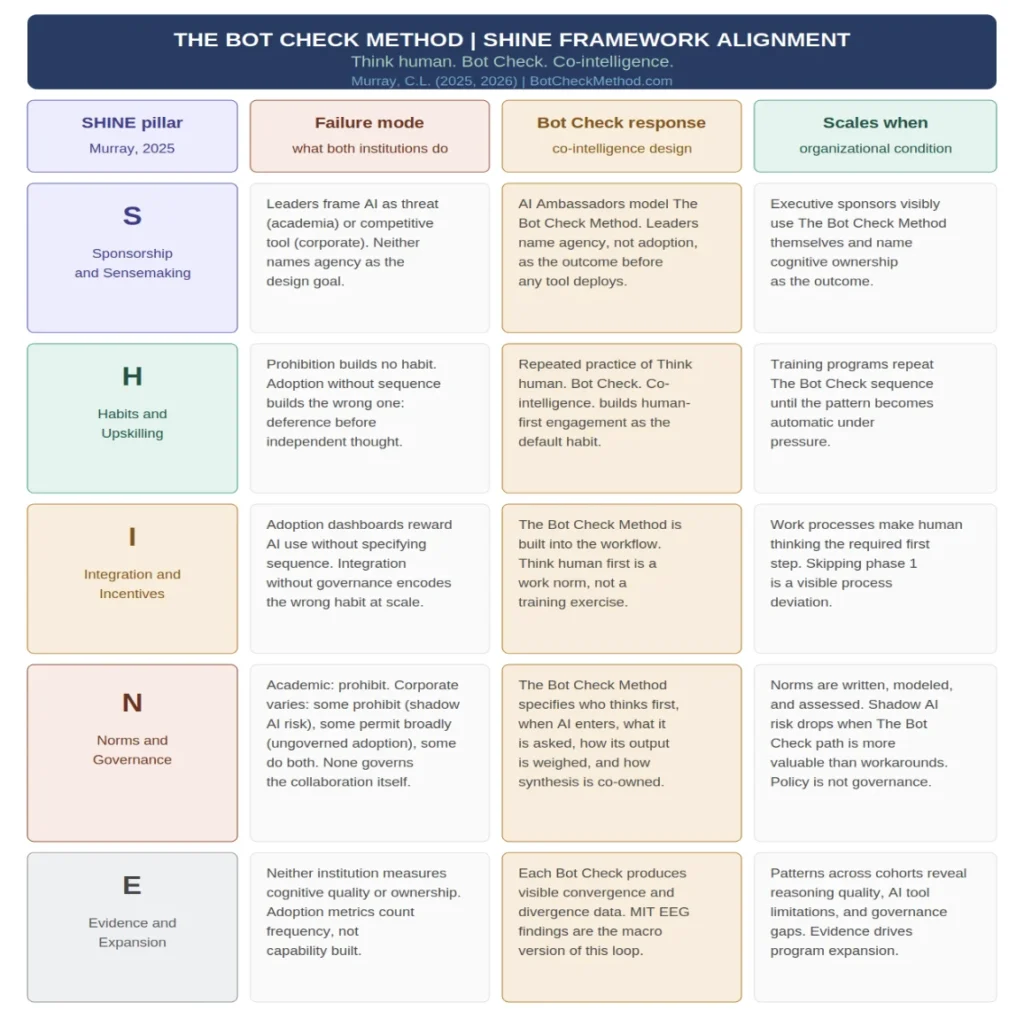
Moving The Bot Check Method from a single classroom or meeting to an organizational capability requires a robust governance architecture. The SHINE framework provides the necessary pillars for this transformation:
- Sponsorship and Sensemaking: Leaders and "AI Ambassadors" must model the method. Sponsorship is not about signing off on a budget; it is about demonstrating what purposeful, human-first AI use looks like in practice.
- Habits and Upskilling: Upskilling should not focus on tool proficiency alone. Instead, it should build the behavioral habit of the "human-first, AI-informed" sequence.
- Integration and Incentives: Workflows must be redesigned to reward the "Think Human" phase. If an incentive structure only rewards the speed of the final output, it will inevitably encourage the shortcuts that lead to cognitive debt.
- Norms and Governance: Governance must move beyond simple usage policies. It must provide a design for how humans and AI think together, ensuring accountability and data security.
- Evidence and Expansion: Organizations must build evidence loops—similar to the MIT EEG study—to measure how AI integration is affecting the quality of team reasoning and long-term capability building.
Broader Impact and Implications for the Future of Work
The implications of "cognitive debt" extend far beyond the classroom. In a corporate environment, a workforce that has outsourced its thinking to AI is a workforce that lacks resilience, creativity, and the ability to innovate during "black swan" events where historical data (on which AI is trained) is no longer applicable.
Industry experts suggest that as AI becomes more agentic—capable of performing complex tasks with minimal human intervention—the "Think Human" phase becomes even more vital. If the human element is removed from the triggering and exploration phases of problem-solving, the resulting "co-intelligence" will be hollow.
The shift from AI abstinence to AI agency represents a fundamental change in the role of the learning leader. Whether in the boardroom or the executive classroom, the goal is no longer to manage a tool, but to design the sequence of human engagement. By adopting methods like The Bot Check, institutions can harness the power of AI without sacrificing the neurological health and intellectual ownership of their people. The journey forward requires a commitment to human-centric design, ensuring that as the "bot" gets smarter, the human does as well.