In an era where diversity, equity, and inclusion (DEI) are no longer aspirational goals but fundamental pillars of corporate strategy, the efficacy of communication in attracting a broad talent pool has become paramount. Organizations across all sectors are increasingly leveraging advanced gender writing analysis tools to ensure their outreach, particularly job descriptions and recruitment communications, is inclusive and free from unconscious bias. This strategic adoption is driven by compelling data demonstrating a direct correlation between gender-neutral language and superior hiring outcomes, positioning these analytical instruments as indispensable assets in the competitive talent acquisition landscape of 2026.
The Genesis of Inclusive Language in Hiring: A Chronology
The journey towards equitable hiring has seen significant evolution over the past decade. While discussions around workplace diversity began gaining traction in the late 20th century, the specific focus on linguistic bias in recruitment accelerated in the early 2010s. Initial efforts were largely manual, involving HR teams scrutinizing job postings for overtly gendered terms. However, as research began to shed light on the subtle, often unconscious ways language could deter specific demographic groups, the need for more sophisticated solutions became apparent.
By the mid-2010s, basic online "gender decoders" emerged, offering rudimentary checks against predefined lists of masculine and feminine-coded words. These tools marked a crucial turning point, raising widespread awareness among recruiters and hiring managers. The late 2010s and early 2020s witnessed a rapid integration of Artificial Intelligence (AI) and Natural Language Processing (NLP) into these tools, transforming them from simple word checkers into intelligent writing assistants. This technological leap allowed for the detection of more nuanced biases, contextual analysis, and proactive suggestions for inclusive alternatives. As of 2026, these advanced tools are not merely supplementary checks but integrated, essential components of modern talent acquisition workflows, reflecting a widespread institutional commitment to fostering truly inclusive workplaces from the ground up.
Empirical Evidence: The Undeniable Business Case for Gender-Neutral Language
The tangible benefits of employing gender-neutral language in recruitment are well-documented and universally accepted in 2026, forming a cornerstone of best practice. A landmark Appcast study, which meticulously analyzed 473,742 job advertisements, provided irrefutable evidence of the profound impact of inclusive language on recruitment efficiency and effectiveness. The study concluded with a widely cited finding: "Job ads with gender-neutral language result in 67.75% more applications at a cost that is 68.5% less per application in comparison to job ads that use a combination of female and male-coded terms." This staggering improvement in both volume and cost-efficiency has cemented the economic rationale for adopting such tools, directly impacting recruitment budgets, accelerating time-to-hire, and significantly broadening talent pipelines.
Further reinforcing this, research from the Harvard Kennedy School revealed a critical psychological barrier: women are 50% less likely to apply for jobs that contain masculine-sounding language. This finding underscores how subtle linguistic cues can inadvertently shrink the potential talent pool, limiting an organization’s access to highly skilled female candidates and hindering its diversity goals. Moreover, the United Nations has consistently highlighted the pervasive nature of workplace bias, asserting that despite advancements in inclusive hiring, subconscious biases continue to impact career progression and opportunities globally. These authoritative studies, widely referenced by DEI professionals and HR strategists, solidify the argument that addressing linguistic bias is not merely a cosmetic adjustment but a critical, strategic step in achieving genuine workplace equity and unlocking broader talent potential across all industries.
The Technological Frontier: AI and NLP in Bias Detection
The sophistication of gender writing analysis tools in 2026 is largely attributable to groundbreaking advancements in Artificial Intelligence (AI) and Natural Language Processing (NLP). Early iterations of these tools primarily relied on predefined lexicons of gender-coded words, which, while effective to a degree, often lacked the nuance required to detect more subtle biases. Modern AI-powered platforms, however, utilize complex algorithms trained on vast and continuously updated datasets of linguistic patterns. These sophisticated systems can identify not only explicit gender-coded terms but also more insidious linguistic cues, tonal biases, and even structural elements within a text that might implicitly favor one gender over another.
These advanced tools extend far beyond simple word replacement. They offer contextual suggestions, evaluate overall readability, and seamlessly integrate with broader HR systems such as Applicant Tracking Systems (ATS) and career sites to provide a holistic view of an organization’s recruitment communications. The capability to rapidly and consistently scan large volumes of text ensures that every piece of outward-facing content adheres to stringent inclusive standards, minimizing human error and ensuring a unified, unbiased employer brand message. This significant technological leap has fundamentally transformed how companies approach content creation for talent acquisition, making it a precise, data-driven, and equitable endeavor. Industry analysts anticipate that these AI-driven functionalities will only grow more robust, further refining the detection of various forms of bias.
Leading the Charge: Top Gender Analysis Writing Tools in 2026
The market for gender writing analysis tools has matured significantly, offering a diverse range of solutions tailored to various organizational needs, from small businesses to multinational enterprises. Each tool brings unique strengths, contributing to a comprehensive ecosystem for inclusive hiring in 2026.
1. Ongig Text Analyzer
Ongig’s Text Analyzer is an augmented gender analysis writing tool that has become a benchmark for identifying and rectifying masculine language in job descriptions and other recruitment materials. Its robust AI engine meticulously scans uploaded text or .docx files for various forms of bias, distinctively flagging masculine-coded words with a red underline. This visual cue allows users to click on flagged terms and access immediate suggestions for more inclusive replacements, significantly streamlining the editing process. Beyond gender, the Text Analyzer also detects other types of bias, contributing to a truly equitable content strategy. A key differentiator is its smart templating function, which enables companies to create, store, and edit job descriptions at scale for similar vacancies. These AI-polished JDs can be seamlessly integrated into Applicant Tracking Systems (ATS) and career sites, facilitating skills-based hiring campaigns that resonate with a broad and diverse talent pool. Ongig caters to a wide spectrum of clients, from SMBs to large enterprises, with pricing reflecting its comprehensive suite of features and enterprise-grade capabilities.
2. Grammarly
While universally recognized for its foundational grammar and spelling checks, Grammarly’s professional accounts in 2026 have evolved to offer sophisticated features crucial for inclusive hiring. Its advanced autocorrect function is now highly adept at identifying exclusionary words and phrases that could inadvertently alienate potential candidates. Users simply paste their text into the editor, and the tool intelligently highlights non-inclusive terms, such as "manpower," providing context-aware gender-neutral alternatives. While a basic version remains free for fundamental checks, the inclusive hiring suggestions are a core component of its premium offerings, with professional accounts typically starting at $12 per month, scaling up for larger teams. Grammarly’s ubiquity, intuitive interface, and continuous evolution make it a popular choice for individual recruiters and small teams seeking an accessible yet powerful solution for linguistic refinement.
3. Gender Decoder
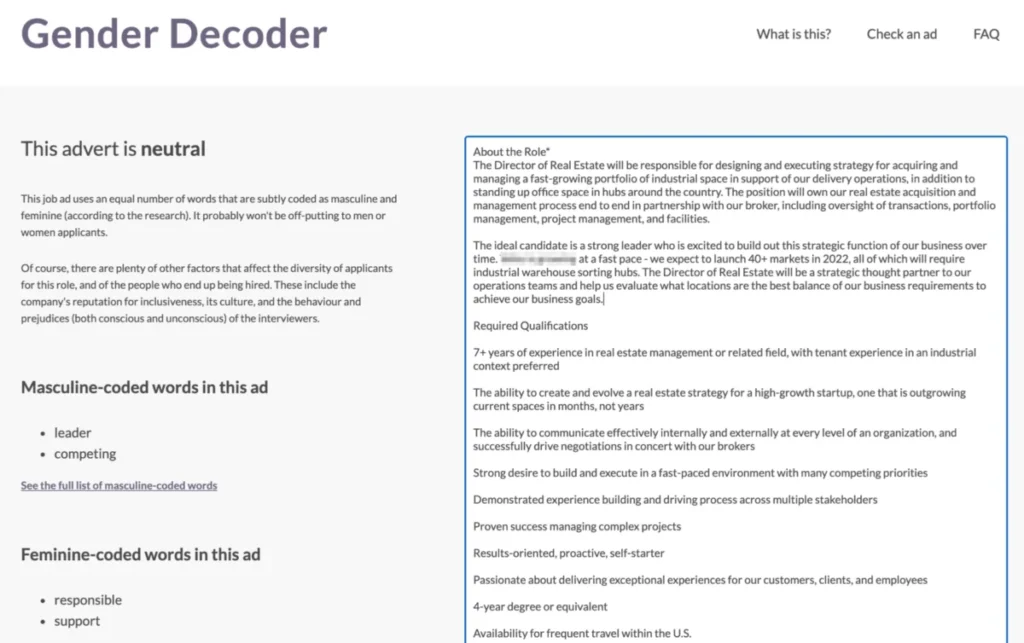
The Gender Decoder continues to be a widely utilized, free-to-use tool for quick gender-neutrality checks, especially valued for its simplicity. Its straightforward web interface allows users to paste text and receive an immediate analysis, highlighting masculine or feminine-coded words. The tool then provides a clear, categorized list of these identified terms, empowering users to manually adjust their language for greater inclusivity. Additionally, the website hosts a comprehensive, easy-to-reference panel of potentially biased words, serving as a practical guide for hiring teams striving to craft fair and appealing job descriptions from the initial drafting stage. Its accessibility and simplicity make it an excellent entry point for organizations embarking on their journey towards gender-neutral language in recruitment.
4. Witty.Works
Witty.Works positions itself as an advanced inclusive writing assistant, specifically designed to empower hiring teams in creating and scaling inclusive content across their ATS and career sites. This intelligent software excels at identifying exclusionary language and proposing nuanced, neutral alternatives engineered to resonate with a diverse audience. Living up to its name, Witty.Works also offers insightful and sometimes creative recommendations, aiming to foster teamwork and diversity by refining exaggerated language and promoting more cordial, professional communications. Its high integration capabilities allow for seamless operation within existing talent acquisition pipelines, leading to measurable improvements in application and hiring rates, particularly for roles where diversity is a strategic priority and a competitive advantage.
5. Microsoft Word (with Microsoft 365 and Co-pilot)
For organizations deeply integrated into the Microsoft ecosystem, Microsoft Word’s inclusive language checker, available with a Microsoft 365 subscription, offers a convenient and powerful gender writing analysis tool. Users can activate this feature by navigating through File > Options > Proofing > Settings and selecting the Gender Neutral option, which flags gender writing bias and other forms of bias directly within the document creation environment. Furthermore, the integration of MS Word with Co-pilot add-ons in 2026 represents a significant leap forward in automated bias detection. Co-pilot can intelligently rewrite entire sections of job descriptions with gender-neutral efficiency, leveraging advanced AI to suggest comprehensive structural and lexical changes. Microsoft business plans, offering these premium features, typically range from $7-$14 per month, depending on the chosen organizational requirements and scale.
6. Total Jobs Gender Bias Decoder
The Total Jobs Gender Bias Decoder is another highly accessible, free-to-use tool that focuses on rapid bias identification. Its simplicity is a core strength: users copy and paste text into a designated box, and the tool instantly highlights female-coded words in blue and male-coded words in pink/red. A notable and practical feature is its provision of neutral alternatives specifically for masculine-coded words. The tool explicitly states that it does not offer recommendations for feminine-coded words, based on extensive research suggesting that such terms do not typically dissuade male candidates from applying. This focused and research-backed approach makes it an efficient utility for ensuring foundational gender neutrality in recruitment communications.
7. Applied Text Analysis (Job Description Analysis Tool – JDAT)
Part of Applied’s broader Job Description tool, the Job Description Analysis Tool (JDAT) is a sophisticated platform that meticulously scans for both masculine and feminine words to ensure gender-neutral text. Beyond gender, JDAT incorporates specialized algorithms to track socioeconomic background and age biases, significantly enhancing skills-based hiring campaigns and promoting true meritocracy. Users paste their text into the tool, which then highlights exclusionary terms. Its AI-driven analysis extends to providing a comprehensive readability report, detailing estimated reading time, current content reading level, and word count. While a free gender bias decoder function is readily available, a broader suite of advanced features, including in-depth bias detection and reporting, is accessible via customized paid plans, making it scalable for diverse organizational needs.
8. Clovers
Clovers distinguishes itself as an AI-driven interview intelligence platform that tackles unconscious biases throughout the entire hiring process. Its comprehensive offerings range from redacted resume reviews to a dedicated gender bias checker for job descriptions. Clovers is particularly effective in assessing interview flow dynamics and minimizing interviewer biases through advanced Natural Language Processing (NLP) capabilities. The gender bias language checker reviews job descriptions for gender stereotypes and gender-coded language, providing actionable insights for immediate improvement. Its seamless integration with Microsoft Teams makes it exceptionally easy for talent acquisition teams to embed data-guided, equitable interview practices directly into their existing ATS. Given the Harvard Kennedy School finding that women are 50% less likely to apply to jobs with masculine-sounding language, Clovers proves to be a crucial tool for organizations genuinely committed to workplace gender equality.
9. Datapeople
Datapeople is a specialized solution provider focused exclusively on optimizing job descriptions, featuring its powerful Smart Editor tool. This software meticulously reviews job descriptions to promote truly inclusive language, going beyond simple word flagging. Datapeople’s Smart Editor not only pinpoints problematic language but also makes strategic recommendations regarding length, structure, and formatting – all vital elements for creating effective and inclusive JDs that attract a wider array of candidates. It ensures content aligns with the constantly shifting employer compliance regulations and evolving best practices. Users can leverage the system’s pre-approved templates for publishing impactful job descriptions that meet stringent standards and optimize candidate engagement. The Smart Editor also offers user transparency for content revision reviews, a valuable feature for larger organizations with complex HR workflows and significant internal oversight responsibilities.
10. Happy Dance Job Page Grader
The Happy Dance Job Page Grader is a free, accessible tool that specifically scans published job descriptions via their URL for unconscious bias and gendered language. Its primary advantage is its cost-effectiveness, making it available to organizations of all sizes that publish job descriptions online. Beyond bias detection, the Job Page Grader vets and suggests improvements for a job page based on its URL, encompassing critical aspects like mobile optimization, SEO performance, and code hygiene – all essential for boosting loading speeds and enhancing the overall candidate experience. While limited to scanning one published page at a time and not offering offline analysis, it serves as a robust initial evaluation tool for users requiring minimal support and focused gender bias language checking functionalities, making it a valuable resource for quick, public-facing content audits.
Broader Impact and Future Outlook: Beyond Gender in 2026
The widespread adoption of gender writing analysis tools in 2026 signifies a broader, systemic commitment to transformative change in talent acquisition. These tools are instrumental in dismantling outdated recruitment practices that historically relied on established language and industry jargon, which are now often perceived as clunky, old-fashioned, and overtly exclusionary. By identifying and rectifying gender stereotypes, reinforced roles, and undue fixation on gender differences, organizations are actively cultivating a more welcoming and equitable entry point for all candidates, fostering a sense of belonging from the very first interaction.
The implications of this shift extend far beyond simply attracting a more diverse pool of applicants. They contribute significantly to closing persistent societal gaps, such as the gender wage gap, and addressing systemic issues like the lack of paid paternity leave and the extraordinary cost of childcare by ensuring women have equal opportunities for career advancement and fair compensation. The integration of AI and augmented writing tools is allowing companies to eliminate not just gender bias, but also increasingly sophisticated forms of socioeconomic and accessibility biases, ensuring that talent is truly assessed on skills, potential, and merit, irrespective of background. This aligns with broader societal goals for fairness and equitable opportunity.
Industry experts and HR leaders anticipate that the capabilities of these tools will continue to expand rapidly. Future iterations are expected to detect and mitigate even more nuanced forms of bias, including those related to ageism, ethnicity, disability, neurodiversity, and cultural background. The prevailing vision for 2026 and beyond is a fully automated, AI-powered system that ensures every piece of organizational communication is universally inclusive, reflecting a deep-seated commitment to fairness and equity from the very first interaction. This shift is not merely about regulatory compliance or mitigating legal risks; it is about fundamentally reshaping corporate culture to be more representative, innovative, and ultimately, more successful and resilient in an increasingly complex global economy.
Conclusion
As of June 16, 2026, gender writing analysis tools have definitively transitioned from innovative niche solutions to essential, indispensable components of strategic talent acquisition. The compelling data on increased application rates, enhanced diversity, and reduced hiring costs, coupled with the profound ethical imperative for diversity and inclusion, solidifies their critical role in the modern enterprise. By leveraging these AI-powered instruments, companies are not only optimizing their recruitment pipelines for efficiency and reach but are also actively contributing to the creation of a more equitable and inclusive professional world. This commitment sets a new, elevated standard for how talent is identified, attracted, and integrated into the global workforce. The continuous evolution of these technologies promises an even more refined and comprehensive approach to bias detection, ensuring that the future of work is truly accessible, fair, and empowering for everyone.