
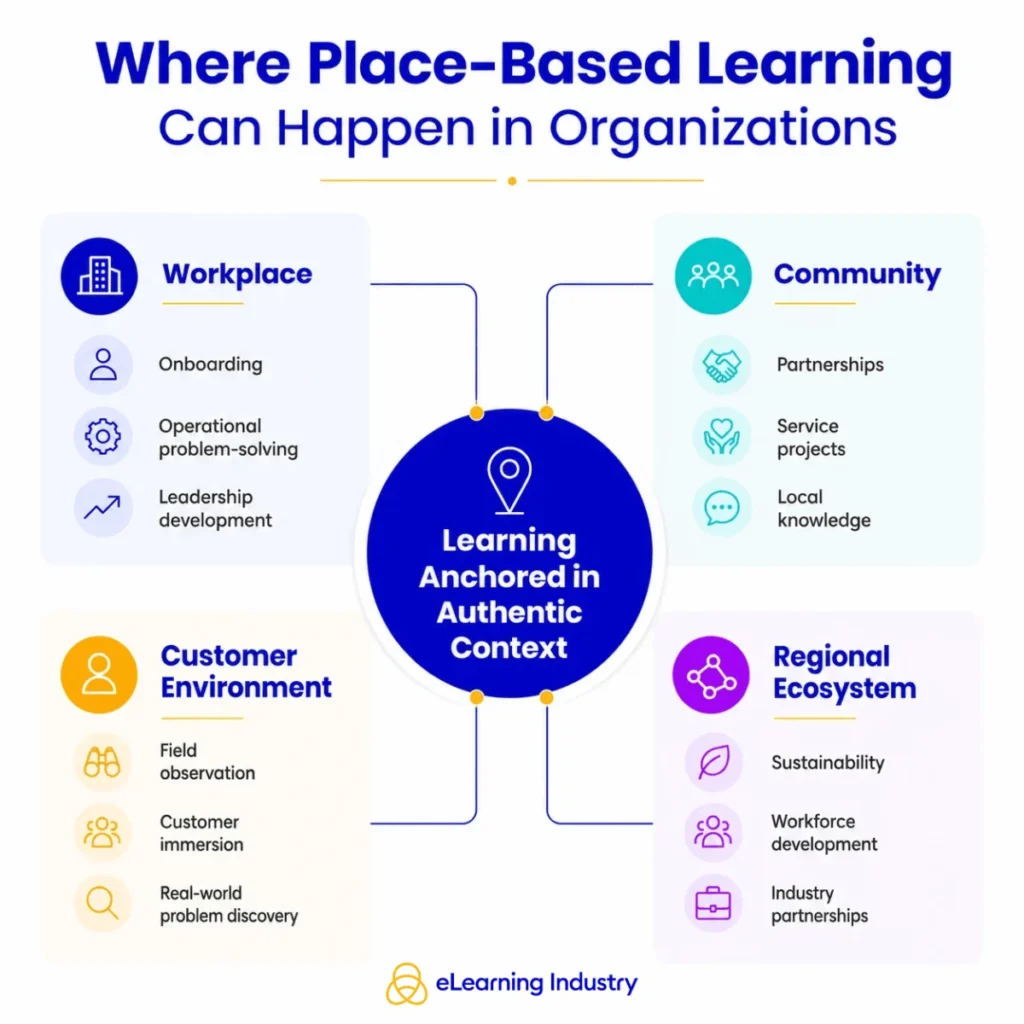
Place-based learning is fundamentally reshaping the methodology through which academic institutions, global corporations, and local communities approach the acquisition of knowledge. This pedagogical shift prioritizes the construction of expertise through tangible, real-world experiences, moving away from the traditional model of teaching theoretical concepts in academic isolation. As the global economy undergoes rapid digital transformation and the demand for specialized skills fluctuates, learning frameworks that anchor abstract theory in concrete, local situations have become an essential component of professional and personal development.
While the origins of place-based learning are rooted in K–12 environmental education, its underlying principles are now being utilized to refine workplace training, executive leadership programs, urban sustainability initiatives, and cross-disciplinary community projects. By immersing learners in their specific local environments—incorporating geography, culture, history, and socioeconomic challenges—this approach ensures that educational content is not only more relevant but significantly more memorable. Unlike conventional classroom settings, which often create a barrier between the "what" and the "how," place-based learning places the participant directly within the "where," facilitating a seamless transition from information intake to practical execution.
The Historical Context and Chronological Development of Place-Based Pedagogy
The concept of place-based learning (PBL) is not entirely new, but its formalization has evolved significantly over the last century. Its roots can be traced back to the progressive education movements of the early 20th century, led by theorists such as John Dewey, who argued that education should be grounded in experience and social reality. However, the specific term "place-based education" gained prominence in the 1990s, pioneered by educators like David Sobel and organizations like the Orion Society.
In its early iterations, PBL was primarily a tool for rural schools to combat "brain drain" by teaching students the value of their local ecosystems and economies, encouraging them to stay and contribute to their home communities. By the early 2000s, the movement expanded into urban environments, focusing on social justice and civic engagement. In the last decade, the corporate sector has adopted these strategies to solve the "skills gap." Today, the timeline of PBL has reached a digital inflection point, where technology—such as Augmented Reality (AR) and Geographic Information Systems (GIS)—allows learners to overlay digital data onto physical locations, creating a hybrid model of place-based inquiry.
Core Principles of the Place-Based Framework
The efficacy of place-based learning is derived from several foundational pillars that distinguish it from standard instructional design:
1. Local Context as a Primary Resource: This principle posits that deep understanding is achieved when knowledge is tied to the physical and social landscapes where learners spend their lives. By utilizing local environments and cultures as living laboratories, the curriculum becomes a tangible entity rather than a series of slides or textbook chapters.
2. Strategic Community Partnerships: Success in PBL relies on the bridge between the learning institution and external stakeholders. This includes municipal governments, non-profit organizations, and local businesses. These partnerships provide learners with access to professional mentorship and real-world data, while organizations benefit from the fresh perspectives and problem-solving efforts of the learners.
3. The Inquiry-Based Method: Rather than passive consumption, PBL requires active investigation. Participants are tasked with identifying local problems, gathering evidence, and proposing viable solutions. This mirrors the scientific method and the iterative processes used in modern business management.
4. Interdisciplinary Synthesis: Real-world problems rarely exist within a single academic silo. Solving a local water quality issue, for example, requires knowledge of chemistry (science), local legislation (government), budget management (economics), and public awareness (communication). PBL naturally encourages this cross-functional thinking.

5. The Reflection-Action Cycle: A critical component of the pedagogy is the opportunity to look back on an experience to extract meaning. This reflection ensures that the "action" taken in the community is not just a task completed, but a lesson learned and internalized.
Supporting Data: Why the Model Succeeds
The shift toward place-based learning is supported by significant findings in educational psychology and neurological research. According to the "70-20-10" model of leadership development—a widely accepted industry standard—approximately 70% of a professional’s knowledge comes from job-related experiences, 20% from interactions with others, and only 10% from formal educational events. Place-based learning maximizes that 70% by formalizing the "experience" part of the equation.
Furthermore, studies in cognitive load theory suggest that when information is presented in the context where it will be used, the brain’s "encoding" process is more efficient. Industry data from Learning and Development (L&D) surveys indicate that experiential learning programs result in a 25% to 40% higher retention rate compared to traditional lecture-based training. For organizations, this translates to a higher Return on Investment (ROI) for training budgets, as employees require less retraining and can apply new skills almost immediately.
Practical Applications Across Diverse Sectors
The versatility of place-based learning is evidenced by its successful implementation across various fields:
- Environmental and K–12 Education: In regions like the Pacific Northwest, students often engage in "salmon in the classroom" projects, where they study biology by raising fish and then physically restoring local stream habitats. This creates an emotional and intellectual connection to environmental stewardship.
- Corporate Onboarding and Culture: Forward-thinking companies are moving away from day-long PowerPoint sessions. Instead, new hires may participate in "neighborhood immersions" to understand the demographics of the customers they serve or visit local production facilities to see the supply chain in action. This builds an immediate sense of purpose and organizational identity.
- Healthcare and Public Health: Medical programs are increasingly using "community rotations" where students do not just work in hospitals but visit local community centers to understand the social determinants of health—such as housing and food security—that affect patient outcomes in that specific zip code.
- Leadership and Management: Executive programs often utilize "urban challenges" where leaders must navigate and solve a logistical or social problem in a city they are unfamiliar with, forcing them to use communication and adaptability skills in a high-stakes, real-world environment.
Stakeholder Perspectives and Industry Reactions
Industry experts suggest that the rise of place-based learning is a direct response to the "de-personalization" of digital learning. "While eLearning offers scale, it often lacks the ‘stickiness’ of physical experience," notes one senior L&D strategist. "Place-based learning provides the ‘why’ that makes the ‘how’ important to the employee."
From a community perspective, local leaders often view these programs as essential for civic health. By involving students and professionals in local issues, the community gains a workforce that is more attuned to local needs and more likely to engage in long-term civic participation. Human Resources professionals have also noted that place-based initiatives significantly improve Employee Value Propositions (EVP), as modern workers—particularly Millennials and Gen Z—prioritize employers who demonstrate a tangible commitment to community impact and social responsibility.
Implementation Best Practices for Organizations
To successfully transition to a place-based model, organizations and educators should adhere to the following strategies:
- Identify Authentic Challenges: Avoid "make-work" projects. The learning should address a real need, whether it is improving a local park’s biodiversity or solving a recurring bottleneck in a specific regional branch of a company.
- Leverage Hybrid Technology: Use digital tools to enhance the physical experience. Mapping apps, project management software, and collaborative platforms can help document the journey and share findings with a wider audience.
- Prioritize Learner Agency: The most successful PBL programs are those where the learners have a say in the direction of their inquiry. This autonomy fosters deep engagement and a sense of ownership over the results.
- Quantify Impact: Beyond testing for knowledge, measure the external impact. Did the community project reduce local waste? Did the corporate onboarding program reduce "time to productivity" for new hires? Data-driven results justify the continued investment in these programs.
Broader Impact and Future Implications
The long-term implications of place-based learning extend into the realms of economic development and global sustainability. As organizations increasingly align with Environmental, Social, and Governance (ESG) criteria, place-based learning serves as a primary vehicle for achieving these goals. It transforms the workforce from a collection of individuals with abstract skills into a cohesive network of "citizen-professionals" who understand their role within a larger ecosystem.
In an era dominated by Artificial Intelligence and remote work, the physical "place" remains the one variable that cannot be fully digitized. By leaning into the unique characteristics of local environments, place-based learning ensures that education remains human-centric, contextually relevant, and profoundly impactful. As this methodology continues to mature, it is expected to become the gold standard for developing the adaptable, critical-thinking talent required to navigate the complexities of the 21st century. Through the marriage of local action and global thinking, place-based learning is not just teaching people about the world—it is empowering them to change it.






