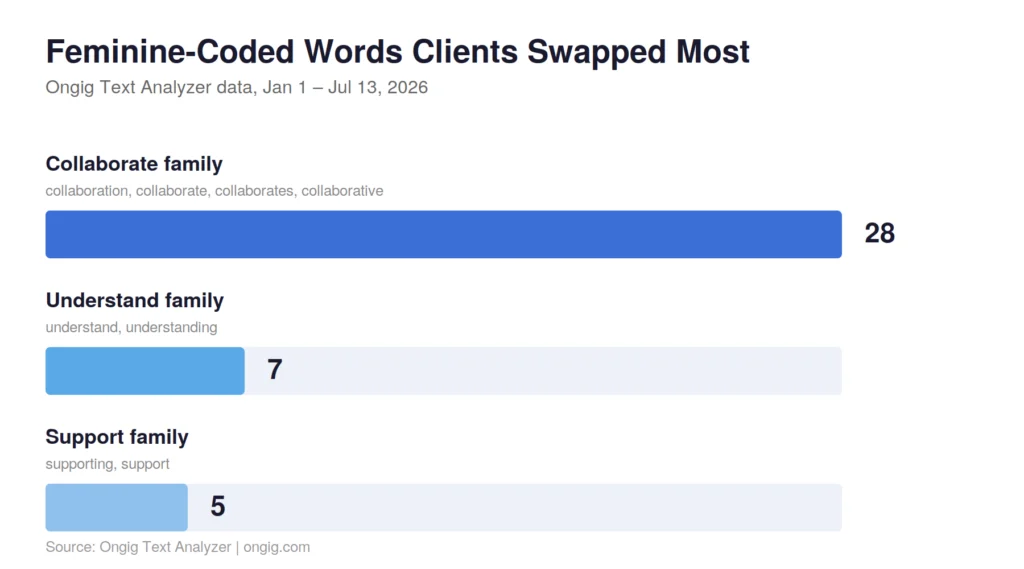
Recruitment language, a critical gatekeeper to talent pools, continues its dynamic evolution, with new data for 2026 indicating a significant shift in how companies are identifying and addressing gender bias in their job descriptions. A mid-year analysis by Ongig, a leader in job description optimization, reveals that the "collaborate" family of words (collaboration, collaborate, collaborative, collaborates) has emerged as the most frequently swapped feminine-biased term by clients using their Text Analyzer platform. This marks a departure from previous methodologies and highlights a growing sophistication in how organizations combat unconscious bias to foster more diverse and inclusive hiring practices. Following "collaborate" in terms of active removal were "understand" and "support," while "committed," a word that has consistently appeared on such lists since 2019, surprisingly did not make the cut this year.
This 2026 update represents a pivotal shift in how Ongig collects and interprets data on gender-coded language. In prior analyses, specifically in 2019 and 2024, the methodology involved scanning vast quantities of random job postings and tallying the frequency of feminine-biased words. The new approach, implemented from January through mid-July 2026, leverages direct client behavior within Ongig’s Text Analyzer. This means the data now reflects words that actual recruiters and hiring managers consciously chose to identify, flag, and replace in their job descriptions. This methodological pivot offers a more robust and actionable insight: it moves beyond mere word prevalence to indicate which terms are actively perceived as problematic and are being addressed by industry professionals. It underscores the difference between a word merely existing in a job ad and a word actively impacting a recruiter’s decision-making process.
A New Methodology for Deeper Insight into Recruitment Bias
The transition to analyzing client-initiated word swaps provides an unprecedented level of granularity into the real-world application of bias detection. Instead of inferring impact from frequency, Ongig’s 2026 data directly reflects intent and action. When a client uses Text Analyzer and opts to replace a suggested feminine-biased word, they are making a conscious decision that this particular term could be detrimental to their recruitment efforts. This feedback loop is invaluable, as it highlights not just academic or theoretical biases, but those that are actively causing concern for talent acquisition professionals in their daily work. While this new tracking mechanism, stemming from a Mixpanel update on Ongig’s internal systems, presents the data in a slightly different shape than previous years – functioning more as a mid-year snapshot – it promises a more accurate reflection of evolving industry best practices. Ongig has indicated a more comprehensive year-end analysis will follow, providing a fuller picture of these ongoing linguistic shifts.
Key Findings from the 2026 Mid-Year Analysis
The prominence of the "collaborate" family of words as the top swapped feminine-coded term in 2026 is particularly noteworthy. While phrases like "collaborative environment" or "collaborates cross-functionally" appear innocuous and even desirable in modern team-oriented workplaces, their overuse can inadvertently signal a softer, less assertive work culture, which may disproportionately appeal to or deter certain gender demographics. Recruiters are increasingly recognizing that while teamwork is essential, the repetitive use of such terms can dilute the message and potentially contribute to an unintended gender bias. This suggests a growing awareness that even seemingly positive attributes can carry subtle gendered implications within the nuanced language of recruitment.
Following closely behind "collaborate" were "understand" and "support." These words, while fundamental to many roles, can also be perceived as emphasizing empathy or subservience over direct action, leadership, or technical proficiency, thereby inadvertently leaning into traditional gender stereotypes. Their consistent appearance on lists of feminine-biased words underscores the ongoing challenge of crafting job descriptions that are both accurate and gender-neutral.
Perhaps the most surprising revelation from the 2026 data is the absence of "committed" from the top swapped list. "Committed" had been a persistent feature of Ongig’s feminine-biased word rankings since 2019. Its disappearance suggests a potential shift in either its prevalence in job postings, a decreased perception of its biased nature by recruiters, or a general reduction in its usage within the industry. This single detail highlights the fluid nature of language and how quickly terms can fall out of favor or become less problematic as societal awareness around bias evolves. It serves as a stark reminder that what constitutes biased language is not static but rather a constantly moving target that requires continuous monitoring and adaptation.
The Broader Context: Global Research on Language and Labor Participation
The insights from Ongig’s 2026 data resonate deeply with broader global research on the impact of language in the labor market. A comprehensive study by Lightcast and UNESCO, analyzing job postings across six English-speaking countries, revealed a stark disparity: labor force participation for women globally is 25% lower than for men. This research critically linked the prevalence of male-coded language to industries where this gender gap is most pronounced, such as STEM fields and manufacturing. The findings suggest that the subtle linguistic cues embedded in job descriptions contribute significantly to the pipeline issue, discouraging women from even applying to certain roles or sectors.
Furthermore, the Lightcast and UNESCO study extended its analysis beyond entry-level positions, uncovering that manager-level job postings consistently exhibit noticeably more masculine-coded language than non-managerial roles. This observation provides compelling linguistic evidence for the persistent "glass ceiling" phenomenon, indicating that even after women navigate the initial hiring hurdles, they encounter further subtle biases in career progression, often communicated through the very language used to define leadership roles. The overlap between these global findings and Ongig’s specific data is undeniable; "support" and "committed" were both identified by Lightcast and UNESCO as top female-coded terms globally, aligning perfectly with their consistent appearance on Ongig’s previous lists, with "committed" only recently dropping off. This confluence of data from different sources underscores the pervasive nature of gender-coded language and its far-reaching implications for global workforce diversity.
Historical Perspective: The Evolution of Bias in Recruitment
The recognition of gender-coded language in recruitment is not a new phenomenon, but rather one that has gained significant traction over the past decade. Early efforts to promote diversity and inclusion (D&I) often focused on structural barriers or overt discrimination. However, as organizations matured in their D&I strategies, the spotlight shifted to more subtle, often unconscious biases embedded within the hiring process, with job descriptions emerging as a critical point of intervention. The advent of artificial intelligence (AI) and natural language processing (NLP) tools has revolutionized this field, enabling sophisticated analysis of text for nuanced biases that human reviewers might easily miss. Companies like Ongig have been at the forefront of this technological application, developing platforms that help organizations systematically identify and rectify such linguistic biases. This journey from simple keyword detection to sophisticated algorithmic analysis reflects a broader societal commitment to creating equitable opportunities for all candidates.
Strategic Recommendations for Mitigating Bias
Understanding which words are problematic is only the first step; the critical challenge lies in knowing how to effectively rewrite them without compromising clarity or accuracy. Ongig’s analysis offers concrete, actionable strategies for mitigating the impact of these feminine-biased terms:
-
Addressing the "Collaborate" Family: When job descriptions are saturated with terms like "collaborative environment" or "collaborates cross-functionally," the intended message of teamwork can become diluted and potentially gender-coded. The recommendation is to use these terms judiciously. Instead of repetition, identify one or two specific instances where collaboration is truly a distinct, crucial aspect of the role or team structure. For other instances, replace the generic "collaborate" with more precise, action-oriented alternatives such as "works with," "partners with," "joins forces with," or "integrates with." This not only reduces bias but also provides clearer context for the candidate.
-
Refining "Understand" and "Understanding": The word "understand" often appears vague and can imply a passive grasp rather than active competence. For example, "understanding of SQL" is less impactful than specifying the required skill level. A more effective approach is to replace "understand" with clear, measurable competencies. "Comfortable writing SQL queries," "proficient in SQL syntax," or "experienced in debugging SQL scripts" communicate exact expectations. This transformation serves a dual purpose: it reduces the feminine coding of the language and simultaneously enhances the clarity of the job requirement for all applicants, fostering a more transparent and equitable assessment of skills.
-
Rethinking "Support" and "Supporting": The term "support" is frequently used in job functions, making its removal challenging without altering the core responsibility. Phrases like "supports the sales team" are legitimate duties. The solution isn’t to eliminate the word entirely but to enrich the sentence with specific, concrete actions. Instead of a generic "supports the sales team," rewrite it to "handles onboarding processes and manages contract renewals for the sales team." This revision transforms a passive, potentially coded term into a list of active responsibilities, making the role’s scope clearer, less gender-coded, and significantly more informative for prospective candidates.
The overarching principle behind these recommendations is specificity. Vague or generalized language often serves as a hiding place for unconscious gender coding. By meticulously describing the actual tasks, responsibilities, and required competencies, organizations can drastically reduce the unintended signals that a single word might convey. This commitment to precision not only helps in attracting a more diverse pool of candidates but also improves the overall quality and effectiveness of job descriptions.
Implications for Talent Acquisition and Organizational Diversity
The continuous identification and rectification of gender-coded language carry profound implications for talent acquisition and broader organizational diversity. By actively addressing these linguistic biases, companies can significantly broaden their applicant pools, ensuring they attract qualified candidates from all demographics. This is not merely an ethical imperative but a strategic business advantage; numerous studies have demonstrated that diverse teams lead to enhanced innovation, better problem-solving, and improved financial performance. Companies that neglect to update their language risk narrowing their talent pipeline, missing out on top performers, and ultimately falling behind competitors.
Furthermore, a commitment to inclusive language in job descriptions strengthens an organization’s brand reputation. In an era where corporate values and D&I initiatives are closely scrutinized by prospective employees and consumers alike, a proactive approach to bias mitigation signals a genuine dedication to equity. Conversely, companies perceived as perpetuating biased language can face reputational damage, making it harder to attract talent and maintain a positive public image. The role of technology, particularly AI-powered tools like Ongig’s Text Analyzer, is becoming indispensable in this landscape, offering scalable solutions for organizations hiring hundreds or thousands of people annually to ensure consistency and compliance in their inclusive language efforts.
Looking Ahead: The Future of Inclusive Job Descriptions
The 2026 mid-year analysis by Ongig serves as a crucial reminder that language is a living, evolving entity, and the nuances of gender bias within it are constantly shifting. The drop of "committed" from the top list, while perhaps a small detail, is indicative of a larger trend: the ongoing need for vigilance and adaptive strategies in crafting recruitment communications. As societal norms continue to evolve and awareness of unconscious bias grows, the language that attracts or deters candidates will also change. Ongig’s commitment to following up with a fuller year-end check-in highlights the continuous nature of this work.
Ultimately, the goal is not to eliminate specific words for their own sake, but to ensure that job descriptions are clear, accurate, and universally appealing, allowing every qualified individual to envision themselves in a role. By proactively identifying and removing subtle biases, organizations can build more equitable hiring processes, leading to more diverse workforces and stronger, more innovative companies in 2026 and beyond.
This analysis, dated July 16, 2026, was informed by research led by Rob Kelly, published under the category of Writing Job Descriptions. It underscores Ongig’s ongoing mission to transform job descriptions through its Text Analyzer, eliminating gender and other biases to make job ads more attractive and effective. For organizations hiring at scale, the ability to gender-neutralize job descriptions through such innovative tools is no longer a luxury but a fundamental component of modern talent acquisition strategy.