The demands placed upon leaders have undergone a profound transformation, shaped by the accelerating integration of artificial intelligence and a palpable shift in global political and social dynamics. This era compels a critical re-evaluation of what constitutes effective leadership. For decades, the discourse surrounding leadership has been characterized by evolving paradigms, from the foundational principles espoused by management theorists like Peter Drucker to the command-and-control philosophies exemplified by Jack Welch. More recently, the concept of servant leadership, championed by figures such as Howard Schultz, and the first-principles approach of innovators like Elon Musk, have offered distinct models for emulation. However, in the current climate, identifying the definitive leadership model for today requires a deeper understanding of fundamental changes.
While core leadership responsibilities remain constant—setting direction, defining mission, and aligning individuals—the behavioral expectations and the very fabric of organizational dynamics are being reshaped. Insights gleaned from recent extensive research, particularly concerning the rise of "Supermanagers" and the broader impact of AI on the workforce, illuminate these critical shifts.
The Rise of the "Voluntary Army": Redefining the Employer-Employee Contract
Perhaps the most significant evolutionary leap in leadership over the past half-century is what can be termed the "decoupling" of the employee from the traditional organizational structure. Historically, particularly through the industrial age, leaders could issue directives, and employees, bound by established hierarchies and the implicit contract of employment, would largely comply. This boss-subordinate relationship, deeply embedded in corporate culture and human resource practices, has been the bedrock of organizational management for generations. However, this era is demonstrably drawing to a close.
Today’s professional environment increasingly resembles a "voluntary army." This metaphor encapsulates a workforce composed not only of traditional employees but also contingent workers, freelancers, and, significantly, AI-powered "Superworkers." These individuals operate with a distinct set of needs, aspirations, and personal priorities that extend beyond mere job fulfillment. They do not simply "sign up" for a role; rather, they "opt in" daily, a dynamic that underscores a fundamental shift in their engagement. Consequently, the traditional levers of authority and hierarchy, once potent tools for control, have been supplanted by a more nuanced and often more fragile currency: trust.
Building and sustaining this trust requires a multifaceted approach. It necessitates an unwavering commitment to clarity in mission and vision, fostering an environment of empowerment and continuous professional development, and, crucially, actively soliciting and valuing new ideas from all levels of the organization. In an increasingly specialized professional landscape, it is not uncommon for individual contributors or emerging professionals to possess insights or innovative approaches that surpass those of their direct superiors. To ignore or suppress such potential is not only shortsighted but actively detrimental to organizational progress. Empowering these individuals and encouraging them to articulate their perspectives is no longer an option but a strategic imperative.
This decoupling, a trend that has been subtly unfolding for fifty years, has been dramatically amplified by the advent and rapid advancement of artificial intelligence. The potential for a single, highly skilled engineer or a discerningly astute professional to fundamentally reimagine and reshape an entire business model means that leaders must cultivate an environment of active listening, deep engagement, and genuine empowerment for every member of their team.

From Perfection to Iteration: Embracing Agility in the AI Era
A second pivotal shift in leadership is the transition from a "do it well" mentality to a "do it now" imperative. This transformation is driven by the ubiquitous presence of new, powerful, and inherently non-deterministic technologies, most notably artificial intelligence. The pervasive narrative surrounding AI adoption – that failing to engage with it risks obsolescence for both individuals and organizations – has understandably led to a natural inclination among leaders to meticulously "figure it out and do it right" before implementation.
However, recent observations from engagements with leading global organizations such as IBM, Standard Chartered, and Mastercard reveal that the pursuit of a "perfect" solution is often a precursor to failure in the current dynamic. Delaying action in anticipation of absolute certainty introduces significant and often unmanageable risks. In contrast to the industrial age, where product launches often waited for a flawlessly executed 1.0 version, the AI age demands a comfort with imperfection.
Consider the strategic decisions made by major corporations. IBM, for instance, transitioned from Workday to SuccessFactors within an ambitious 18-month timeframe, fully aware that the new system would not be entirely flawless at its inception. Similarly, Microsoft is actively deploying Copilot agents across its human resources functions globally, even as new use cases and potential enhancements are continually being discovered. The traditional model of "waiting until it’s done" is simply no longer a viable strategy in this rapidly evolving technological landscape.
Leaders must internalize the understanding that the path from conception to successful execution is rarely a straight line. It is, instead, a complex series of iterations, learning experiences, and incremental improvements. The leader’s role is to maintain a steadfast focus on the overarching problem or customer need while simultaneously granting teams the necessary autonomy to experiment, to err, and to learn from those experiences. This agile approach fosters resilience and accelerates innovation, crucial attributes for navigating the uncertainties of the contemporary business environment.
Refocusing on Trust, Ethics, and Inclusion: The Moral Compass of Modern Leadership
The third significant evolution in leadership is a renewed emphasis on core values, ethical conduct, and moral responsibility. The contemporary media landscape is replete with examples of ethical breaches and political controversies, amplified by the ease with which misinformation, often generated or disseminated by AI, can proliferate. In such an environment, discerning objective truth has become an increasingly formidable challenge.
Leaders, therefore, bear a profound responsibility to actively counteract this trend. The rationale is rooted in a fundamental human desire for authenticity and trustworthiness. Most individuals possess an innate ethical framework and seek to align themselves with organizations that reflect these values. When leaders compromise their integrity, circumvent ethical guidelines, or engage in unfair treatment, the consequences extend far beyond legal liabilities. Such actions deeply damage the human spirit, eroding morale and undermining the very foundation of organizational cohesion.
As articulated in the research and widely disseminated literature on creating "Irresistible" organizations, the inherent power of the human spirit is arguably the most potent, yet often overlooked, asset in the business world. Organizations that foster environments where individuals feel valued, respected, and ethically secure are those that unlock unparalleled levels of engagement and productivity.
The Precipitous Decline in Institutional Trust: A Leadership Imperative
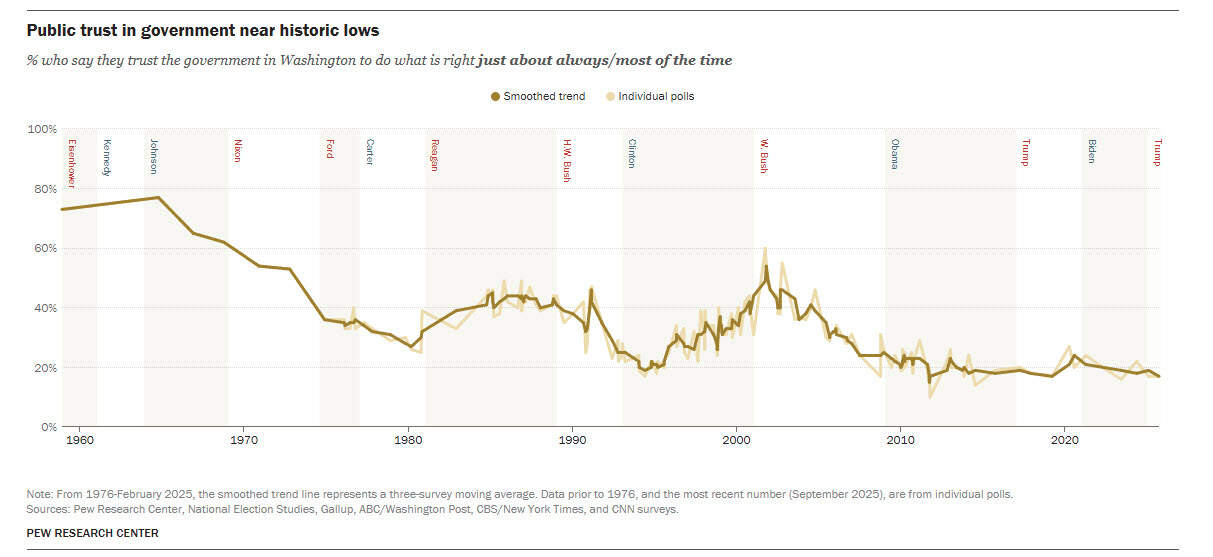
The current global context is marked by significant complexity, characterized by a dramatic erosion of trust in institutions. In the United States, for example, historical data reveals a stark decline: while approximately 80% of Americans expressed trust in their government during the 1960s, that figure has plummeted to a mere 17% in contemporary surveys. This widespread disillusionment creates a void that effective leaders must endeavor to fill.
Figure 1: Historical Trends in Public Trust in Government (United States)
[Placeholder for a chart illustrating the decline in public trust in government from the 1960s to the present day, referencing a credible source like Pew Research Center.]
The critical question then becomes: how can leaders bridge this trust deficit? The answer lies in a recommitment to fundamental principles: actively listening to employees, maintaining an unwavering focus on core values, and employing common sense in decision-making. This includes the courage to speak truth to power, to articulate a clear stance on critical issues, and to genuinely listen to dissenting or alternative viewpoints. Despite often being subject to political polarization or mischaracterization, values such as diversity, equity, and inclusion remain essential pillars of ethical and effective leadership in the modern era. Leaders who embrace these principles are better positioned to build resilient and respected organizations.
Cultivating Future Leaders: An Unprecedented Necessity
In conclusion, the prevailing organizational imperative is to critically re-examine and, if necessary, revise existing leadership models. An organization’s capacity for adaptation and sustained success is inextricably linked to the quality of its leadership. Leaders who can effectively drive change, ignite enthusiasm, and uphold core values are not merely assets; they are indispensable architects of future viability.
The development of such leaders is more crucial now than at any point in recent history. This necessitates a holistic approach that acknowledges the multifaceted challenges and opportunities presented by AI, evolving workforce demographics, and a heightened societal demand for authenticity and ethical conduct.
Further exploration into the evolving nature of leadership is available through comprehensive research reports on "The Rise of the Supermanager" and related analyses. Tools such as AI-powered leadership assessment platforms, trained on decades of research and real-world case studies, can provide personalized insights into an organization’s leadership capabilities and offer tailored development pathways. These platforms are designed to equip leaders with the skills and knowledge necessary to navigate the complexities of the modern business landscape, particularly in the context of AI integration.
The upcoming annual research conference, "Irresistible 2026," scheduled to convene in June at USC, promises the unveiling of significant new offerings focused on leadership development, further underscoring the industry’s commitment to addressing these critical evolving needs. The conversation surrounding leadership is not merely academic; it is a pragmatic necessity for organizations striving to thrive in an era of unprecedented change.