
The corporate learning landscape is undergoing a seismic shift, moving from traditional, formal training models to sophisticated, AI-powered content and enablement solutions. This transformation, detailed in the recently released "The Definitive Guide to Corporate Learning," is rapidly reshaping the vendor market and offering unprecedented opportunities for Human Resources leaders and Chief Learning Officers (CLOs) to enhance employee development and organizational agility. The implications for talent management, employee engagement, and overall business performance are profound, necessitating a strategic understanding of the evolving technological ecosystem.
The AI Revolution in Corporate Learning: Core Use Cases and Emerging Technologies
At the heart of this revolution are several key applications of Artificial Intelligence within corporate training and development. These include:
- Dynamic Content Generation: AI algorithms can now create bespoke learning materials, adapting to individual learner needs and evolving business requirements. This moves beyond static, SCORM-compliant modules to fluid, responsive content.
- AI-Powered Coaches and Scenarios: Learners can engage with AI-driven virtual coaches or participate in simulated scenarios that provide real-time feedback and personalized guidance, mimicking aspects of human mentorship.
- AI-Fueled Needs Analysis: AI can analyze vast datasets, including performance metrics, market trends, and employee feedback, to identify skill gaps and learning needs with greater precision and speed than traditional methods.
- AI-Generated Skills Models: The creation and maintenance of comprehensive skills taxonomies and competency frameworks are being accelerated and refined through AI, providing a more accurate and up-to-date view of organizational capabilities.
- AI-Powered Skills Assessments: AI is transforming how skills are measured, moving towards dynamic, adaptive assessments that provide nuanced insights into proficiency levels and identify areas for targeted development.
- AI-Centric Learning Experiences: This encompasses advanced applications like "Supertutors," conversational AI interfaces, and highly personalized learning pathways driven by AI, offering a fundamentally different approach to knowledge acquisition.
The convergence of these AI capabilities presents corporate learning as an ideal domain for immediate investment. The vision of a personal AI agent—one that possesses deep knowledge of an individual’s role, experience level, and career aspirations, and is constantly updated with relevant organizational and industry information—is no longer a distant prospect; it is becoming a present reality.
Navigating the Evolving Vendor Landscape: A Strategic Overview
Despite the immense potential of AI, the corporate learning sector faces a significant challenge: an estimated $4 billion invested in legacy Learning Management Systems (LMS), outdated content libraries, and traditional content development tools. Furthermore, a substantial workforce is skilled in delivering training within these pre-AI paradigms. This presents a complex transition, requiring organizations to either modernize existing infrastructure or adopt new, AI-native solutions. The vendor market is responding with rapid innovation across several key categories.

End-to-End Learning Platforms: The Modern LMS Evolution
The traditional LMS is being reimagined as a dynamic, AI-enabled platform. Key players and their recent developments include:
- Sana: Positioned as a partner with Galileo and Galileo Learn, Sana is at the forefront of AI-native learning solutions, emphasizing dynamic content and personalized learning experiences.
- Docebo: This vendor has integrated AI across its entire suite, enhancing content development, coaching capabilities, simulation modules, and administrative functions. Their acquisition of 365 Talents underscores a strategic move towards integrated skills intelligence.
- Cornerstone: Cornerstone has launched "Galaxy," an AI-fueled system designed for skills-based learning and talent management, signaling a commitment to an AI-driven future.
- Arist: A rapidly growing vendor, Arist leverages AI-driven needs assessments to generate content and offer a broader range of AI-enabled learning functionalities.
- Uplimit: As an AI-native platform, Uplimit focuses on delivering highly engaging technical and high-stakes training, incorporating numerous AI-scalable features to optimize learning outcomes.
- 360Learning: This platform incorporates AI for content generation, offers an AI companion for learners, and provides AI-generated assessments and adaptive learning paths.
- Disprz: Disprz is an AI-native, end-to-end learning platform that emphasizes dynamic content development, catering to the need for responsive and adaptable learning solutions.
The imperative for organizations is clear: if their current LMS is not evolving towards a dynamic, post-SCORM content model, a strategic review is essential. While some established LMS vendors may struggle with the architectural and technological shifts required, the pace of innovation is undeniable. Organizations that embrace AI-native platforms are unlikely to revert to older systems, recognizing the superior learning experiences and efficiencies they offer. While major players like OpenAI are integrating with learning platforms such as Coursera, their primary focus remains outside the direct scope of dedicated corporate learning solutions.
AI-Powered Content: Intelligent Curation and Delivery
The creation and delivery of courseware and instructional materials are also being profoundly impacted by AI. Major content providers are integrating AI to enhance learner engagement and accessibility:
- LinkedIn Learning, Coursera-Udemy, Skillsoft, Pluralsight, Degreed: These industry leaders are incorporating AI to summarize courses, provide live Q&A functionalities within their content libraries, and act as "CoPilots" to assist learners in navigating and accessing legacy content more effectively.
The concept of "Learning in the Flow of Work" is significantly amplified by these AI-driven content agents. Even if organizations are not yet ready to convert their entire course libraries to AI-generated formats, they can leverage AI to access existing materials more efficiently.
The future of the content market is likely to shift towards "content intelligence platforms." These platforms, exemplified by Galileo, will serve as central hubs where learning content is curated, labeled, and enriched with competency models. Users will access this material through vendor-specific agents, personalized AI agents, or a meta-level "agent of agents." This paradigm shift means that "course builder" companies will increasingly need to position themselves as "expertise curators," with their platforms unlocking access to this curated knowledge. Providers like Attensi, which offer end-to-end AI-assisted training and content creation, and AI-powered avatar providers like Colossyan and HeyGen (which offer tools for image, video, and audio generation), are also making significant inroads into the Learning and Development (L&D) market.
AI-Powered Assessments: Beyond Traditional Testing
AI is revolutionizing assessment methodologies, moving beyond static, test-based certifications to more dynamic and personalized evaluations.
- CodeSignal: This platform utilizes AI to create adaptive assessments for skills evaluation, targeted learning recommendations, and recruitment purposes. It can be trained on specific company products, processes, or knowledge domains to generate tailored experiences, including tests, exercises, simulations, and feedback mechanisms, all designed to foster proficiency.
- Pluralsight: By extending its "Skill IQ" capabilities, Pluralsight is enhancing its AI-driven skills assessment offerings.
- Skillable: A leader in learning labs, Skillable is also innovating in the AI assessment space.
- HackerRank: This platform is moving in a similar direction, and many Large Language Models (LLMs) possess native capabilities for assessment generation.
This trend suggests a future where AI-driven assessments will gradually replace traditional, standardized testing and pre-hire evaluations. Companies specializing in pre-hire and developmental assessments, such as SHL, are also poised to leverage L&D opportunities as AI gains the ability to interpret and repurpose their extensive testing models. SHL, a partner of Galileo, utilizes its Universal Competency Framework to train AI models, enabling more sophisticated skill inference and assessment.

Galileo, trained on extensive research and maturity models, employs "agentic prompts" to assess individual or organizational maturity, generate development plans, and benchmark skills against a vast corpus of job, skills, and HR-related data.
AI-Powered Skills Intelligence: Mapping and Developing Capabilities
The domain of skills intelligence, though often complex, is consolidating around AI-driven solutions that provide granular insights into employee capabilities. Vendors like Eightfold, Findem, Maki People, Seekout, Lightcast, and Draup, primarily known for their recruitment and internal mobility tools, are now applying their technologies to assess employee skills at a detailed level.
This has spurred the development of comprehensive solutions from companies like Gloat, Fuel50, and 365 Talents, which focus on internal talent marketplaces and career development. Vendors such as Skyhive (now part of Cornerstone Galaxy) and Techwolf use AI to infer skills by analyzing both internal and external data sources. Increasingly, these platforms are integrating with learning systems.
Docebo’s acquisition of 365 Talents exemplifies this trend, aiming to create integrated systems that allow large organizations to assess skills enterprise-wide and immediately align learning offerings with identified needs. Cornerstone’s integration with Skyhive and Sana’s AI-native approach to tracking skill advancement through user activity further highlight this convergence.
Furthermore, AI-powered career development platforms are leveraging static career models to create AI-enabled pathways. Guild, a leader in this space with its new "Guild Navigator" product, along with Gloat, Fuel50, SAP, Workday, and Eightfold, are all offering capabilities that infer skills from resumes and present AI-updated career opportunities.
Employee Enablement and AI-Search: Real-Time Support and Knowledge Access
One of the most significant opportunities lies in dynamic employee enablement, particularly through AI-powered search and knowledge access. Imagine a customer service representative encountering an unfamiliar issue. Instead of searching through a vast library of courses, they can simply ask a question and receive an immediate, contextually relevant answer, potentially accompanied by a video demonstration.
This "dynamic enablement" is becoming increasingly accessible with AI-native platforms and sophisticated AI copilots. Organizations can leverage platforms like Sana, Arist, and Docebo to ingest videos of problem-solving scenarios or call recordings, enabling employees to learn dynamically from real-world examples. This is particularly valuable for sales training, new product launches, and disseminating critical real-time information.
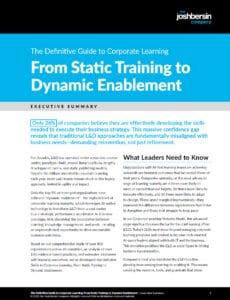
Historically, employee enablement has resided outside the purview of L&D, often falling under IT, Sales, or Support functions. However, AI-powered learning platforms now enable L&D to centralize and manage organizational knowledge, including company documents, business recordings, and other critical information. This empowers local business teams to manage their own enablement platforms, freeing L&D from localized support and fostering the development of what can be termed a "digital twin" of organizational knowledge—where the expertise of individuals is accessible to others.
While the term "digital twin" in this context is still evolving, it represents the aggregation of an organization’s collective intelligence derived from emails, internal documents, meeting recordings, and sales or call center transcripts. AI platforms can then query this aggregated knowledge to provide immediate answers. Glean is an example of a company achieving this in the IT space, and L&D leaders can replicate this functionality with platforms like Sana or Docebo. The ability to rapidly create and disseminate knowledge—whether in the form of podcasts, courses, or videos—is being revolutionized. Imagine a scenario where new information is immediately accessible to all relevant personnel, transforming the speed of knowledge transfer. Microsoft and Google are actively investing in this area, suggesting that the "enablement" model will fundamentally redefine L&D.
The Enduring Relevance of Foundational Learning Principles
Despite the dramatic advancements in AI, core principles of employee development will remain essential. Compliance training, onboarding for new hires, leadership development, and support for individuals entering new roles will continue to require structured, formal instruction. The expertise in instructional design and learning experience creation remains highly valuable.
However, the toolset available to L&D professionals has expanded exponentially. Dynamic development, personalized delivery mechanisms, and enterprise-grade search platforms offer unprecedented opportunities to enhance the impact and efficiency of learning initiatives. Organizations are strongly encouraged to engage with their current vendors to understand their AI roadmaps. If a vendor demonstrates insufficient speed or agility in adopting these transformative technologies, it may be prudent to explore alternative solutions.
For organizations embarking on this journey, seeking guidance on L&D strategy transformation can be invaluable. Expert consultations can help navigate this complex landscape and identify the most effective path towards an AI-enhanced learning future. Similarly, vendors seeking strategic direction or marketing support in this rapidly evolving market are encouraged to connect with specialists in the field.
The ongoing evolution of AI in corporate learning is not merely an upgrade; it represents a fundamental reinvention of how organizations foster knowledge, skills, and performance. The vendors and technologies discussed herein are shaping a future where learning is more personalized, agile, and deeply integrated into the fabric of daily work.







