The ground beneath the human resources landscape is shifting, not with a gradual tremor, but with the sudden, seismic force of a technological revolution. This is not an incremental upgrade; it is a fundamental reimagining of how work is executed, by whom, at what velocity, and on what scale. Just as the steam engine irrevocably altered the textile industry and the personal computer birthed entirely new professions, we are witnessing a paradigm shift driven by the transition from conventional software to what is being termed "superintelligence." Most HR leaders, however, are finding themselves ill-equipped to navigate this precipice, still operating under the outdated tenets of a bygone era.
Organizations that grasp this profound transition and proactively adapt will not merely gain a competitive edge; they will forge chasms measured in market dominance, not quarterly earnings. Conversely, those that cling to yesterday’s methodologies and tools will find themselves managing a workforce optimized for a past that is rapidly receding, while AI-native competitors operate on an entirely different plane of operational efficiency and strategic agility. This new epoch, characterized by the fusion of human expertise and artificial intelligence, heralds the arrival of the "Infinite Workforce."
The Finite Ceiling of Traditional Scaling
For decades, the prevailing wisdom for business growth has been deceptively simple: more output necessitated more human input. When demand surged, the response was invariably to hire more recruiters, add administrative staff to manage application volumes, and dedicate more executive time to interviews. This linear equation, however, has encountered an insurmountable barrier.
The limitation is not a deficit in human capability, which remains as vital and creative as ever. Instead, the bottleneck lies in workflows that depend on human intervention for every manual action – clicking buttons, moving digital files, or coordinating schedules. These processes are inherently constrained by the finite nature of human labor. People require rest, operate within specific time zones, and possess a finite capacity for repetitive tasks. This model, reliant on human energy and attention for every operational step, simply cannot scale at the pace demanded by today’s dynamic global economy.
Forward-thinking, AI-native organizations have already transcended this limitation. They are not attempting to wring more productivity from their existing human workforce through sheer exertion. Instead, they are strategically deploying "digital agents" – sophisticated AI systems designed to manage high-volume, repetitive execution tasks. This strategic delegation liberates human employees to concentrate on activities that truly demand human judgment, creativity, and strategic oversight. This is the essence of "manufacturing intelligence" – not just processing information, but intelligently generating insights and driving action at an unprecedented scale. The divergence between these pioneering organizations and legacy enterprises is no longer a gradual widening; it is an exponential acceleration, creating a chasm that will redefine industry leadership.
Legacy Tools: Anchors in an Accelerating Tide
A stark and uncomfortable truth facing many HR departments is that the technology they have invested in over the past decade was not designed to address this new reality. Instead, these platforms were built to digitize and streamline existing, human-centric processes, effectively reinforcing the old paradigms.
Traditional HR technologies, such as Applicant Tracking Systems (ATS) and Human Resource Information Systems (HRIS), function primarily as "systems of record." Their core design revolves around tracking headcount, ensuring regulatory compliance, and storing employee data. In these systems, candidates are often treated as static database entries, and employees are viewed as cost centers on a balance sheet. While they can accurately report on who is employed, they falter when asked to identify individuals with transferable skills across roles, predict future talent needs, or proactively identify potential leaders for emerging positions.
Furthermore, the artificial intelligence embedded within these legacy systems is typically trained exclusively on an organization’s internal historical data. This data, often incomplete, riddled with historical biases, and confined by departmental silos, provides a narrow and potentially skewed view of the workforce. An AI that learns solely from past decisions is incapable of truly predicting future outcomes; instead, it risks amplifying past errors with a veneer of computational confidence. This can inadvertently create a "bias-laundering machine," perpetuating inequities under the guise of data-driven decision-making.
The alternative often presented – general-purpose large language models (LLMs) – while remarkable in their ability to process and generate language, also present significant challenges in the professional realm. These tools excel at tasks like drafting emails, summarizing documents, and engaging in conversational exchanges. However, they lack the "spatial intelligence" required to navigate the complexities of the modern workplace. They do not inherently understand career trajectories, the adjacency of skills, or the intricate compliance implications of talent acquisition decisions. The disclaimers often accompanying these tools, acknowledging their potential for error, are a luxury that organizations cannot afford in critical talent management processes.
In essence, the industry has presented HR leaders with a dichotomy: the inertia of legacy systems that anchor them to the past, or the unpredictable volatility of generalist AI that lacks the specific domain expertise required for effective talent acquisition.
The Infinite Workforce: A New Operating Architecture
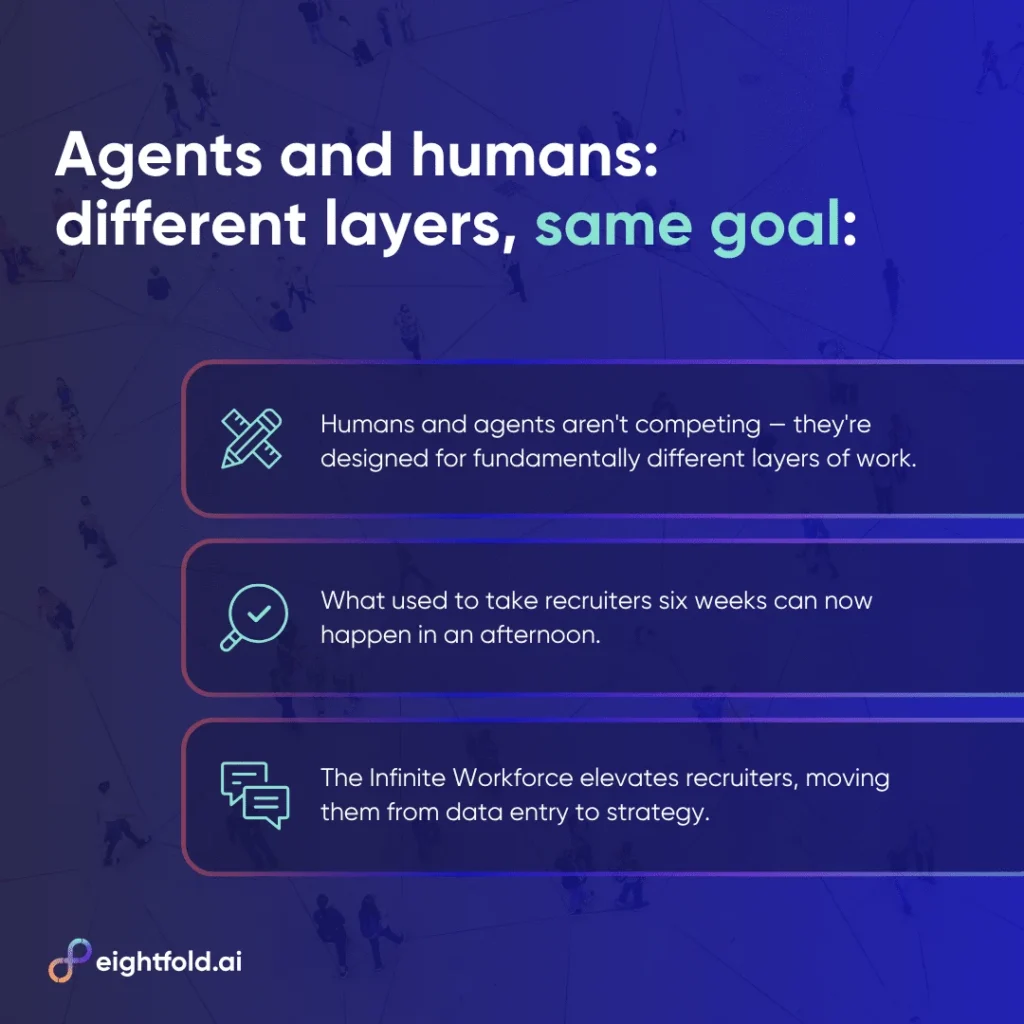
The concept of the "Infinite Workforce" transcends a mere technological product; it represents a fundamental shift in operational architecture. This new paradigm is built on the crucial understanding that humans and intelligent agents are not in competition for the same work. Instead, they are designed to excel in distinct layers of operational complexity.
Intelligent agents are engineered to manage execution at scale, handling the high-volume, repetitive tasks that have traditionally consumed significant human effort. This includes initial candidate screening, interview scheduling, preliminary assessments, and proactive candidate sourcing. These agents can operate 24/7, across all open requisitions, and at the full capacity of the candidate pipeline. What once took a team of recruiters weeks to accomplish can now potentially be streamlined into a matter of hours.
In this model, human professionals transition to a role of orchestration and strategic oversight. They are positioned "above the loop," making the critical judgment calls that intelligent agents cannot. These decisions involve defining strategic priorities, assessing nuanced cultural fit, crafting compelling value propositions for passive candidates, and establishing ethical guardrails for AI deployment. Human recruiters become strategic advisors to hiring managers, relationship builders, and the architects of talent acquisition strategy, leveraging their emotional intelligence and interpersonal skills in ways that algorithms cannot replicate.
This shift is fundamentally about elevating the role of recruiters, not diminishing it. When recruiters are mired in administrative tasks, spending an estimated 70% of their time on scheduling and screening, they are not truly recruiting. They are engaged in data entry, a task that fails to leverage their expertise, intuition, and human connection capabilities. This is a profound underutilization of the most sophisticated intelligence available: the human mind. The transition to the Infinite Workforce empowers them to move "above the loop," where agents manage the routine, and humans manage the irreplaceable.
Evidence of a Paradigm Shift: The Agentic AI Advantage
The emergence of the Infinite Workforce is not a distant prophecy; it is a present competitive reality, with demonstrable impacts already visible. Organizations that have embraced agentic AI in their talent acquisition processes are reporting transformative results. Hiring cycles are being compressed from an average of 42 days to under a week. Talent pools are expanding by as much as 100 times without a proportional increase in headcount. Up to 80% of manual recruiter tasks are being automated, while simultaneously maintaining exceptional interview completion rates (upwards of 92.5%) and high candidate satisfaction scores (a Net Promoter Score of 93%).
These are not marginal efficiency improvements; they represent structural competitive advantages being built by empowering recruiters to focus on strategic, human-centered work. This is the work they were initially hired to do – building relationships, understanding organizational needs, and identifying individuals who will drive long-term success.
The Critical Question for HR Leaders in 2026
The World Economic Forum’s "Future of Jobs Report 2025" projects a significant transformation in the labor market, with an estimated 92 million jobs displaced by 2030, but a concurrent creation of 170 million new roles. The organizations poised to thrive in this evolving talent landscape will not be those that passively observe these changes. They will be the ones that proactively began building their Infinite Workforce before the fundamental shift in operational models became undeniable.
The Intelligence Revolution is not a future event to be planned for; it is a present condition demanding an immediate response. Every day that a recruiting team dedicates to administrative execution rather than strategic talent engagement represents a missed opportunity for more meaningful work and a tangible loss of ground to competitors already operating at agent scale.
The Infinite Workforce is not about achieving more with fewer people. It is about enabling the people you have to do more valuable work. It is about fostering a powerful synergy where human judgment, empathy, and creativity are amplified by intelligent agents that expertly handle the rest. This partnership between human insight and agentic capability represents the definitive competitive advantage of 2026 and beyond. The crucial question for every HR leader today is not if this shift will occur, but how quickly their organization is prepared to build and embrace it.
For those seeking a deeper understanding of how to navigate this transition, the comprehensive ebook, "The Infinite Workforce," offers a detailed roadmap. It outlines strategies for escaping the constraints of legacy systems, effectively deploying agentic AI in talent acquisition, and liberating recruiting teams to focus on the high-impact activities that truly propel business forward.