
The global business landscape is currently abuzz with discussions surrounding reskilling, upskilling, and the rapid integration of Artificial Intelligence (AI). This sentiment was powerfully echoed during a recent gathering of over 200 Chief Human Resources Officers (CHROs) in India and Singapore, where the paramount concern was "AI readiness" – specifically, how organizations can accelerate AI fluency and capability across all functional areas. This urgent need for adaptation has brought to light a critical revelation: the prevailing methodologies, philosophies, technological stacks, and operational models for corporate learning are, by and large, obsolete.
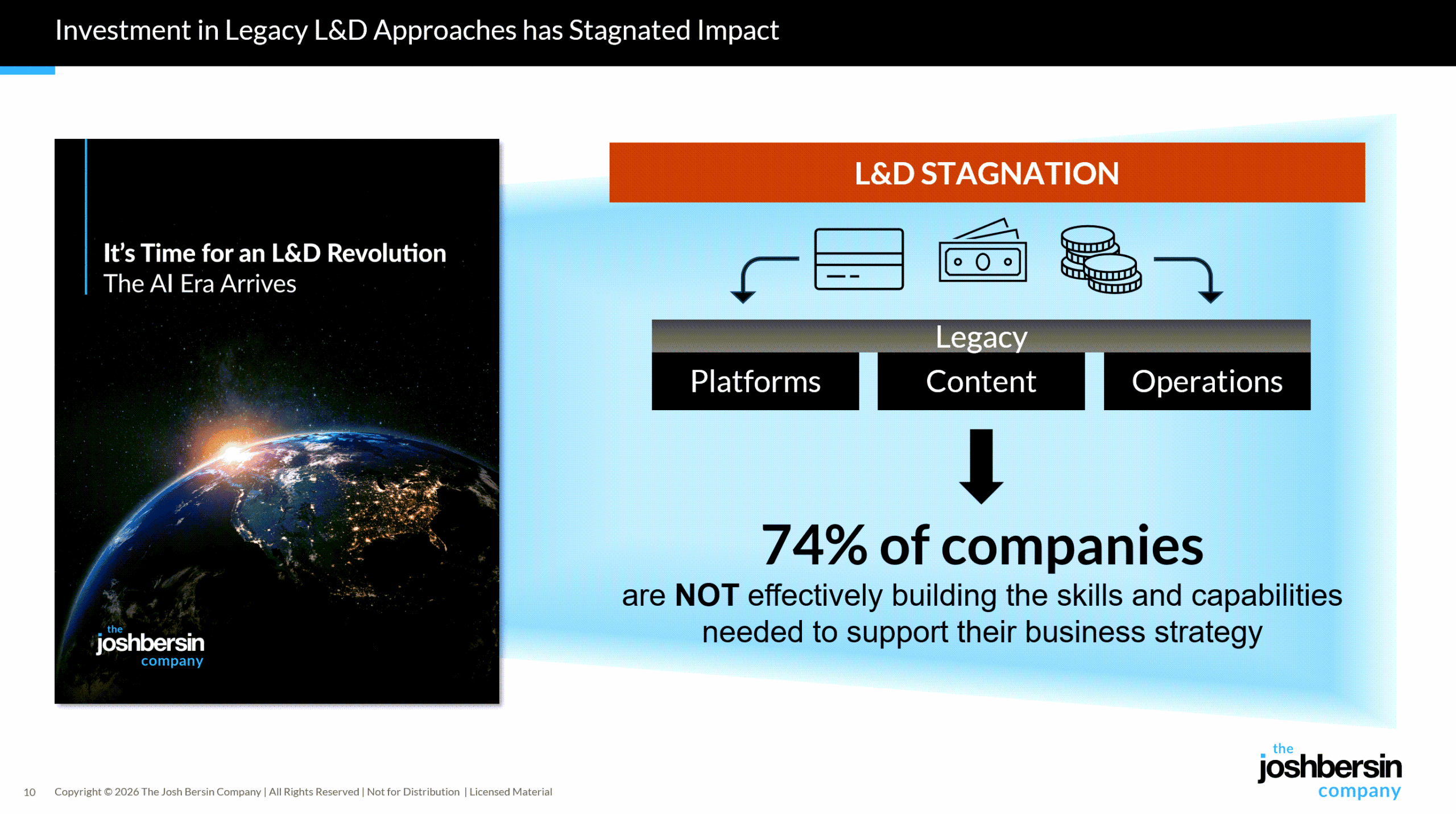
This assertion stems from extensive, multi-year research into corporate training programs. The findings, detailed in a newly released fifth major study on corporate Learning & Development (L&D), reveal a stark reality: a staggering 74% of companies admit they are not keeping pace with their organization’s evolving demand for new skills. Considering the substantial global investment in corporate training, estimated to be in the hundreds of billions of dollars annually, this statistic signifies a significant and widespread inefficiency, potentially amounting to billions of dollars in wasted effort.
The core of the issue, according to the research, lies in a fundamental misunderstanding of the problem. The current skills challenge in the workplace is not merely a matter of "learning" or "training" in the traditional sense. Instead, it is an imperative to dynamically share information, empower individuals to explore, question, and apply novel ideas. The long-standing pedagogical paradigm of "training," with its structured, often static approach, is identified as a significant impediment to progress.

The Dawn of AI-Native Learning: A Paradigm Shift
The research, which involved surveying and interviewing hundreds of companies, vendors, and senior leaders, posits that AI is on the cusp of fundamentally reinventing how organizations foster learning and development. This hypothesis, explored in greater detail in the seminal work "The Revolution of Corporate Learning," has been definitively validated by the latest findings.
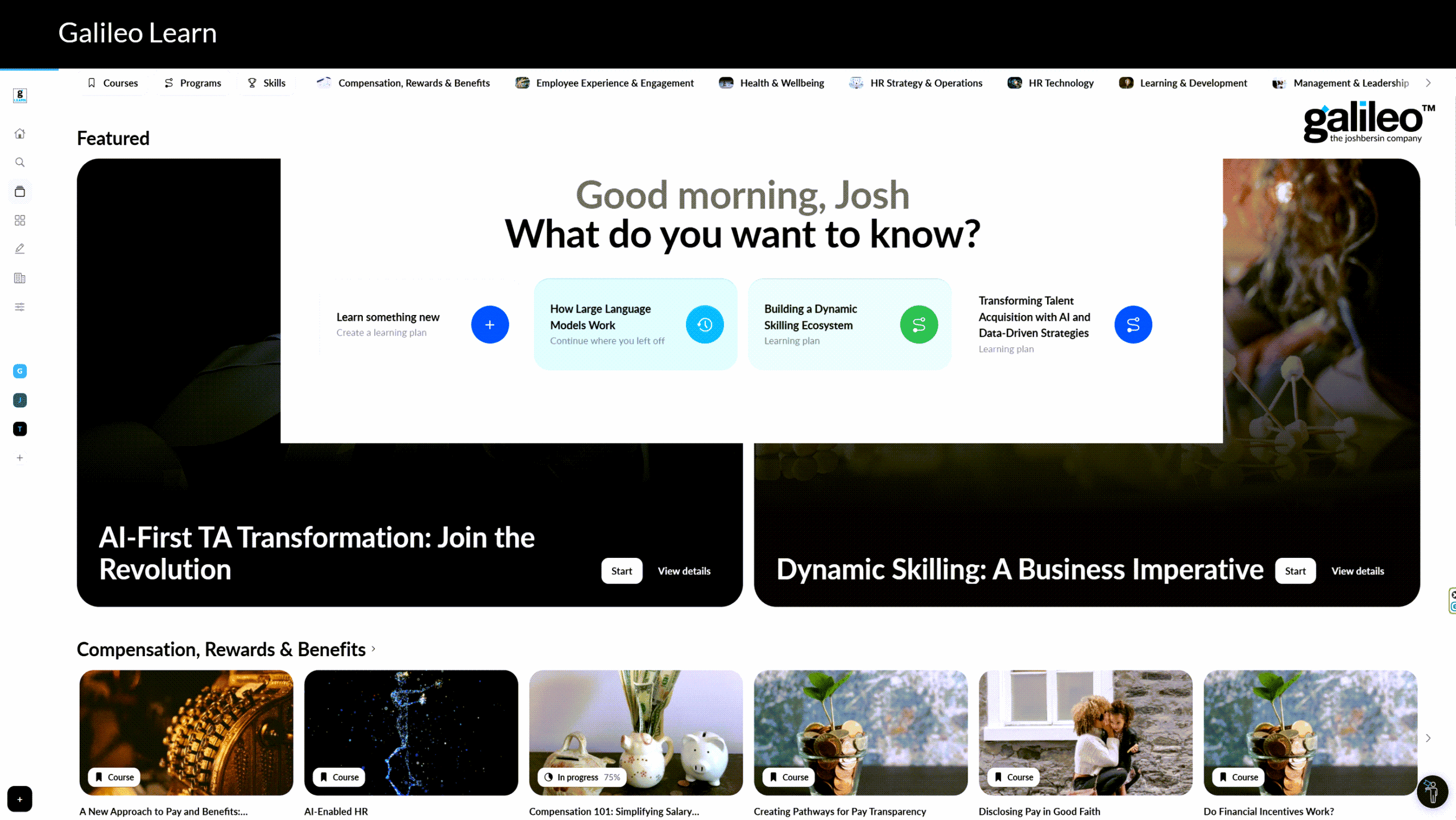
AI-native systems, characterized by their ability to dynamically and systematically generate content, are poised to revolutionize how employees are trained, upskilled, supported, and ultimately, "enabled." This new era of learning, exemplified by platforms like Galileo, is set to redefine the functions of L&D, HR, and indeed, all facets of organizational change management.
What Constitutes AI-Native Learning?
At its heart, AI-native learning leverages generative AI’s inherent capability for dynamic content creation, making it an exceptionally potent tool for development. Unlike traditional courseware, which is manually designed, built, and updated – a process that is inherently static and requires continuous revision, translation, and improvement – AI platforms construct content on demand, adapting to user needs and available formats.
Platforms like Galileo, built on advanced AI architectures, can generate new learning modules in a matter of days, rather than the months typically required for conventional course development. This rapid content generation ensures that as new topics emerge or existing knowledge evolves, the entire learning ecosystem can be instantaneously updated. This agility empowers employees to:

- Access knowledge precisely when needed: Just-in-time learning becomes a reality, delivering information at the point of application.
- Explore information dynamically: AI can generate tailored explanations, summaries, and even simulate scenarios based on user queries.
- Ask questions and receive intelligent answers: Generative AI can act as a sophisticated knowledge assistant, drawing from a vast repository of company information.
- Learn through diverse formats: Content can be delivered as text, audio, video, or interactive simulations, catering to individual learning preferences.
Crucially, these AI-native systems automatically categorize all content into a predefined skills taxonomy. As employees engage with the platform, their skill levels are dynamically inferred from their activities. Furthermore, every piece of content within the system is interconnected, transforming the learning environment into a cohesive "intelligence system" for the organization. This eliminates the need to hunt for specific courses to answer a question; the system inherently links related information, providing a holistic understanding.
The widespread adoption of tools like ChatGPT, with an estimated 60% of its 900 million weekly users engaging in learning activities, underscores the effectiveness of this paradigm. This level of user engagement and successful learning outcome far surpasses that achieved by traditional course catalogs. The research also highlights innovative applications, such as integrating recordings of expert interviews into these platforms, continuously enriching the knowledge base with real-time insights, tips, and findings. This generative approach to knowledge sharing is described as a "miraculous application of AI," with the potential to unlock trillions of dollars in business improvement.
Navigating the Learning Maturity Model
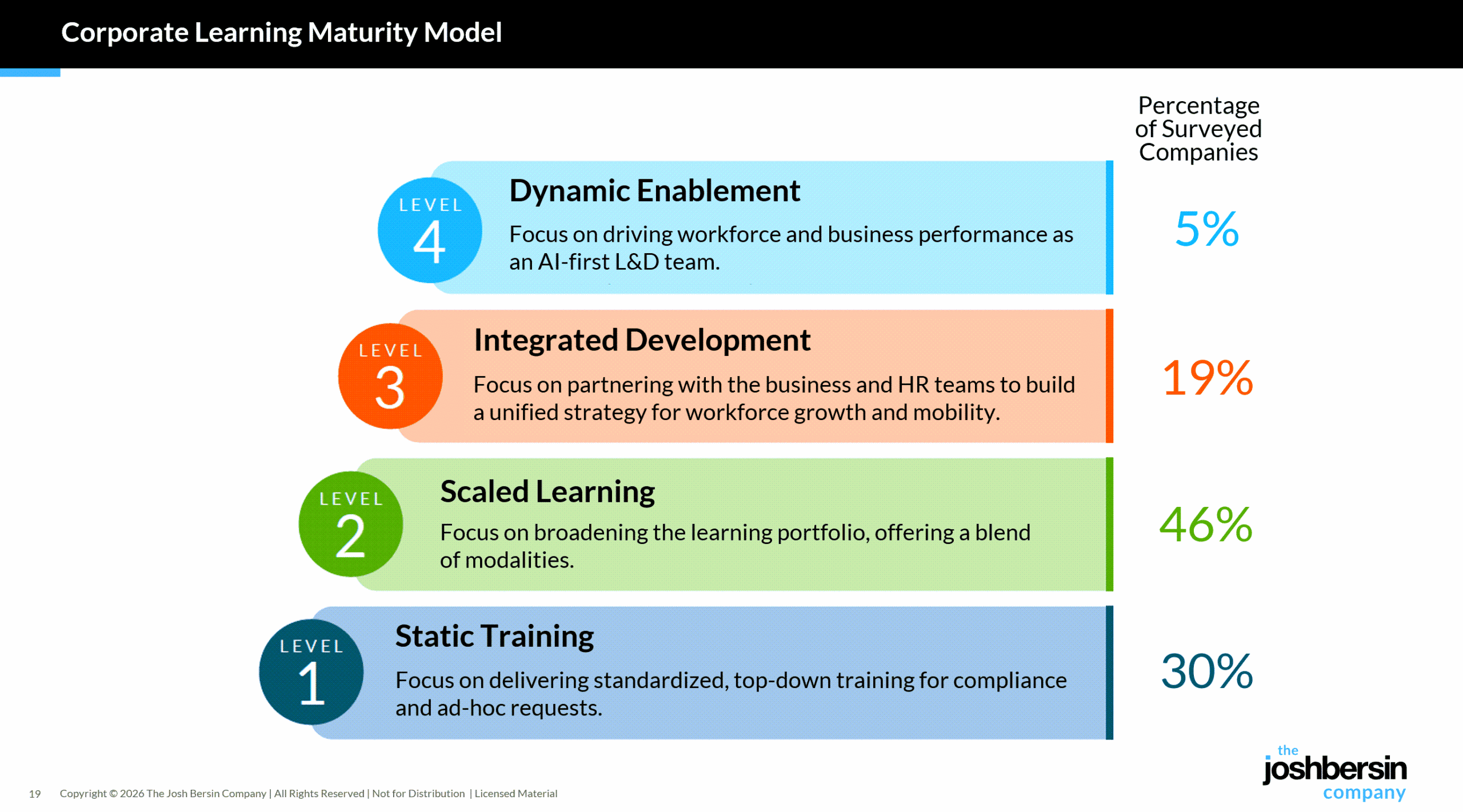
To guide organizations through this transformation, a new Learning Maturity Model has been developed, outlining four distinct levels of sophistication:
Level 1: Static Training
This foundational stage is characterized by the development or acquisition of "training" in the form of courses. These programs are often compliance-driven or mandated from a top-down perspective. Approximately one-third of the market operates at this level, focusing on essential compliance, new product launches, or other episodic learning needs. While these programs are relatively inexpensive to create or procure and help employees stay current on immediate developments, they offer limited scope for deep skill development.
Level 2: Scaled Learning
Building upon the static training model, approximately 46% of companies expand their offerings to encompass "Scaled Learning." This involves incorporating a broader range of learning assets, such as videos, audio recordings, and job aids. These formats broaden the learning portfolio, providing employees with more options, often leveraging content developed by third-party vendors. Platforms like LinkedIn Learning, Coursera, Skillsoft, and Pluralsight largely fall into this category. While the training is more extensive, the onus remains on the individual learner to navigate and select relevant content.
Level 3: Integrated Development
At this advanced stage, companies move beyond discrete training modules to design "Integrated Development" programs. Learning is tailored around specific job roles, skills, and defined career paths. This shift necessitates the creation of comprehensive "development programs" rather than just isolated training sessions. The complexity escalates significantly, requiring the management of multi-dimensional skill models encompassing technical proficiencies, professional competencies, and role-specific requirements across various job levels.
However, the dynamic nature of the modern workplace presents a significant challenge to this model. LinkedIn reports that 70% of job-related skills become obsolete annually, making the maintenance of static career paths and curricula an arduous and costly endeavor. While this approach remains relevant for specific applications like channel training, technical certifications, and onboarding new employees, its broad implementation becomes resource-intensive. Companies at Level 3 often face escalating L&D costs associated with building, maintaining, and refreshing numerous programs, curricula, skills models, and content objects. This complexity can lead to significant operational challenges, particularly regarding content governance and maintenance.
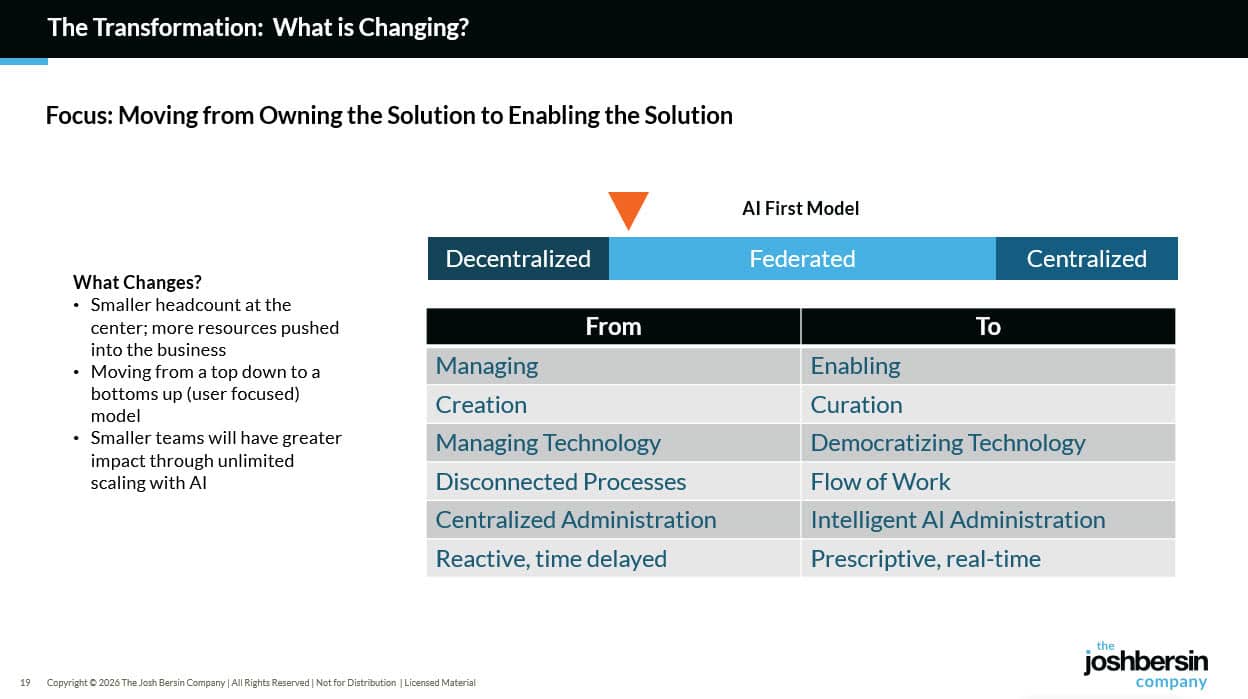
Furthermore, corporate learning is inherently decentralized. While central L&D teams manage strategic programs, an estimated 70% of training occurs within specialized domains such as sales, manufacturing, and customer service. This necessitates locally updated content, leading to a distributed operational model. This "federated" approach, while more complex, offers greater scalability by allowing functional domains to manage their specific training needs.
Level 4: AI-Transformed Enablement
The apex of the maturity model is "AI-Transformed Enablement," where AI fundamentally reshapes the learning landscape. This level envisions a unified platform housing all organizational knowledge – encompassing courses, documents, policies, and expert interviews. This transcends the traditional definition of a "learning platform" and ushers in a new domain termed "Dynamic Enablement."
In this paradigm, L&D can publish information in days, not months, and employees can access learning in their preferred manner. Legacy Learning Management Systems (LMS) are often retained for compliance programs, while new AI platforms supplant Learning Experience Platforms (LXPs), learning portals, and most content development tools. Early adopters of AI-native solutions are reporting significant reductions in internal L&D spend, with savings ranging from 40% to 50%.
The Impact of Dynamic Enablement
Dynamic Enablement offers a compelling proposition: substantial savings in time and resources for delivering learning solutions, coupled with an exceptional employee experience. The integration of AI into corporate chatbots and agents further embeds learning into the daily workflow. For instance, employees can inquire about benefits during HR form submissions, seek sales coaching when entering new opportunities into CRM systems, or receive updates on departmental changes upon logging into their workstations.
One notable example involves a large travel reservation company that leverages call recordings from top-performing customer service agents. These recordings are integrated into the learning system, enabling other agents to learn best practices and navigate challenging customer interactions. This approach holds immense potential for training across customer service, engineering, sales, and all support functions.
Similarly, organizations can publish all new internal materials, including client interviews, into AI-native platforms. This ensures that any employee can gain insights into client needs, understand industry trends, or deepen their understanding of specific customer requirements. This shift from "learning" to "enablement" aligns with the core business objective: empowering individuals to perform at higher levels and drive organizational growth.
Proven Returns and the Path Forward
The research substantiates the profound business benefits of moving towards AI-native learning. Organizations operating at Level 4 are demonstrably more innovative, achieving financial targets at significantly higher rates and exhibiting superior adaptability to change. The trajectory from formal training to dynamic enablement promises escalating improvements in speed, innovation, and overall business performance.
Strategic Recommendations for Organizations
Adopting Dynamic Enablement, or "AI-Native Learning," is not merely about accelerating course creation. It necessitates a fundamental shift away from traditional SCORM-based LMS platforms towards dynamic content systems. The roadmap to enablement involves several key steps:
- Content Rationalization: Companies must critically evaluate their existing content, identifying which assets to retain and which can be transformed into AI-native formats. Platforms like Galileo can assist in converting legacy SCORM courses into dynamic content.
- New Governance Models: Establishing a clear governance framework for L&D is crucial. Leading organizations are finding that once the AI-native system is established, they can effectively delegate line-of-business training to local staff.
- Hybrid/Distributed Operating Model: This approach fosters agility. Corporate HR can focus on global strategic initiatives such as leadership development, compliance, culture, and business strategy. Individual business units can then establish their own "Enablement Academies" for specialized areas like sales and manufacturing.
The Future is AI-Native
The evidence is compelling: companies at Level 4 are significantly more likely to be innovation leaders, outperform financial targets, and effectively navigate change. Dynamic Enablement represents the critical learning, change driver, and strategy execution mechanism required to thrive in today’s rapidly evolving business environment.
To facilitate this transition, comprehensive research, case studies, benchmark data, and maturity model diagnostics are available through platforms like Galileo. These resources include Agentic Workflows designed to help organizations assess their current maturity level, explore case studies, and evaluate vendor solutions. Furthermore, specialized learning programs, such as "The Journey to Dynamic Enablement," are offered to guide organizations through this transformation. By embracing AI-native learning, businesses can unlock unprecedented levels of efficiency, employee engagement, and strategic advantage.