The global corporate landscape is approaching a critical inflection point as 2027 nears, driven by a fundamental shift in how organizations perceive the relationship between employee development and operational performance. For decades, the primary challenge for Chief Learning Officers (CLOs) and Human Resources executives was the democratization of knowledge—ensuring that employees had access to the information required to do their jobs. However, as the digital era matures and artificial intelligence becomes ubiquitous, a new and more complex crisis has emerged: the workforce capacity gap. This phenomenon is defined not by a lack of educational resources, but by a systemic inability of the workforce to absorb, process, and apply the sheer volume of change being demanded by modern enterprise strategies.
The Convergence of Overload and Rapid Skill Obsolescence
As learning leaders prepare for the 2027 fiscal year, the central question has shifted from "How do we teach them?" to "Where is the capacity for all of this supposed to come from?" The modern employee is currently navigating a unprecedented confluence of demands. They are expected to master generative AI tools, adapt to radically restructured workflows, develop soft skills such as emotional intelligence and resilience, and navigate frequent organizational pivots—all while maintaining or increasing their baseline productivity.
The scale of this pressure is reflected in recent industrial data. According to research from Deloitte, the average worker now experiences 10 planned enterprise changes each year. This represents a fivefold increase from 2016, when the average was just two major changes annually. This "change fatigue" has reached a breaking point; global surveys indicate that approximately two-thirds of workers feel overwhelmed by the velocity of workplace evolution, and nearly 50 percent express significant anxiety that the pace of change will eventually render their roles obsolete.
Parallel to this exhaustion is the accelerating rate of skill decay. The PwC 2026 Global AI Jobs Barometer highlights a stark reality: skills required in roles highly exposed to AI are evolving twice as fast as those in less-exposed sectors. This creates a "Red Queen" effect, where employees must run faster and faster just to stay in the same place professionally.
A Chronology of the Capacity Crisis (2016–2027)
To understand the 2027 landscape, one must look at the decade-long trajectory of corporate learning and development (L&D).
- The Accessibility Era (2016–2019): Organizations focused on building massive libraries of digital content. The goal was "anytime, anywhere" learning. During this period, the average worker faced minimal enterprise-level changes, allowing for a more leisurely pace of professional development.
- The Disruption Catalyst (2020–2022): The global pandemic forced a decade’s worth of digital transformation into a two-year window. Capacity began to strain as remote work and new digital tools became mandatory overnight.
- The AI Explosion (2023–2025): Generative AI introduced a new layer of complexity. Learning was no longer about static skills but about co-piloting with machines. The "10 changes per year" threshold was reached during this window.
- The Capacity Crisis (2026–2027): Organizations realized that while content is infinite (thanks to AI), human attention and energy are finite. The focus shifted from providing "more learning" to managing the "cognitive load" of the workforce.
Distinguishing Capability from Capacity
A critical error in contemporary management is the conflation of capability and capacity. While related, they represent different dimensions of organizational health. Capability refers to whether an individual possesses the skills and knowledge to perform a task. Capacity, conversely, is the availability of time, energy, and mental bandwidth to actually deploy those skills or learn new ones.
In the 2027 environment, capability is becoming easier to solve through AI-generated simulations, instant performance support, and personalized coaching bots. However, capacity remains a scarce resource. When employees are deprived of the time to practice new skills or the mental space to reflect on feedback, the organization’s "adaptive capacity" shrinks. Industry analysts suggest that many current capability gaps are actually "symptoms" of a capacity problem. When an employee fails to adopt a new technology, it is often not because the training was poor, but because they had no "margin" to integrate the new behavior into their existing 40-hour work week.
The Role of Personalization in Reducing Friction
The learning agenda for 2027 emphasizes a more sophisticated version of personalization. In previous years, personalization meant a recommendation engine suggesting a course based on a job title. In the coming year, the goal is "frictionless development." This involves identifying the shortest possible path between an employee’s current capability and the required performance.
This new model of personalization asks:
- What is the specific performance gap?
- What is the "least burdensome" intervention?
- Can the problem be solved with an AI-enabled tool in the flow of work rather than a formal course?
By focusing on reducing the effort required to become capable, organizations can preserve employee energy. LinkedIn’s 2025 Workplace Learning Report found that 49 percent of L&D professionals reported executive concern over skill gaps affecting business strategy. The 2027 response to this concern is to move away from "continuous training" and toward "continuous performance support."
The Psychological Infrastructure of Learning
A major shift in the 2027 learning strategy is the integration of psychological safety and energy management into the core L&D curriculum. Experts argue that these are no longer "wellness" initiatives but "functional" requirements for learning.
Psychological safety is the bedrock of capacity. If an employee fears the consequences of making a mistake, they will not experiment with new AI tools or unfamiliar workflows. Without the safety to admit ignorance, the organization cannot accurately diagnose where help is needed, leading to "hidden" capability gaps that eventually manifest as operational failures.
Similarly, resilience is being redefined. Rather than an expectation that workers should "absorb more," resilience is being treated as a finite resource that must be budgeted. Learning leaders are beginning to audit the "cumulative demand" of their initiatives, recognizing that every new training program competes for the same limited pool of employee attention.
Implications for Corporate Strategy: The Workforce Capacity Loop
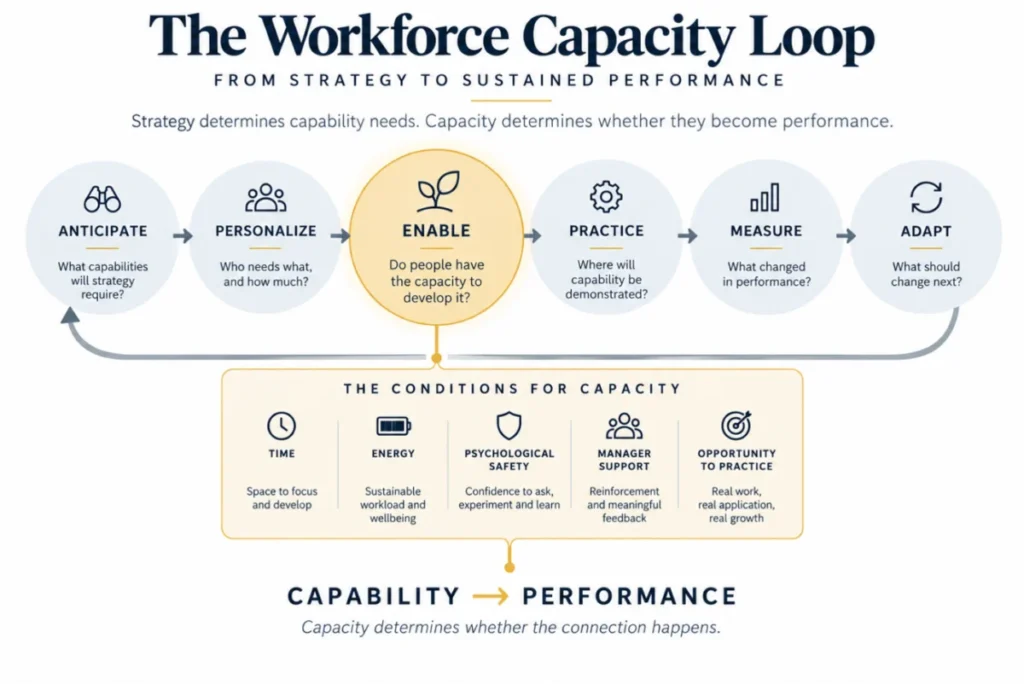
To navigate these challenges, a new conceptual framework known as the "Workforce Capacity Loop" is gaining traction among global CLOs. This model moves beyond the traditional ADDIE (Analysis, Design, Development, Implementation, and Evaluation) model to focus on sustainability.
The loop begins with a strategic identification of needed capabilities but places heavy emphasis on the "Enable" and "Practice" phases. It asks whether the environment—not just the individual—is ready for the change. This involves checking for managerial reinforcement, clear expectations, and, most importantly, the allocation of time.
Key Questions for 2027 Learning Initiatives:
- Alignment: Does this initiative solve a verified performance problem, or is it merely "just-in-case" training?
- Bandwidth: Have we identified what the employee should stop doing to make room for this new learning?
- Safety: Is there a "grace period" for lower productivity while the new skill is being mastered?
- Support: Does the existing workflow allow for the application of this skill, or does it actively hinder it?
Analysis: The End of the Learning Catalog
The broader implication of the capacity crisis is the potential end of the "learning catalog" as a metric of success. For decades, L&D departments were judged by the volume of content available and the number of hours employees spent in training. In 2027, these metrics are increasingly viewed as liabilities.
High-performing organizations are now prioritizing "learning subtraction"—identifying and removing obsolete training to clear cognitive space. The rise of AI-driven performance support means that for many infrequent tasks, employees no longer need to "learn" the information at all; they only need to know how to access and verify the AI’s guidance in the moment of need.
This shift requires a brave new stance from learning professionals: the willingness to say, "This is not a learning problem." Many performance issues currently labeled as "skill gaps" are actually results of poor process design, inadequate tools, or conflicting priorities. By diagnosing these correctly, L&D leaders can protect the workforce’s limited capacity for the changes that truly matter.
Conclusion: A New Metric for a New Era
As organizations finalize their 2027 strategies, the ultimate goal is to build an "agile" workforce without causing "attrition by exhaustion." The organizations that thrive will not be those with the most robust LMS or the largest training budgets. They will be the ones that treat human attention as their most precious and finite resource.
The 2027 agenda is a call for a more humane and efficient approach to development. By focusing on the Workforce Capacity Loop and prioritizing the "least burdensome" path to performance, companies can ensure that their people remain capable of adapting to a world that shows no signs of slowing down. In an era of infinite information, the most valuable thing a leader can provide is the capacity to use it.