
The modern corporate landscape is witnessing a silent but significant drain on revenue, rooted not in production inefficiencies or marketing failures, but in the structural inadequacy of the systems used to educate external partners and customers. While internal Learning Management Systems (LMS) have long been the standard for employee compliance and professional development, a growing body of evidence suggests that these platforms are fundamentally ill-equipped to handle the complexities of external training. This architectural misalignment often goes unnoticed at the executive level, manifesting instead as declining renewal rates, underperforming reseller channels, and a general erosion of brand loyalty across global distributor networks.
The Disconnect Between Metrics and Commercial Reality
In many boardroom reviews, the success of a training program is measured by completion rates, quiz scores, and login frequencies. However, these metrics often mask a deeper problem within external training initiatives. For internal employees, completion is often mandatory and tied to performance reviews or legal compliance. For external learners—such as third-party distributors, resellers, and end-users—engagement is entirely voluntary and driven by commercial self-interest.
When an external partner stops engaging with a training program, it is rarely flagged as a support ticket. Instead, the cost is deferred. It appears six to twelve months later in the form of a distributor pushing a competitor’s product because they found the rival’s documentation easier to digest, or a customer failing to renew a subscription because they never fully mastered the product’s core features. The inability to track the revenue attached to these "quietly disengaged" learners represents a significant blind spot in modern business intelligence.
A Chronology of the LMS Evolution
The current crisis in external training is the result of a decades-long evolution in educational technology that prioritized the internal user. In the early 2000s, the first generation of LMS platforms was designed to solve the problem of scale for HR departments. These systems were built on the assumption of a stable, known, and captive audience. The goal was record-keeping and compliance.
By the 2010s, the "Extended Enterprise" model began to emerge as companies realized they needed to train their value chain. Rather than building new infrastructure, most organizations simply extended their existing employee-facing LMS to external users. While this was a cost-effective short-term solution, it ignored the fundamental shift in learner psychology.

By 2020, the rapid digitalization of global markets and the complexity of modern B2B products created a demand for high-level technical competency among partners. The legacy systems, built for the "office furniture" environment of internal HR, were suddenly being asked to perform in the "stadium" environment of global commerce. The result has been a widespread failure to maintain engagement, leading to the current push for purpose-built external learning architectures.
The Architectural Problem: Employee vs. External Design
The root cause of underperforming external programs is rarely the quality of the content itself; rather, it is the underlying architecture of the platform. Employee-centric LMS platforms operate on several assumptions that do not hold true in an external context. First, they assume a high level of data cleanliness. In an internal system, an employee’s role, seniority, and department are clearly defined in an HR Information System (HRIS).
In contrast, a global partner network is chaotic. A "Sales Associate" in a Southeast Asian distributorship may have entirely different responsibilities and prior knowledge than a "Regional Agent" in Western Europe. When an LMS attempts to force these diverse users into rigid, rule-based pathways, the system often misfires. Experts find themselves forced to sit through introductory modules they mastered years ago, while beginners are overwhelmed by advanced technical content without sufficient context.
Furthermore, internal systems rely on the "legal obligation" of the employee to show up. External learners, however, are governed by "commercial motivation." If a platform is clunky, slow, or irrelevant, the external learner simply closes the tab. There is no supervisor to enforce completion, and the result is a dramatic drop-off in participation within the first few weeks of a program.
Supporting Data: The Impact of Adaptive Learning
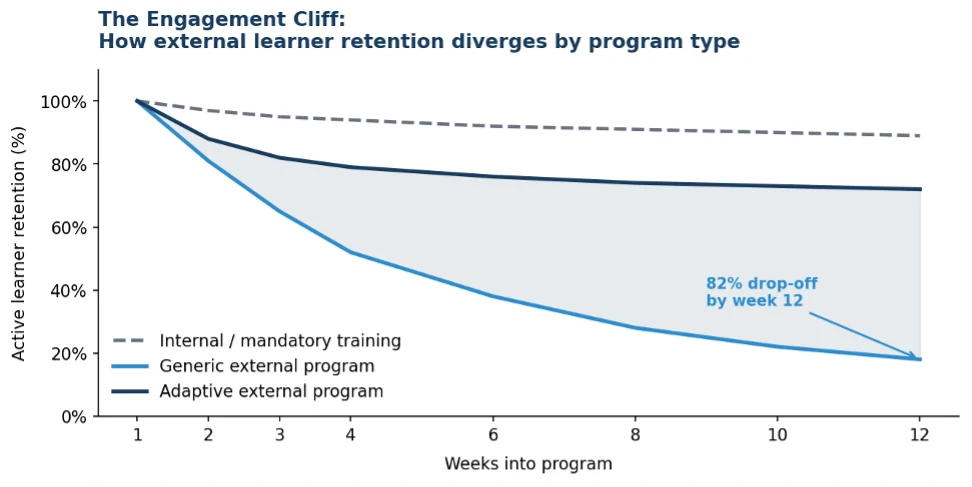
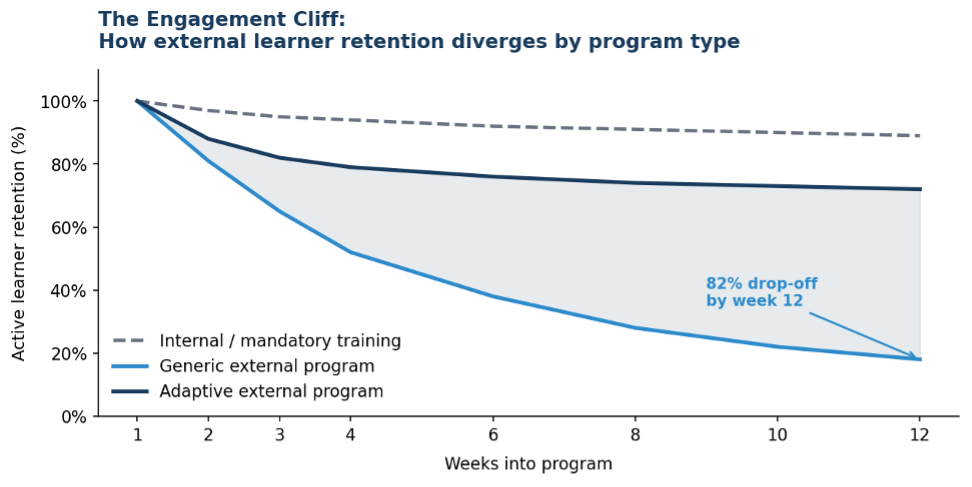
Recent industry data highlights the stark difference in retention between generic, one-size-fits-all external programs and those utilizing adaptive learning technologies. Adaptive programs—which adjust content and sequencing based on demonstrated learner knowledge and real-time context—retain learners at significantly higher rates.
Quantitative analysis of learner retention over a 12-week period reveals that generic external programs typically lose more than 60% of their active learners by the midpoint of the course. In contrast, adaptive programs have been shown to retain more than three times as many learners over the same duration. This retention is directly linked to the perceived utility of the content; when the system respects the learner’s time by skipping known material and focusing on gaps, the learner remains engaged.
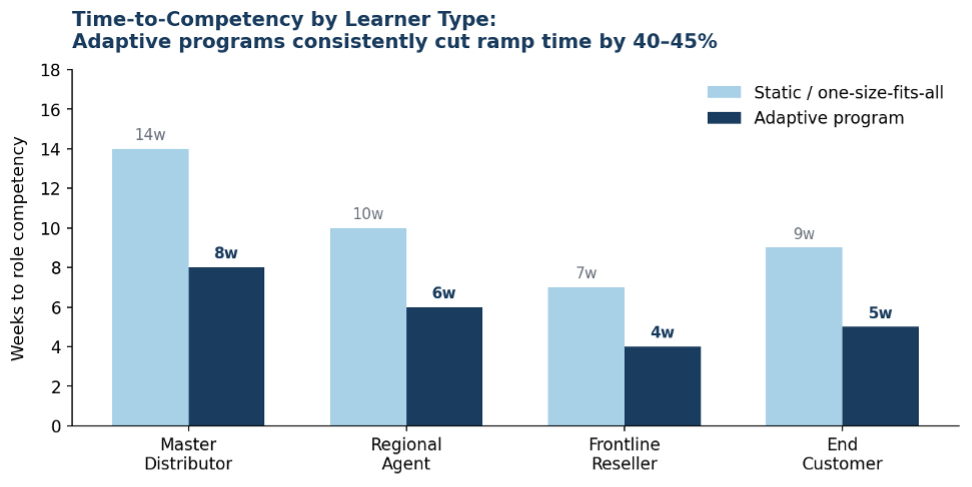
The business impact of this engagement is most visible in "time-to-competency." Adaptive learning models consistently reduce the time it takes for a partner to become fully productive. On average, adaptive pathways deliver a 40% to 45% faster ramp time compared to static programs. For a master distributor, this can mean the difference between a productive sales cycle starting in month two rather than month four, representing a substantial gain in market share and revenue.
The Failure of Traditional Personalization Methods
To combat disengagement, many organizations have attempted to "bolt on" personalization features to their existing LMS. However, these methods—rule-based pathways, manual segmentation, and recommendation engines—often fail at scale.
- Rule-Based Pathways: These depend on clean, stable role data which partner networks rarely possess. The administrative burden of constantly updating these rules as partner organizations shift is often unsustainable.
- Manual Segmentation: While effective for small groups, manual segmentation collapses under the weight of managing programs across dozens of countries and hundreds of different partner types. It turns into a full-time administrative task that drains resources away from content creation.
- Recommendation Engines: These are often trained on internal employee data. Because the motivations and learning habits of a distributor are fundamentally different from those of an internal staff member, the recommendations often miss the mark, leading to further learner frustration.
Industry analysts note that layering Artificial Intelligence (AI) on top of these flawed architectures does not solve the core problem. AI tends to amplify the underlying logic of a system. If the system was built for employees, the AI-driven personalization will still be based on employee-centric assumptions, resulting in what experts call "educated guesswork" rather than genuine learner-centric adaptation.
Official Responses and Industry Sentiment
While many LMS vendors claim to support "extended enterprise" functionality, chief technology officers (CTOs) and learning leaders are increasingly skeptical. In recent industry forums, the sentiment has shifted toward the need for "purpose-built" infrastructure.
"The mistake we made was thinking that a learner is a learner, regardless of their relationship to the company," noted one Chief Learning Officer from a Fortune 500 manufacturing firm. "We spent three years trying to make our internal system work for our dealers. We realized too late that we weren’t just changing the audience; we were changing the entire value proposition of the training. We needed a system that prioritized the user’s time as much as the content’s accuracy."
Consultants in the digital transformation space are now advising clients to evaluate their LMS not on its feature list, but on its "structural fit" for external complexity. This includes the ability to handle multi-tenant environments, diverse language requirements, and the fluctuating data quality of third-party networks.
Broader Impact and Strategic Implications
The decision to move to a purpose-built external training platform is often delayed because of the perceived cost of migration. Organizations frequently have significant investments in their current LMS and are hesitant to "start over." However, the long-term cost of maintaining a misaligned system is proving to be much higher.
The broader impact of getting external training right extends beyond immediate sales. It affects the entire ecosystem of a brand. In a globalized economy where product features are quickly replicated, the "competency of the network" becomes a primary competitive advantage. A brand whose distributors are more knowledgeable, more confident, and more capable of solving customer problems will invariably capture more market share.
Ultimately, the question for leadership is not whether their current platform can "handle" external training. Technically, almost any platform can host a video or a PDF. The real question is whether the platform was designed to thrive in the high-complexity, high-speed, and voluntary environment of the global market. As the gap between leaders and laggards in the "learning economy" continues to widen, the architecture of external training is moving from a back-office concern to a frontline strategic priority. Organizations that recognize this shift early will avoid the "competency cost" that is currently dragging down their less-adaptable competitors.






