The landscape of professional communication, particularly in talent acquisition, is undergoing a profound transformation driven by an increasing emphasis on diversity, equity, and inclusion (DEI). Organizations globally are recognizing that the language they use in job descriptions, emails, and social media posts directly impacts their ability to attract a broad and diverse pool of candidates. Consequently, the adoption of tools for gender writing analysis has become not merely a best practice, but a strategic necessity, ensuring content is both inclusive and demonstrably unbiased.
The tangible benefits of this shift are well-documented. A pivotal Appcast study, analyzing an extensive dataset of 473,742 job advertisements, provided compelling evidence: "Job ads with gender-neutral language result in 67.75% more applications at a cost that is 68.5% less per application in comparison to job ads that use a combination of female and male-coded terms." This data underscores a dual advantage: enhanced applicant flow and significant cost efficiencies. Beyond mere metrics, the underlying principle is to dismantle subtle linguistic barriers that, often unintentionally, deter qualified candidates. By proactively identifying and removing gender-coded words, companies can craft inclusive content that resonates with a wider demographic, particularly attracting more women to roles where they might traditionally be underrepresented, starting directly with their job postings.
The Evolution of Inclusive Language in Hiring
Historically, job descriptions and corporate communications often reflected prevailing societal norms, inadvertently embedding biases through specific word choices. Terms like "manpower," "aggressive," or "dominant" were once commonplace, appealing predominantly to traits stereotypically associated with men, while words such as "supportive," "nurturing," or "collaborative" could inadvertently code a role as more feminine. This linguistic gendering, often unconscious, has historically contributed to self-selection biases, where individuals, particularly women, might perceive themselves as less suited for roles described with masculine-coded language, leading to fewer applications from diverse groups. The Harvard Kennedy School, in a significant study, found that women are 50% less likely to apply to jobs that contain masculine-sounding language.
The early efforts to counteract this involved manual reviews and basic checklists, a time-consuming and often inconsistent process. However, with the rapid advancements in natural language processing (NLP) and artificial intelligence (AI), sophisticated software tools have emerged, capable of identifying and suggesting alternatives for biased language with unprecedented speed and accuracy. These tools represent a crucial technological leap, empowering HR and talent acquisition teams to move beyond rudimentary checks to a more systematic and scalable approach to inclusive communication. The year 2026 marks a period where these AI-enhanced solutions are becoming standard, reflecting a maturing understanding of how linguistic precision underpins broader DEI objectives.
Spotlight on Key Gender Analysis Writing Tools in 2026
The market now offers a robust suite of tools designed to aid in the creation of gender-neutral content. These platforms vary in their sophistication, integration capabilities, and pricing models, catering to a wide range of organizational needs, from small businesses to large enterprises.
-
Ongig Text Analyzer:
Ongig’s Text Analyzer stands out as an augmented gender analysis writing tool, leveraging AI to flag masculine language and propose inclusive alternatives. Its user-friendly interface allows for easy copy/paste or .docx file uploads, scanning for various forms of bias, including gender. Masculine-coded words are distinctly underlined in red, enabling users to click and replace them with gender-neutral options. Beyond bias detection, the Text Analyzer offers smart templating functions, allowing companies to create, store, and edit job descriptions (JDs) at scale for similar vacancies. This feature is invaluable for ensuring consistency and efficiency across a large volume of postings. Hiring teams can integrate these AI-polished JDs directly into their Applicant Tracking Systems (ATS) and career sites, facilitating a seamless, skills-based hiring campaign that actively appeals to talent from all backgrounds. Ongig serves a broad clientele, from SMBs to large enterprises with multiple users (recruiters, hiring managers, talent acquisition, diversity teams). With pricing starting at $11,997 per year, a demo can be requested to explore its full capabilities. -
Grammarly:
While widely known for its general grammar and spelling checks, Grammarly’s sophisticated autocorrect function now extends to identifying exclusionary words. For those engaged in talent acquisition, this means content can be made more appealing to every candidate by flagging non-inclusive terms like "manpower." While the basic spelling, punctuation, and grammar checks are free, advanced features, including inclusive hiring suggestions, require a professional account. Professional accounts begin at approximately $12 per month, with tiered pricing for teams, reaching up to $12.50 per member per month for organizations with 3 to 149 members. This makes it an accessible option for individuals and smaller teams looking to enhance their writing for inclusivity. -
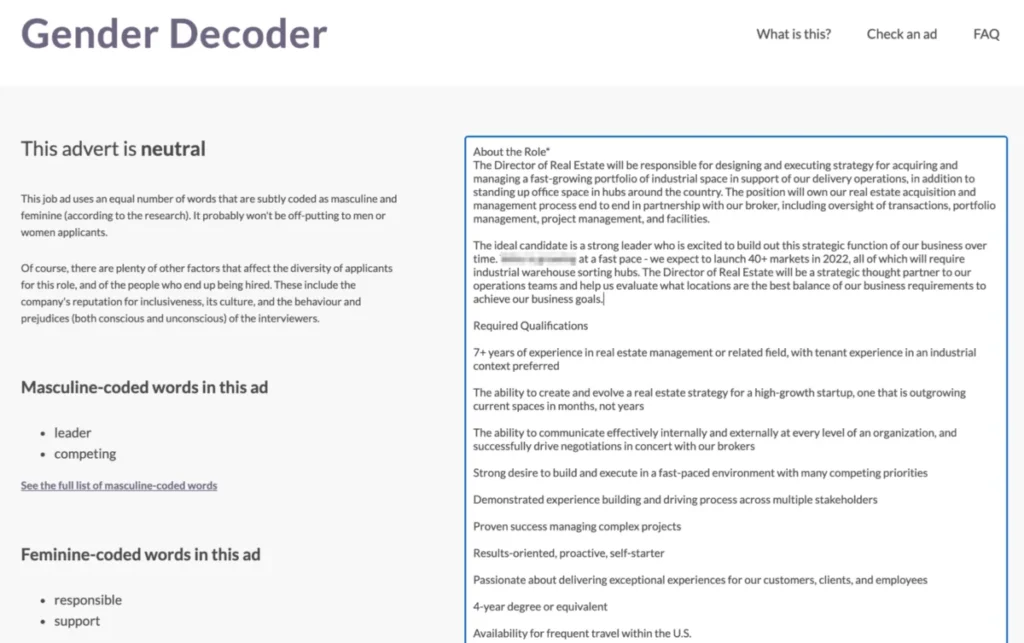
Gender Decoder:
Gender Decoder provides a straightforward, free solution for making writing gender-neutral. Users paste their text into the tool, which then analyzes it for masculine or feminine-coded words, presenting a clear list of identified terms. This simplicity makes it a popular choice for quick checks and for those seeking a basic, yet effective, initial assessment of their content. The platform also offers a comprehensive panel of potentially biased words for quick reference, enabling hiring teams to proactively craft fair and appealing JDs from the outset. Its zero-cost model ensures broad accessibility. -
Witty.Works:
Witty.Works operates as an inclusive writing assistant, specifically designed to empower hiring teams in scaling inclusive content across their ATS and career sites. The intelligent software excels at identifying exclusionary language and proposing neutral alternatives that resonate with a diverse audience. True to its name, Witty.Works provides engaging recommendations that aim to foster teamwork and diversity, often by replacing exaggerations and promoting friendlier communications. Its high integration capabilities allow for seamless operation within existing talent acquisition pipelines, leading to improved application and hiring rates. -
Microsoft Word:
For users with a Microsoft 365 subscription, Microsoft Word’s inclusive language checker offers an embedded gender writing analysis tool. Activating these settings allows Word to flag gender writing bias and other forms of bias directly within the document. This feature can be enabled by navigating through File > Options > Proofing > Settings and selecting the Gender Neutral option. This integration is particularly convenient for organizations already heavily invested in the Microsoft ecosystem. While Microsoft business plans (premium versions) typically range from $7-$14 per month, pricing is ultimately dependent on the specific organizational requirements and chosen plan. A notable "Pro tip" suggests that integrating MS Word with Co-pilot add-ons further enhances this capability, enabling users to rewrite JDs with gender-neutral efficiency through advanced AI functionalities. -
Total Jobs Gender Bias Decoder:
The Total Jobs Gender Bias Decoder provides a simple, effective, and free method for identifying gender bias. Users copy and paste their text into a designated box, and the tool visually distinguishes female-coded words in blue and male-coded words in pink/red. It also offers neutral alternatives for masculine-coded words. Interestingly, the software does not provide recommendations for feminine-coded words, based on research suggesting that their presence does not significantly dissuade male candidates during job applications. This tool prioritizes ease of use and immediate visual feedback, making bias detection straightforward and contributing to fair and equal writing. -
Applied Text Analysis (JDAT):
The Job Description Analysis Tool (JDAT) is a component of Applied’s broader Job Description tool. It scans for both masculine and feminine words to ensure text is gender-neutral. Beyond gender bias, this advanced tool incorporates specialized algorithms to track socioeconomic background and age, aiming to improve skills-based hiring campaigns comprehensively. Users simply copy and paste their text for a scan that highlights exclusionary terms. The AI also generates a readability report, analyzing reading time, current content reading level, and word count. While JDAT offers a free gender bias decoder function, a broader range of features is available through a paid version via a customized quote, catering to more extensive analytical needs. -
Clovers:
Clovers is an AI-driven interview intelligence platform designed to address unconscious biases throughout the hiring process. Its offerings range from redacted resume reviews to a robust gender bias checker for job descriptions. Clovers excels at assessing interview flow and minimizing interviewer biases through advanced Natural Language Processing (NLP). Their gender bias language checker meticulously reviews job descriptions for gender stereotypes and gender-coded language. Integration with Microsoft Teams makes it easy for talent acquisition teams to apply data-guided interview practices seamlessly within their ATS. The Harvard Kennedy School’s finding that women are 50% less likely to apply to jobs with masculine-sounding language underscores why a tool like Clovers is critical for achieving gender equality in the workplace. -
Datapeople:
Datapeople specializes in optimizing job descriptions through its Smart Editor tool. This software reviews JDs to promote inclusive language, but its capabilities extend beyond mere bias detection. It pinpoints problematic language and makes strategic recommendations regarding length, structure, and formatting, ensuring job descriptions are optimized for engagement. Smart Editor helps decision-makers ensure their content aligns with constantly shifting employer compliance standards and best practices. Users can confidently publish impactful JDs using the system’s pre-approved templates, which meet stringent standards for candidate engagement. The Smart Editor also provides user transparency for content revision reviews, which is ideal for larger organizations with complex HR workflows and significant internal oversight responsibilities. Datapeople’s tool is invaluable for organizations committed to revising and updating their job description catalog to reflect a strong commitment to gender equality and fair hiring. -
Happy Dance Job Page Grader:
Happy Dance’s Job Page Grader is a free tool designed to scan published job descriptions for unconscious bias and gendered language by simply using the job page’s URL. Its free accessibility makes it a valuable resource for organizations of all sizes, particularly those that publish job descriptions online. Beyond bias detection, the Job Page Grader vets and suggests improvements for a job page based on its URL, ensuring it meets the latest standards in mobile optimization, SEO, and code hygiene, which are crucial for boosting page loading speeds. While a free tool inherently has limitations, such as scanning only one page at a time and lacking offline capabilities, it serves its purpose well for users requiring minimal yet robust support and evaluation functions from a gender bias language checker.
The Broader Context: Why Bias Checks Matter in 2026
The traditional approach to writing job descriptions, which often prioritized established industry jargon and conventional phrasing, is increasingly outdated. Many of these unchallenged words and phrases can now be perceived as clunky, old-fashioned, or even subtly offensive by top-tier candidates. Outdated job descriptions frequently include language that perpetuates gender stereotypes, reinforces gender roles, or unnecessarily fixates on gender differences. The major strides in AI development and augmentation have rendered the elimination of socioeconomic and accessibility biases not just a desirable feature, but a fundamental standard in modern JDs.
Companies in 2026 must remain acutely aware of the evolving nuances of language, especially concerning job descriptions. Even the most diligent and well-intentioned HR professionals can inadvertently overlook language that reinforces gender bias. The ten gender bias language checker tools discussed herein are critical in minimizing these costly human errors by identifying subtle linguistic cues, such as masculine or male-coded words, within JDs.
Beyond the immediate impact on application rates, unchecked gender bias in language contributes to systemic issues like the persistent gender wage gap, the lack of paid paternity leave, and the extraordinary cost of childcare. These factors disproportionately affect women in the workforce. Hiring and retaining women necessitates a comprehensive reform of corporate policies, and AI-enhanced job descriptions are a foundational component of this reform.
Research from the United Nations continues to highlight the pervasive nature of workplace bias, despite significant advancements in inclusive hiring. The year 2026 presents a pivotal opportunity to accelerate change through the widespread implementation of smart AI tools that tackle subconscious hiring bias at its core. By providing talent with a more equitable foundation, these tools are instrumental in securing diverse roles in an increasingly competitive global job landscape. The ultimate implication extends beyond individual hiring metrics to foster more inclusive organizational cultures, enhance employer branding, and drive innovation through diverse perspectives. As companies strive for competitive advantage, the commitment to unbiased language is not merely an ethical imperative, but a strategic business advantage that resonates with modern talent and aligns with global DEI objectives.