In today’s rapidly evolving U.S. workplaces, the traditional annual employee survey is increasingly proving inadequate, failing to capture the volatile shifts in employee sentiment influenced by workload changes, leadership decisions, recognition moments, and the daily sense of support. This timing gap, where feedback becomes outdated long before it can be acted upon, carries significant consequences for organizational health and employee retention. A recent industry report, echoing sentiments found in contemporary studies, starkly reveals that only a minority of employees—as low as 29% in some projections—feel truly engaged or appreciated at work. Concurrently, more than a third of the workforce is either actively seeking new employment or uncertain about their future with their current employer. This pervasive disengagement, often building silently, underscores a critical need for more frequent, focused, and agile listening mechanisms: the employee pulse survey.
The Evolution of Employee Feedback: A Historical Perspective
The concept of employee feedback is not new, tracing its roots back to early 20th-century industrial psychology. Initial attempts often involved rudimentary suggestion boxes, giving way in the mid-to-late 20th century to more structured, albeit infrequent, annual surveys. These comprehensive questionnaires, typically administered once a year, aimed to provide a holistic view of organizational culture, engagement, and satisfaction. While groundbreaking for their time, their inherent limitations became glaringly apparent as the pace of business accelerated and workforce demographics shifted.
The late 1990s and early 2000s saw the rise of 360-degree feedback, broadening the scope of evaluation to include peers and subordinates, yet still largely periodic. However, the true catalyst for the shift towards continuous listening emerged in the 2010s. The advent of digital platforms, coupled with a generational change in workforce expectations—millennials and Gen Z employees demanding more transparent communication and immediate feedback—paved the way for more dynamic approaches. The "Great Resignation" phenomenon, commencing in 2021, further highlighted the urgency for organizations to understand and respond to employee needs in real-time, moving beyond retrospective annual reviews to proactive, preventative measures. This era underscored that employee engagement is not a static state but a dynamic continuum, necessitating tools that can monitor its ebb and flow with greater precision and frequency.
Defining the Pulse: What Sets Them Apart
An employee pulse survey is a short, frequent questionnaire designed to provide organizations with a real-time snapshot of employee sentiment, rather than an annual retrospective. Unlike their exhaustive annual counterparts, pulse surveys are characterized by their brevity, typically comprising just a handful of questions (often 5-15), making them quick to complete. Their frequency, often monthly or quarterly, allows for the tracking of changes in engagement, morale, and sentiment over time, identifying emerging trends or immediate concerns.
The core distinction lies in their purpose: pulse surveys are not meant to be an exhaustive diagnostic tool but rather a ‘check-in.’ They are designed to be agile, focused on specific themes, and repeatable, fostering a continuous dialogue between employees and leadership. This iterative process allows for rapid data collection, analysis, and, crucially, action, before minor issues can fester into significant problems. They are nimble instruments, adaptable to current organizational priorities or emergent challenges, ensuring the feedback gathered remains highly relevant and actionable.

The Business Imperative: Why Organizations Are Adopting Pulse Surveys
The strategic shift towards pulse surveys is driven by a clear business imperative: to foster a responsive, adaptive, and high-performing workforce. The consequences of disengagement are profound, impacting everything from productivity and innovation to customer satisfaction and financial performance. Gallup estimates that low engagement costs the global economy trillions annually in lost productivity. Against this backdrop, pulse surveys offer a powerful mechanism to mitigate these risks and unlock significant organizational benefits.
Unveiling Critical Metrics: What Pulse Surveys Can Measure
Pulse surveys are inherently flexible, capable of measuring a wide array of factors critical to employee experience. While maintaining consistency in key "anchor" questions to track trends, they can also adapt to focus on specific, timely issues. Common themes include:
- Engagement: Measuring employees’ emotional commitment and dedication. Questions like, "On a scale of 1-10, how engaged do you feel at work today?" or "Do you feel motivated to do your best work?" provide a direct gauge of overall sentiment.
- Recognition and Appreciation: Assessing whether employees feel valued for their contributions. Examples include, "How often do you receive meaningful recognition for your work?" or "Do you feel appreciated by your manager and peers?"
- Manager Support: Evaluating the effectiveness of leadership in fostering a supportive environment. Questions might cover, "My manager provides me with the support I need to succeed," or "My manager communicates expectations clearly."
- Workload and Well-being: Understanding the demands on employees’ time and their overall mental and physical health. "Do you have a healthy work-life balance?" or "Do you feel your workload is manageable?" are crucial indicators.
- Connection and Belonging: Gauging employees’ sense of inclusion and connection to their colleagues and the organization’s mission. "I feel a strong sense of belonging at this company," or "I feel connected to my team" are typical questions.
- Purpose and Impact: Exploring employees’ understanding of their role’s significance. "I understand how my work contributes to the company’s success," can be an indicator.
- Open-Text Feedback: Providing a qualitative dimension, allowing employees to elaborate on their experiences. A simple prompt like, "What is one thing we could do to improve your experience at work?" yields invaluable insights.
By consistently measuring these drivers, organizations can identify specific areas requiring intervention and track the efficacy of their initiatives over time.
From Data to Decisions: Actioning Pulse Survey Insights
The true value of a pulse survey lies not in the data collected, but in the action it inspires. Many organizations falter at this crucial stage, leading to employee cynicism and "survey fatigue." To truly leverage pulse survey results, a systematic approach is essential:
- Identify Patterns Driving Results: This involves meticulously reviewing scores, comments, and engagement drivers to spot recurring themes. Are employees consistently citing a lack of recognition, insufficient manager support, limited development opportunities, or concerns about well-being or work-life balance? Repeated themes signal systemic issues that demand attention.
- Prioritize Issues for Action: Not every issue can be addressed simultaneously. Leaders must strategically select one or two high-impact themes that are both significant to employees and realistically improvable within a reasonable timeframe. Priorities that employees will quickly notice—such as enhancing recognition practices, improving manager check-ins, clarifying role expectations, or addressing workload imbalances—yield the greatest trust dividends.
- Create an Action Plan with Owners and Timelines: Each prioritized issue requires a clear, measurable action plan. This involves assigning responsibility to a specific leader or team, defining concrete next steps, and setting realistic deadlines. For instance, if inconsistent manager feedback is a concern, the plan might specify a workshop for managers on effective feedback techniques, a designated owner from HR, a start date, and a target for improvement to be measured in the subsequent pulse survey.
- Use Recognition to Reinforce Desired Behaviors: Integrating recognition with survey feedback is a powerful culture-shaping tool. If survey results highlight gaps in collaboration or communication, leaders should visibly recognize employees and teams who exemplify these desired behaviors. This not only reinforces positive actions but also demonstrates a tangible link between feedback, action, and reward.
- Communicate What Will Change: Transparency is paramount. Organizations must close the feedback loop by clearly communicating survey findings to employees, outlining the identified themes, the chosen priorities, and the specific actions that will be taken. This transparency builds trust and provides employees with a compelling reason to continue participating in future surveys, validating their input.
- Measure Progress in the Next Pulse Survey: The cyclical nature of pulse surveys allows for continuous improvement. The next survey should include questions designed to assess the impact of the actions taken. If the previous priority was manager support, the subsequent survey should reveal whether employees perceive a meaningful improvement in that area. This ongoing measurement ensures accountability and informs future iterations of the action plan.
Beyond Engagement: Broader Strategic Benefits
The advantages of employee pulse surveys extend far beyond merely boosting engagement scores. They serve as a multifaceted strategic tool for modern organizations:
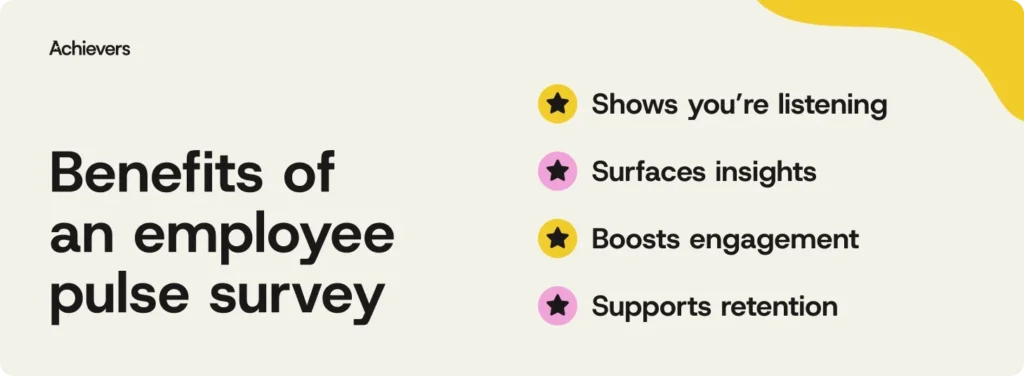
- Demonstrates Authentic Listening: Regular pulse surveys send a powerful message that employee voices are valued. This builds psychological safety and credibility, especially when followed by visible action.
- Surfaces Rapid Insights: Their brevity and frequency allow for quick identification of emerging issues, enabling proactive intervention before problems escalate and impact morale or productivity.
- Boosts Engagement and Morale: When employees see their feedback translate into tangible improvements, their engagement naturally rises. Studies show that employees surveyed more frequently report higher levels of engagement.
- Supports Talent Retention: Pulse surveys act as an early warning system, identifying factors contributing to potential attrition, such as burnout or dissatisfaction. Addressing these concerns proactively significantly reduces turnover risk.
- Flags Issues Before Escalation: From communication breakdowns to leadership disconnects, pulse surveys help catch concerns while they are still manageable, preventing them from becoming crises.
- Encourages Honest Feedback: The anonymity inherent in well-designed pulse surveys empowers employees to provide candid feedback, particularly about sensitive topics or direct managers, fostering a more authentic dialogue.
- Fuels a Culture of Continuous Improvement: By providing regular data points, pulse surveys enable leaders to continually refine strategies, identify best practices, and adapt to changing employee needs, fostering an agile organizational culture.
- Reduces Bias in Feedback: Standardized, anonymous questions level the playing field, reducing subjectivity and ensuring that all voices have an equal opportunity to be heard, leading to more reliable insights.
- Informs Smarter Strategic Decisions: Data-driven insights from pulse surveys allow leaders to move beyond assumptions, focusing resources and initiatives on areas that will have the greatest positive impact on the workforce and business outcomes.
- Drives Higher Participation Rates: The short, manageable nature of pulse surveys dramatically increases completion rates compared to lengthy annual questionnaires, ensuring a broader and more representative sample of employee sentiment.
Mitigating "Survey Fatigue": Best Practices for Sustained Participation
The specter of "survey fatigue" often deters organizations from frequent listening. However, research suggests that fatigue is less about the frequency of surveys and more about the lack of follow-through. When employees perceive their feedback disappearing into a black hole, participation inevitably wanes. To sustain high engagement with pulse surveys:
- Close the Loop Consistently: Always communicate what was learned, what actions will be taken, and, crucially, what won’t be changed (and explain why). This transparency reinforces trust.
- Maintain Anchor Questions: Keep a core set of consistent questions to track key trends over time, providing a clear narrative of progress or regression.
- Rotate Thematic Focus: Beyond anchor questions, vary the themes of each pulse survey. Focus on one or two specific areas (e.g., recognition, workload, manager support) per cycle to keep surveys relevant and fresh.
- Only Ask What You Can Act On: Resist the urge to include "nice-to-know" questions. Every question should correspond to an area where the organization is genuinely prepared and able to take action.
- Ensure Anonymity is Clear and Real: Employees must trust that their responses are confidential. Clearly communicate the anonymity safeguards in place to encourage honest and candid feedback.
- Recognize Action-Takers: Publicly acknowledge and celebrate teams and leaders who actively respond to survey feedback and implement positive changes. This transforms listening into a celebrated cultural habit.
The Future of Workplace Listening: Integration and Technology
The efficacy of pulse surveys is further amplified by their integration with broader HR technology ecosystems. Modern platforms often combine pulse survey capabilities with recognition and rewards systems, performance management tools, and learning and development modules. This holistic approach allows organizations to not only gather feedback but also immediately link it to tangible actions and reinforcements. The rise of artificial intelligence and advanced data analytics is also revolutionizing how qualitative feedback from open-text responses is processed, identifying nuanced sentiment and emerging themes that might otherwise be missed. This technological evolution promises even more sophisticated and actionable insights from continuous listening.
Conclusion: A Cornerstone of Modern People Strategy
An employee pulse survey is more than just a data collection tool; it is a fundamental pillar of a forward-thinking people strategy. It represents a commitment to seeing, hearing, and appreciating employees, fostering an environment where their voices truly matter. In an era defined by rapid change and intense competition for talent, the ability to quickly understand employee sentiment and respond with agility is no longer a luxury but a strategic imperative.
However, listening is merely the initial step. The profound difference lies in the subsequent actions: the speed with which insights are translated into concrete initiatives, the consistency with which feedback informs recognition and rewards, and the clarity with which employees witness their input driving meaningful change. For organizations seeking a lightweight, high-impact method to stay intimately connected to their workforce, and to transform feedback into a continuous cycle of recognition and improvement, the employee pulse survey stands as an indispensable tool. By embracing such platforms, organizations can ensure that employee listening is not an isolated function but a deeply integrated process, shaping culture, driving performance, and ultimately building a resilient and thriving workforce.