
A pivotal moment is upon us, a juncture where the established paradigms of industrial operations are not merely evolving but fundamentally collapsing, ushering in an era where the old rules of engagement are rendered obsolete with startling rapidity. This seismic shift, analogous to the transformative impact of the steam engine on textiles or the personal computer on office dynamics, is not a gradual upgrade but an instantaneous metamorphosis of how work is conceptualized, executed, and scaled. Yet, a significant portion of human resources leadership remains ill-prepared for this profound transition from sophisticated software to pervasive superintelligence, a change that transcends mere technological enhancement and represents a radical redefinition of the workforce. Organizations that proactively embrace this paradigm shift stand to gain an insurmountable competitive advantage, measured not in incremental gains but in entirely new market categories. Conversely, those that cling to legacy systems and outdated methodologies risk managing yesterday’s workforce with yesterday’s tools while AI-native competitors operate on an entirely different, exponentially more efficient plane.
The traditional model of scaling businesses, which for the better part of a century revolved around the simple equation of "more output requires more head count," has demonstrably hit a critical ceiling. This is not a reflection of human capability, which remains immense, but rather a limitation imposed by the inherent constraints of human labor. Every workflow demanding manual intervention – a button press, a file transfer, a calendar scheduling – is inherently capped by the finite nature of human energy, availability, and geographical presence. This is the fundamental flaw that AI-native organizations are actively overcoming. They are not simply asking their human talent to do "more with less"; instead, they are strategically deploying digital agents to assume the mantle of high-volume, repetitive execution tasks. This liberation allows human employees to dedicate their invaluable cognitive resources to areas demanding critical judgment, strategic thinking, and nuanced decision-making. The outcome is not merely increased efficiency but the active "manufacturing of intelligence," a process that accelerates the competitive gap between forward-thinking enterprises and legacy organizations at an exponential rate.
The current landscape of HR technology, unfortunately, exacerbates this challenge rather than resolves it. A significant portion of investments made over the past decade has been channeled into systems designed to digitize existing, inefficient processes rather than fundamentally re-engineer them. Applicant Tracking Systems (ATS) and Human Resource Information Systems (HRIS), while valuable as systems of record for managing head count, compliance, and data storage, fall short when tasked with predictive talent management. These legacy platforms often treat candidates as static database entries and employees as mere cost centers. While they can readily report on who is currently employed, they falter when asked to identify potential future leaders, assess skill adjacencies across different roles, or forecast talent needs with strategic foresight.
Compounding this issue is the nature of the artificial intelligence embedded within these legacy systems. Typically trained exclusively on an organization’s internal data – data that is frequently incomplete, historically biased, and siloed across departments – this AI often amplifies past mistakes with a veneer of statistical confidence. This creates what can only be described as a "bias-laundering machine," perpetuating and entrenching existing inequalities and suboptimal decision-making rather than fostering objective and equitable talent acquisition.
The alternative, the deployment of general-purpose large language models (LLMs), presents its own distinct set of challenges. While these tools demonstrate remarkable prowess in language generation, summarization, and conversational interfaces, they lack the crucial "spatial intelligence" within the complex ecosystem of work. They do not inherently understand the intricacies of career progression, the nuanced relationships between disparate skills, or the critical compliance implications of hiring decisions. The ubiquitous disclaimers accompanying these tools, acknowledging their potential for error, are simply unacceptable in the high-stakes arena of talent acquisition, where precision and reliability are paramount. Consequently, HR leaders find themselves navigating a precarious landscape, tethered by the anchors of legacy systems on one side and confronted by the unreliability of generalized AI on the other.
The Dawn of the Infinite Workforce: A New Operational Architecture
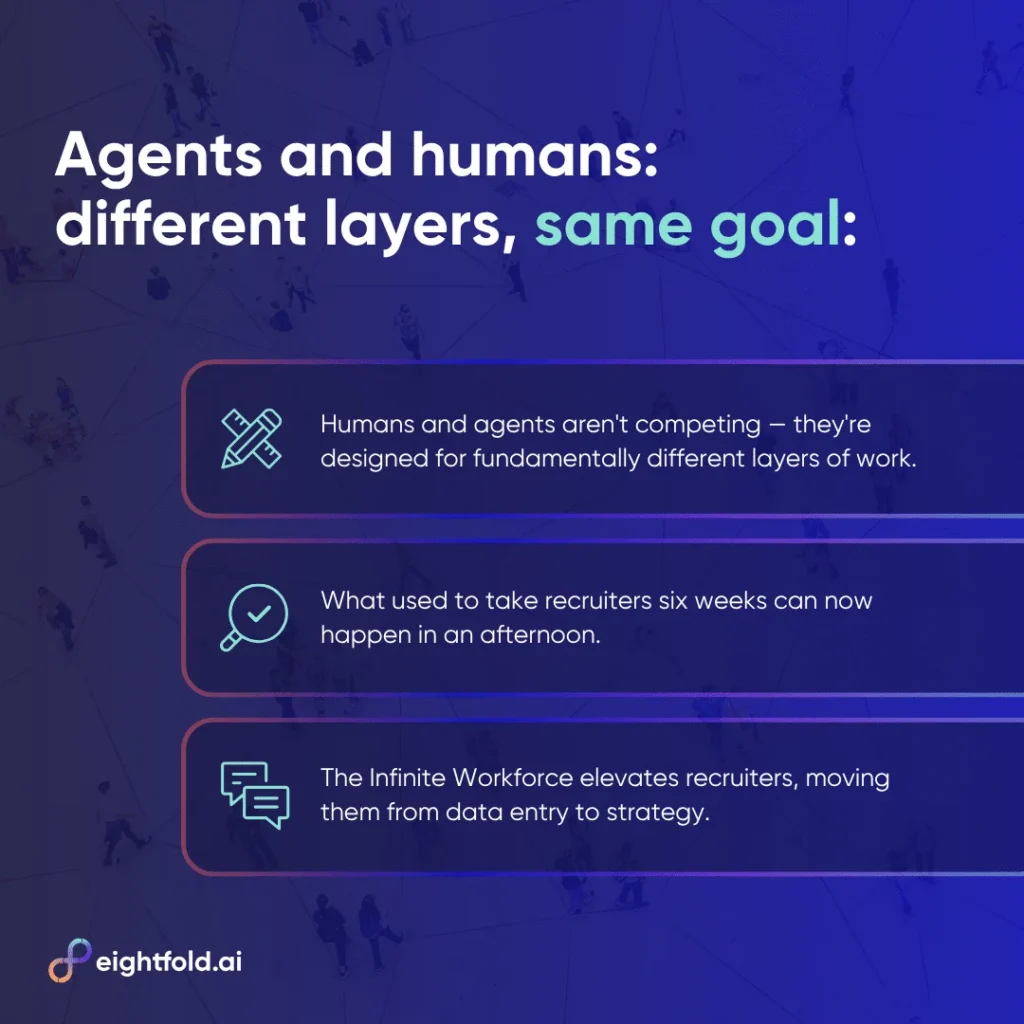
The concept of the "Infinite Workforce" transcends the realm of a mere technological product; it represents a fundamental re-architecture of operational strategy. This new paradigm is built upon the critical recognition that humans and AI agents are not in competition for the same work but are designed to operate at fundamentally different, complementary layers of the organizational structure.
AI agents are poised to assume responsibility for execution at an unprecedented scale. Their capabilities encompass the high-volume, repetitive tasks of screening applications, scheduling interviews, conducting initial assessments, and proactively surfacing suitable candidates. These digital agents operate around the clock, across all open requisitions, and can process a volume of candidates that would overwhelm any human team. Tasks that once consumed weeks for a recruiting team can now be accomplished within a single afternoon, dramatically compressing hiring cycles.
In this new architecture, humans are elevated to a supervisory and strategic role, orchestrating operations from above the loop. They are tasked with making the crucial judgment calls that AI agents are not equipped to handle: discerning the most critical roles for strategic growth, defining nuanced cultural fit beyond superficial metrics, and employing persuasive strategies to engage passive candidates who possess multiple compelling offers. Human leaders are responsible for establishing ethical guardrails, providing strategic counsel to hiring managers, and cultivating the deeply human relationships that no algorithm can replicate.
This paradigm shift is not about sidelining recruiters but about profoundly elevating their roles. When recruiters dedicate a disproportionate amount of their time – often upwards of 70% – to administrative tasks like interview scheduling and resume screening, they are not leveraging their core competencies. They are engaged in data entry, work that fails to capitalize on their expertise, intuition, and innate ability to connect with people. This represents a suboptimal utilization of the most sophisticated intelligence available: the human brain. The transition to the Infinite Workforce strategically repositions teams to operate "above the loop," where agents manage the repetitive, and humans dedicate their irreplaceable talents to the strategic and relational aspects of their roles.
Quantifiable Impact: The Proof is Already Here
This is not a theoretical future scenario; it is an unfolding competitive reality that is already reshaping industries. Organizations that have embraced agentic AI within their talent acquisition processes are witnessing transformative results. Hiring cycles are being compressed from an average of 42 days to under a week. Talent pools are expanding by an order of magnitude – a 100x increase – without any corresponding increase in headcount. Crucially, up to 80% of manual recruiter workload is being automated, while simultaneously maintaining exceptionally high interview completion rates (92.5%) and candidate satisfaction scores (93% Net Promoter Score). These are not minor efficiency gains; they represent profound structural competitive advantages, achieved by empowering recruiters to focus on the strategic, human-centered work that truly drives organizational success.
The Strategic Imperative for HR Leaders in 2026
The global economic landscape is in constant flux, and projections from authoritative bodies like the World Economic Forum highlight the dynamic nature of the job market. Their reports, such as the "Future of Jobs Report 2025," predict significant displacement of existing jobs – an estimated 92 million by 2030 – alongside the creation of 170 million new roles. The organizations that will ultimately prevail in this evolving talent war will not be those that observed these shifts from the sidelines but those that proactively built their Infinite Workforce capabilities before the fundamental change in operational models became widely apparent.
The "Intelligence Revolution" is not a distant future to be planned for; it is a present condition demanding immediate strategic response. Every day that a recruiting team remains mired in administrative execution, rather than engaging in strategic talent acquisition, represents a missed opportunity for more meaningful work and a gradual erosion of competitive standing against organizations already operating at agent scale.
The essence of the Infinite Workforce is not about achieving more with fewer individuals. It is about enabling the existing human workforce to undertake more valuable, impactful work by strategically pairing human judgment, empathy, and creativity with the unparalleled efficiency of AI agents. This symbiotic partnership is poised to become the defining competitive advantage of 2026 and the years that follow. The critical question for every organization today is not if this shift will occur, but how rapidly they are prepared to build and integrate this transformative partnership.
For those seeking a deeper understanding of how to navigate this transition, the comprehensive ebook, "The Infinite Workforce," offers a detailed roadmap. It outlines strategies to liberate organizations from the constraints of legacy systems, effectively deploy agentic AI in talent acquisition, and empower recruiting teams to focus on the strategic initiatives that truly propel business forward.







