
The transition of artificial intelligence from a speculative, future-facing technology to a foundational element of daily business execution has occurred with unprecedented velocity. For years, AI was discussed primarily within the confines of strategy decks and experimental laboratories, viewed as a "someday" solution for complex problems. However, the landscape has shifted radically. Today, enterprises have moved beyond the experimentation phase, embedding AI directly into their operational DNA. This shift marks a new era where automation and intelligent processes are no longer optional advantages but are the baseline requirements for remaining competitive in a globalized economy.
The Evolution of AI from Strategy to Execution
In the current corporate environment, artificial intelligence is no longer relegated to high-level planning. Instead, it has become a practical layer that sits inside day-to-day execution, actively shaping how companies run their core functions. The shift is most visible in operations, where the primary objectives are speed, accuracy, and consistency. Modern organizations rely on AI to automate repetitive tasks, refine decision-making processes, and streamline the movement of work across multidisciplinary teams.
According to the state of AI in 2024 and 2025, the focus has moved toward "operationalizing" intelligence. A recent McKinsey Global Survey on AI highlights this trend, reporting that 55% of organizations have adopted AI in at least one business function. More importantly, those who have adopted these technologies report measurable gains in efficiency and a significant return on investment. This data reflects a clear departure from pilot programs toward the full-scale embedding of AI into real-world operational flows.
Understanding AI in the Operational Context
Operational AI refers to the application of machine learning, natural language processing, and robotic process automation to improve how daily business work is executed. Unlike strategic AI, which might focus on long-term market forecasting or product innovation, operational AI is concerned with the "here and now." It focuses on removing manual effort, reducing human error, and accelerating the velocity of internal workflows.
The core value of this technology lies in three specific areas:
- Task Automation: Handling repetitive, rule-based steps such as data entry, ticket routing, and standard approvals.
- Augmented Decision-Making: Using real-time data to provide employees with insights, helping them choose the "next best action" without manual data crunching.
- Process Optimization: Identifying bottlenecks in a workflow and automatically suggesting or implementing improvements to keep work moving.
By focusing on these areas, businesses can create faster cycles and more consistent performance. This allows organizations to scale their output significantly without needing to increase their headcount at the same rate, a concept known as "decoupling growth from labor."
The Chronology of AI Adoption in Business
The journey toward the current state of AI in operations has followed a distinct timeline, moving from simple automation to complex, autonomous agents.
- The RPA Era (2010–2018): Early adoption focused on Robotic Process Automation (RPA). These systems were "dumb" in that they followed strict scripts to move data between software. While helpful, they could not handle exceptions or learn from new data.
- The Machine Learning Pivot (2018–2022): Companies began integrating machine learning models to predict outcomes, such as identifying which customers were likely to churn or when a machine on a factory floor might fail.
- The Generative and Agentic Era (2023–Present): With the rise of Large Language Models (LLMs), AI can now understand context, generate reports, and act as "agents" that coordinate between different software platforms. This era is defined by AI that doesn’t just follow a script but understands the goal of a process.
Strategic Integration Points: Where AI Fits into the Workflow
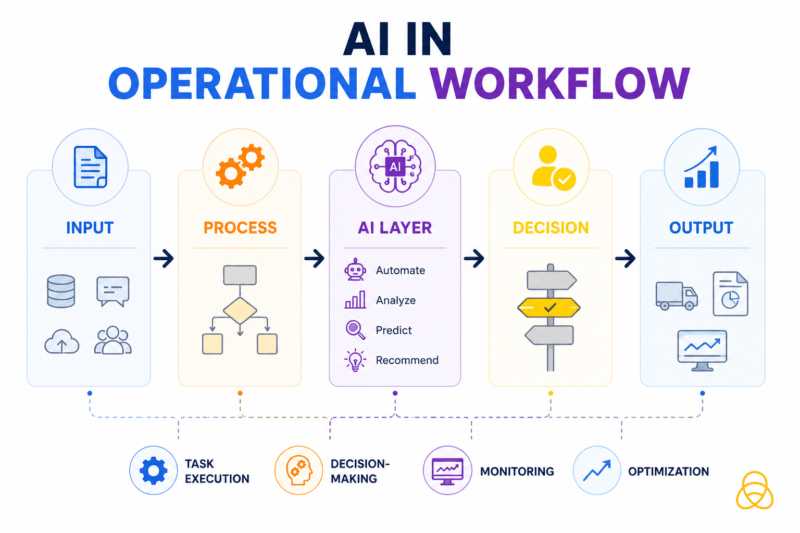
To understand the impact of AI, one must look at where it integrates into the standard business workflow. These integration points are the "gears" that drive organizational momentum.
Automated Task Execution
In many companies, the "middle" of a process is often the slowest. AI workflow automation targets these middle steps—approvals, document handling, and internal routing. By removing the need for a human to manually "pass the baton" to the next department, AI reduces delays that previously took days down to mere seconds.
Data-Driven Decision Support
Operational data is often siloed and overwhelming. AI serves as a processing layer that analyzes this data as it is generated. For a manager in finance or HR, this means receiving a notification that flags an anomaly or suggests a budget adjustment based on real-time spending patterns, rather than waiting for a month-end report.
Real-Time Monitoring and Flagging
AI tracks operational activity as it happens. In a supply chain context, this might involve monitoring global shipping delays and automatically re-routing orders. In a customer service context, it involves sentiment analysis that flags a frustrated customer to a human supervisor before the situation escalates.
Continuous Process Refinement
Unlike traditional software, AI systems can learn. By analyzing historical performance, AI can identify that a specific approval step in a procurement process consistently causes a three-day delay. It can then recommend a structural change to the workflow, allowing the organization to evolve its processes dynamically.
Key Use Cases Across Business Functions
The practical application of AI varies by department, but the underlying goal of operational excellence remains constant.
Human Resources and Workforce Management
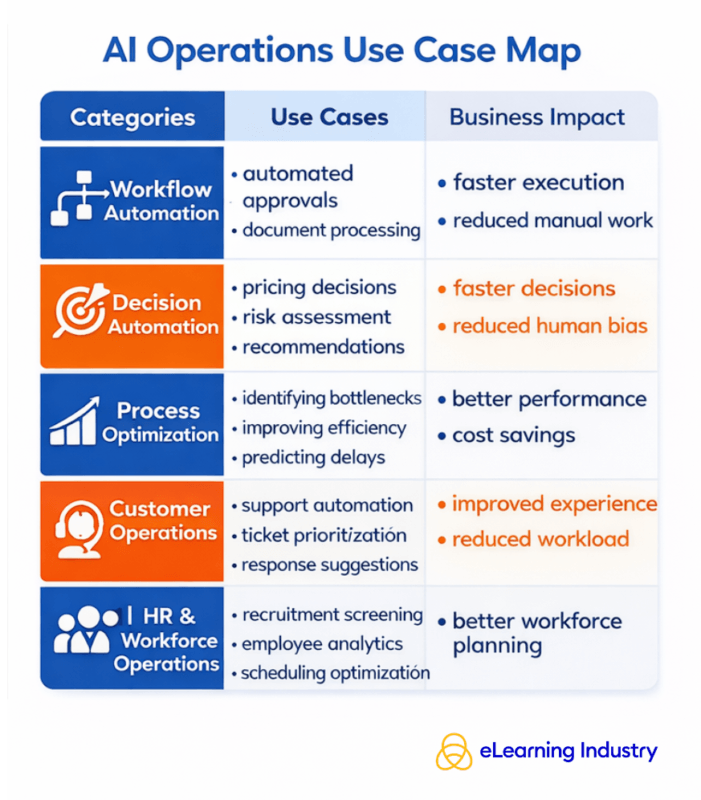
HR teams are utilizing AI to streamline the entire employee lifecycle. In recruitment, AI-driven platforms match candidates to roles based on skill sets rather than just keywords, reducing the time-to-hire. In workforce management, AI optimizes scheduling for retail or manufacturing environments, ensuring the right people are in the right place based on predicted demand.
Finance and Data Handling
The finance sector has been a pioneer in operational AI. Beyond simple accounting, AI is used for real-time fraud detection, automated invoice processing, and predictive budgeting. These systems reduce the "manual touch" required for compliance and reporting, allowing finance professionals to focus on strategic capital allocation.
Customer Operations and Service
AI supports customer-facing teams by handling high-volume, low-complexity queries through intelligent chatbots and self-service portals. However, the deeper impact is in "agent assistance," where AI provides human representatives with relevant customer history and suggested solutions in real-time, drastically reducing resolution times.
Quantifiable Benefits of Operational AI
The push toward AI is driven by measurable outcomes that affect the bottom line.
- Efficiency and Friction Removal: By automating routine updates and coordination, teams can redirect their energy toward high-value work. This leads to a more engaged workforce and a higher quality of output.
- Substantial Cost Reduction: Reducing the reliance on manual labor for repetitive tasks and preventing costly errors through automated oversight leads to significant operational savings.
- Speed as a Competitive Advantage: In a market where customer expectations are higher than ever, the ability to execute a process—whether it’s a loan approval or a product shipment—faster than a competitor is a major differentiator.
- Enhanced Accuracy: AI does not suffer from fatigue. It follows defined rules and processes data with a level of precision that human operators cannot consistently maintain over long periods.
Navigating the Challenges of Implementation
Despite the clear benefits, the path to AI operationalization is fraught with obstacles. Success requires more than just purchasing a software license; it requires a structural and cultural shift.
The Integration Gap
Many organizations operate on "legacy" infrastructure—older software systems that were not designed to communicate with modern AI. Bridging the gap between these disconnected platforms is a major technical challenge that often requires significant middleware investment.
The Data Quality Crisis
AI is only as effective as the data it consumes. Many businesses struggle with "dirty data"—information that is inconsistent, outdated, or trapped in silos. Without a clean, structured data foundation, AI outputs can be misleading or outright incorrect.
Cultural Resistance and the Skills Gap
The "human element" is perhaps the most significant barrier. Employees often view AI with suspicion, fearing job displacement. Furthermore, there is a global shortage of talent capable of managing and scaling these systems. Organizations must invest in "upksilling" their workforce to ensure that employees view AI as a tool for empowerment rather than a threat.
The Role of Learning and HR Tech in AI Adoption
Learning and Development (L&D) and HR technology companies have emerged as critical enablers in this transition. AI in operations cannot succeed in a vacuum; it requires a workforce that is literate in these new tools.
Modern learning platforms are moving away from theoretical training and toward "in-the-flow" learning. This involves embedding training modules directly into the software employees use daily. When an AI-driven tool is introduced to a workflow, the HR tech platform provides immediate, contextual guidance on how to use it. This approach reduces the "learning curve" and ensures that the investment in AI translates into actual usage and productivity.
Analysis: From Automation to Long-Term Strategic Advantage
As we look toward 2026 and beyond, the distinction between "AI companies" and "traditional companies" will likely disappear. Every successful enterprise will, by necessity, be an AI-driven enterprise. The current trend suggests a move toward "Agentic Workflows," where AI doesn’t just assist a human but takes ownership of an entire process from start to finish, with humans serving in an oversight capacity.
The broader implication is a fundamental shift in how business value is created. In the past, scaling a business required a linear increase in staff. In the AI-augmented future, scaling will be determined by the sophistication of an organization’s digital infrastructure and the quality of its data. This shift will likely lead to smaller, more agile teams that wield immense operational power through automated systems.
Final Summary and Key Takeaways
Artificial intelligence has moved from the periphery of business strategy to the core of operational execution. For organizations looking to thrive, the mandate is clear: AI must be embedded into structured workflows, supported by high-quality data, and championed by a trained workforce.
Success in this new reality is not defined by the complexity of the AI tools an organization buys, but by how seamlessly those tools are integrated into the daily lives of employees. When AI is used to remove friction, speed up decisions, and scale operations, it ceases to be a "tech project" and becomes a powerful engine for sustainable growth. The organizations that master this integration today will be the ones that define the competitive landscape of tomorrow.
Frequently Asked Questions
- What is the primary difference between AI strategy and AI operations? AI strategy focuses on long-term goals and planning, while AI operations focuses on the immediate, day-to-day execution of tasks and processes.
- How does AI improve decision-making in a business setting? AI analyzes vast amounts of real-time data to identify patterns and anomalies, providing managers with evidence-based recommendations rather than relying on intuition or delayed reports.
- What is the biggest obstacle to implementing AI in operations? While technical issues like data quality are significant, cultural resistance and a lack of internal skills are often the most difficult challenges to overcome.
- Can AI replace entire departments? While AI can automate many tasks, its primary role is to augment human capabilities. It is more likely to change the nature of roles within a department than to eliminate the department entirely.






