The moment arrives with a somber announcement: a team member shares news of a significant loss in their life. In the immediate aftermath, a leader’s instinct is to offer support, yet for many, this is swiftly followed by a quiet wave of uncertainty—a question of "What do I do now?" This pervasive lack of preparedness highlights a critical gap in leadership development, particularly concerning the universal human experience of grief. The word "bereaved" itself, stemming from an ancient term meaning "to be robbed," aptly captures the profound sense of loss that cannot simply be compartmentalized or managed away. Despite its ubiquity, affecting nearly all working adults, often multiple times, most organizational leaders receive no formal training or preparation for supporting grieving employees. While good intentions abound, effective support frequently falls short, creating an opportunity for leadership development focused not on turning managers into grief counselors, but on equipping them to be present, honest, and willing to engage with what they cannot fix.
Bereavement at Work: The Undeniable Toll
Understanding the scope of bereavement in the workplace is crucial for effective leadership. It is the intersection of profound personal loss and the unyielding demands of professional life, a phenomenon that defies schedules and containment. Grief, by its very nature, does not cease at the office door. A comprehensive three-perspective approach, surveying managers, coworkers, and bereaved employees, reveals that the impact of loss extends far beyond the individual experiencing it.
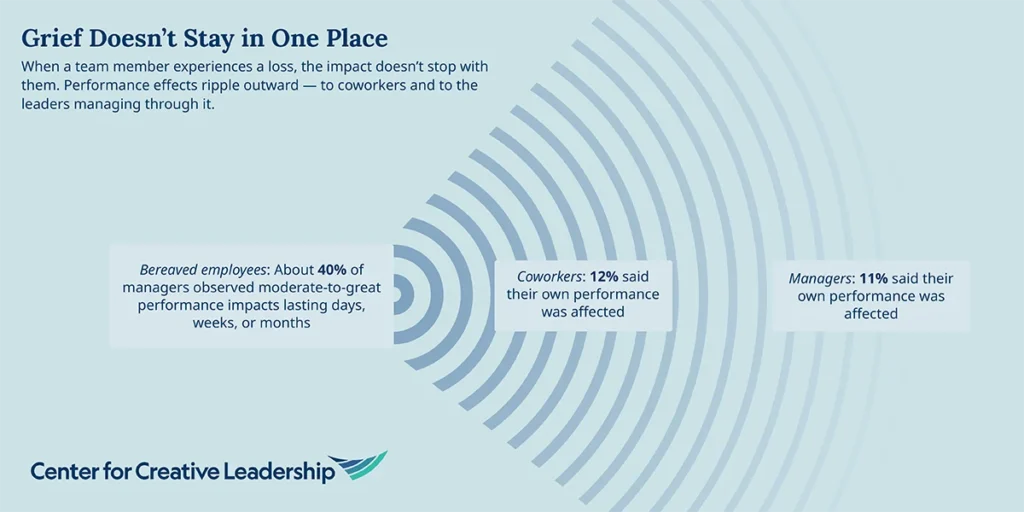
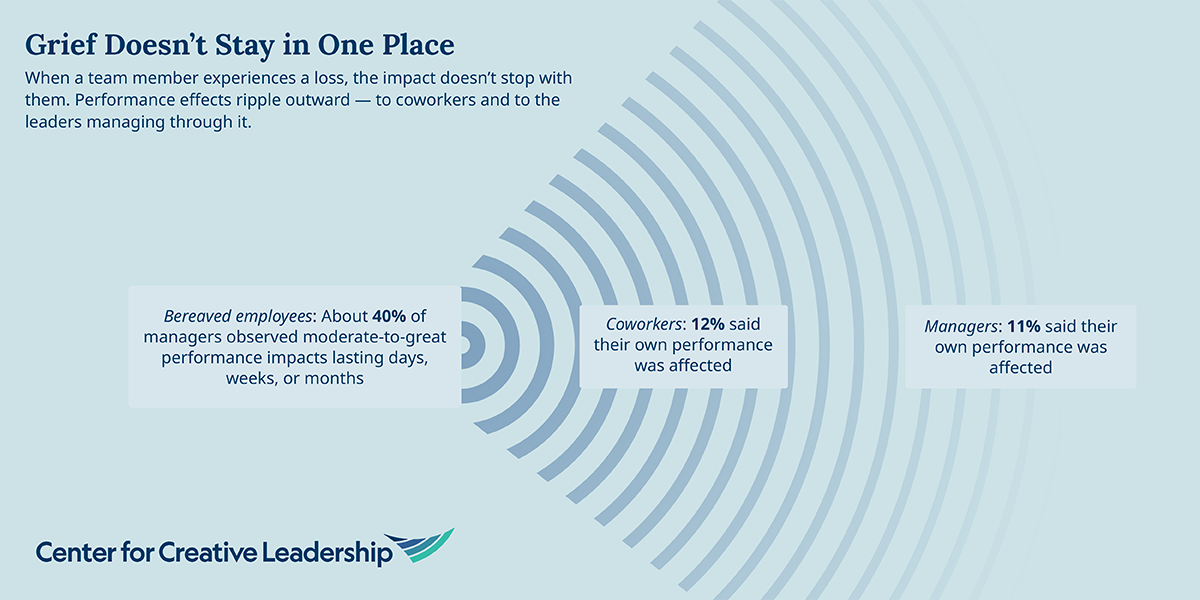
Research indicates that a staggering 90% of managers observe some form of performance impact in a bereaved employee, with approximately 40% noting moderate to significant disruptions that can persist for days, weeks, or even months. More surprisingly, the ripple effect extends to colleagues and managers themselves. Our data shows that 11% of managers reported their own performance was affected by a colleague’s grief, and 12% of coworkers experienced similar impacts. This underscores that bereavement is not an isolated event but a force that disrupts the entire team dynamic.
The current landscape of bereavement leave further exacerbates these challenges. A substantial 73% of bereaved employees report insufficient time off to adequately process their grief. Compounding this issue, a concerning 28% of employees have no formal bereavement leave at all. Consequently, many individuals are compelled to return to work before they are emotionally ready, attempting to navigate the arduous emotional terrain of grief while simultaneously fulfilling professional responsibilities. This burden is amplified by the practical and emotional demands of supporting grieving family members and managing logistical tasks such as funeral arrangements and estate settlement. These statistics are not mere productivity metrics; they are stark indicators of the silent weight employees are often asked to carry, frequently without adequate support structures in place.
Supporting Grieving Employees: Bridging the Gap Between Intention and Impact
The desire to provide support during times of grief is a common attribute among leaders. However, the chasm between wanting to help and knowing how to help can be significant. Our research highlights that while 60% of bereaved employees feel their manager offered compassion to a great extent, a disheartening 20% reported receiving little to no support. This means one in five individuals experiencing one of life’s most challenging events felt their leader was absent.
It is essential to clarify what is not expected of leaders in these situations. They are not tasked with finding the perfect words, nor are they meant to “fix” grief—an impossible endeavor—or accelerate someone’s healing, which is an unreasonable expectation. Leaders are not therapists. The core requirement, as revealed by our research on bereavement in the workplace, is far simpler: to show up, pay attention, offer choices, and crucially, follow the employee’s lead.

Subtle Signals, Significant Impact
A critical insight from our research is the necessity for managers to be attuned to subtle cues. Leaders often default to responding only when distress is overtly visible—a breakdown, a missed deadline, or an obvious struggle. However, grief at work rarely announces itself so dramatically. More frequently, it manifests in quieter, more difficult-to-interpret changes. These can include alterations in communication patterns, a decline in proactive engagement, or subtle shifts in work habits. These are not immediate red flags, but rather nuanced signals that, if missed, represent a lost opportunity to intervene and offer support.
Conversely, certain leader behaviors can inadvertently worsen the situation. These include instances of excessive reassurance, downplaying the significance of the loss, or attempting to rush the grieving process. The act of checking in, therefore, requires not certainty, but keen observation and a willingness to notice.
Small Gestures, Lasting Impressions
In supporting grieving employees, the impact of consistent, low-key presence often outweighs grand gestures. Simple acts such as a signed card, an unsolicited coffee, or a brief, non-intrusive check-in that doesn’t require the employee to perform normalcy can leave a profound and lasting impression. These gestures communicate a fundamental message: "I see you as a person, not just as a role." In contrast, employees often recall unhelpful actions such as platitudes, attempts to distract, or premature pressure to return to full productivity.
One Size Does Not Fit Grief
One of the most significant findings from our research is that individual responses to grief and needs for support vary considerably. Some employees may require space and solitude, while others may find solace in talking. Some may wish to immerse themselves in work as a coping mechanism, while others may need adjusted expectations. Unfortunately, many leaders tend to apply a one-size-fits-all approach, often defaulting to avoidance or overly frequent check-ins, rather than proactively asking.
The solution to this challenge is straightforward and represents a core leadership skill: asking. Phrases such as, "How can I support you right now?" or "Would you prefer to ease back in, or jump in?" signal that the employee’s experience is valued and remove the guesswork that leads to mismatched support. It is important to acknowledge that employees may not always know what they need, thus offering options and revisiting these conversations over time is crucial.
When Leaders Get It Right
Bereaved employees vividly remember leaders who were present and supportive during their time of loss. The most impactful responses often involved nothing more than flexibility, consistent presence, and a degree of protection from undue workplace pressures. These leaders demonstrated attentiveness and acted upon their observations. They advocated for additional time off, maintained consistent yet non-intrusive check-ins, allowed employees to set their own pace, actively listened, and, crucially, acknowledged the loss. Our research unequivocally demonstrates that the acknowledgment of grief holds more significance for employees than most leaders realize.
Bereavement at Work: A Crucial Leadership Development Opportunity
Even well-structured leadership development programs often have blind spots when it comes to navigating unscripted human moments. A team member’s bereavement falls squarely into this category, and most leaders arrive at such junctures entirely unprepared. A significant 73% of managers surveyed indicated a need for training on how to effectively support a bereaved employee, highlighting that nearly three-quarters of leaders are actively seeking guidance on fundamental human skills to support their teams.
These essential capabilities are not new to the field of leadership development; they are, in fact, its very foundation. The skills required to respond effectively to a grieving employee are intrinsically linked to broader leadership competencies, including emotional intelligence, self-awareness, empathy, the ability to conduct difficult conversations, and coaching presence. Bereavement in the workplace serves as a high-stakes assessment of these skills—a test for which most leaders have received no prior preparation.
The solution lies not in creating standalone bereavement programs, but in integrating these competencies into existing leadership development frameworks. Bereavement in the workplace offers a natural context for cultivating the very skills that anchor leadership programs. Every discussion on emotional intelligence can, in part, address how a leader might navigate grief in the workplace and offer solace to someone who is grieving. Similarly, coaching skills modules can prepare leaders for asking, without haste, "How are you really doing?" and "What else do you need to feel supported?" This is not about adding a new layer to leadership development, but rather about adopting a new lens through which to view and enhance existing curricula.
The Path Forward: Readiness for Human Moments
Bereavement is an inevitable reality that will touch every workplace and team. The critical question is whether leaders will be adequately prepared when they encounter it. This readiness is not contingent on possessing the perfect words, but on cultivating the skills to notice, to ask, and to follow. It is, quite simply, about embodying the principle of being "human first," as one research participant eloquently put it.
Therefore, it is imperative to consider: Where in your leadership curriculum do managers learn how to sit with another person’s pain? Where do your leaders practice articulating, "I don’t know what to say, but I’m here"? Engaging with these questions and actively developing leaders who can show up for their people in the ways they truly need is work of immense value.
The ongoing research into bereavement in the workplace continues to shed light on this critical area. Organizations and leaders are encouraged to stay informed of the latest insights and to actively integrate these learnings into their leadership development strategies. By doing so, they can foster more compassionate, supportive, and resilient work environments capable of navigating the profound human experiences that inevitably intersect with professional life.