
The global shift toward remote work and the increasing prevalence of digital fatigue have catalyzed a significant transformation in how organizations approach professional development, leading to the rise of storytelling podcasts as a cornerstone of modern instructional design. These narrative-driven audio formats utilize structured storytelling to communicate complex ideas, cultural values, and technical lessons in a manner that transcends the limitations of traditional, text-heavy eLearning modules. By integrating narrative arcs with pedagogical objectives, learning and development (L&D) professionals are now leveraging the "theatre of the mind" to foster deeper engagement and long-term knowledge retention among adult learners.
Defining the Narrative-Driven Audio Landscape
Storytelling podcasts are professional-grade audio productions that prioritize narrative structure over direct instruction or conversational exchange. While informational podcasts focus on the raw delivery of facts and interview-based podcasts center on expert dialogues, storytelling podcasts are characterized by a deliberate narrative arc: a beginning that establishes context, a middle that introduces tension or conflict, and an ending that provides resolution and actionable learning outcomes.
The effectiveness of this medium lies in its ability to humanize abstract concepts. Through character-driven learning, the listener is invited to inhabit a relatable persona or navigate a specific workplace scenario. This immersive approach ensures that information is not merely consumed but experienced. By utilizing emotional engagement—driven by curiosity, empathy, or suspense—instructional designers can anchor information in the learner’s memory, making it far more durable than information presented in static formats.
The Neuroscience of Narrative Learning
The adoption of storytelling podcasts in professional settings is supported by significant findings in cognitive science and neuroscience. Research indicates that when humans hear a well-told story, the brain releases oxytocin, often referred to as the "empathy chemical," which enhances the listener’s ability to relate to the characters and retain the narrative’s core message. Furthermore, narrative structures activate multiple regions of the brain, including the sensory cortex and the emotional centers, creating a "neural coupling" between the storyteller and the listener.
Data from the educational technology sector suggests that narrative-based learning can improve knowledge retention by up to 65% compared to traditional lecture-style instruction, which often sees retention rates as low as 10% after three days. In a corporate environment where "screen fatigue" has become a documented psychological barrier, audio-first learning provides a cognitive break from visual stimulation while maintaining high levels of intellectual rigor.
The Evolution of Audio Learning: A Chronology
The integration of storytelling into corporate training has followed a distinct evolutionary path over the last several decades:
- The Analog Era (1970s–1990s): Training was largely confined to cassette tapes and physical workshops. Learning was linear and often lacked the production value required for deep immersion.
- The Digital Transition (2000s): The advent of the iPod and early MP3 players introduced "m-learning" (mobile learning). However, content remained largely academic or lecture-based.
- The Podcast Boom (2014–Present): Following the success of narrative series like "Serial," the public’s appetite for high-quality storytelling increased. L&D departments began to notice that employees were consuming podcasts during commutes, leading to the "Bring Your Own Learning" (BYOL) trend.
- The Instructional Design Integration (2020–Present): Organizations began hiring scriptwriters, sound designers, and voice actors to create proprietary, internal podcasts designed specifically for onboarding, leadership, and compliance training.
The Anatomy of a High-Performing Storytelling Podcast
For a storytelling podcast to function as an effective instructional tool, it must adhere to a specific architectural framework. Professional designers focus on five core elements to ensure the content resonates with a sophisticated adult audience:
The Hook
The first 30 to 60 seconds are critical. A high-performing podcast introduces immediate tension or a compelling question that signals value. In a professional context, this might involve presenting a high-stakes workplace dilemma or a counterintuitive industry insight that challenges the listener’s current understanding.

The Character Proxy
Relatability is the engine of narrative learning. By creating a "learner proxy"—a protagonist who shares the audience’s challenges, doubts, and goals—designers facilitate emotional involvement. When the listener identifies with the character, the stakes of the story become personal.
The Challenge and Conflict
Conflict is the driver of engagement. Without a clear obstacle—such as a difficult client, a technical failure, or an ethical gray area—there is no narrative tension. This stage is where the "learning problem" is introduced, requiring the protagonist to navigate obstacles that mirror real-world professional hurdles.
Resolution and Application
The resolution is where the character applies new knowledge or skills to overcome the challenge. This serves as a demonstration of the learning objective in action. Unlike traditional training, which tells the learner what to do, the podcast shows the consequences of those actions within a narrative framework.
The Learning Takeaway
The final segment of the podcast reinforces the meaning of the story. Whether through a brief concluding narration or a reflective prompt, this stage ensures that the emotional experience of the story is successfully converted into a concrete professional competency.
Strategic Use Cases in Corporate Environments
The versatility of the storytelling podcast format allows it to be applied across various organizational functions. Industry experts point to several areas where narrative audio is currently outperforming traditional eLearning:
- Onboarding and Culture Immersion: Rather than reading through a handbook, new hires listen to "Day in the Life" narratives that weave company history, values, and workflows into a cohesive story. This reduces cognitive overload and builds an immediate emotional connection to the brand.
- Leadership Development: Narrative podcasts allow emerging leaders to explore complex decision-making scenarios. By listening to how a fictionalized executive handles a crisis, learners can evaluate trade-offs and strategic nuances in a low-risk environment.
- Compliance and Ethics: Compliance training is often viewed as a "check-the-box" activity. Story-based podcasts transform these modules by placing characters in ethical dilemmas where the consequences of non-compliance are dramatized, making the rules more memorable and behaviorally relevant.
- Customer Service Excellence: By simulating realistic customer interactions, these podcasts help service teams internalize tone, empathy, and problem-solving techniques. Audio allows for the nuances of human speech—such as hesitation or frustration—to be conveyed more effectively than text-based scripts.
Technical Production and Instructional Methodology
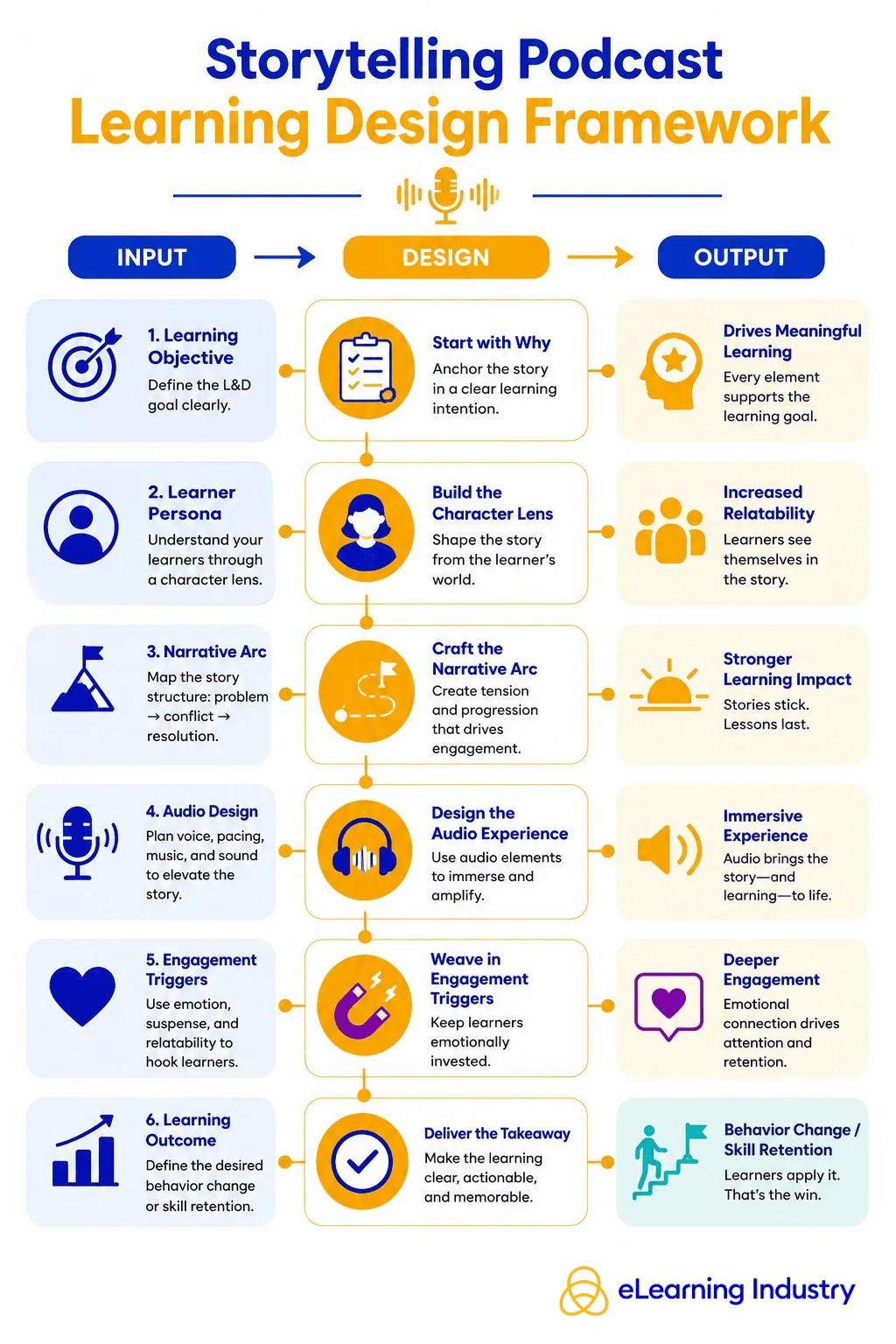
Creating a storytelling podcast for professional audiences requires a blend of creative writing and technical precision. The process typically follows a six-step methodology:
- Defining Measurable Outcomes: Every script begins with a clear business goal, such as reducing error rates or improving employee engagement scores.
- Persona Mapping: Designers conduct interviews with the target audience to ensure the characters and dialogue reflect the actual "language of the shop."
- Narrative-Skill Mapping: The plot is structured so that the climax of the story coincides with the application of the most critical skill being taught.
- Conversational Scripting: Writers avoid formal "corporate speak," opting instead for realistic dialogue that includes workplace objections and colloquialisms to maintain authenticity.
- Sound Layering: Professional sound design—including ambient office noise, rhythmic pacing, and strategic silence—is used to guide the listener’s focus and highlight key learning moments.
- Validation and Assessment: To measure impact, organizations often pair podcasts with interactive "choose-your-own-adventure" follow-ups or knowledge checks delivered via a mobile app.
Broader Impact and Future Implications
The rise of storytelling podcasts signals a broader shift in the L&D landscape toward "pull" learning rather than "push" learning. When content is engaging and accessible, employees are more likely to seek it out voluntarily, leading to a culture of continuous improvement. Furthermore, the audio format offers unparalleled flexibility, allowing learning to occur during "dead time," such as commutes or exercise, thereby increasing the total hours of professional development without encroaching on productive work time.
As artificial intelligence and voice synthesis technologies continue to advance, the cost of producing high-quality narrative podcasts is expected to decrease. This will allow smaller organizations to deploy sophisticated audio learning tracks that were once the exclusive domain of Fortune 500 companies.
In conclusion, storytelling podcasts represent a sophisticated synthesis of ancient narrative techniques and modern cognitive science. By moving away from passive content consumption toward immersive, audio-first experiences, organizations can drive measurable behavioral change and foster a more deeply connected and informed workforce. The future of corporate learning is not just about delivering information; it is about telling the stories that make that information matter.






