
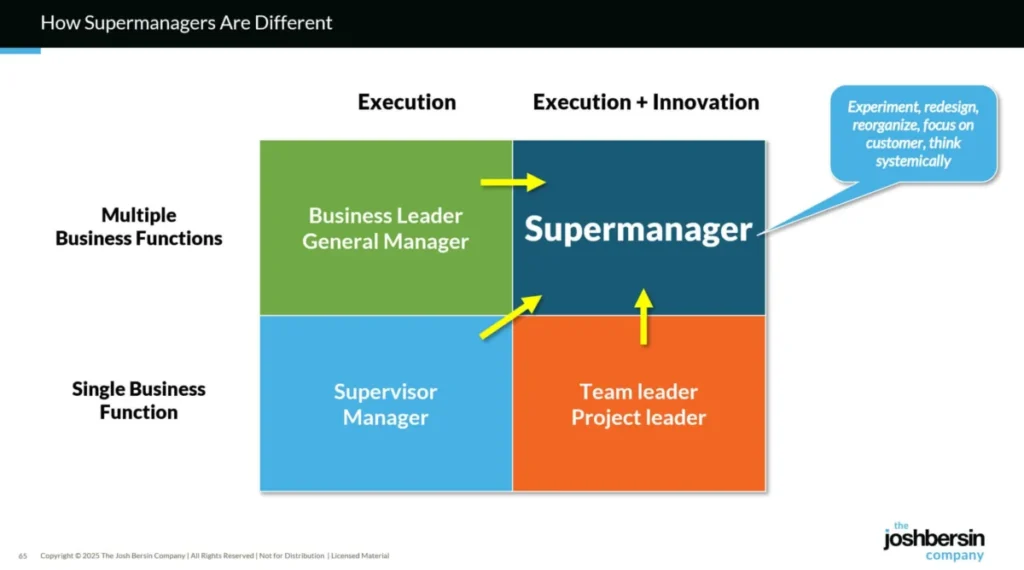
Artificial intelligence is no longer a theoretical concept confined to research labs; it has permeated our daily lives and is now profoundly reshaping the landscape of management. This evolution necessitates a re-evaluation of leadership roles and capabilities, giving rise to a new paradigm: the "Supermanager." This article delves into the transformative impact of AI on management, introducing groundbreaking research titled "The Rise of the Supermanager," which explores the emergence and critical functions of this evolved leadership archetype.
A Historical Perspective on Management
For decades, the fundamental understanding of management, as articulated by influential thinkers like Peter Drucker, has centered on a clear division: managers direct and orchestrate, while employees execute tasks. This traditional model posits that managers are responsible for setting strategic direction, ensuring team alignment, establishing priorities, and equipping individuals with the necessary skills and resources for success. When performance falters or alignment wavers, managers are tasked with coaching, reassigning, or, in some cases, terminating employees.
This role, while seemingly straightforward in principle, is inherently complex in practice. Leaders are routinely confronted with challenging decisions, including hiring, promotion, and fostering peak team performance. Consequently, a multitude of management philosophies and frameworks have emerged over the years. These range from the assertive, results-driven "Jack Welch" style to the empathetic "servant leadership" championed by Howard Schultz, the customer-centric "press release" approach pioneered by Jeff Bezos, and the first-principles thinking exemplified by Elon Musk. Each of these approaches, while valuable in their respective contexts, has historically operated within a pre-AI framework.
The advent of AI introduces a novel and dynamic dimension to leadership. It compels organizations to consider a new critical question: How prepared are managers to embrace experimentation, drive change, and reinvent their teams in the age of intelligent automation? This fundamental shift underscores "the rise of the Supermanager."

The Unique Nature of AI Transformation
While it might be tempting to view AI as merely another technological tool to be integrated into existing workflows, its impact is fundamentally different from previous technological advancements. Unlike past productivity systems that offered incremental improvements, AI possesses the unique capability to learn, adapt, and personalize its functions for individual users. This allows teams and individuals to harness unprecedented levels of power and gain profound insights from enterprise data, exemplified by the burgeoning field of "Digital Twins."
Consequently, AI transformation is not merely about implementation; it is an extensive exercise in enablement, learning, and reinvention. Traditional hierarchical structures, where line managers often await directives from corporate innovation departments, are proving insufficient. Instead, front-line leaders must proactively guide this transformation from within their teams.
Bottom-Up and Top-Down AI Innovation
Empirical evidence suggests that many of the most significant AI-driven innovations originate not from centralized IT departments or executive suites, but from front-facing teams experimenting with the technology. A compelling case in point emerged from a client in Japan, where a Thai distribution center independently developed a photo-based application for inventory management. This ingenious, self-initiated solution dramatically reduced monthly inventory processing time by an astonishing 75%. Upon sharing this innovation with corporate headquarters, it was subsequently replicated across the entire organization, demonstrating the potent power of grassroots AI adoption.
Another illustrative example comes from an analyst at IATA, the International Air Transport Association. This individual utilized an AI platform, Galileo, to construct a sophisticated staffing, skills, and workforce planning model for the global airline industry. This self-developed AI solution saved months of traditional planning effort and is now being disseminated to airline leaders worldwide, showcasing AI’s capacity to democratize advanced analytics.
Within a leading financial institution, an individual investment advisor leveraged the company’s secure AI agent platform to create a personalized portfolio advisor. The IT department recognized the ingenuity of this employee-driven creation and is now utilizing it as the foundation for a global portfolio management system designed for high-net-worth clients.

These anecdotes are not isolated incidents; they represent a growing trend across various industries. Opportunities for AI transformation abound, spanning areas such as marketing content generation, job analysis and recruitment, employee performance data crunching, and automated performance appraisal writing. Crucially, many of the most impactful ideas are emerging from frontline employees. The research highlights that "Supermanagers" play a pivotal role in this process by enabling, encouraging, and empowering individuals to bring these nascent ideas to fruition. These three "E’s" – Enable, Encourage, Empower – are posited as the fundamental pillars of successful AI transformation.
The Supermanager: Driving Execution and Innovation
What distinguishes Supermanagers, and why have many undoubtedly encountered such leaders in their careers, is their innate ability to seamlessly balance a focus on tangible results with a commitment to reinvention. This dual capability is cultivated through a distinct set of skills and attributes, and importantly, they are not typically characterized as "rebels" or "disruptors" in the conventional sense.
In contemporary organizations, the establishment of AI steering committees and dedicated technology teams is common practice, aimed at developing standardized platforms and managing large-scale initiatives. For instance, Standard Chartered is actively developing a new global onboarding platform to streamline complex talent acquisition processes across more than 80 countries. However, even these centralized corporate bodies cannot possibly anticipate every nascent opportunity for AI application.
Supermanagers, conversely, foster an environment where their teams are encouraged to generate novel ideas, critically prioritize initiatives, and proactively present their innovations. Rather than passively awaiting the development of new solutions by corporate IT, they actively champion and support employee-led innovation. This proactive approach is critical in bridging the gap between technological potential and realized business value.
Bridging the Productivity Gap with Supermanagement
A significant challenge in the current AI landscape is the widening disparity between the rapid advancement of AI technology and the slower pace at which organizational productivity adapts. As illustrated in the accompanying chart, while powerful AI tools like Microsoft Copilot offer immense potential, the time required for employees to effectively leverage them often lags behind technological development. This creates a growing chasm between the trajectory of technological advancement (represented by the green arrow) and the progress of business productivity (represented by the red arrow).

Supermanagers, in this context, act as the crucial catalyst, providing the "fuel and energy" necessary to elevate the red productivity line to meet the pace of technological progress. Traditional managers, often accustomed to waiting for IT-delivered solutions or issuing vague directives for increased productivity, are insufficient in this new era.
In contrast, Supermanagers possess a foundational understanding of AI. They actively engage with the technology, encourage experimentation within their teams, collaborate with IT departments to explore potential solutions, and foster a culture of out-of-the-box thinking. These seemingly small, frontline innovations, driven by empowered teams, generate valuable experience, build momentum, and create specific demands on IT resources. The cumulative effect is a company that fosters a multitude of innovations, each contributing to the upward trajectory of business productivity. As new AI features emerge, this synergistically managed environment of "Superworkers" and "Supermanagers" continues to drive innovation forward.
This dynamic is made possible by the increasing accessibility and customizability of AI systems. The development of prompts and the management of data within AI agents have become as intuitive as working with spreadsheets, exemplified by platforms like Galileo, which offers an open system with extensive developer features. This ease of use empowers effective Supermanagers to spearhead these transformative initiatives.
Strategic Imperatives for Organizations
Organizations must critically examine their existing leadership models. Key questions to consider include:
- Execution vs. Innovation: To what extent does the current leadership model prioritize execution and results versus fostering innovation and creation?
- Role Agility: How empowered are managers to reassign roles and create new positions to adapt to evolving technological landscapes?
- Skill Development: Are leaders being adequately trained in job design and organizational change management, particularly in the context of AI integration?
- AI Literacy: How familiar are organizational leaders with AI technologies? There is no longer an excuse for a lack of understanding; this revolutionary technology is reshaping every business function, and leaders must rapidly acquire the necessary skills. HR leaders, in particular, must set a precedent for this continuous learning.
Furthermore, organizations should re-evaluate their management models and reward systems. As highlighted in recent discussions, investing in the development of Supermanagers may represent one of the most critical strategic decisions for navigating the AI revolution successfully.

The research paper, "The Rise of the Supermanager," provides in-depth insights into the capabilities and strategies that define this new breed of leader. Additionally, exploring resources like "Galileo for Managers," an AI agent designed to support leaders at all organizational levels, can offer practical tools and guidance for fostering Supermanagerial effectiveness.
Broader Impact and Future Implications
The emergence of the Supermanager signifies a fundamental shift in organizational dynamics. It moves away from a command-and-control structure towards a more agile, collaborative, and employee-centric model, driven by the intelligent augmentation of human capabilities. This evolution has several key implications:
- Enhanced Agility and Responsiveness: Organizations with a strong cadre of Supermanagers will be better equipped to adapt to rapidly changing market conditions and technological advancements. Their ability to foster bottom-up innovation allows for quicker identification and response to emerging opportunities and threats.
- Increased Employee Engagement and Empowerment: By actively enabling, encouraging, and empowering their teams, Supermanagers foster a more engaged and motivated workforce. This not only drives innovation but also improves employee retention and overall job satisfaction.
- Democratization of AI Expertise: The emphasis on Supermanagers democratizes AI adoption, moving it from the exclusive domain of specialized technical teams to accessible tools and processes that can be leveraged by individuals across the organization.
- Redefined HR and Talent Management: The rise of the Supermanager necessitates a recalibration of HR practices. Talent acquisition, development, and performance management frameworks will need to evolve to identify, cultivate, and reward the unique competencies associated with this leadership style. This includes focusing on skills like adaptability, learning agility, and the ability to foster a culture of experimentation.
- Strategic Advantage: Companies that successfully cultivate Supermanagers will likely gain a significant competitive advantage. They will be better positioned to harness the full potential of AI, drive continuous innovation, and achieve superior business outcomes in the AI-driven economy.
The transition to an AI-augmented workplace is not merely a technological upgrade; it is a fundamental organizational transformation. The "Supermanager" represents a critical leadership evolution necessary to navigate this complex and dynamic future, ensuring that organizations not only adopt AI but thrive because of it.
Additional Resources:







