In an era of tightening corporate budgets and heightened accountability, a landmark study sponsored by the Association for Talent Development (ATD) has revealed a significant shift in executive expectations regarding employee training. According to the research, which surveyed CEOs of Fortune 500 companies, a staggering 96 percent of top executives now rank "business impact" as their primary measure of success for talent development programs. While Return on Investment (ROI) remains a critical secondary metric, the overwhelming consensus among leadership is that learning and development (L&D) must move beyond simple participation rates and toward tangible, bottom-line results.
This demand for accountability is not limited to the private sector. Leaders in nonprofit organizations and governmental agencies are increasingly applying "business" metrics—such as output volume, service quality, operational costs, and time efficiency—to their internal growth initiatives. The central "why" of any modern program is its eventual impact on the organization’s mission-critical goals. To meet these expectations, L&D professionals are turning to the ROI Methodology, a rigorous 12-step process that has become the global standard for evaluating the effectiveness of human resources and training investments.
The Historical Evolution of Evaluation Models
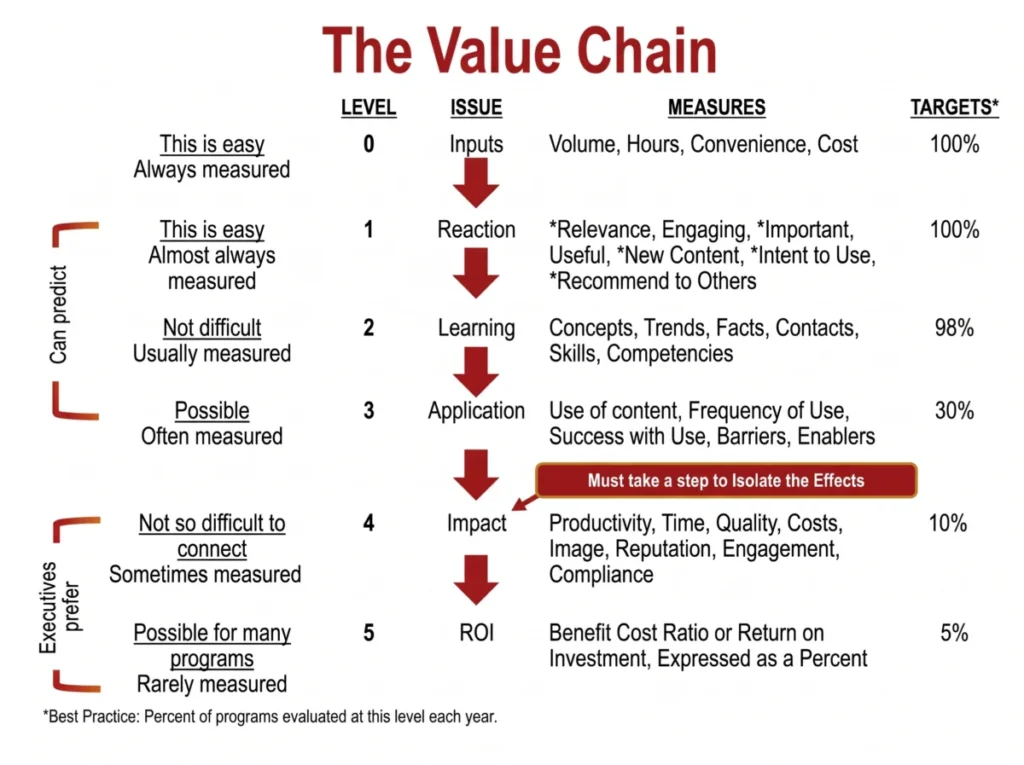
The journey toward modern ROI measurement began decades ago, evolving from simple academic theories into a robust corporate framework. The foundation of current evaluation systems is a logic model known as the "value chain," which suggests that data types build upon one another in a sequential fashion. While many associate these levels exclusively with Donald Kirkpatrick, who popularized them in the mid-20th century, the framework actually traces its roots back to the 1800s, with psychologist Raymond Katzell publishing a definitive version in 1952.
The methodology expanded significantly in the 1970s and 80s when researchers, most notably Dr. Jack Phillips, integrated a fifth level—ROI—to address the growing need for financial justification in corporate spending. Today, more than 10,000 organizations worldwide utilize this expanded system to ensure that training is not merely an expense but a strategic investment.
The Five Levels of Outcome: A Value Chain Perspective
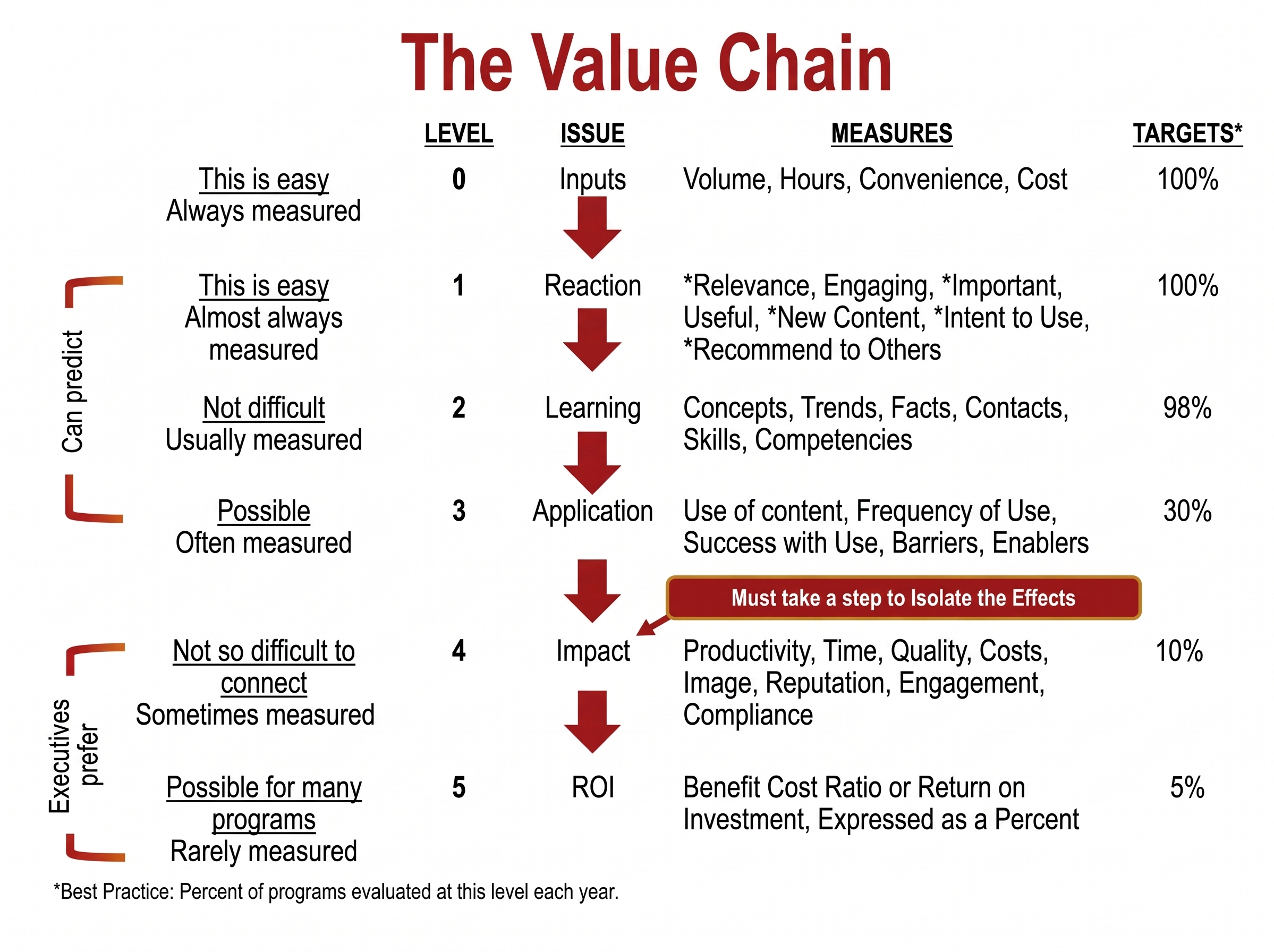
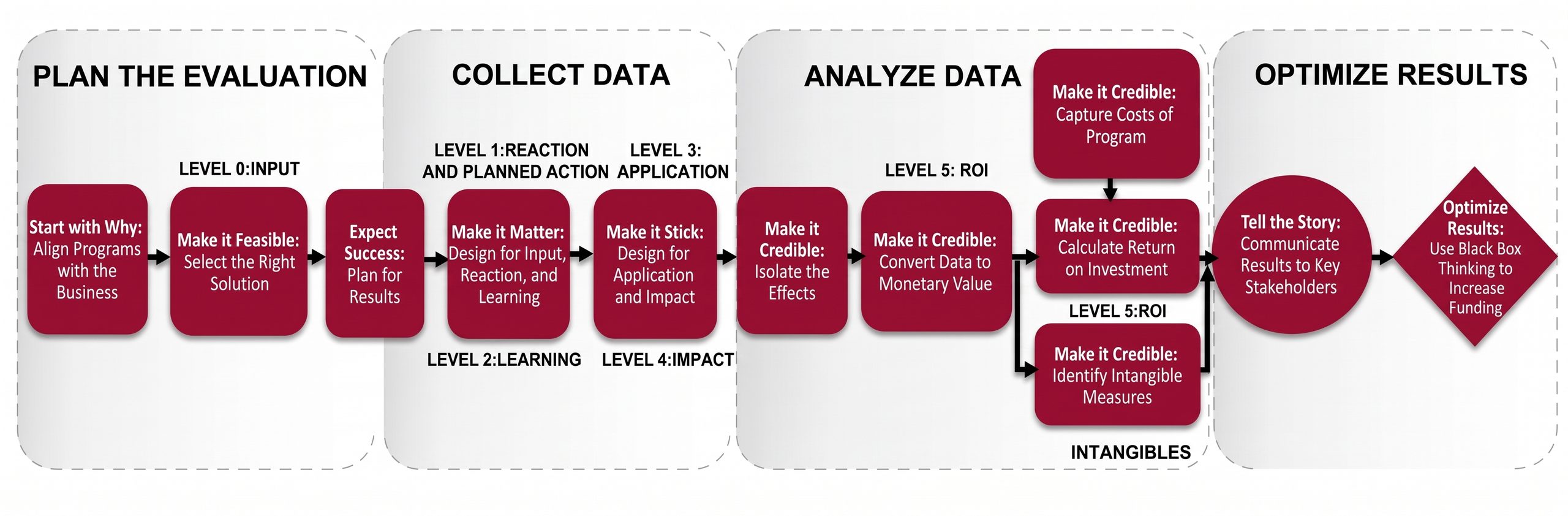
To understand how a program generates value, it is essential to categorize data into specific tiers. The ROI Methodology utilizes a "Level 0 to Level 5" structure that tracks the progression from initial participation to final financial return.

Level 0: Input and Indicators
This level tracks the raw logistics of a program, including the number of participants, the duration of the training, and the total initial costs. While necessary for administrative purposes, Level 0 data provides no insight into the effectiveness of the content.
Level 1: Reaction and Planned Action
This tier measures how participants perceive the value of the program. Organizations assess whether employees found the content relevant, important, and actionable. A negative reaction at this stage can often derail a project before it has a chance to produce results, making it a vital early warning system.
Level 2: Learning
At this stage, the focus shifts to the acquisition of knowledge or skills. Through assessments, simulations, or demonstrations, the organization confirms that the participants actually absorbed the information provided during the program.
Level 3: Application
Application involves the transfer of knowledge to the workplace. This level tracks how frequently and successfully participants use their new skills on the job. It also identifies the barriers—such as lack of manager support—and the enablers that influence success.
Level 4: Impact
This is the metric most desired by CEOs. Impact measures the consequences of application, typically categorized into four areas: output, quality, cost, and time. For a program to be deemed successful at this level, its effects must be isolated from other external influences, such as market shifts or new technology.
Level 5: Return on Investment (ROI)
The final level converts impact data into monetary value and compares it against the total cost of the program. This calculation answers the fundamental question asked by CFOs: "Was it worth it?"
The 12-Step ROI Methodology: A Chronology of Implementation
The implementation of a high-level evaluation system requires a disciplined, step-by-step approach that begins long before the training session starts and continues long after it ends.
Phase 1: Evaluation Planning
The first three steps focus on "starting with why."
- Aligning with Business Measures: Developers must identify a specific business problem or opportunity. If the measures are not obvious, discussions with stakeholders are necessary to define what success looks like in business terms.
- Selecting the Right Solution: Analysis is conducted to ensure the proposed program actually addresses the root cause of the business problem.
- Expecting Success: Using design thinking, developers set specific objectives for reaction, learning, application, and impact. This phase results in a formal data collection plan and an ROI analysis plan.
Phase 2: Data Collection
Steps four and five involve gathering the evidence.
- Reaction and Learning Data: Collected during or immediately after the program.
- Application and Impact Data: Collected after a predetermined period (often three to six months) to see how the training has changed performance in the real world.
Phase 3: Data Analysis
This phase, encompassing steps six through ten, is where credibility is established.
- Isolating Program Effects: Using techniques such as control groups, trend lines, or expert estimates, analysts determine exactly how much of the performance improvement was caused by the training rather than external factors.
- Converting Data to Money: Impact measures (like a 10% reduction in errors) are converted into a dollar value based on company records or standard industry values.
- Identifying Intangibles: Measures that cannot be credibly converted to money—such as brand reputation or employee morale—are recorded separately but remain part of the final report.
- Capturing All Costs: This includes direct costs (materials, instructors) and indirect costs (participant time, travel, overhead).
- Calculating ROI: The final math is performed to show the Benefit-Cost Ratio (BCR) and the ROI percentage.
Phase 4: Reporting and Optimization
The final steps ensure the data leads to action.
- Telling the Story: Analysts combine the hard data from all levels into a narrative that engages stakeholders and demonstrates value.
- Optimizing Results: The findings are used to improve the program, justify future funding, and recognize the contributions of those involved.
Industry Implications and the CFO Perspective
The shift toward the ROI Methodology represents a fundamental change in the relationship between L&D departments and the C-suite. Traditionally, training was viewed as a "discretionary" expense—one of the first items to be cut during an economic downturn. By adopting a rigorous financial framework, L&D leaders are positioning themselves as strategic partners who contribute to the organization’s capital efficiency.
Industry analysts suggest that this trend is driven by the increasing complexity of the modern workforce. With the rise of AI and rapid digital transformation, companies are spending billions on "upskilling." However, without a way to measure the impact of these investments, organizations risk wasting resources on programs that do not move the needle on productivity.
Financial experts and CFOs have generally welcomed the move toward the ROI Methodology because of its conservative nature. The system operates on the principle of "when in doubt, leave it out" regarding benefits, and "when in doubt, leave it in" regarding costs. This ensures that any reported ROI is not an exaggeration but a defensible, credible figure that can withstand an audit.
Broader Impact on Talent Management
The implications of this data-driven approach extend beyond the training room. When organizations can prove the value of talent development, they are more likely to increase their investment in human capital. This creates a virtuous cycle where employees receive better development opportunities, leading to higher engagement and lower turnover.
Furthermore, the methodology allows for "failed" programs to be identified and corrected quickly. If a program shows high Level 2 (learning) scores but low Level 3 (application) scores, management knows the issue is not the training content, but rather the workplace environment or manager support. This level of diagnostic detail is impossible with traditional "smile sheet" evaluations.
As the global economy becomes increasingly competitive, the ability to link human performance to financial outcomes will likely become a requirement rather than an option. The ROI Methodology provides the roadmap for this transition, ensuring that the "why" of talent development is always firmly rooted in the success of the business. By following these 12 steps, organizations can ensure that their most valuable asset—their people—is being developed in a way that is both meaningful for the individual and profitable for the enterprise.