
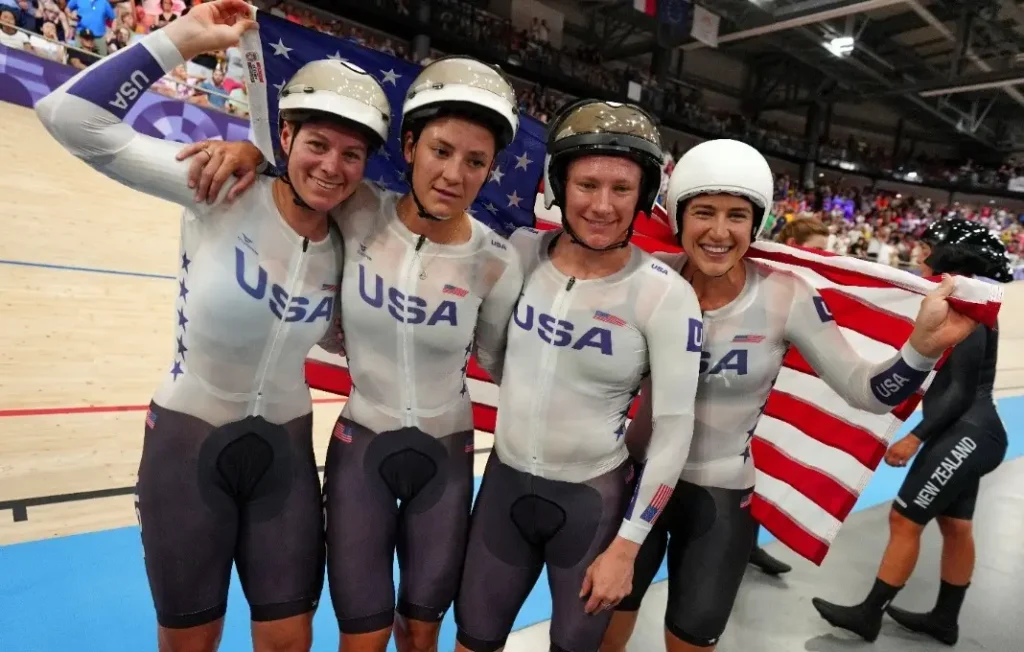
Great teams aren’t powered by solo heroes; they win when people over-communicate under pressure, drop the ego, and rotate in and out of the lead so the whole system can move faster together. This principle, often abstract in the boardroom, is vividly demonstrated in the high-stakes world of Olympic cycling, particularly in the demanding discipline of the team pursuit. A recent conversation with two-time Olympic gold medalist Kristen Faulkner offers a compelling case study for business leaders seeking to cultivate truly high-performing teams, revealing that the seemingly individualistic pursuit of athletic excellence is, in fact, a masterclass in collaborative velocity.
Faulkner, a Harvard graduate who built a career in venture capital before achieving Olympic glory, did not begin cycling until her mid-twenties. Yet, her trajectory has been meteoric, culminating in gold medals at the 2024 Paris Olympics in both the individual road race and the team pursuit. This remarkable achievement is not a product of chance but a testament to intentional choices, profound resilience, and a fundamentally different approach to team dynamics. Her insights, forged in the crucible of elite competition where split-second decisions and unwavering trust are paramount, offer transferable lessons for organizations striving for peak performance.
The Unfiltered Dialogue of High-Pressure Collaboration
The cornerstone of successful team pursuit, according to Faulkner, is communication so pervasive it borders on the relentless. "There’s basically two important things," she explained. "The first is communication, like over-communicate with the entire time. You cannot sit there and feel something is wrong and not say it out loud." This stands in stark contrast to many corporate environments where unspoken concerns can fester, leading to missed opportunities and systemic inefficiencies.
In the visually serene yet intensely demanding world of professional cycling, the outward appearance of calm belies a constant, unfiltered exchange. "Behind the scenes, it’s constant, raw communication. No filters. No hesitation," Faulkner emphasized. This directness is not about confrontation but about absolute clarity and mutual reliance. "If the person in front of you is starting to slow down, you have to tell them to get off the front. You can’t hold anything back in the moment."
This radical transparency, while potentially jarring in less disciplined settings, is the bedrock of trust in team pursuit. It eliminates ambiguity and ensures that every member is aware of the team’s collective state. The implications for business are significant. In organizations where feedback is often softened or delayed, critical issues can escalate unnoticed. As communication expert Simon Sinek has noted, effective communication acts as the "lubricant" for teamwork, dissolving silos, reducing assumptions, and creating the psychological safety necessary for individuals to admit errors, seek assistance, and perform optimally under duress.
Faulkner’s second key insight is perhaps even more challenging for ego-driven cultures: "There can be no ego at all." In team pursuit, individual strength is not demonstrated by pushing beyond one’s limits to the detriment of the team. Instead, it manifests as self-awareness and strategic contribution. A rider feeling strong might extend their turn at the front, absorbing more of the wind resistance. Conversely, a rider experiencing fatigue will signal their need to rotate off the lead earlier, preventing a drop in the team’s overall pace. The objective is not personal glory but collective output.
This philosophy directly challenges the prevailing business paradigm that often celebrates individual heroics, even when such efforts strain organizational resources or lead to burnout. Cycling, in this context, redefines high performance, prioritizing self-awareness and selfless contribution to the team’s success over individual accolades. The business lesson is clear: fostering environments where immediate, candid feedback is encouraged and where stepping back to allow others to lead is recognized as a sign of strength, not weakness, is crucial for sustained collective achievement.
The Currency of Trust: Self-Awareness Over Authority
Trust, in Faulkner’s experience, is not an abstract concept granted by titles or seniority; it is a tangible asset built through consistent, observable behavior. "If someone is always going to the point where they’re slowing down in a race, it can erode trust," she stated. This suggests that for team members to rely on each other, they must demonstrate a deep understanding of their own capabilities and limitations, and act in accordance with that self-knowledge.
Conversely, a consistent track record of reliable performance builds profound trust. "If someone always hits their numbers, I start to feel like, wow, this person is really self-aware," Faulkner observed. High-performing teams, therefore, are not composed of flawless individuals but of members who possess a high degree of self-awareness and act responsibly within their defined capacities.
Faulkner illustrates this with an anecdote: "I have a teammate who goes so hard that the people behind her actually get dropped, and I don’t always trust that she doesn’t want to show how strong she is." This scenario, sadly familiar in many workplaces, highlights how individual excellence, when misaligned with team objectives, can create unintended obstacles for others. The issue is not the pursuit of excellence itself, but the lack of alignment with collective goals.
This resonates with principles articulated by James Clear in Atomic Habits, which posits that sustained high performance stems not from sheer willpower but from designing systems and habits that enable consistent contribution without disrupting the surrounding environment. Similarly, the concept of "mutual accountability," as explored by Positive Intelligence, emphasizes that responsibility for outcomes—and the methods by which they are achieved—is a shared team endeavor, not solely the purview of leadership. In the most effective teams, accountability is distributed, reinforcing the idea that trust is earned through consistent actions that benefit the collective, not merely through individual high output.
The Velocity of Feedback: Direct, Objective, and Continuous
The effectiveness of a team is directly proportional to its ability to learn and adapt. In team pursuit cycling, feedback is not an infrequent event but a constant, embedded process. Faulkner is unequivocal on this point: "The best way to give feedback is to never make assumptions about intent." Instead of questioning motives, the focus remains resolutely on observable facts: what occurred, what was experienced, and what needs adjustment.
This objective approach to feedback is championed by organizations like Fearless Culture, which advocates for clarifying questions to transform raw observations into actionable insights. Faulkner further stresses the importance of clarity, stating, "I think if you beat around the bush, then things can get a little confusing… the clearest ‘this is what happened’ is the best." Direct, unambiguous communication minimizes misinterpretation and accelerates the learning cycle.
The continuous nature of feedback in cycling is also crucial. Following every training effort, detailed reviews are conducted, often augmented by data and video analysis. This immediate, specific, and actionable feedback loop is vital for rapid improvement. Research published on platforms like Medium indicates that constructive feedback, when delivered frequently and effectively, not only corrects errors but also enhances performance, engagement, personal growth, and inter-team trust.
Faulkner notes the evolving dynamic of feedback within a team: "There’s a lot of accountability for the decisions that we make in real time and there’s a constant feedback loop." Over time, as feedback becomes normalized, its emotional impact diminishes. It transitions from a potentially sensitive interpersonal exchange to a standard, functional tool for collective enhancement. The business lesson is to cultivate feedback loops that are rapid, objective, frequent, and safe, prioritizing learning velocity over the illusion of individual perfection.
Micro-Awareness: Reading the Unspoken Language of Team Performance
In the absence of elaborate dashboards or real-time digital metrics, cyclists in a pursuit rely on a profound level of situational awareness, often referred to as "micro-awareness." This involves reading subtle cues—cadence, body language, minute shifts in pace—to gauge the team’s collective state. "If the cadence is starting to slow down, it means the person on the front is going too slow," Faulkner explains. "If the person in front of you is wobbling, maybe they need to get off sooner." This constant sensing and adjusting allows for immediate course correction.
This principle translates directly to the business world. Subtle signals, such as shifts in posture, delayed responses, or fleeting expressions of hesitation, can reveal unspoken concerns or disengagement before they manifest as overt problems. As explored by Mindful Insights, these non-verbal cues often represent "unspoken truths" that can surface underlying frustrations or doubts.
The typical business approach often involves waiting for formal reports, metrics, or escalations, by which time issues may have become significantly more complex to resolve. Faulkner’s description highlights a form of situational awareness that empowers teams to adapt and recalibrate in real-time. The business implication is to train teams to recognize and respond to these subtle signals early, fostering an environment that values observation and intuitive understanding alongside analytical processing.
The Systemic Advantage: Lessons for Business Leaders
Reflecting on Faulkner’s insights, it becomes evident that elite athletes do not merely possess exceptional individual talent; they deliberately engineer their teams around fundamental principles of collaboration. These principles, honed in the high-stakes environment of Olympic cycling where every millisecond counts, offer a potent blueprint for business leaders.
The six essential elements that emerge are:
- Over-Communication Under Pressure: Fostering a culture where open, honest, and frequent dialogue is not just tolerated but expected, especially during challenging periods.
- Ego Dissolution: Prioritizing collective goals and team synergy over individual recognition or self-promotion.
- Fluid Leadership Rotation: Encouraging adaptability and shared responsibility, where individuals step into leadership roles as needed and gracefully cede them when appropriate.
- Trust Built on Self-Awareness: Cultivating an environment where individuals understand their strengths and limitations and act accordingly, thereby earning the trust of their teammates.
- Direct, Objective, and Continuous Feedback: Implementing a feedback system that is immediate, fact-based, and focused on learning and improvement rather than blame.
- Micro-Awareness and Situational Sensing: Training team members to observe and interpret subtle cues, enabling proactive adjustments and early problem identification.
These are not abstract theoretical constructs for Faulkner; they are practiced daily, under immense pressure. In the business arena, while the immediate stakes may differ, the underlying principles of effective teamwork remain remarkably consistent. The most successful teams do not merely coexist; they operate as a cohesive system, intuitively understanding when to take the lead, when to support, and when to share the burden. They adapt dynamically, hold each other accountable, and engage in a perpetual cycle of improvement. Ultimately, high performance is not the domain of individual brilliance alone but the amplified power of collective momentum, driven by how effectively the team shares the load and propels itself forward together. The team pursuit is not just a race; it’s a profound metaphor for how any group can achieve peak velocity through unified effort.








